Currency changes, prices and the current account
引入| English | 释义 | 拼音 |
|---|---|---|
| revaluation/rɪˌvæljuːˈeɪʃn/ | 货币升值(官方调整) | huò bì shēng zhí ( guān fāng tiáo zhěng ) |
| devaluation/diːˌvæljuːˈeɪʃn/ | 货币贬值(官方调整) | huò bì biǎn zhí ( guān fāng tiáo zhěng ) |
China lets the yuan rise, 2005
- For ten years the yuan was fixed at about 8.28 per dollar. On 21 July 2005 China's central bank raised its value by about 2% to 8.11, and then let it rise slowly. By 2013 a dollar bought only about 6.1 yuan.
- Changes in a currency's value change prices for exporters and importers.
Official changes
- Revaluation 货币升值(官方调整) is a government decision to raise a fixed currency's value.
- Devaluation 货币贬值(官方调整) is a decision to lower it. In floating markets the same moves are called appreciation and depreciation.
Match each term to its meaning.
难度 2/5 · 今日首次完成可获 140 金币及少量额外奖励
Official or market change.
Effects on prices
- A fall in the yuan makes Chinese exports cheaper abroad and imports dearer in China.
- A rise does the opposite: exports dearer, imports cheaper.
China revalues the yuan. What happens to Chinese exports?
难度 1/5 · 今日首次完成可获 100 金币及少量额外奖励
Each yuan costs foreigners more.
Worked example: the yuan falls from 7 to 8
A Chinese toy costs 70 yuan. An American book costs 20 dollars.
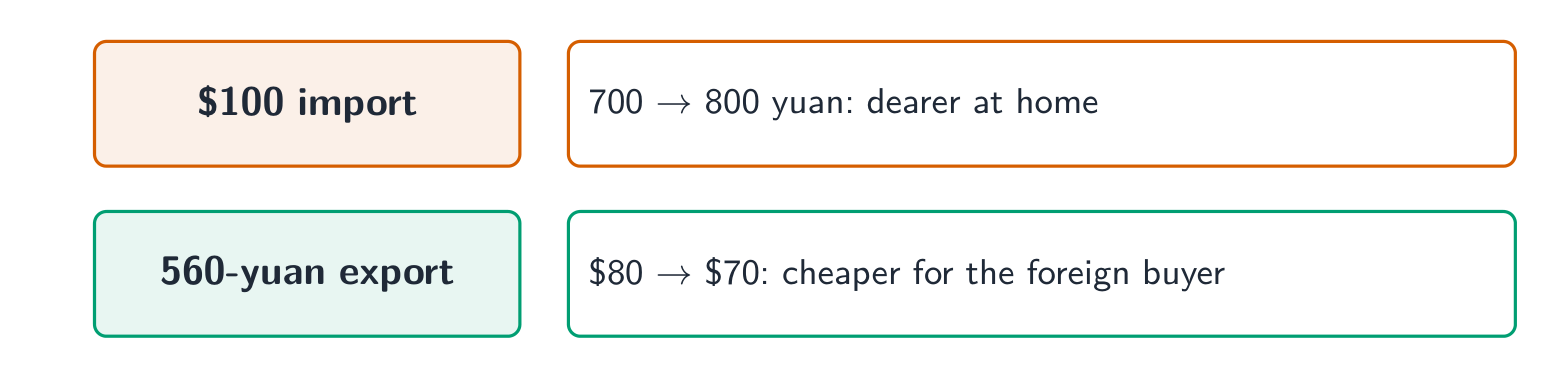
- Toy in dollars: $\dfrac{70}{7} = 10$ before; $\dfrac{70}{8} = 8.75$ after — cheaper for Americans.
- Book in yuan: $20 \times 7 = 140$ before; $20 \times 8 = 160$ after — dearer for Chinese buyers.
- Likely result: exports rise, imports fall, and the current account improves.
汇率报价与价格换算
用明确的汇率报价换算货币,再比较报价与其倒数。每次比较均保持原币金额不变。
A Chinese bicycle costs 560 yuan. What does it cost in dollars at 8 yuan per dollar?
难度 2/5 · 今日首次完成可获 140 金币及少量额外奖励
560 ÷ 8.
A 50-dollar US textbook costs how many yuan at 8 yuan per dollar?
难度 2/5 · 今日首次完成可获 140 金币及少量额外奖励
50 × 8.
Does the current account improve?
- Only if demand responds. If buyers keep buying imports because they have no substitutes, the import bill can rise.
- Effects take time: contracts are signed months ahead.
Inflation risk
- Dearer imports raise costs of oil, food and parts, which can push up inflation.
- Firms that buy imported materials may lose some of their export advantage.
A fall in the currency can raise inflation by making imports dearer.
难度 1/5 · 今日首次完成可获 100 金币及少量额外奖励
Imported costs rise.
A weaker currency is not always good for the economy. Exporters gain, but consumers and firms that import pay more, and inflation may rise. Weigh both sides.
A weaker currency is good for every group in the economy.
难度 1/5 · 今日首次完成可获 100 金币及少量额外奖励
Importers and consumers pay more.
Revaluation raises a fixed currency's value; devaluation lowers it. A fall in the currency makes exports cheaper and imports dearer, which may improve the current account if demand responds, but can raise inflation.
Evaluate the effect of a devaluation on a country's current account.
Exchange-rate changes.