Tariffs, quotas and production subsidies
引入| English | 释义 | 拼音 |
|---|---|---|
| tariff/ˈtærɪf/ | 关税 | guān shuì |
| import quota/ɪmˈpɔːt ˈkwəʊtə/ | 进口配额 | jìn kǒu pèi é |
Dearer washing machines, 2018
- In 2018 the US placed tariffs of 20% or more on imported washing machines. A later study found that washer prices rose by about 12% — and dryer prices too, though dryers were not taxed. American buyers paid most of the cost.
- Governments have three main tools to restrict imports.
Tariffs
- A tariff 关税 is a tax on imports. It raises the home price, so home firms sell more and imports fall.
- The government collects revenue on the imports that still arrive.
Quotas
- An import quota 进口配额 is a limit on the quantity of a good that may be imported.
- It cuts imports directly but raises no tax revenue; importers with licences may earn extra profit.
Which raises revenue for the government?
难度 1/5 · 今日首次完成可获 100 金币及少量额外奖励
A subsidy costs money.
Worked example: a 2-yuan tariff on berries
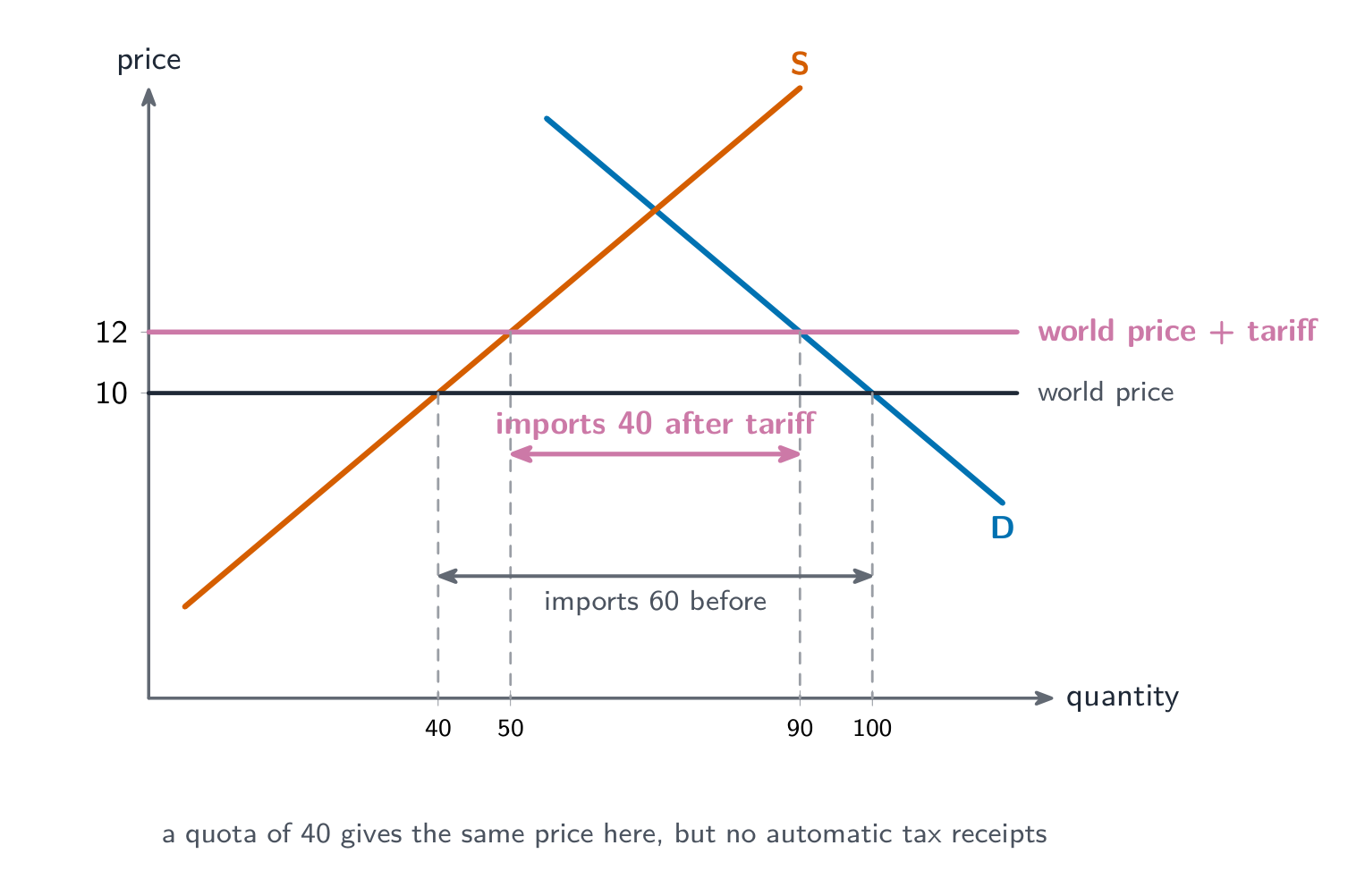
At the world price of 10 yuan a box, home demand is 100 boxes and home supply 40. A tariff of 2 yuan is added.
- Before: imports $100 - 40 = 60$ boxes.
- After (price 12): demand 90, home supply 50, imports $90 - 50 = 40$.
- Tariff revenue: $2 \times 40 = 80$ yuan. A quota of 40 boxes would cut imports by the same amount, with no revenue.
A tariff raises the home price and cuts imports
At the world price of 10 yuan, home demand is 100 boxes and home supply 40, so 60 are imported. A tariff of 2 raises the price to 12: demand 90, supply 50, imports 40 and tariff revenue 2 × 40 = 80 yuan.
At the world price, home demand is 200 and home supply 80. How many units are imported?
难度 2/5 · 今日首次完成可获 140 金币及少量额外奖励
200 − 80.
After a 3-yuan tariff, 70 units are imported. What is the tariff revenue?
难度 2/5 · 今日首次完成可获 140 金币及少量额外奖励
3 × 70.
Production subsidies
- A production subsidy is a government payment to home producers, which lowers their costs.
- Home output rises and imports fall, but the price to consumers stays at the world price.
Match each tool to its description.
难度 2/5 · 今日首次完成可获 140 金币及少量额外奖励
Three tools.
A production subsidy keeps the consumer price at the world price.
难度 1/5 · 今日首次完成可获 100 金币及少量额外奖励
Producers get extra, consumers pay the world price.
Comparing the tools
- Tariffs raise revenue but raise prices; quotas give certain import limits; subsidies keep prices low but cost taxpayers.
- All three help home producers at someone else's expense.
Foreign firms do not pay all of a tariff. The tariff is paid when goods enter the country, and home buyers face higher prices — as US washer buyers found in 2018.
Foreign producers pay the whole cost of a tariff.
难度 1/5 · 今日首次完成可获 100 金币及少量额外奖励
Home buyers pay higher prices.
Tariffs tax imports, raise prices and earn revenue. Quotas limit quantity with no revenue. Subsidies cut home producers' costs without raising prices. Each protects home firms but has costs for consumers or taxpayers.
Using the US washing-machine tariff of 2018, evaluate the use of tariffs to protect home industries.
Trade protection.