Supply-side capacity and implementation
引入| English | 释义 | 拼音 |
|---|---|---|
| deregulation/diːˌreɡjʊˈleɪʃn/ | 放松管制 | fàng sōng guǎn zhì |
| supply-side policy/səˈplaɪ saɪd ˈpɒlɪsi/ | 供给侧政策 | gōng jǐ cè zhèng cè |
Opening the skies, 1978
- Before 1978 the US government decided which airlines could fly each route and what they could charge. The Airline Deregulation Act removed those controls. New airlines entered, fares fell sharply over the following years, and flying became normal for millions of families.
- Policies like this aim to raise what an economy can produce.
Supply-side policy
- A supply-side policy 供给侧政策 aims to increase the economy's productive capacity — shifting its PPF outwards.
- It works on the quantity and quality of factors of production, not on demand.
A successful supply-side policy
难度 1/5 · 今日首次完成可获 100 金币及少量额外奖励
Capacity rises.
The main tools
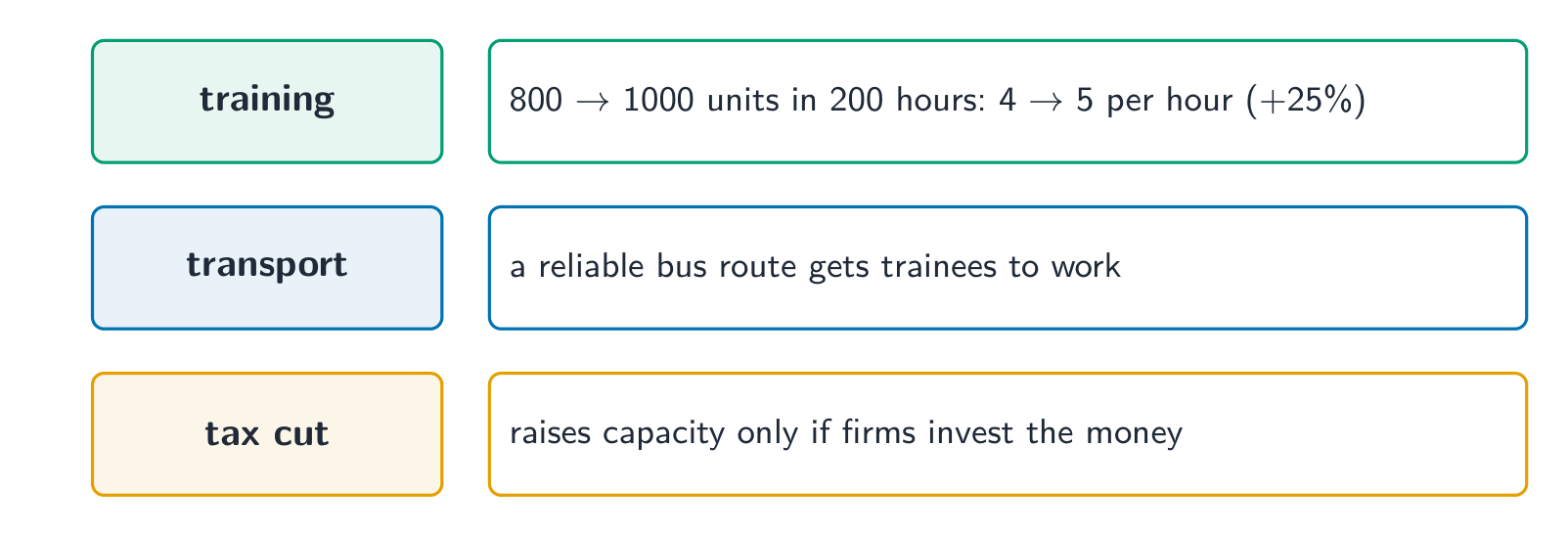
- Education and training, investment in infrastructure, lower taxes on work and investment.
- Deregulation 放松管制: removing rules that limit competition, so new firms can enter markets.
Which are supply-side policies?
难度 2/5 · 今日首次完成可获 140 金币及少量额外奖励
Interest rates are monetary policy.
Deregulation can increase competition by letting new firms enter.
难度 1/5 · 今日首次完成可获 100 金币及少量额外奖励
As with US airlines after 1978.
Worked example: training
A factory's workers put in 200 hours a week and make 800 units. After a government training programme, the same 200 hours make 1000 units.
- Before: $\dfrac{800}{200} = 4$ units per hour.
- After: $\dfrac{1000}{200} = 5$ units per hour.
- Rise: 25% more output from the same labour — the economy's capacity has grown.
A 25% rise in productivity
Training raises output from 800 to 1000 units with the same 200 worker-hours: productivity rises from 4 to 5 units per hour, a 25% increase.
Output rises from 600 to 750 units with the same 150 hours. By what percentage does productivity rise?
难度 2/5 · 今日首次完成可获 140 金币及少量额外奖励
4 → 5 per hour.
Time to work
- Training and infrastructure take years to raise output: a new railway can take a decade.
- Supply-side policies are better for long-run growth than for fixing a recession quickly.
Why are supply-side policies weak at ending a sudden recession?
难度 1/5 · 今日首次完成可获 100 金币及少量额外奖励
Long time lags.
Costs and risks
- Training and infrastructure cost government money now. Tax cuts reduce revenue.
- Deregulation can bring lower prices, but also risks to safety, workers' rights or the environment.
Supply-side policy is not just "help for firms". It means raising capacity — through skills, competition, infrastructure and incentives. A subsidy that keeps an inefficient firm open does not raise productivity.
A subsidy keeping an inefficient firm open is a supply-side policy that raises productivity.
难度 1/5 · 今日首次完成可获 100 金币及少量额外奖励
It does not raise capacity.
Supply-side policies raise productive capacity through training, infrastructure, tax incentives and deregulation. They can raise growth without inflation, but take time, cost money, and can carry risks.
Evaluate the use of training programmes as a supply-side policy.
Supply side.