Oligopoly and interdependent decisions
引入| English | 释义 | 拼音 |
|---|---|---|
| oligopoly/ˌɒlɪˈɡɒpəli/ | 寡头垄断 | guǎ tóu lǒng duàn |
| collusion/kəˈluːʒn/ | 合谋 | hé móu |
The electric-car price war, 2023
- In January 2023 Tesla cut its car prices in China by up to about 14%. Within weeks, rival makers such as BYD, Xpeng and others cut prices or offered discounts too. In a market with a few big sellers, one firm's move forces the others to react.
- That kind of market is an oligopoly.
Oligopoly
- An oligopoly 寡头垄断 is a market dominated by a few large firms: mobile networks, airlines, car makers, supermarkets.
- Firms are interdependent: each must think about how rivals will respond.
Which market is most likely an oligopoly?
难度 1/5 · 今日首次完成可获 100 金币及少量额外奖励
A few dominant firms.
Firms in an oligopoly are interdependent.
难度 1/5 · 今日首次完成可获 100 金币及少量额外奖励
Each must consider rivals' reactions.
Price wars
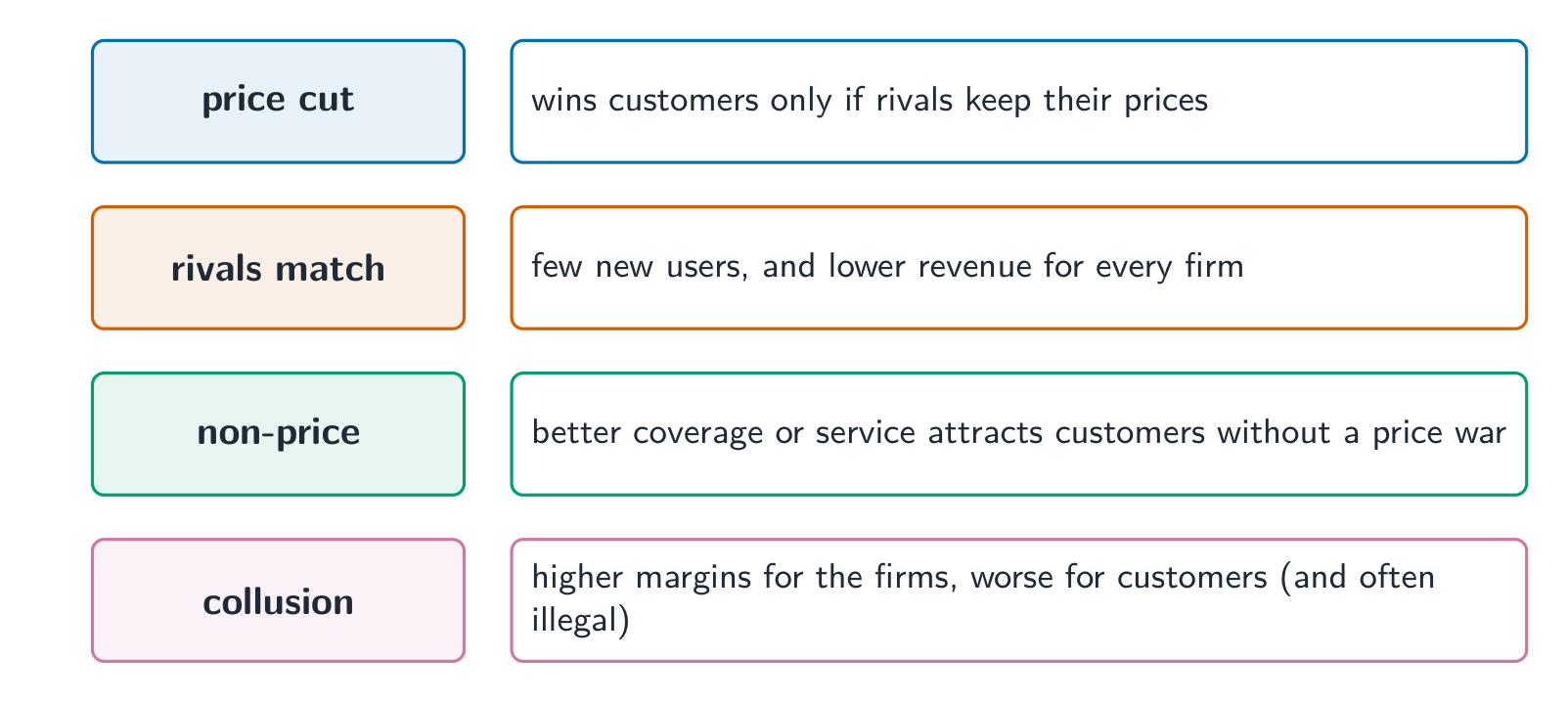
- If one firm cuts its price, rivals may cut too, and all earn less.
- So oligopolies often avoid price competition and compete with adverts, loyalty schemes and new features instead.
Which are forms of non-price competition?
难度 2/5 · 今日首次完成可获 140 金币及少量额外奖励
A price cut is price competition.
Worked example: two networks
Two mobile networks each choose to keep or cut their price. Profits (in million yuan): both keep 8 each; both cut 4 each; if one cuts alone, it earns 12 and the other 2.
- If the rival keeps: cutting gives 12 instead of 8, so cut.
- If the rival cuts: cutting gives 4 instead of 2, so cut.
- Result: both cut and earn 4 — less than the 8 each they would get by both keeping prices.
Cut the price, or keep it?
Each network does better by cutting if its rival keeps its price, yet if both cut, both earn less than if both had kept prices. Interdependence means the outcome depends on the rival's choice.
In the network game, both firms keep prices and earn 8 each, or both cut and earn 4 each. How much profit does each firm lose if both cut?
难度 2/5 · 今日首次完成可获 140 金币及少量额外奖励
8 − 4.
Collusion
- Collusion 合谋 is when firms secretly agree to fix prices or share out the market. It is illegal in most countries.
- In 2016 the European Commission fined five truck makers about 2.9 billion euros for 14 years of price collusion.
Firms secretly agree to keep prices high. This is
难度 1/5 · 今日首次完成可获 100 金币及少量额外奖励
An illegal agreement.
Good or bad for consumers?
- Oligopolies can mean high prices and little choice, especially with collusion.
- But big firms can afford research, and a price war, while it lasts, gives buyers lower prices.
An oligopoly is not a monopoly. There are several large firms, not one, and each watches the others. That is why a price cut by one firm matters so much to the rest.
An oligopoly has only one firm.
难度 1/5 · 今日首次完成可获 100 金币及少量额外奖励
That is a monopoly.
An oligopoly has a few dominant, interdependent firms. Price wars can leave every firm worse off, so firms often compete in other ways or are tempted to collude, which is illegal. Results for consumers depend on how firms behave.
Explain why other car makers cut prices after Tesla did in China in 2023, and whether consumers gained.
Oligopoly behaviour.