| English | 释义 | 拼音 |
|---|---|---|
| current account/ˈkʌrənt əˈkaʊnt/ | 经常账户 | jīng cháng zhàng hù |
| balance of payments/ˈbæləns ɒv ˈpeɪmənts/ | 国际收支 | guó jì shōu zhī |
| primary income/ˈpraɪməri ˈɪŋkʌm/ | 初次收入 | chū cì shōu rù |
| secondary income/ˈsekəndəri ˈɪŋkʌm/ | 二次收入 | èr cì shōu rù |
| current account deficit/ˈkʌrənt əˈkaʊnt ˈdefɪsɪt/ | 经常账户赤字 | jīng cháng zhàng hù chì zì |
Selling cars, buying banking
- The UK has run a deficit on trade in goods for decades: it imports far more cars, food and machines than it exports.
- Yet it sells the world huge amounts of banking, insurance, education and law — a surplus on services.
- Both appear in one account: the current account 经常账户 of the balance of payments 国际收支.
What the balance of payments records
- It records all money flows between a country's residents and the rest of the world over a year.
- The current account has four parts: trade in goods, trade in services, primary income 初次收入 (wages, interest, profits and dividends earned across borders) and secondary income 二次收入 (transfers such as remittances and foreign aid).
Which are parts of the current account?
难度 2/5 · 今日首次完成可获 140 金币及少量额外奖励
Buying companies is a financial-account flow. Secondary income is the fourth part.
Worked example: adding up the current account
In billions: goods exports 120, goods imports 150; services exports 60, imports 40; primary income received 15, paid 25; secondary income received 8, paid 3.
- Goods $= 120 - 150 = -30$; services $= 60 - 40 = +20$; so trade in goods and services $= -10$.
- Primary income $= 15 - 25 = -10$; secondary income $= 8 - 3 = +5$.
- Current account $= -30 + 20 - 10 + 5 = -15$: a current account deficit 经常账户赤字.
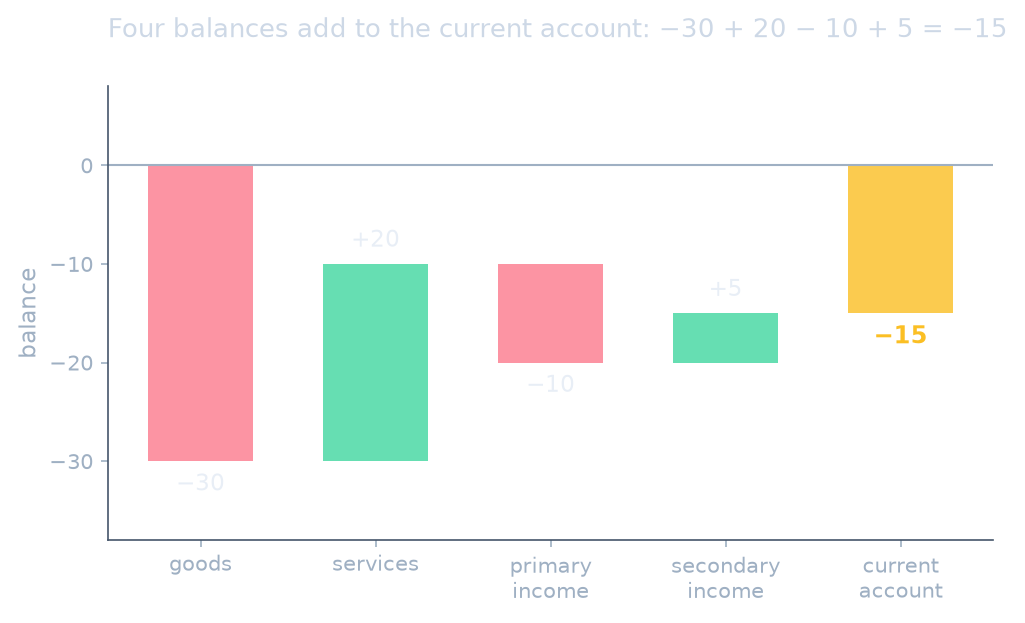
Building the current account from its four parts
Goods −30 (120 − 150), services +20 (60 − 40), primary income −10 (15 − 25) and secondary income +5 (8 − 3) give a current-account balance of −15, although the goods and services balance alone is −10.
Goods balance −50, services +35, primary income +10, secondary income −5 (billion). What is the current account balance?
难度 2/5 · 今日首次完成可获 140 金币及少量额外奖励
$-50 + 35 + 10 - 5 = -10$.
Where each flow goes
- A Chinese student paying fees to a UK university is a UK service export.
- Dividends paid by a Chinese factory to its foreign owners are primary income paid abroad.
- A worker in Dubai sending money home to India is secondary income for India.
Match each flow to its part of the current account.
难度 2/5 · 今日首次完成可获 140 金币及少量额外奖励
Goods, services, income from factors, and transfers.
A Chinese student paying fees to a UK university is a UK export of services.
难度 1/5 · 今日首次完成可获 100 金币及少量额外奖励
Money flows into the UK in return for a service.
Buying shares or a whole company is not trade. When a foreign firm buys a domestic company, that is a financial flow, recorded in the financial account, not an export. Only the dividends it later pays out enter the current account, as primary income.
A US firm buys a Chinese software company. How is the purchase itself recorded?
难度 1/5 · 今日首次完成可获 100 金币及少量额外奖励
Buying assets is financial, not trade. Future dividends will be primary income.
Is a deficit bad?
- A deficit means a country spends more abroad than it earns, and must borrow or sell assets to pay for it.
- It can be a sign of weak competitiveness, or simply of strong domestic demand or imports of machinery that will raise future output.
- A large, long-lasting deficit financed by short-term borrowing is the most risky.
Which current account deficit is LEAST worrying?
难度 1/5 · 今日首次完成可获 100 金币及少量额外奖励
Imports of capital goods can raise future output and exports.
The current account records trade in goods, trade in services, primary income and secondary income. Its balance is the sum of all four, not just exports minus imports of goods. Whether a deficit matters depends on its size, its cause and how it is financed.
Explain why a country can have a deficit on trade in goods but a surplus on its current account.
The current account is the sum of four balances.