| English | 释义 | 拼音 |
|---|---|---|
| consumer surplus/kənˈsuːmə ˈsɜːpləs/ | 消费者剩余 | xiāo fèi zhě shèng yú |
| producer surplus/prəˈdjuːsə ˈsɜːpləs/ | 生产者剩余 | shēng chǎn zhě shèng yú |
| welfare/ˈwelfeə/ | 福利 | fú lì |
"I would have paid ¥800!"
- A fan buys a concert ticket for ¥500 but would happily have paid ¥800.
- The singer's company would have sold that ticket for as little as ¥200.
- Both sides gained from the deal. Economists can measure exactly how much each side gained.
Consumer surplus
- Consumer surplus 消费者剩余 is the difference between what buyers are willing to pay and what they actually pay.
- On a diagram it is the area below the demand curve and above the price.
- The fan's consumer surplus is $800 - 500 = ¥300$.
You would pay ¥45 for a T-shirt and buy it for ¥30. What is your consumer surplus?
难度 2/5 · 今日首次完成可获 140 金币及少量额外奖励
$45 - 30 = ¥15$.
Producer surplus
- Producer surplus 生产者剩余 is the difference between the price sellers receive and the lowest price they would accept.
- It is the area above the supply curve and below the price.
- The company's producer surplus on this ticket is $500 - 200 = ¥300$.
Match each surplus to its area on a supply-and-demand diagram.
难度 2/5 · 今日首次完成可获 140 金币及少量额外奖励
Each surplus lies between its own curve and the market price.
Worked example: the areas
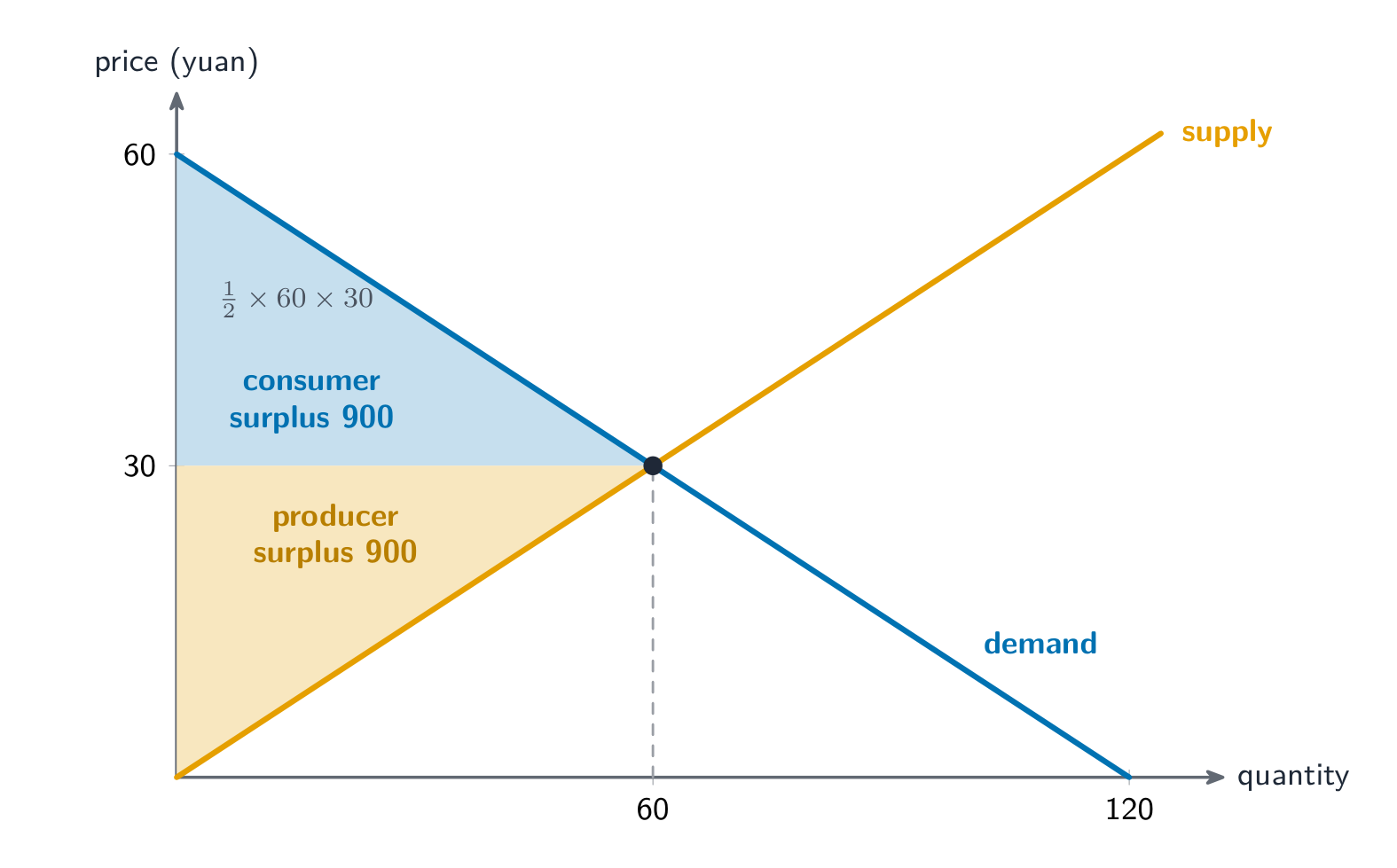
Demand is $Q = 120 - 2P$ and supply is $Q = 2P$, so $P = 30$, $Q = 60$. Demand meets the price axis at $P = 60$; supply starts at $P = 0$.
- Consumer surplus $= \tfrac{1}{2} \times \text{base} \times \text{height} = \tfrac{1}{2} \times 60 \times (60 - 30) = 900$.
- Producer surplus $= \tfrac{1}{2} \times 60 \times (30 - 0) = 900$.
- Total surplus $= 1800$: the whole gain from trade in this market.
Demand meets the price axis at 50. The market price is 20 and the quantity is 60. What is consumer surplus?
难度 2/5 · 今日首次完成可获 140 金币及少量额外奖励
$\tfrac{1}{2} \times 60 \times (50 - 20) = 900$.
Supply starts at a price of 10. The market price is 30 and the quantity is 40. What is producer surplus?
难度 2/5 · 今日首次完成可获 140 金币及少量额外奖励
$\tfrac{1}{2} \times 40 \times (30 - 10) = 400$.
When demand rises
- Demand rises to $Q = 160 - 2P$. The new equilibrium is $P = 40$, $Q = 80$.
- Consumer surplus $= \tfrac{1}{2} \times 80 \times (80 - 40) = 1600$; producer surplus $= \tfrac{1}{2} \times 80 \times 40 = 1600$.
- Buyers pay more per unit, yet consumer surplus rises — because many more buyers now value the good highly.
Surplus before and after a rise in demand
With Qd = 120 − 2P and Qs = 2P, the market clears at P 30, Q 60, and CS and PS are both ½ × 30 × 60 = 900. Demand rising to Qd = 160 − 2P gives P 40, Q 80, and both surpluses become 1,600: buyers pay more, yet their surplus rises.
A higher price does not always mean lower consumer surplus. If the price rises because supply falls, consumer surplus shrinks. If it rises because demand grows, consumer surplus can grow, since the demand curve itself has moved up. Always say which curve moved.
Bad weather shifts the supply of coffee beans to the left. What happens to consumer surplus?
难度 1/5 · 今日首次完成可获 100 金币及少量额外奖励
Price rises and quantity falls with demand unchanged, so the triangle under demand and above price shrinks.
A rise in demand can increase consumer surplus even though the price rises.
难度 1/5 · 今日首次完成可获 100 金币及少量额外奖励
The demand curve moves up, so the area below it and above the new price can grow.
Why surplus matters
- Surplus measures welfare 福利: how much better off buyers and sellers are.
- Later topics use it to show who gains and loses from taxes, subsidies, price controls and monopoly — and how much welfare is lost.
Consumer surplus is the area below demand and above price; producer surplus is the area above supply and below price. Together they measure the gains from trade, and changes in them show who gains and loses when a market changes.
Explain what happens to producer surplus when demand for electric cars rises.
Refer to the area on the diagram.