| English | 释义 | 拼音 |
|---|---|---|
| model/ˈmɒdl/ | 模型 | mó xíng |
| ceteris paribus/ˈsetərɪs ˈpærɪbəs/ | 其他条件不变 | qí tā tiáo jiàn bù biàn |
| normative statement/ˈnɔːmətɪv ˈsteɪtmənt/ | 规范性陈述 | guī fàn xìng chén shù |
| positive statement/ˈpɒzɪtɪv ˈsteɪtmənt/ | 实证性陈述 | shí zhèng xìng chén shù |
| value judgement/ˈvæljuː ˈdʒʌdʒmənt/ | 价值判断 | jià zhí pàn duàn |
Did the fare rise cut the journeys?
- At the end of 2014 Beijing replaced its flat ¥2 subway fare with distance-based fares of ¥3 and more.
- In the following weeks fewer journeys were made. But it was also winter, and Spring Festival travel was starting.
- How much of the fall was caused by the fare? Answering that is what an economic model 模型 is for.
Economics is a social science
- Economists study people, firms and governments. They cannot put a whole city in a laboratory.
- So they build models: simplified versions of reality that keep only the relationship being studied.
- A model is judged by how well it explains and predicts, not by how realistic every detail is.
Why do economists use models?
难度 1/5 · 今日首次完成可获 100 金币及少量额外奖励
Whole economies cannot be put in a laboratory, so a model keeps only the relationship being studied.
Ceteris paribus: hold everything else still
- Ceteris paribus 其他条件不变 means "other things being equal".
- To study the fare, the model keeps income, weather, petrol prices and population unchanged.
- Then any change in journeys in the model is caused by the fare alone.
"Other things being equal" is written in Latin as ceteris ____.
难度 1/5 · 今日首次完成可获 100 金币及少量额外奖励
Ceteris paribus holds every other factor constant so that one cause can be studied.
Worked example: isolate the fare effect
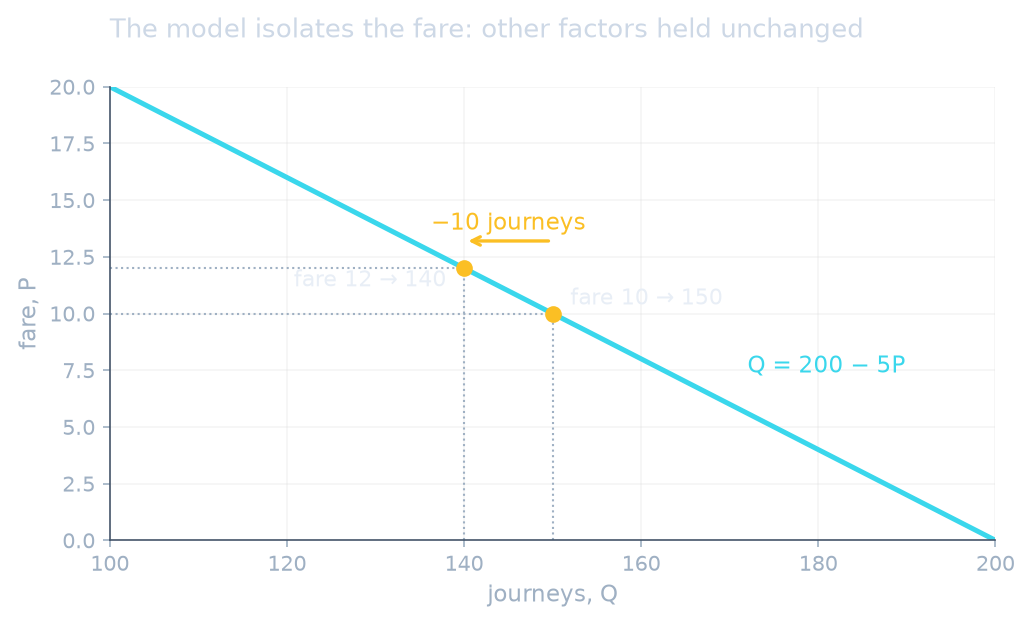
A model of journeys per day (thousands) is $Q = 200 - 5P$, where $P$ is the fare.
- At $P = 10$: $Q = 200 - 5(10) = 150$.
- At $P = 12$: $Q = 200 - 5(12) = 140$.
- Model effect of the fare rise: $140 - 150 = -10$ thousand journeys.
- Real journeys fell from $150$ to $125$, a fall of $25$. Only about $10$ of that is the fare; the other $15$ came from factors that were not held constant.
The isolated effect of a fare rise
The model Q = 200 − 5P predicts 150 journeys at a fare of 10 and 140 at 12: the isolated model effect of the fare rise is −10 journeys, other factors unchanged.
With $Q = 200 - 5P$, by how many thousand journeys does $Q$ fall when the fare rises from 12 to 14?
难度 2/5 · 今日首次完成可获 140 金币及少量额外奖励
$Q$ falls from $140$ 到 $130$: each extra unit of fare loses $5$ thousand journeys.
Positive and normative statements
- A positive statement 实证性陈述 is about what is, was or will be. It can be tested with evidence: "The fare rise reduced journeys by 10,000 a day."
- A normative statement 规范性陈述 is about what ought to be. It contains a value judgement 价值判断: "Fares should be kept low so that poorer workers can travel."
- Clue words for normative: should, ought, fair, too high, better.
Which statements are NORMATIVE?
难度 2/5 · 今日首次完成可获 140 金币及少量额外奖励
"Should" and "unfair" carry value judgements. The other two can be checked against data.
Positive does not mean true. "The fare rise doubled journeys" is a positive statement — it can be tested, and the test shows it is false. A statement is positive because it can be checked against evidence, not because it is correct.
"Raising the minimum wage always increases unemployment" is a positive statement.
难度 1/5 · 今日首次完成可获 100 金币及少量额外奖励
It is a claim about what happens, so it can be tested with evidence. Evidence suggests it is not always true, but it is still positive.
Why value judgements matter in policy
- Evidence can tell a city how many journeys a fare rise loses and how much revenue it raises.
- It cannot tell the city whether lower fares for workers are worth the cost to taxpayers. That choice needs value judgements.
- So good policy analysis keeps the two apart: first the positive effects, then the normative weighing.
A city must decide whether to cut fares. Which question can evidence alone answer?
难度 1/5 · 今日首次完成可获 100 金币及少量额外奖励
The number of extra journeys is a positive question. The other three need value judgements.
Economists use models with ceteris paribus to isolate one cause at a time. Positive statements can be tested with evidence, even if they turn out false; normative statements contain value judgements about what should happen. Policy needs both.
Write one positive and one normative statement about the price of housing in a large city.
Test each one by asking whether evidence could settle it.