Carrying out practicals and judging measurements
引入 7:22
生物学实践技能 II
Unit 6 是最后一份生物试卷,它和其他试卷都不一样。一道题会给你一个只填了一半的统计表;另一道题会要求你根据一个并非由你选择的假设,设计完整的探究。所有内容都来自 Units 4 和 5 的实验,包括呼吸计、肺量计、样方和稀释平板,但现在你要进行设计、测量、检验并得出结论。
英文讲解 · 可切换中英文字幕
本课内容
| English | 释义 | 拼音 |
|---|---|---|
| tidal volume/ˈtaɪdl ˈvɒljuːm/ | 潮气量 | cháo qì liàng |
How much oxygen does a seed use?
- A germinating pea uses far less than 1 cm³ of oxygen in an hour. To measure it, you need clever apparatus and careful reading.
- Unit 6 asks how you would carry out the core practicals, and how good your measurements really are.
The respirometer (core practical 16)
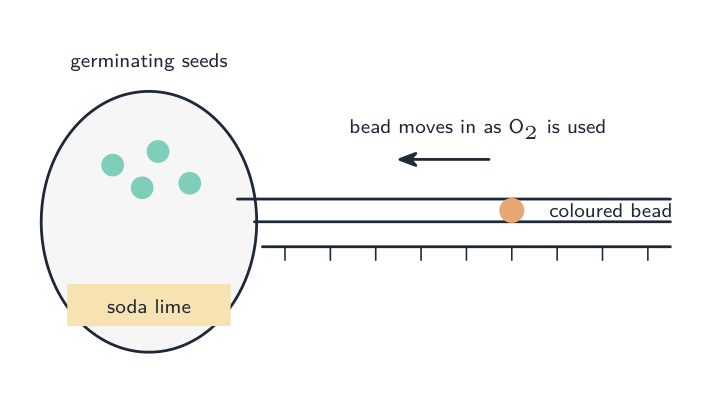
- Organisms sit in a sealed tube above soda lime, which absorbs carbon dioxide. As they use oxygen, the gas volume falls and the coloured liquid moves along the scale.
- A control tube with glass beads of the same volume instead of seeds shows changes caused by temperature or pressure.
What is the job of the soda lime in a respirometer?
难度 1/5 · 今日首次完成可获 100 金币及少量额外奖励
With CO₂ removed, only oxygen uptake changes the gas volume.
From distance to volume
- Volume of oxygen used = π r² × distance moved, where r is the radius of the capillary tube.
- Divide by time and by the mass of organisms to compare rates fairly.
Worked example. The liquid moves 24 mm in 10 minutes. The tube has a radius of 0.5 mm. The seeds have a mass of 5 g.
- Volume = 3.14 × 0.5² × 24 = 18.8 mm³ of oxygen.
- Rate = 18.8 ÷ 10 ÷ 5 = 0.38 mm³ per minute per gram.
The liquid moves 40 mm in a tube of radius 0.5 mm. What volume of oxygen was used, in mm³? Use π = 3.14.
难度 2/5 · 今日首次完成可获 140 金币及少量额外奖励
3.14 × 0.5² × 40 = 31.4 mm³.
The spirometer (core practical 17)
- A spirometer trace shows tidal volume 潮气量 (the height of one breath) and breathing rate (breaths per minute). Minute ventilation = tidal volume × breathing rate.
- The trace slopes down over time because soda lime absorbs the carbon dioxide breathed out; the slope gives oxygen uptake.
Tidal volume is 0.5 dm³ and the breathing rate is 16 breaths per minute. What is the minute ventilation in dm³ per minute?
难度 2/5 · 今日首次完成可获 140 金币及少量额外奖励
0.5 × 16 = 8 dm³ per minute.
Judging your measurements
- Accuracy: how close a reading is to the true value. Precision: how close repeated readings are to each other.
- Uncertainty is usually half the smallest scale division. A larger measurement on the same scale has a smaller percentage uncertainty.
Match each term to its meaning.
难度 2/5 · 今日首次完成可获 140 金币及少量额外奖励
Results can be precise but not accurate.
Errors and how to reduce them
- Random errors make repeats spread out (for example judging a colour change by eye); reduce them with more repeats and objective methods such as a colorimeter.
- Systematic errors shift every reading the same way (for example a balance that reads 0.2 g with nothing on it); find them with a control or calibration.
Match each problem to the type of error.
难度 2/5 · 今日首次完成可获 140 金币及少量额外奖励
Systematic errors shift every reading the same way.
More repeats make results more reliable, not more accurate. Repeats reduce the effect of random error. They cannot remove a systematic error, which shifts every reading by the same amount.
Repeating a measurement many times removes systematic error.
难度 1/5 · 今日首次完成可获 100 金币及少量额外奖励
Use a control or calibration to find systematic error.
A respirometer measures oxygen uptake: soda lime absorbs CO₂, volume = π r² × distance, and a control tube corrects for temperature and pressure. A spirometer gives tidal volume, breathing rate and minute ventilation. Accuracy is closeness to the true value, precision is closeness of repeats. Repeats reduce random error; calibration and controls deal with systematic error.
Explain why a respirometer experiment uses a control tube with glass beads instead of seeds.
Say what the control detects and how it is used.
出了什么问题?只有网站团队能看到这些信息。