Culturing microorganisms and growth curves
引入 10:46
单元 4:能量、环境、微生物学与免疫学
一片麦田截获阳光,固定碳,支撑食物链——但在每一步都会损失能量。本单元将追踪从光子到生态系统的能量流动……
英文讲解 · 可切换中英文字幕
本课内容
| English | 释义 | 拼音 |
|---|---|---|
| Turbidity/tɜːˈbɪdɪti/ | 浊度 | zhuó dù |
| Dilution plating/daɪˈluːʃn ˈpleɪtɪŋ/ | 稀释涂布 | xī shì tú bù |
| Lag/læɡ/ | 延迟期 | yán chí qī |
| Log/lɒɡ/ | 对数期 | duì shù qī |
| Stationary/ˈsteɪʃənəri/ | 稳定期 | wěn dìng qī |
| Death/deθ/ | 衰亡期 | shuāi wáng qī |
One bacterium, millions of cells by tomorrow
- Under good conditions some bacteria divide every 20 minutes. One cell could become millions overnight.
- To study them safely, biologists grow them with aseptic technique and measure how the population grows.
Aseptic technique
- Heat the inoculating loop until it glows red, and pass the neck of the culture bottle through a flame. Open lids only briefly and only a little.
- Tape plates shut (do not seal them all round) and incubate at about 25 °C, not body temperature, so harmful human pathogens are less likely to grow.
Which are parts of aseptic technique?
难度 2/5 · 今日首次完成可获 140 金币及少量额外奖励
Incubating at about 25 °C reduces the risk of growing human pathogens.
Ways to count microorganisms
- Direct count: count cells in a known small volume using a haemocytometer under the microscope (this counts dead cells too).
- Turbidity 浊度: a colorimeter measures how cloudy a broth is; more cells means more cloudy. Dilution plating 稀释涂布: dilute the culture, spread a known volume on agar, and count the colonies.
Match each method to what it measures.
难度 2/5 · 今日首次完成可获 140 金币及少量额外奖励
Only living cells form colonies.
Working out a viable count
- Each colony grows from one living cell. Cells per cm³ = number of colonies × dilution factor ÷ volume spread (in cm³).
- Choose a plate with 30–300 colonies: fewer is unreliable, more are too crowded to count.
Worked example. A culture is diluted 10⁶ times. 0.1 cm³ is spread on a plate and 54 colonies grow.
- Cells per cm³ = 54 × 10⁶ ÷ 0.1 = 5.4 × 10⁸ cells per cm³.
- Only living cells form colonies, so this is a viable count.
A culture is diluted 10⁵ times, 0.1 cm³ is spread, and 72 colonies grow. How many cells per cm³, in millions?
难度 2/5 · 今日首次完成可获 140 金币及少量额外奖励
72 × 10⁵ ÷ 0.1 = 7.2 × 10⁷ = 72 million per cm³.
The growth curve
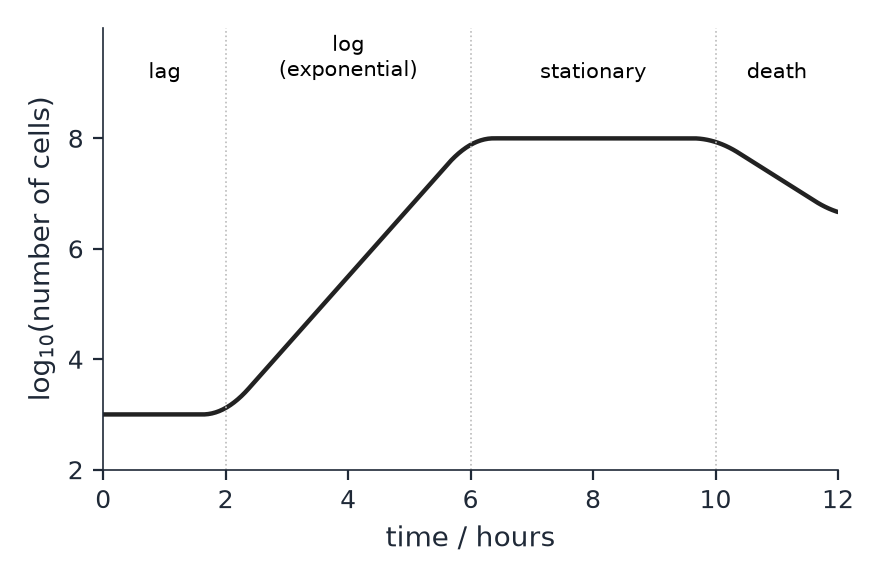
- Lag 延迟期 phase: cells make enzymes and grow, but hardly divide. Log 对数期 phase: cells divide at a constant rate, so the number doubles again and again.
- Stationary 稳定期 phase: nutrients run out and waste builds up, so deaths equal new cells. Death 衰亡期 phase: more cells die than are made.
Put the phases of the growth curve in order.
难度 3/5 · 今日首次完成可获 200 金币及少量额外奖励
Lag, log, stationary, death.
Why does the population stop growing in the stationary phase?
难度 1/5 · 今日首次完成可获 100 金币及少量额外奖励
Division still happens, but it is balanced by death.
Growth rate and log scales
- Because numbers rise so fast, they are plotted on a log scale, where the log phase becomes a straight line.
- Growth rate constant k = (log₁₀ N_t − log₁₀ N₀) ÷ (0.301 × t), in generations per hour. Mean generation time = 1 ÷ k.
Cells increase from 10³ to 10⁶ in 5 hours. Using k = (log₁₀ N_t − log₁₀ N₀) ÷ (0.301 × t), what is k in generations per hour? Give 2 decimal places.
难度 2/5 · 今日首次完成可获 140 金币及少量额外奖励
(6 − 3) ÷ (0.301 × 5) = 3 ÷ 1.505 = 1.99.
Core practical 13: growth in a broth
- Inoculate a nutrient broth and incubate it. Every hour, take a sample with aseptic technique and measure its turbidity with a colorimeter (or make dilution plates).
- Plot the results and identify the lag, log and stationary phases.
The log phase is a straight line only on a log scale. On an ordinary scale the same numbers curve steeply upwards. Check the y-axis before you describe the shape of a growth curve.
Aseptic technique keeps cultures pure and people safe. Count microbes directly (haemocytometer), by turbidity, or by dilution plating (colonies × dilution ÷ volume). The growth curve has lag, log, stationary and death phases. On a log scale the log phase is straight; k = (log₁₀ N_t − log₁₀ N₀) ÷ (0.301 × t).
Explain why a dilution plate count gives fewer cells than a haemocytometer count of the same culture.
Compare what each method can see.
出了什么问题?只有网站团队能看到这些信息。