Evolution and speciation
引入 10:46
单元 4:能量、环境、微生物学与免疫学
一片麦田截获阳光,固定碳,支撑食物链——但在每一步都会损失能量。本单元将追踪从光子到生态系统的能量流动……
英文讲解 · 可切换中英文字幕
本课内容
| English | 释义 | 拼音 |
|---|---|---|
| allele frequency/əˈliːl ˈfriːkwənsi/ | 等位基因频率 | děng wèi jī yīn pín lǜ |
| Stabilising selection/ˈsteɪbəlaɪzɪŋ sɪˈlekʃn/ | 稳定选择 | wěn dìng xuǎn zé |
| Directional selection/daɪˈrekʃənl sɪˈlekʃn/ | 定向选择 | dìng xiàng xuǎn zé |
| Speciation/ˌspiːʃɪˈeɪʃn/ | 物种形成 | wù zhǒng xíng chéng |
| Allopatric/ˌæləˈpætrɪk/ | 异域的 | yì yù de |
| Sympatric/ˈsɪmpətrɪk/ | 同域的 | tóng yù de |
Bacteria that antibiotics cannot kill
- In a few decades, some bacteria have become resistant to almost every antibiotic we have.
- This is evolution happening fast enough to watch. The same process, over millions of years, has made new species.
What evolution is
- Evolution is a change in allele frequency 等位基因频率 in a population over generations.
- It needs variation. New alleles come from mutation, and meiosis and random fertilisation make new combinations of them.
Which is the best definition of evolution?
难度 1/5 · 今日首次完成可获 100 金币及少量额外奖励
Evolution is measured in populations, through allele frequencies.
Natural selection
- Individuals with alleles that suit the environment survive and reproduce more, so they pass those alleles on.
- Over many generations, those alleles become more common. In small populations, allele frequencies can also change by chance (genetic drift).
Put the steps of natural selection in order.
难度 3/5 · 今日首次完成可获 200 金币及少量额外奖励
Variation, selection, inheritance, change in frequency.
Types of selection
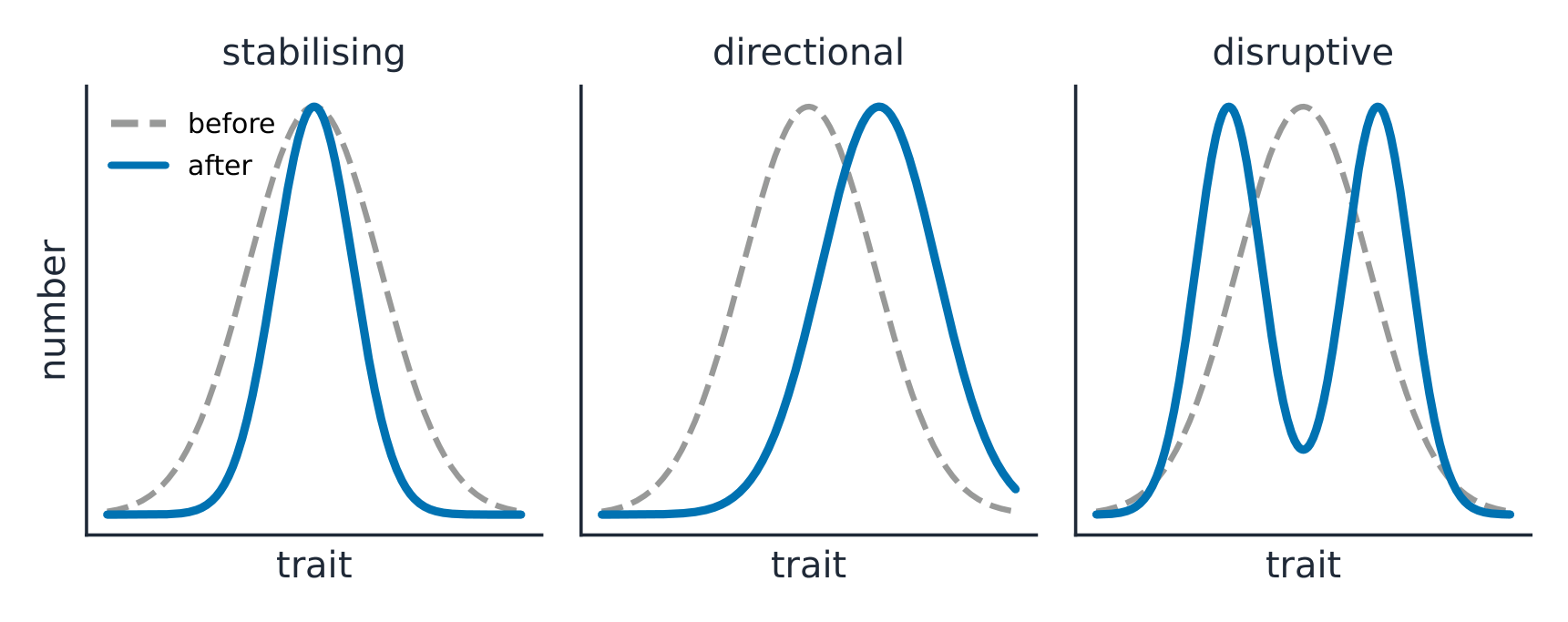
- Stabilising selection 稳定选择 favours the average and removes the extremes, in a stable environment (for example human birth mass).
- Directional selection 定向选择 favours one extreme when the environment changes, so the mean shifts (for example antibiotic resistance).
Match each example to the type of selection.
难度 2/5 · 今日首次完成可获 140 金币及少量额外奖励
Stabilising keeps the mean; directional shifts it.
Speciation needs isolation
- A species is a group that can interbreed to produce fertile offspring. Speciation 物种形成 happens when two populations stop interbreeding and their allele frequencies change in different ways.
- Allopatric 异域的 speciation: a physical barrier such as a mountain or sea separates the populations. Sympatric 同域的 speciation: the populations live in the same place but cannot breed, for example because they breed at different times or have different courtship behaviour.
Worked example: allele frequency change. In a population of 500 beetles, 100 alleles out of 1000 are for dark colour. Ten generations later, 350 out of 1000 are.
- Starting frequency = 100 ÷ 1000 = 0.10; final frequency = 350 ÷ 1000 = 0.35.
- The frequency increased by 0.25, so the dark allele was probably favoured by directional selection.
In a population, 180 of 600 alleles for a gene are the dark allele. What is its frequency?
难度 2/5 · 今日首次完成可获 140 金币及少量额外奖励
180 ÷ 600 = 0.3.
Two populations of the same fish live in one lake but breed at different times of year. Over time they become separate species. What is this?
难度 1/5 · 今日首次完成可获 100 金币及少量额外奖励
They share a place, so there is no physical barrier.
Molecular evidence for evolution
- Closely related species have more similar DNA base sequences and more similar amino acid sequences in proteins (for example cytochrome c).
- Counting the differences shows how long ago two species shared a common ancestor, and has changed some classifications.
Two species whose cytochrome c differs by 2 amino acids are probably more closely related than two species whose cytochrome c differs by 20.
难度 1/5 · 今日首次完成可获 100 金币及少量额外奖励
Fewer differences suggest a more recent common ancestor.
How scientists check new evidence
- New findings are published in scientific journals only after peer review: other experts check the methods and conclusions.
- Results are also discussed at conferences and must be repeated by other scientists before they are accepted.
Individuals do not evolve; populations do. An organism does not change its alleles because it "needs" to. Selection changes how common alleles are in the population over generations.
Evolution is a change in allele frequency. Mutation gives variation; natural selection makes useful alleles more common, and drift changes them by chance. Stabilising selection removes extremes; directional selection shifts the mean. Isolation (allopatric or sympatric) leads to new species. DNA and protein sequences show how closely species are related, and peer review checks new evidence.
Explain how a mountain range can lead to the formation of two new species.
Isolation, then different selection, then reproductive isolation.
出了什么问题?只有网站团队能看到这些信息。