Neurones, nerve impulses and synapses
引入 10:16
单元 5:呼吸、内环境、协调与基因技术
冲刺赶公交车时,身体宛如演奏交响乐:肌肉加速消耗葡萄糖,心输出量翻倍,通气加深,开始出汗,肾脏……
英文讲解 · 可切换中英文字幕
本课内容
| English | 释义 | 拼音 |
|---|---|---|
| neurones/ˈnjuːrəʊnz/ | 神经元 | shén jīng yuán |
| resting potential/ˈrestɪŋ pəˈtenʃl/ | 静息电位 | jìng xī diàn wèi |
| sodium-potassium pump/ˈsəʊdɪəm pəˈtæsɪəm pʌmp/ | 钠钾泵 | nà jiǎ bèng |
| threshold/ˈθreʃəʊld/ | 阈值 | yù zhí |
| all-or-nothing/ɔːl ɔː ˈnʌθɪŋ/ | 全或无 | quán huò wú |
| refractory period/rɪˈfræktəri ˈpɪərɪəd/ | 不应期 | bù yīng qī |
| myelinated/maɪˈelɪneɪtɪd/ | 有髓 | yǒu suǐ |
| saltatory conduction/ˈsɒltətəri kənˈdʌkʃn/ | 跳跃传导 | tiào yuè chuán dǎo |
| synapse/ˈsɪnæps/ | 突触 | tū chù |
| neurotransmitter/ˈnjuːrətrænsmɪtə/ | 神经递质 | shén jīng dì zhì |
| acetylcholinesterase/ˈæsɪtɪlkəlaɪnstəreɪz/ | 乙酰胆碱酯酶 | yǐ xiān dǎn jiǎn zhǐ méi |
Why you pull your hand back before you feel the pain
- Touch a hot pan and your hand moves away in about 0.2 s. You feel the pain only afterwards.
- The message travels along neurones 神经元 as electrical impulses, and crosses the gaps between them as chemicals.
The resting potential: a charged membrane
- The sodium-potassium pump 钠钾泵 uses ATP to move 3 Na⁺ out of the axon for every 2 K⁺ it moves in.
- The membrane leaks K⁺ out more easily than Na⁺ comes in, so the inside is negative: about −70 mV, the resting potential 静息电位.
Why is the inside of a resting axon negative?
难度 1/5 · 今日首次完成可获 100 金币及少量额外奖励
More positive ions end up outside than inside, so the inside is about −70 mV.
Depolarisation: sodium rushes in
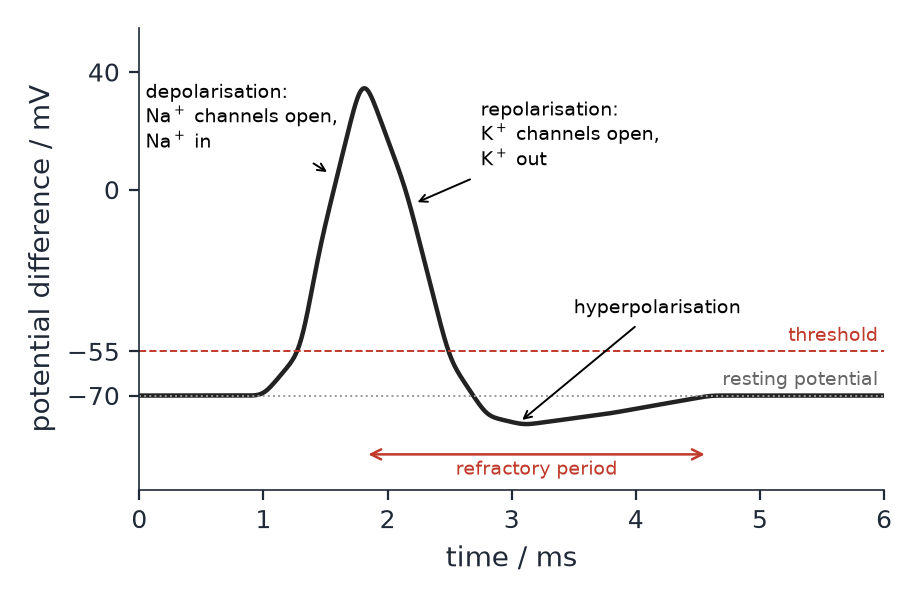
- A stimulus opens some sodium channels. If the potential reaches the threshold 阈值 (about −55 mV), many voltage-gated Na⁺ channels open.
- Na⁺ diffuses in and the inside becomes positive, up to about +30 mV.
Repolarisation and the all-or-nothing rule
- The Na⁺ channels close and voltage-gated K⁺ channels open. K⁺ leaves, the inside becomes negative again and briefly drops below −70 mV (hyperpolarisation).
- Every action potential reaches the same size: it is all-or-nothing 全或无. A stronger stimulus gives more impulses per second, not bigger ones.
Put the events of an action potential in order.
难度 3/5 · 今日首次完成可获 200 金币及少量额外奖励
Depolarisation comes from Na⁺ entering; repolarisation from K⁺ leaving.
Travelling along the axon
- The Na⁺ that enters spreads sideways and depolarises the next part of the membrane. The part behind is in its refractory period 不应期, so the impulse moves one way only.
- In myelinated 有髓 neurones, action potentials happen only at the nodes of Ranvier, so the impulse jumps from node to node: saltatory conduction 跳跃传导, much faster.
Worked example: conduction speed. An impulse takes 4.0 ms to travel 0.30 m along a myelinated axon.
- Change the time to seconds: 4.0 ms = 0.0040 s.
- Speed = distance ÷ time = 0.30 ÷ 0.0040 = 75 m/s. An unmyelinated axon of the same width conducts at only about 1–2 m/s.
An impulse travels 0.45 m along an axon in 6.0 ms. What is its speed in m/s?
难度 2/5 · 今日首次完成可获 140 金币及少量额外奖励
6.0 ms = 0.0060 s, and 0.45 ÷ 0.0060 = 75 m/s.
The refractory period makes the impulse travel in one direction along the axon.
难度 1/5 · 今日首次完成可获 100 金币及少量额外奖励
The membrane behind the impulse cannot depolarise again yet, so the impulse can only move forward.
At the synapse: releasing the transmitter
- The impulse reaches the end of the presynaptic neurone. Voltage-gated Ca²⁺ channels open and calcium ions enter.
- Vesicles of neurotransmitter 神经递质 (for example acetylcholine) fuse with the membrane and release it into the synaptic cleft by exocytosis.
At the synapse: binding and clearing
- The transmitter diffuses across the cleft and binds to receptors on the postsynaptic membrane. Na⁺ channels open; if threshold is reached, a new action potential starts.
- The transmitter is then removed: acetylcholine is broken down by acetylcholinesterase 乙酰胆碱酯酶. Receptors are only on the postsynaptic side, so a synapse 突触 passes signals one way.
Put the events at a cholinergic synapse in order.
难度 3/5 · 今日首次完成可获 200 金币及少量额外奖励
Calcium entry is the trigger for release; breakdown stops the signal.
Drugs that act at synapses
- Lidocaine blocks voltage-gated Na⁺ channels, so no impulses pass and the area goes numb.
- SSRIs block the reuptake of serotonin, so it stays in the cleft longer; MDMA releases extra serotonin and then leaves the stores depleted.
Match each drug to how it acts.
难度 2/5 · 今日首次完成可获 140 金币及少量额外奖励
Each changes one step of signalling.
A bigger stimulus does not give a bigger action potential. Every action potential reaches about +30 mV. The brain learns how strong a stimulus is from the frequency of impulses and from how many neurones fire.
The pump and K⁺ leakage hold the resting potential at about −70 mV. At threshold, Na⁺ enters (depolarisation), then K⁺ leaves (repolarisation). The refractory period keeps impulses one-way and separate, and myelin makes them jump between nodes. At a synapse, Ca²⁺ entry releases neurotransmitter, which diffuses, binds postsynaptic receptors and is then removed.
Explain why impulses travel faster along myelinated axons than unmyelinated ones.
Name the mechanism, then link it to speed.
出了什么问题?只有网站团队能看到这些信息。