Listening: matching speakers and long multiple choice
引入您的已保存位置保留在此浏览器中。恢复操作不会完成课程或回答其中的问题。
本课内容
| English | 中文 |
|---|---|
| supplier/səˈplaɪə/ | 供应商 |
| monologue/ˈmɒnəʊlɒɡ/ | 独白 |
| word-match trap | 同词陷阱 |
| staff survey | 员工调查 |
| unreliable | 不可靠的 |
Five people, five reasons
- Five business owners explain why they changed suppliers. One says "price" but means something else. Another says the quality was "the same as everyone else's", so quality was not the reason.
- In Vantage and Higher Listening Part 2 you match speakers to reasons, opinions or problems. The right answer is always said clearly, but rarely with the same words as the option.
Matching and long multiple choice
| Vantage | Higher | |
|---|---|---|
| Part 2: matching | 2 × 5 short monologues; match each to options A–H | the same: 10 questions |
| Part 3: multiple choice | a conversation of about 4 minutes, 8 questions, options A–C | an interview or discussion, 8 questions, options A–C |
- Preliminary Part 1 (8 short extracts) and Part 4 (a 3-minute conversation, 8 questions) use multiple choice too, so the same skills help at every level.
- Each Part 2 section has 8 options for 5 speakers: three options are not used.
In one Part 2 section there are 8 options for 5 speakers. How many options are not used?
难度 2/5 · 今日首次完成可获 140 金币及少量额外奖励
8 − 5 = 3 options are distractors.
Match each task with its number of questions.
难度 2/5 · 今日首次完成可获 140 金币及少量额外奖励
Part 2 is two sections of five; the long multiple-choice task has eight questions.
The word-match trap
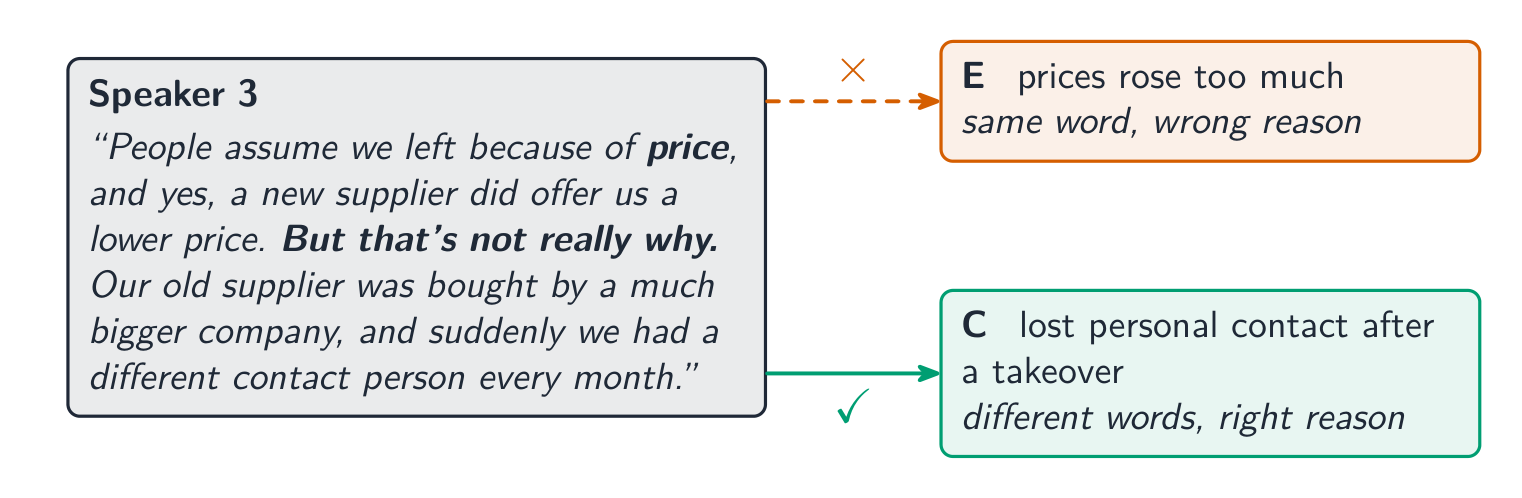
- A speaker may mention the word in a wrong option and then reject it: "…but that's not really why." Listen for the reason the speaker chooses, not the words you recognise.
- Signals that a reason is being rejected: not really, people assume…, it wasn't that, the same as everyone else's.
"The quality was the same as everyone else's." Is quality the speaker's reason?
难度 1/5 · 今日首次完成可获 100 金币及少量额外奖励
Mentioning a word is not choosing it as the reason.
Listen: why did they change suppliers?
- Listen to each speaker twice. Choose the main reason each one gives, from A–H in the exercises below.
Transcripts: read them after your second listen
Speaker 1: We'd used the same packaging company for nearly ten years, and their prices were always fair. But last spring we had three late deliveries in a row, and one of them stopped our production line for a whole day. After that, we simply couldn't trust them any more, so we looked for someone else.
Speaker 2: Honestly, the service was excellent. They always answered the phone and delivered on time. The problem was that our new product range needed a special recycled material, and they just didn't make it. They offered to develop it, but it would have taken a year, and we couldn't wait that long.
Speaker 3: People assume we left because of price, and yes, a new supplier did offer us a lower price. But that's not really why. Our old supplier was bought by a much bigger company, and suddenly we had a different contact person every month. Nobody knew our account. We missed having a real relationship.
Speaker 4: We didn't really have a choice. The government brought in new safety rules for children's products, and our supplier's factory didn't have the right certificate. They're working on it, I believe, but we had to sell in the new year, so we moved to a supplier that already met the standard.
Speaker 5: It came down to money in the end. Our old supplier put their prices up twice in one year, by eight per cent each time. The quality was the same as everyone else's, and so was the delivery. When a competitor offered the same product for much less, it was an easy decision.
Listen to speaker 1. What was the main reason for changing suppliers?
难度 1/5 · 今日首次完成可获 100 金币及少量额外奖励
"Three late deliveries in a row… we simply couldn't trust them." Prices were fair, so not E.
Listen to speaker 2. What was the main reason for changing suppliers?
难度 1/5 · 今日首次完成可获 100 金币及少量额外奖励
"Our new product range needed a special recycled material, and they just didn't make it." The service was excellent, so not A.
Listen to speaker 4. What was the main reason for changing suppliers?
难度 1/5 · 今日首次完成可获 100 金币及少量额外奖励
"New safety rules… our supplier's factory didn't have the right certificate."
Listen to speaker 5. What was the main reason for changing suppliers?
难度 1/5 · 今日首次完成可获 100 金币及少量额外奖励
"Prices up twice in one year, by eight per cent each time." Quality and delivery were the same as everyone else's, so not F or A.
Long multiple choice: follow the discussion
- Part 3 tests opinions and decisions, not just facts. The question often asks what does Tom think…? or what do they decide…?
- Read the questions before you listen: they follow the order of the conversation. Speakers often suggest one thing and then agree on another.
Transcript: read it after your second listen
Karen: So, Tom, you wanted to talk about the staff survey before we send it out. Tom: Yes. I've looked at last year's results, and the main thing is that only about a third of staff answered. I don't think the questions were the problem. People just didn't believe anything would change. Karen: That's fair. We did promise a new canteen and it never happened. Tom: Exactly. So this year I'd like us to start the survey with a short message saying what we actually changed after the last one. The flexible start times, for example. Karen: I like that. What about making it shorter? Last year's had forty questions. Tom: I thought about that, but most people who started it finished it. So length isn't really the issue. I'd rather keep the questions so we can compare with last year. Karen: All right. And the timing? We planned to send it in December. Tom: That's my other worry. December is our busiest month in sales, so I'd prefer the second week of January. People will have more time then. Karen: Fine, January it is. I'll tell the directors. They'll want a short report on the results by the end of February. Tom: That should be possible.
Listen to the discussion. Why does Tom think few staff answered last year?
难度 1/5 · 今日首次完成可获 100 金币及少量额外奖励
"I don't think the questions were the problem. People just didn't believe anything would change."
What does Tom want to add to the start of the survey?
难度 1/5 · 今日首次完成可获 100 金币及少量额外奖励
"Start the survey with a short message saying what we actually changed."
What do they decide about the number of questions?
难度 1/5 · 今日首次完成可获 100 金币及少量额外奖励
"Length isn't really the issue. I'd rather keep the questions so we can compare."
When will they send the survey?
难度 1/5 · 今日首次完成可获 100 金币及少量额外奖励
December was the first plan; Tom prefers January and Karen agrees. February is the report deadline.
Traps in multiple choice
- All three options are mentioned. In the survey talk you hear the questions, people didn't believe anything would change and forty questions. Only one is Tom's real reason.
- A first idea that is dropped: "We planned to send it in December." The decision is January.
- A "yes, but": "I thought about that, but…" Whatever comes after but is the speaker's real view.
In "I thought about that, but most people finished it", the speaker's real view comes after "but".
难度 1/5 · 今日首次完成可获 100 金币及少量额外奖励
Yes but… introduces the speaker's real position.
Rules for matching and multiple choice
- Read the options first and think of other ways to say each one (late deliveries = unreliable delivery).
- Listen for the speaker's final position, not the first word that matches.
- Use the second listen to confirm your choice and to rule out the options you didn't use.
出了什么问题?只有网站团队能看到这些信息。