| English | 释义 | 拼音 |
|---|---|---|
| battery/ˈbætəri/ | 电池组 | diàn chí zǔ |
| chemical cell/ˈkemɪkl sel/ | 化学电池 | huà xué diàn chí |
A lemon battery
- Push a zinc nail and a copper coin into a lemon and connect them to a voltmeter: it reads nearly 1 V.
- In 1800 Alessandro Volta stacked zinc and copper discs with salty cloth between them and made the first battery.
- Two different metals in an electrolyte make a chemical cell 化学电池.
What do you need to make a simple chemical cell?
难度 2/5 · 今日首次完成可获 140 金币及少量额外奖励
Identical metals give no voltage.
How a cell works
- The more reactive metal (zinc) loses electrons more easily. Electrons flow through the wire to the less reactive metal (copper).
- This flow of electrons is a current; the push is a potential difference (voltage).
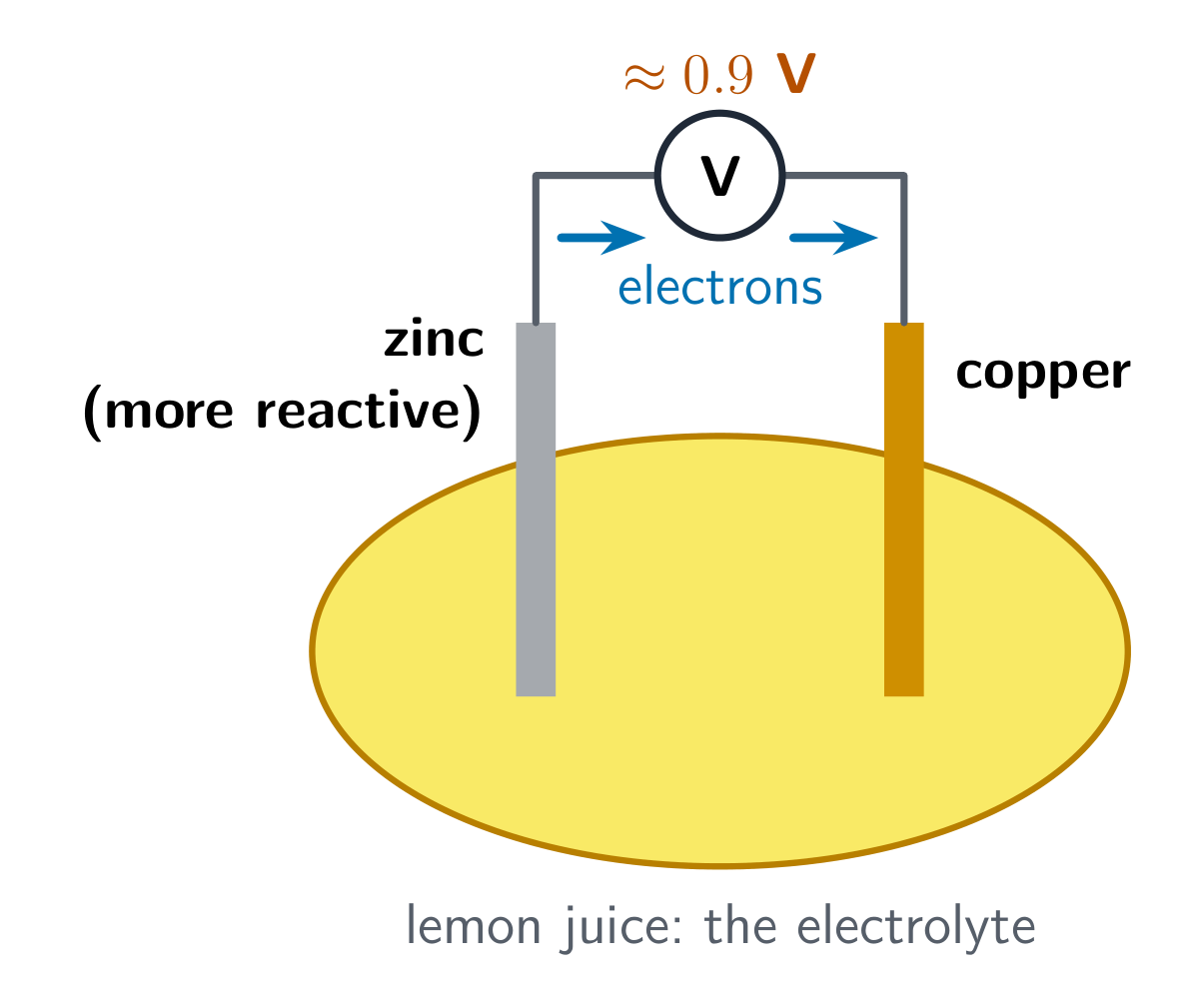
In a zinc–copper cell, which way do electrons flow through the wire?
难度 1/5 · 今日首次完成可获 100 金币及少量额外奖励
Zinc is more reactive.
What sets the voltage
- The metals: the bigger their difference in reactivity, the bigger the voltage. Zinc–copper gives more than iron–copper.
- The electrolyte and its concentration also change the voltage.
Same metals and a different electrolyte
The supplied table gives a zinc–copper cell 0.90 V in electrolyte A and 0.65 V in electrolyte B. The metal pair sets the direction; the voltage also depends on the electrolyte and conditions.
Which pair of metals would give the largest voltage?
难度 1/5 · 今日首次完成可获 100 金币及少量额外奖励
Largest reactivity difference.
Batteries
- A battery 电池组 is two or more cells connected in series. Their voltages add.
- Three 1.5 V cells in series give 4.5 V.
Worked example: cells in series
A zinc–copper cell gives 0.90 V in one electrolyte (and 0.65 V in a different one).
- Three cells in series, all the same way: $3 \times 0.90 = 2.70$ V.
- One cell reversed: $0.90 + 0.90 - 0.90 = 0.90$ V — the reversed cell subtracts.
- Same two metals → same direction of current; the electrolyte changes the size.
Cells in series add their voltages
Three identical 0.90 V cells aligned in series give an ideal 2.70 V. Reverse one and it subtracts: 0.90 + 0.90 − 0.90 = 0.90 V.
Four 1.5 V cells are connected in series, all the same way. What is the total voltage?
难度 2/5 · 今日首次完成可获 140 金币及少量额外奖励
$4 \times 1.5 = 6.0$ V.
Four 1.5 V cells are in series, but one is reversed. What is the total voltage?
难度 2/5 · 今日首次完成可获 140 金币及少量额外奖励
$1.5 \times 3 - 1.5 = 3.0$ V.
Two identical metals give no voltage. Copper and copper in lemon juice read 0 V: there is no difference in reactivity to push the electrons.
Two copper electrodes in lemon juice produce a voltage.
难度 1/5 · 今日首次完成可获 100 金币及少量额外奖励
The metals must differ.
A chemical cell is two different metals in an electrolyte. Electrons flow from the more reactive metal to the less reactive one. The voltage depends on the metals and the electrolyte; cells in series add to make a battery.
A student makes cells with copper and different metals in salt water. Predict and explain how the voltage changes from iron to zinc to magnesium.
Further apart in the series, higher voltage.