| English | 释义 | 拼音 |
|---|---|---|
| temperature change/ˈtemprɪtʃə tʃeɪndʒ/ | 温度变化 | wēn dù biàn huà |
| line of best fit/laɪn ɒv best fɪt/ | 最佳拟合线 | zuì jiā nǐ hé xiàn |
Finding the neutral point with a thermometer
- Neutralisation is exothermic. Add alkali to acid in small portions, and the temperature climbs — until the acid runs out.
- In Required Practical 4 you measure the temperature change 温度变化 and use a graph to find exactly when neutralisation was complete.
The method
- Put 25 cm³ of dilute hydrochloric acid in a polystyrene cup inside a beaker. Record its temperature.
- Add sodium hydroxide 5 cm³ at a time, stirring. Record the highest temperature after each addition.
- Continue to about 40 cm³ of alkali.
Identify each variable.
难度 2/5 · 今日首次完成可获 140 金币及少量额外奖励
Change, measure, keep the same.
Reducing energy loss
- The polystyrene cup is an insulator; a lid reduces loss by evaporation and convection.
- Stirring makes the temperature even throughout.
Why is a polystyrene cup used?
难度 1/5 · 今日首次完成可获 100 金币及少量额外奖励
Less energy escapes.
Worked example: a repeated reading
Start temperature 20.2 °C. At 25 cm³ of alkali, two runs read 30.4 °C and 30.8 °C.
- Mean $= \dfrac{30.4 + 30.8}{2} = 30.6$ °C.
- Rise $= 30.6 - 20.2 = 10.4$ °C.
- Uncertainty $= \pm\dfrac{0.4}{2} = \pm 0.2$ °C.
The temperature peak marks neutralisation
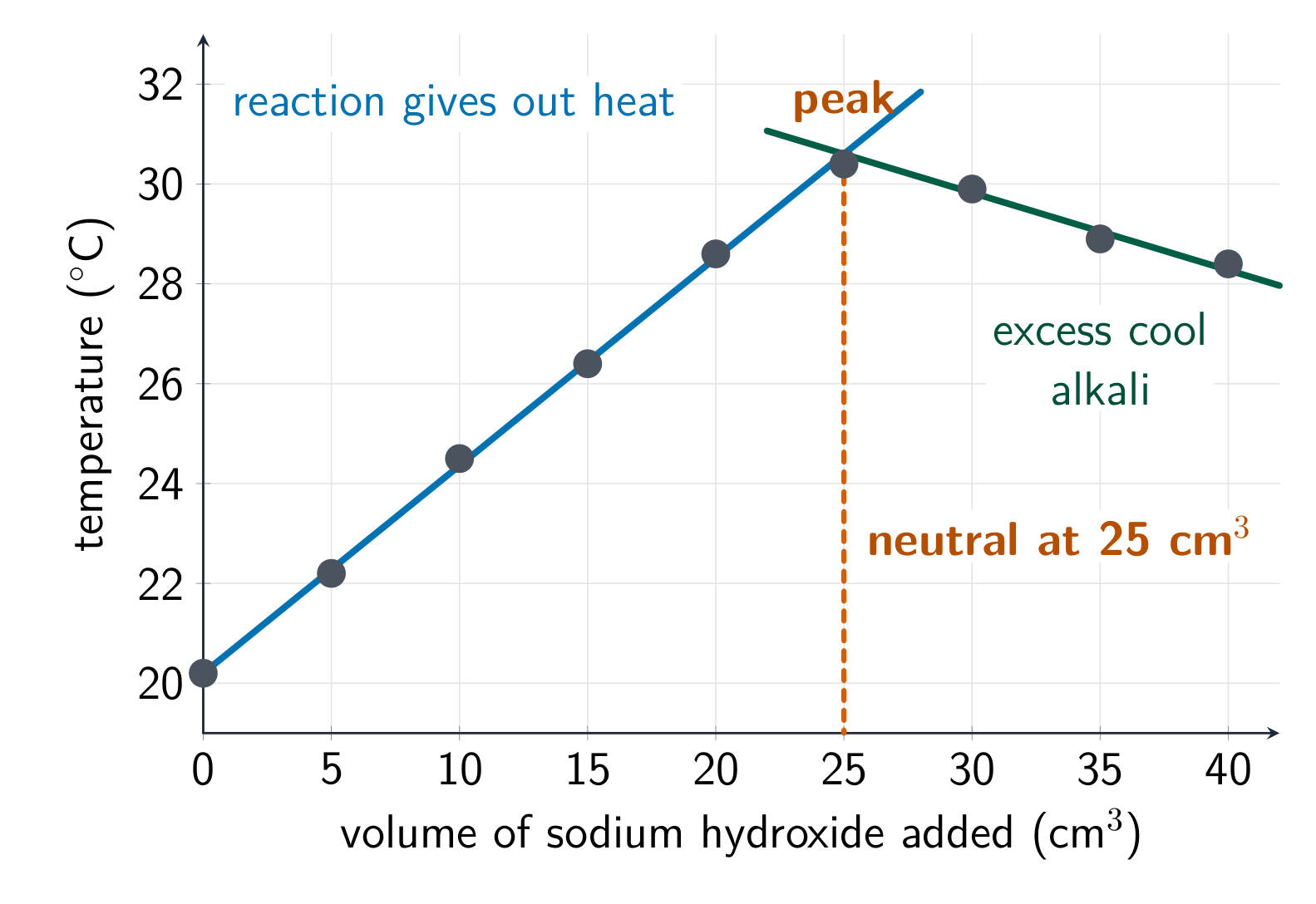
Repeat runs at one volume read 30.4 °C and 30.8 °C: mean 30.6 °C, a rise of 10.4 °C from 20.2 °C. Once the acid is used up, extra cooler alkali lowers the temperature, so the peak shows the neutral volume.
Two runs give maximum temperatures of 28.6 and 29.0 °C. What is the mean?
难度 2/5 · 今日首次完成可获 140 金币及少量额外奖励
$\dfrac{57.6}{2} = 28.8$.
The start temperature was 19.8 °C and the mean maximum is 28.8 °C. What is the temperature rise?
难度 2/5 · 今日首次完成可获 140 金币及少量额外奖励
$28.8 - 19.8 = 9.0$.
Reading the graph
- The temperature rises, peaks, then falls. Draw a line of best fit 最佳拟合线 through the rising points and another through the falling points.
- Where they cross is the volume of alkali that exactly neutralised the acid, and the maximum temperature rise.
Where on the graph is the volume that exactly neutralised the acid?
难度 1/5 · 今日首次完成可获 100 金币及少量额外奖励
The peak marks neutralisation.
The falling part does not mean the reaction became endothermic. After the acid is used up, no more reaction happens. Adding more cool alkali just dilutes and cools the mixture.
After the peak, the temperature falls because neutralisation becomes endothermic.
难度 1/5 · 今日首次完成可获 100 金币及少量额外奖励
Excess cool alkali dilutes the mixture.
In RP4, add alkali in portions to acid in an insulated cup and record the temperature. The graph rises while neutralisation releases energy, then falls as excess cool alkali is added. The crossing of the two best-fit lines gives the neutralisation volume.
Suggest two improvements to RP4 to make the temperature readings more accurate, and explain each.
Less loss, better measurement.