| English | 释义 | 拼音 |
|---|---|---|
| electron transfer/ɪˈlektrɒn ˈtrænsfɜː/ | 电子转移 | diàn zǐ zhuǎn yí |
| half equation/hɑːf ɪˈkweɪʒn/ | 半反应式 | bàn fǎn yìng shì |
Electrons on the move
- A zinc–copper cell, like the one Alessandro Volta's successors built, makes electricity because zinc atoms give electrons to copper ions.
- The same electron transfer happens in a beaker when zinc displaces copper — just without a wire.
- This lesson is Higher Tier.
Redox in terms of electrons
- OIL RIG: Oxidation Is Loss of electrons; Reduction Is Gain.
- This electron transfer 电子转移 definition works even when no oxygen is involved.
Match each process to its definition.
难度 2/5 · 今日首次完成可获 140 金币及少量额外奖励
OIL RIG.
Half equations
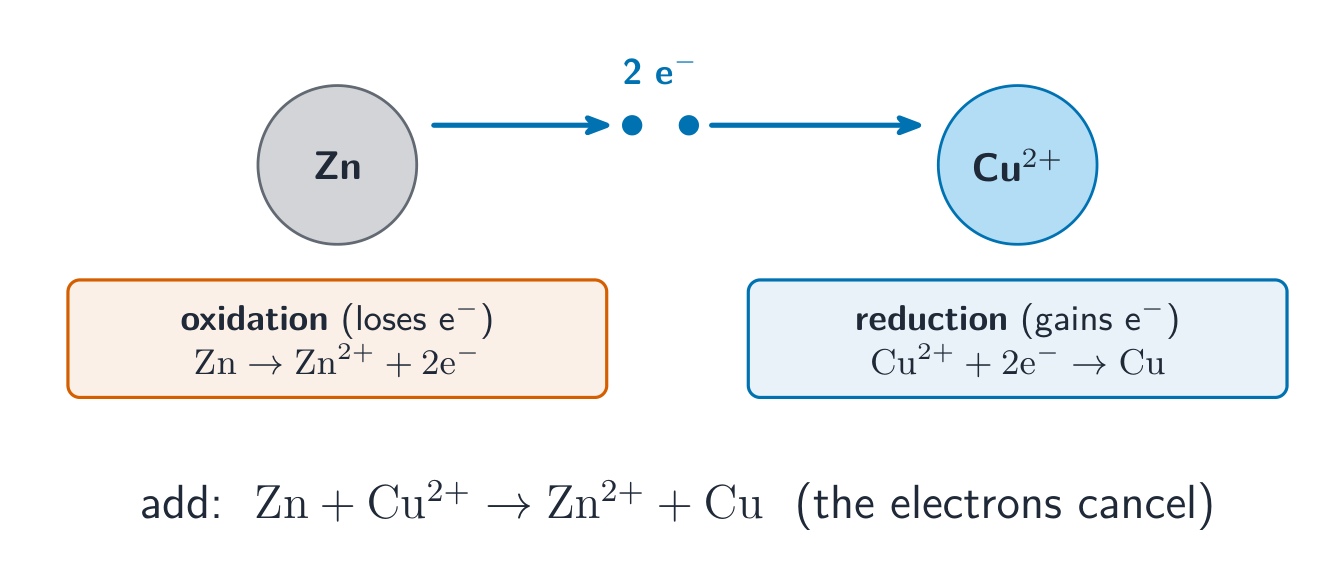
- A half equation 半反应式 shows one side of the transfer, with electrons as e⁻.
- Zinc: $\text{Zn} \rightarrow \text{Zn}^{2+} + 2e^-$ (oxidation). Copper: $\text{Cu}^{2+} + 2e^- \rightarrow \text{Cu}$ (reduction).
Which is the correct half equation for magnesium being oxidised?
难度 1/5 · 今日首次完成可获 100 金币及少量额外奖励
Electrons are lost, shown on the right.
In $\text{Fe} + \text{Cu}^{2+} \rightarrow \text{Fe}^{2+} + \text{Cu}$, which species is reduced?
难度 1/5 · 今日首次完成可获 100 金币及少量额外奖励
Copper ions gain electrons.
Worked example: aluminium and copper ions
Combine the half equations for aluminium displacing copper.
- Oxidation: $\text{Al} \rightarrow \text{Al}^{3+} + 3e^-$. Reduction: $\text{Cu}^{2+} + 2e^- \rightarrow \text{Cu}$.
- Match electrons (6): $2\text{Al} \rightarrow 2\text{Al}^{3+} + 6e^-$ and $3\text{Cu}^{2+} + 6e^- \rightarrow 3\text{Cu}$.
- Add and cancel: $2\text{Al} + 3\text{Cu}^{2+} \rightarrow 2\text{Al}^{3+} + 3\text{Cu}$.
Electrons lost equal electrons gained
2Al → 2Al³⁺ + 6e⁻ and 3Cu²⁺ + 6e⁻ → 3Cu: six electrons lost and six gained. Adding them and cancelling the electrons gives 2Al + 3Cu²⁺ → 2Al³⁺ + 3Cu.
How many electrons are transferred in $2\text{Al} + 3\text{Cu}^{2+} \rightarrow 2\text{Al}^{3+} + 3\text{Cu}$?
难度 2/5 · 今日首次完成可获 140 金币及少量额外奖励
$2 \times 3 = 3 \times 2 = 6$.
Check: charge balances
- Left: $3 \times (+2) = +6$. Right: $2 \times (+3) = +6$.
- An ionic equation must balance atoms and charge.
What is the total charge on the left of $\text{Mg} + 2\text{Ag}^+ \rightarrow \text{Mg}^{2+} + 2\text{Ag}$?
难度 2/5 · 今日首次完成可获 140 金币及少量额外奖励
Two Ag⁺ give +2, matching Mg²⁺.
Electrons go on the right in oxidation, on the left in reduction. Writing $\text{Zn} + 2e^- \rightarrow \text{Zn}^{2+}$ is wrong: adding negative electrons cannot make a positive ion.
$\text{Zn} + 2e^- \rightarrow \text{Zn}^{2+}$ is a correct half equation.
难度 1/5 · 今日首次完成可获 100 金币及少量额外奖励
Electrons go on the right for oxidation.
Oxidation is loss of electrons and reduction is gain of electrons. In displacement, the more reactive metal is oxidised and the less reactive metal's ions are reduced. Match the electrons in the two half equations, add, and cancel them.
Write the two half equations and the overall ionic equation for magnesium reacting with silver ions (Ag⁺). State which is oxidised.
Match electrons.