| English | 释义 | 拼音 |
|---|---|---|
| distillation/dɪstɪˈleɪʃn/ | 蒸馏 | zhēng liú |
| condenser | 冷凝管 | lěng níng guǎn |
| distillate/ˈdɪstɪleɪt/ | 馏出液 | liú chū yè |
| miscible | 可混溶的 | kě hùn róng de |
| fractionating column/ˈfrækʃənətɪŋ ˈkɒlʌm/ | 分馏柱 | fēn liú zhù |
| chromatography/krəʊməˈtɒɡrəfi/ | 色谱法 | sè pǔ fǎ |
Drinking water from the sea
- Saudi Arabia gets much of its drinking water from desalination plants, some of which boil seawater and condense the steam.
- The salt stays behind and pure water is collected. This is distillation 蒸馏 on an industrial scale.
- The method you choose depends on what you want to collect.
Simple distillation
- Heat a solution so the solvent boils. The vapour passes into a cooled condenser and turns back into liquid: the distillate 馏出液.
- The dissolved solid, with a much higher boiling point, stays in the flask. Use it to get pure water from salt water.
Fractional distillation
- Separates miscible liquids (liquids that mix) with different boiling points, such as ethanol (78 °C) and water (100 °C).
- A fractionating column above the flask lets vapour condense and boil again many times. The liquid with the lower boiling point reaches the top first.
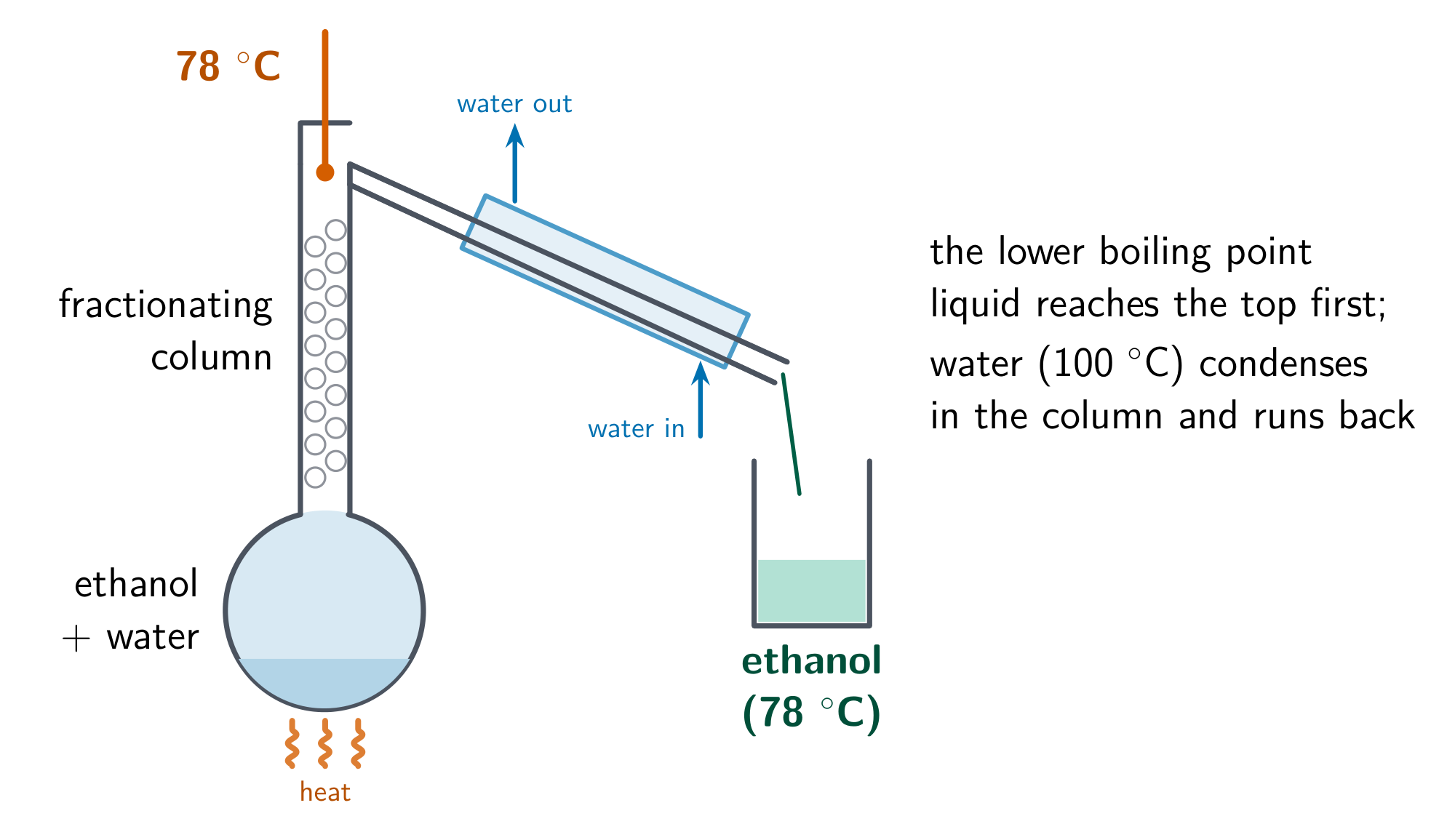
In fractional distillation, the liquid with the higher boiling point reaches the top of the column first.
难度 1/5 · 今日首次完成可获 100 金币及少量额外奖励
The lower-boiling liquid reaches the top first.
Paper chromatography
- Chromatography 色谱法 separates dissolved substances, such as the dyes in an ink.
- Draw a start line in pencil (ink would run), put a spot of the sample on it, and stand the paper in solvent below the line.
- Each dye travels a different distance, depending on how much it dissolves in the solvent compared with how strongly it sticks to the paper.
Match each task to the best method.
难度 2/5 · 今日首次完成可获 140 金币及少量额外奖励
Choose by what you want to collect.
Why is the start line drawn in pencil?
难度 1/5 · 今日首次完成可获 100 金币及少量额外奖励
Ink would separate and spoil the result.
Worked example: Rf value
A dye travels 30 mm from the start line while the solvent front travels 50 mm.
- $R_f = \dfrac{\text{distance moved by substance}}{\text{distance moved by solvent}} = \dfrac{30}{50} = 0.60$.
- Rf has no units, and is always less than 1.
- If an unknown dye has the same Rf as a known dye in the same solvent, it is probably the same substance.
Rf from two distances
Measure both distances from the pencil origin: a dye travelling 30 mm while the solvent front travels 50 mm has Rf = 30 ÷ 50 = 0.60. Rf is always less than 1.
A spot moves 24 mm and the solvent front 80 mm. What is the Rf value?
难度 2/5 · 今日首次完成可获 140 金币及少量额外奖励
$\dfrac{24}{80} = 0.30$.
A dye has Rf 0.45. The solvent front is 60 mm from the start line. How far did the dye travel?
难度 2/5 · 今日首次完成可获 140 金币及少量额外奖励
$0.45 \times 60 = 27$ mm.
An Rf value of 1.2 is possible.
难度 1/5 · 今日首次完成可获 100 金币及少量额外奖励
A substance cannot travel further than the solvent.
Simple distillation cannot separate two liquids with close boiling points. Both would boil and condense together. Use fractional distillation, where the column gives many cycles of boiling and condensing.
Simple distillation collects a solvent from a solution; fractional distillation separates miscible liquids by boiling point; chromatography separates dissolved substances by how far they travel. Rf = distance moved by substance ÷ distance moved by solvent.
Explain how simple distillation produces pure water from salt water.
Boil, then condense.