A parameter can hide the field it should update
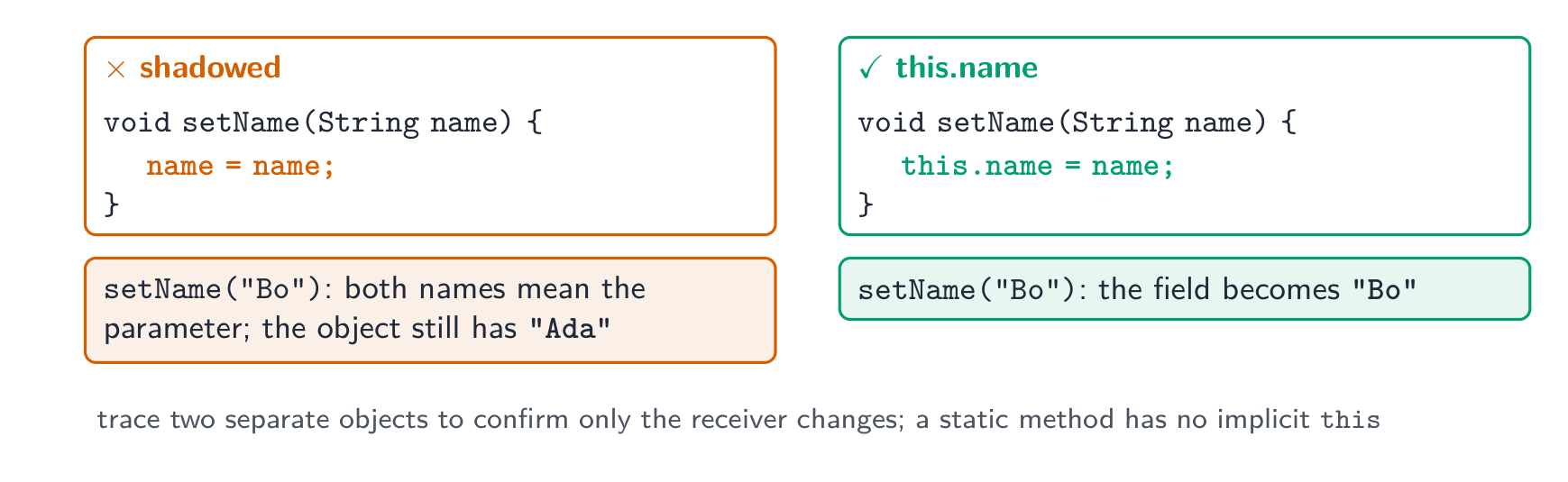
- An object has name "Ada". setName(String name) runs name = name; with the argument "Bo".
- Both unqualified names refer to the parameter, so the object still has "Ada". this.name = name assigns the parameter value to the field instead.
"This object"
- Inside an instance method,
thisrefers to the object the method was called on.student.addScore(10)runs withthis= thatstudent. this.scoremeans "thescoreof the object I'm working on." It lets a method talk about its own object explicitly.
Distinguishing field from parameter
- The main use: tell an instance variable apart from a parameter of the same name.
void setName(String name) { this.name = name; } this.nameis the instance variable; plainnameis the parameter. This is the standard fix for the shadowing bug from 3.8.
Access to the receiver object
thisgives a method a handle on the exact object it was called on. Every instance method has an implicitthis, whether you write it or not.- When score names an unshadowed instance field,
score += s;usesthis.score. If a parameter or local named score shadows it, the unqualified name instead refers to that variable. You writethisexplicitly only when needed (like resolving shadowing).
this 指代接收者对象
在 setName 内部,this 是它被调用时所在的 ada 对象。
在实例方法内部,this 指的是……
难度 1/5 · 今日首次完成可获 100 金币及少量额外奖励
this 是当前对象的一个句柄。
在 setName(String name) { this.name = name; } 中,this.name 是……
难度 1/5 · 今日首次完成可获 100 金币及少量额外奖励
this.name 是字段;单独的 name 是参数。
this 关键字可以在静态方法内部使用。
难度 1/5 · 今日首次完成可获 100 金币及少量额外奖励
静态方法没有特定对象,所以没有 this。
在 setName(String name) 里写 name = name;(没有 this)会怎样?
难度 1/5 · 今日首次完成可获 100 金币及少量额外奖励
两个名字都是参数;用 this.name 触及字段。
每个实例方法都有一个隐式的 this,无论你写不写。
难度 1/5 · 今日首次完成可获 100 金币及少量额外奖励
实例方法有一个当前的接收者。未限定词 score 仅在没有参数或局部变量遮蔽该字段时等同于 this.score。
No this in a static method
- A static method has no
this— it isn't tied to any particular object. So a static method cannot usethisor an unqualified instance field, but may read an instance field through an explicit reference when access permission allows it. - Trying to use
thisin a static method is a compile error. If you needthis, the method must be an instance method, not static.
Use this.field = param; to defeat shadowing — this.name is the instance variable, plain name is the parameter. Writing name = name; (no this) just assigns the parameter to itself. And this doesn't exist in a static method — a static method has no particular object, so using this there won't compile.
Type the field value after the faulty setName("Bo") call on the described object.
难度 1/5 · 今日首次完成可获 100 金币及少量额外奖励
The parameter assigns to itself; the field is unchanged until this.name is used on the left.
如果 别名 和 a 引用同一个 学生 对象,alias.setName("Di") 会改变名称,随后通过 a 读取到的名称也会变化。
难度 1/5 · 今日首次完成可获 100 金币及少量额外奖励
两个引用都指向同一个接收者对象,其字段已被更新。
对象 b 中的代码调用了 a.setName("Cy")。在 setName 方法内部,this 指的是哪个对象?
难度 1/5 · 今日首次完成可获 100 金币及少量额外奖励
接收者 a 提供了 this,无论最初是由哪个其他对象的代码发起的调用。
Fixing the shadowing bug with this:
- Instance variable
private String name; void setName(String name) { this.name = name; }— correct!this.name(the field) gets the value ofname(the parameter).
Carry the reasoning to a new case
- Trace a and b as separately created students named Ada and Bo.
a.setName("Cy")changes a to Cy while b stays Bo. If alias=a,alias.setName("Di")changes that same first object, so a now reads Di. - The receiver is the object the instance method acts on, not necessarily the object whose code called it. A static method can operate on an explicit object reference, but has no implicit this.
this refers to the current object — the one an instance method was called on. Its key use is resolving shadowing: this.name = name; assigns the parameter to the instance variable. Every instance method has an implicit this, but a static method has none, so this can't be used there.