| English | 释义 | 拼音 |
|---|---|---|
| accessor/əkˈsesə/ | 访问方法 | fǎng wèn fāng fǎ |
| mutator/mjuːˈteɪtə/ | 修改方法 | xiū gǎi fāng fǎ |
A rejected update leaves the previous state intact
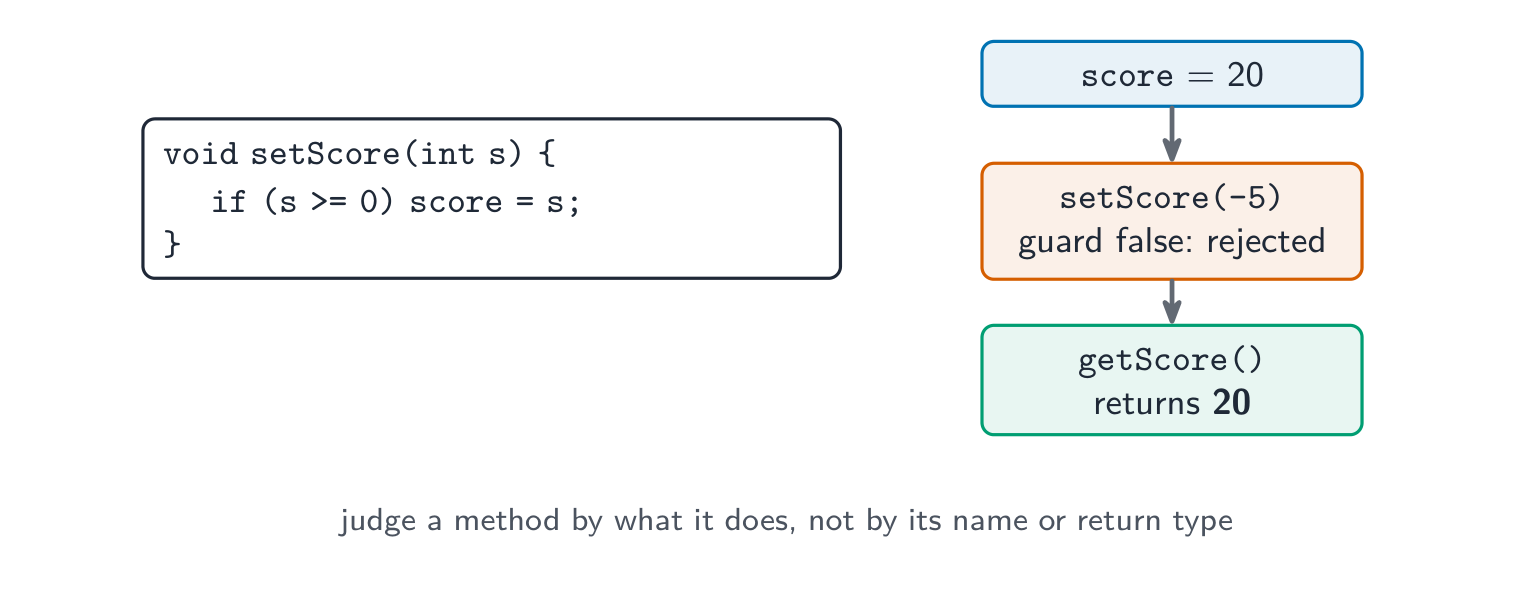
- A score starts at 20. setScore(s) assigns only when s >= 0; the call setScore(-5) leaves score at 20.
- The guard prevents an invalid update. A later getScore() returns the existing state rather than the rejected argument.
Writing a method
- A method has a header and a body. Header:
public void addScore(int s)— access, return type, name, parameters. - Body: the statements in
{ }that do the work. The method can read and change the object's instance variables.
Return values
- A method's return type says what it hands back; use
return value;to send it.public int getScore() { return score; }returns the current score. - A
voidmethod returns nothing — it just does its job (e.g. printing). The returned value must be assignment-compatible with the declared return type; for example, anintvalue can be widened and returned by adoublemethod.
方法 public double result() { return 3; } 可以编译,即使 3 是 int 字面量。
难度 1/5 · 今日首次完成可获 100 金币及少量额外奖励
Java 将 int 类型的结果隐式转换为 双 类型;返回值必须兼容,但不必使用完全相同的类型书写。
Accessors and mutators
- An accessor (getter) 访问方法 returns information without changing the object:
getScore(). A mutator (setter) 修改方法 changes the object's state:addScore(s)orsetName(n). - Getters are usually
int/String-returning; setters are usuallyvoid. Together they form the object's public interface over its private data.
访问方法返回一个值
从分数 20 开始,setScore(-5) 拒绝该更新;getScore 返回 20。
一个返回信息而不改变对象的方法是一个……
难度 1/5 · 今日首次完成可获 100 金币及少量额外奖励
访问方法读取并返回;修改方法改变状态。
一个 void 方法……
难度 1/5 · 今日首次完成可获 100 金币及少量额外奖励
void = 无返回值;它只是执行一个动作。
A non-void method may reach its closing brace and complete normally without returning a value.
难度 1/5 · 今日首次完成可获 100 金币及少量额外奖励
A path completing normally must return a compatible value. A path that throws an exception is a different case.
哪个方法可以在改变状态前验证它的输入?
难度 1/5 · 今日首次完成可获 100 金币及少量额外奖励
setter 可以在赋值前检查(如拒绝负数)。
在 void 方法里写 return value; 能正常编译。
难度 1/5 · 今日首次完成可获 100 金币及少量额外奖励
void 方法不能返回值——那无法编译。
Methods can validate
- Because outside code goes through methods, a method can check before it acts.
public void setScore(int s) { if (s >= 0) score = s; }rejects a negative score. - Private access prevents unrelated code from directly assigning the field. Constructors and every class method that writes it must still preserve the intended rule; the guarded setter cannot repair an invalid initial score by itself.
A non-void method must return a compatible value on every path that completes normally. A path may instead throw an exception. If an int method reaches its end without returning, compilation fails. A void method returns nothing, so return; (or no return) is correct there; writing return value; in a void method won't compile.
For the stated guarded setter, what does getScore() return after setScore(-5)?
难度 2/5 · 今日首次完成可获 140 金币及少量额外奖励
The condition fails, so no assignment occurs and the old score remains 20.
从分数 20 开始,replaceScore(30) 保存旧分数,赋值 30,然后返回旧分数。该调用返回什么值?
难度 2/5 · 今日首次完成可获 140 金币及少量额外奖励
返回的旧分数为 20;新存储的分数为 30。返回值不会阻止状态变更。
An accessor and a mutator:
- Accessor:
public int getScore() { return score; }— reads, returnsint. - Mutator:
public void addScore(int s) { score += s; }— changes state, returns nothing. student.addScore(10); int now = student.getScore();
Carry the reasoning to a new case
- Consider
public int replaceScore(int s) { int old = score; score = s; return old; }. It is a mutator even though it returns a value: starting at 20, replaceScore(30) returns 20 and leaves the score at 30. - Judge behavior rather than names or return types. A method called getScore that increments the score is not a pure accessor, and a void method that merely prints a message need not mutate the object.
A method has a header (access, return type, name, parameters) and a body. A non-void method must return an assignment-compatible value on every normally completing path; a void method returns nothing. Accessors (getters) return state without changing it; mutators (setters) change state and can validate the new value.