| English | 释义 | 拼音 |
|---|---|---|
| Mean Value Theorem/miːn ˈvæljuː ˈθɪərəm/ | 中值定理 | zhōng zhí dìng lǐ |
| average rate of change/ˈævrɪdʒ reɪt ɒv tʃeɪndʒ/ | 平均变化率 | píng jūn biàn huà lǜ |
Somewhere, the instant matches the average
- You drive 120 km in 2 hours, so your average speed is 60 km/h. At some instant your speedometer must have read exactly 60.
- The Mean Value Theorem 中值定理 (MVT) says this in general: the average rate over an interval equals the instantaneous rate at some point inside.
The hypotheses come first
- $f$ must be continuous on $[a,b]$ and differentiable on $(a,b)$. Then there is at least one $c$ in $(a,b)$ with
- Left: the instantaneous rate at $c$. Right: the average rate of change 平均变化率 over $[a,b]$.
The MVT on $[a,b]$ requires which hypotheses?
难度 2/5 · 今日首次完成可获 140 金币及少量额外奖励
Continuous on the closed interval and differentiable on the open one. ($f(a)=f(b)$ is the extra Rolle condition.)
The MVT guarantees a $c$ where $f'(c)$ equals the...
难度 1/5 · 今日首次完成可获 100 金币及少量额外奖励
$f'(c)=\frac{f(b)-f(a)}{b-a}$, the average rate.
A tangent parallel to the secant
- The right side is the slope of the secant line joining the endpoints. So somewhere the tangent line is parallel to it.
- Like the IVT, it is an existence theorem: it says $c$ exists, not where. To find $c$, solve $f'(c)=$ average rate and keep only $c$ in $(a,b)$.
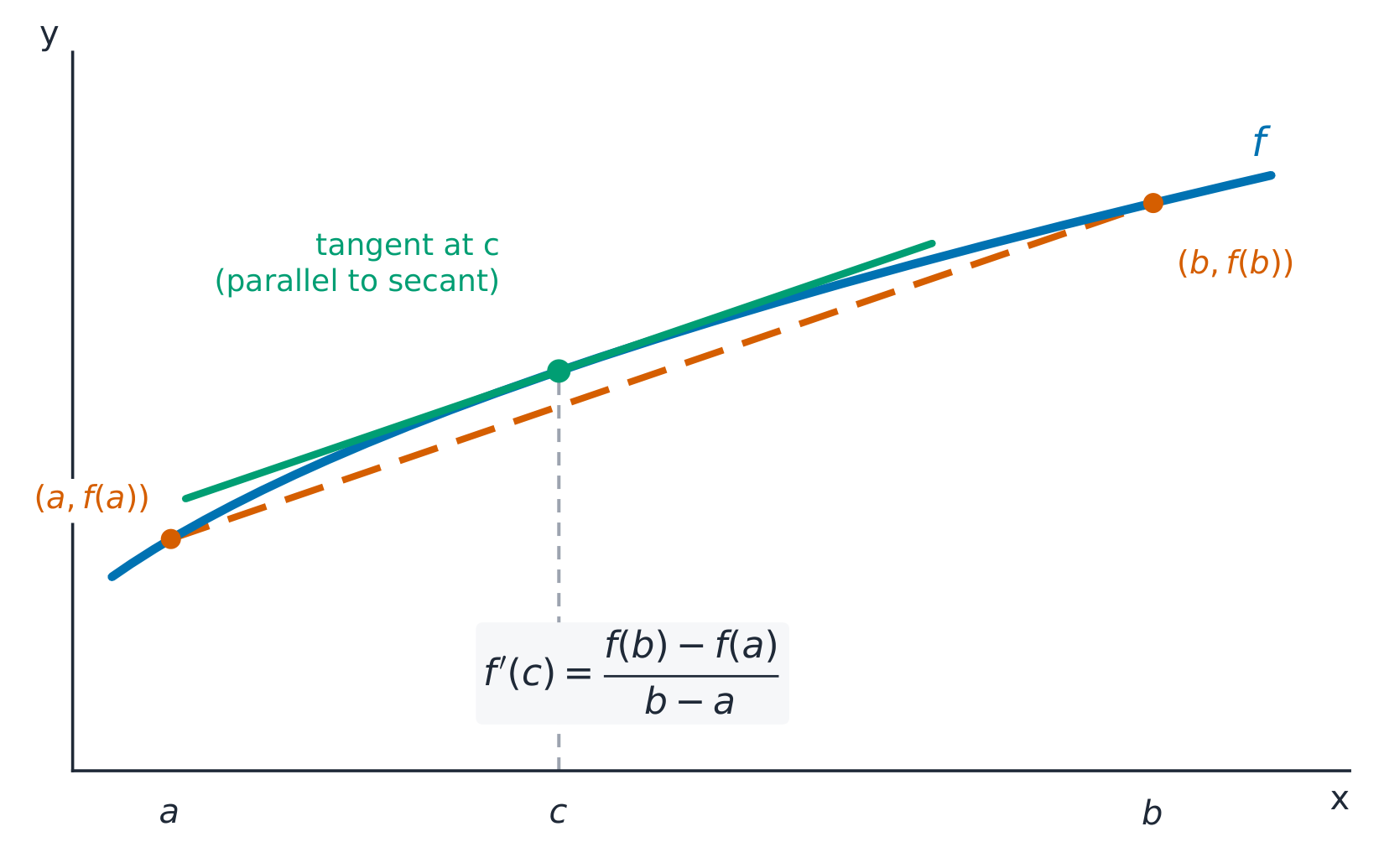
Tangent parallel to the secant
y = x²
Somewhere inside the interval the tangent slope matches the average (secant) slope — that point is the MVT's guaranteed $c$.
Geometrically, the MVT guarantees a tangent line parallel to the ____ line.
难度 1/5 · 今日首次完成可获 100 金币及少量额外奖励
The tangent at $c$ is parallel to the secant joining the endpoints.
Like the IVT, the MVT is what kind of theorem?
难度 1/5 · 今日首次完成可获 100 金币及少量额外奖励
It guarantees such a $c$ exists (though here you can often find it).
For $f(x)=x^2$ on $[1,3]$, find the $c$ guaranteed by the MVT.
- $f$ is a polynomial, so it is continuous and differentiable. Average rate $=\dfrac{9-1}{3-1}=4$.
- $f'(c)=2c=4$, so $c=2$, which is in $(1,3)$.
支持 $f(x)=x^2$ on $[2,6]$, find the $c$ guaranteed by the MVT.
难度 2/5 · 今日首次完成可获 140 金币及少量额外奖励
Average $=\frac{36-4}{4}=8$; $2c=8\Rightarrow c=4\in(2,6)$.
More than one $c$. $f(x)=x^3$ on $[-2,2]$.
- Average rate $=\dfrac{8-(-8)}{2-(-2)}=4$. Solve $3c^2=4$: $c=\pm\dfrac{2}{\sqrt3}\approx\pm1.155$.
- Both are in $(-2,2)$, so there are two points with a tangent parallel to the secant. The MVT promises at least one.
支持 $f(x)=x^3-x$ on $[0,2]$, find the value of $c$ guaranteed by the MVT. Give 3 decimal places.
难度 2/5 · 今日首次完成可获 140 金币及少量额外奖励
Average rate $=\dfrac{6-0}{2}=3$. $f'(c)=3c^2-1=3$ gives $c^2=\tfrac43$, $c=\tfrac{2}{\sqrt3}\approx1.155$. The negative root is outside $(0,2)$.
AP style: a table of values
- AP questions give a table and ask "must there be a time when...?" You can't solve for $c$, but you can cite the MVT.
- Write: the function is differentiable (so continuous), the average rate over the interval is ..., so by the MVT there is a time in that interval where the derivative equals it.
A car's velocity $v(t)$ is differentiable. $v(2)=10$ m/s and $v(6)=30$ m/s. Must the acceleration equal 5 m/s² at some time?
- $v$ is differentiable, so it is continuous on $[2,6]$ and differentiable on $(2,6)$.
- $\dfrac{v(6)-v(2)}{6-2}=\dfrac{20}{4}=5$. By the MVT, there is a $t$ in $(2,6)$ with $v'(t)=a(t)=5$ m/s². Yes.
A tank's volume $V(t)$ is differentiable. $V(0)=200$ L and $V(10)=150$ L. What does the MVT guarantee?
难度 1/5 · 今日首次完成可获 100 金币及少量额外奖励
Average rate $=\dfrac{150-200}{10}=-5$. The MVT gives at least one $t$ with $V'(t)=-5$. $V(t)=175$ is an IVT conclusion, not the MVT.
When the MVT does not apply
- $f(x)=|x|$ on $[-1,1]$: the average rate is $\dfrac{1-1}{2}=0$, but $f'$ is $-1$ or $+1$, never 0. The corner at $x=0$ breaks differentiability.
- If a hypothesis fails, the conclusion may fail. You cannot use the theorem as your reason.
If $f$ has a corner inside $(a,b)$, the MVT is still guaranteed to apply.
难度 1/5 · 今日首次完成可获 100 金币及少量额外奖励
A corner breaks differentiability, so the hypotheses fail and MVT may not apply.
- State the hypotheses before you use the MVT. On the AP exam the conclusion alone earns nothing.
- $c$ must be strictly inside $(a,b)$. Throw out solutions outside it.
- The MVT is about the derivative equalling the average rate. The IVT is about the function taking a value. Don't swap them.
The Mean Value Theorem: if $f$ is continuous on $[a,b]$ and differentiable on $(a,b)$, some $c\in(a,b)$ has $f'(c)=\frac{f(b)-f(a)}{b-a}$: a tangent parallel to the secant. Check the hypotheses, then solve for $c$, or cite the theorem when only a table is given.