跳到主要内容

Reading Comprehension

TOEFL Junior 小托福 · 知识点 4

本主题的视频课程 打开视频页面
5:04

TOEFL Junior · 阅读理解

阅读是标准考试的最后一个部分,五十分钟内完成四十二道题,连同阅读时间在内,每题约七十秒。文本从……

英文讲解 · 可切换中英文字幕

4.1

本主题涵盖的内容

English

Reading Comprehension is the last Standard section: 42 questions in 50 minutes, about 70 seconds per question including reading time. The texts move from everyday material (notices, e-mails, schedules, menus) to stories and then academic passages about science, history and nature.
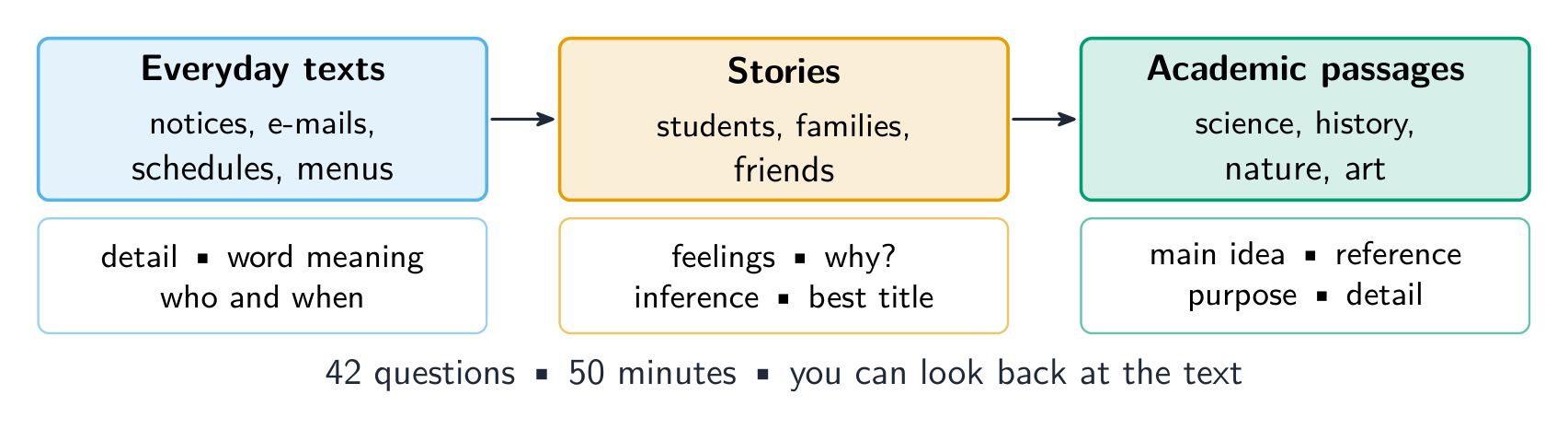
The Reading section from start to end: everyday texts such as notices, e-mails and schedules, then stories, then academic passages, with the main question types under each
Three kinds of text, and the questions each one likes
  • Every question has four options and one answer, and you can look back at the text as often as you like.
  • The question types repeat: main idea, detail, vocabulary in context, reference, inference 推断, purpose and NOT / EXCEPT.
  • Memory hook: question first, then the text. Know what you are looking for before you read closely.
词汇 训练
English 中文 拼音
inference/ˈɪnfərəns/ 推断 tuī duàn
4.2

日常文本:快速查找关键词

English

Read the question, pick its key word (a time, a name, a place, a price), then scan 扫读 the text for that word and read the lines around it.

  • In a schedule, read across the row and down the column, and check every footnote marked with *.
  • Everyday texts hold several people and times. A wrong option often takes a real detail and gives it to the wrong person or day.
  • Watch for limiting words: except, only, not, unless.

Example. "The book sale opens at 10 a.m. Teachers may enter at 9:30 to choose books early." When can students enter? → 10 a.m. The 9:30 time is for teachers.

Club Day Room
Chess Monday 12
Drama Wednesday Hall*
Robotics Friday Lab 2

* Drama meets in Room 12 when the hall is used for exams. Where does Drama meet in exam week? → Room 12, from the footnote.

词汇 训练
English 中文 拼音
scan/skæn/ 扫读 sǎo dú
4.3

学术文章:主旨和细节

English

The first paragraph usually introduces the topic; each later paragraph has one main point.

Three possible titles for a passage about how honeybees find, share and store food: How Bees Make Wax is too narrow, Insects of the World is too wide, and How Honeybees Find, Share and Store Food fits the whole passage
A main idea covers the whole passage: not one part, not more than the passage
  • Main idea 主旨 and best title: choose the option that covers every paragraph. One example is too narrow; All about animals is too wide.
  • Detail (According to the passage…): find the line, then match the meaning. Wrong options change a number, a cause or a result.
  • Purpose (Why does the author mention…?): decide whether it is an example (for example, such as), a comparison (like, unlike), a reason (because) or a result (so, as a result).
词汇 训练
English 中文 拼音
main idea 主旨 zhǔ zhǐ
4.4

词汇题和指代题

English

You do not need to know the word already. The sentences around it, the context 上下文, tell you.

Four context clues around a hard word: a definition (a nocturnal animal, one that is active at night), an example (predators such as lions), a contrast (timid, but his sister was brave) and a cause and effect (slippery, so many people fell)
Four kinds of clue; the sentence almost always explains the word
  • Cover the word, think of your own word, then choose the closest option. Test it in the sentence.
  • ⚠ The trap is often the word's most common meaning: the bank of a river is not a place for money.
  • Reference: it, they, this, these, which point back, usually to a noun in the same or previous sentence. Put the noun in place of the pronoun 代词: if the sentence still makes sense, you found it.

"Bees visit thousands of flowers a day. They carry pollen from one to the next." They = bees. Flowers do not carry pollen.

词汇 训练
English 中文 拼音
context/ˈkɒntekst/ 上下文 shàng xià wén
pronoun/ˈprəʊnaʊn/ 代词 dài cí
4.5

故事:感受、原因和推断

English

Stories show feelings through actions and words; they rarely name them.

  • She checked her bag for the third time and looked at the clock again → nervous. He pushed his lunch away and stared at the empty seat → sad or lonely.
  • Why…? answers sit a few lines before or after the action. Read both sides.
  • An inference must come from clues in the text, never from your own life.
  • NOT / EXCEPT: three options are true. Find each in the text and cross it out; the one left is the answer.
  • Best title for a story: the main event or problem, not one small scene.
4.6

规划你的 50 分钟

English
A time bar of 50 minutes: about 12 minutes for the everyday texts, 14 minutes for the stories, 20 minutes for the academic passages and 4 minutes to check and guess
Everyday texts are quick; give the saved minutes to the long passages
  • Vocabulary and reference questions take about 40 seconds. Main idea and inference take longer because they need the whole text.
  • If a question takes more than 90 seconds, choose your best answer, mark it and move on. Come back if time is left.
  • ⚠ Never leave a blank in the last minute. A guess may be right; a blank never is.
4.7

注意:中国考生的陷阱

English
  • ⚠ Translating every sentence. Full translation is slow and loses the main idea. Read the first and last sentence of each paragraph first, then read closely only where the question sends you.
  • ⚠ Answering from your own knowledge. If the passage says something you think is wrong, the passage still wins.
  • ⚠ Choosing the option with the same words. Correct options paraphrase the text; traps copy its words.
  • ⚠ Look-alike words. relied / replied, raise / rise, quiet / quite. Read each letter of the option.
4.8

尝试一下

English

Read the passage, then answer. Cover the answers first.

The Library Cat

For eight years, a cat named Pepper has lived in the public library of a small town in Scotland. She arrived one winter night, wet and hungry, and a librarian gave her a bowl of milk. The next morning, she was asleep on the history shelf. Nobody had the heart to send her away.

Today Pepper is the library's most famous member. Children come after school to read to her, and teachers say this helps shy readers, because a cat never laughs at a mistake. Pepper even has her own library card, which hangs on the front desk.

Not everyone was happy at first. Some visitors worried about allergies, so the library made one reading room cat-free. Since then, the number of visitors has almost doubled.

  1. What is the passage mainly about? A) How to care for a cat B) A cat that became an important part of a library C) Why libraries need more visitors D) Allergies to animals
  2. The phrase "nobody had the heart to" in paragraph 1 is closest in meaning to A) nobody was brave enough to B) nobody felt it was kind to C) nobody had time to D) nobody remembered to
  3. In paragraph 2, "which" refers to A) the library B) the front desk C) Pepper's library card D) a mistake
  4. Why do teachers think reading to Pepper helps shy readers? A) Pepper likes stories B) A cat does not laugh at mistakes C) The library is quiet D) Children get a card
  5. What did the library do about the allergy worries? A) Asked Pepper to leave B) Made one room free of the cat C) Closed for a week D) Sold library cards
  6. What can be inferred about Pepper's effect on the library? A) It lost many visitors B) It probably helped bring in more visitors C) It made the librarians unhappy D) It had no effect

Answers. 1 B: every paragraph is about Pepper's place in the library. A and D are too narrow or off-topic. 2 B: they could not send away a wet, hungry cat; it did not feel kind. 3 C: the card hangs on the desk. 4 B. 5 B. 6 B: visitors almost doubled after she became famous. The text does not say she was the only reason, so "probably" is right.

4.9

自我检测

English

Answer first, then read the explanation.

  1. What do you read first: the question or the text? — The question, then find its key word in the text.
  2. A title covers only paragraph 2. Is it the best title? — No. It is too narrow.
  3. How do you check a reference answer? — Replace the pronoun with the noun and read the sentence.
  4. The option uses the word's most common meaning. Careful? — Yes. Test the meaning in this sentence.
  5. In an EXCEPT question, which option do you choose? — The one that is not true in the text.

Vocabulary card meanings

inference: A conclusion you reach from clues in a text when it is not said directly. scan: To read quickly to find one particular word or fact. main idea: The most important point of a whole text. context: The words and sentences around a word that help to show its meaning. pronoun: A word such as it, they or this that stands for a noun.

该知识点的互动课程

逐步完成,配合即时检查练习。

更多 TOEFL Junior 小托福 知识点

登录或创建账户

IGCSE, A-Level & AP