The present simple tense is used to talk about things that happen regularly and facts that are always true: daily habits, schedules, scientific facts.
Structure: 主语 + 动词原形
我I 喝drink 咖啡coffee 每every 早上morning.
I drink coffee every morning.
我们We 住live 在in 上海Shanghai.
We live in Shanghai.
Scientific facts also use the present simple:
水Water 沸腾boils 在at 一one 百hundred 度degrees.
Water boils at one hundred degrees Celsius.
It is often used with adverbs of frequency: always, usually, often, sometimes, never.
她She 总是always 乘坐takes (冠词)the 公交车bus.
She always takes the bus.
Note
- When talking about current habits, do not add a be verb: ~~I am drink coffee~~ ✗ → I drink coffee ✓.
- Adverbs of frequency usually go before the main verb, but after the be verb: She is often late.
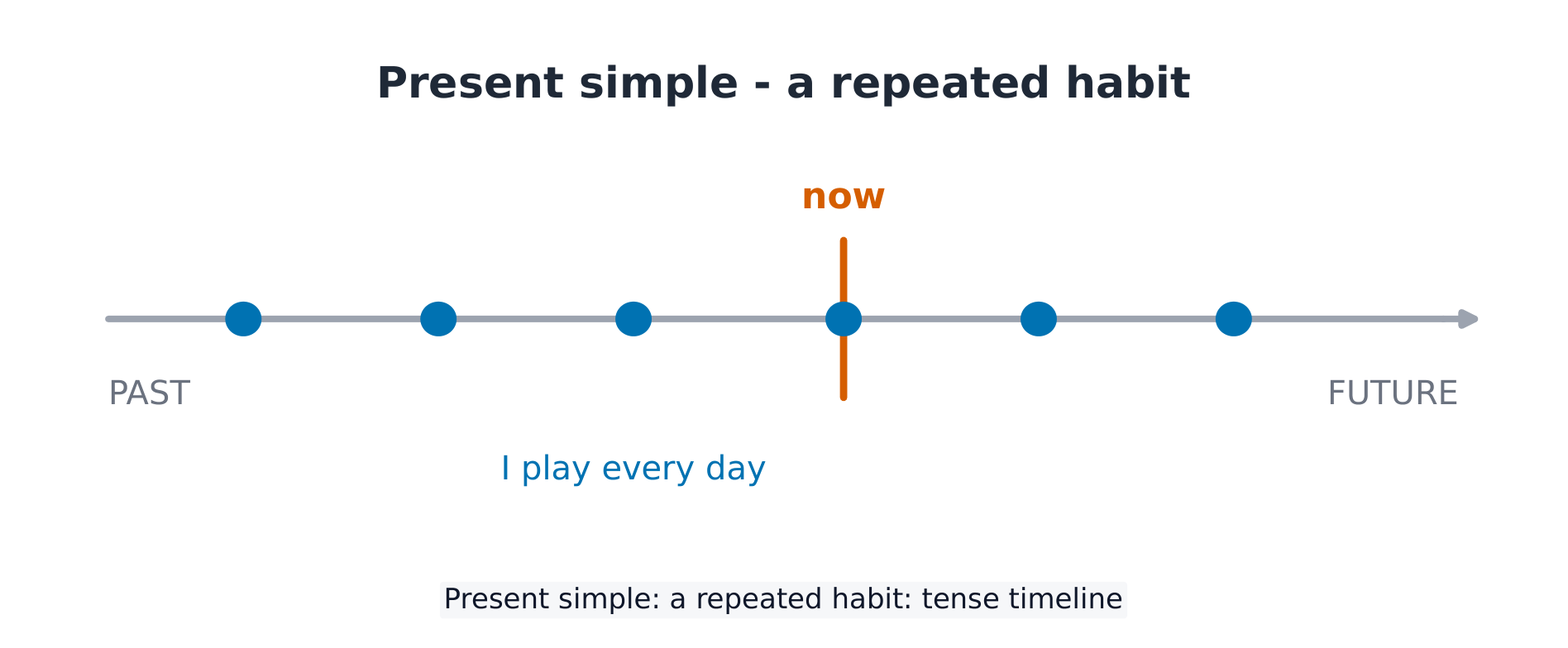
一般现在时 (present simple) 用来谈论经常发生的事和一直为真的事实:每天的习惯、时间表、科学常识。
结构: 主语 + 动词原形
我I 喝drink 咖啡coffee 每every 早上morning.
我每天早上喝咖啡。
我们We 住live 在in 上海Shanghai.
我们住在上海。
科学事实也用一般现在时:
水Water 沸腾boils 在at 一one 百hundred 度degrees.
水在一百度时沸腾。
常和频率副词 (adverbs of frequency) 一起用:always(总是)、usually(通常)、often(经常)、sometimes(有时)、never(从不)。
她She 总是always 乘坐takes (冠词)the 公交车bus.
她总是乘公交车。
注意
- 谈论现在的习惯,不要加 be 动词:~~I am drink coffee~~ ✗ → I drink coffee ✓。
- 频率副词通常放在主要动词前,但放在 be 动词后:She is often late.(她经常迟到。)