This handout teaches C.2 Motor learning for the course first assessed in 2026: what skills and abilities are and how skills are classified, how performers process information and react, how movements are controlled, how people learn skills in stages, how ecological dynamics explains adaptation, how attention is controlled, and how practice, feedback and guidance should be organised. It is written for both SL and HL students.
Prerequisites: unit A.1 (the nervous system, neurons and reaction time) and unit B.1 (muscles and movement).
8.2
技能与能力
English
Half a second to return a serve
Consider a serve travelling 30 m at a constant 220 km/h: speed = 220/3.6 = 61.11… m/s and flight time = 30/61.11… = 0.491 s. Real flight speed changes and the route differs between serves. If a receiver's supplied reaction and movement times total 0.65 s, waiting until this model ball is struck leaves insufficient time for that whole response. Reading early cues may help, but an incorrect anticipation can send the player the wrong way. The useful question is how a performer learns to detect relevant information and coordinate a suitable movement.
A 135 mph serve gives the receiver about half a second to detect, decide and moveThe return-of-serve time budget
Skill and ability
A motor skill 运动技能 is a learned ability to bring about a planned result with maximum certainty and the least time and energy. Skilled movement is consistent, efficient, controlled and fits the goal, and it is learned through practice.
Abilities support skills
An ability 能力 is a relatively enduring capacity that supports skill, such as balance, coordination, reaction time or strength. Biological development, inherited influences and experience contribute to abilities; strength and flexibility can also be trained. Abilities are not fixed ceilings or sufficient predictions of future performance. Skills are built through suitable experience. A gymnast needs the abilities of balance, flexibility and strength to learn the skill of a handstand.
Ability type
Examples
Perceptual–motor abilities
Reaction time, coordination, manual dexterity, aiming
Physical proficiency abilities
Strength, flexibility, stamina, balance, speed
Expertise in sport needs a large amount of high-quality practice. Deliberate practice 刻意练习 is structured, effortful practice directed at improvement with useful feedback. It is one contributor to expertise alongside opportunity, prior experience, health and individual characteristics. Neither practice hours nor one practice label guarantees expertise.
Classifying skills
Skills are placed on continua (scales between two extremes), because few skills are purely one type.
Archery is a closed skill: a stable setting, and the archer chooses when to beginSkills sit along continua, not in boxes: classify the version of the task you are describing
Continuum
One end
Other end
Muscular movement
Gross: large muscle groups, such as a shot put
Fine: small muscle groups, precise, such as a dart throw
Environment
Closed: stable, predictable environment, such as a gymnastics vault
Open: changing, unpredictable environment, such as a football pass in a match
Continuity
Discrete: clear beginning and end, such as a penalty kick
Continuous: no clear beginning or end, such as cycling; serial skills link discrete skills, such as a triple jump
Pacing
Self-paced: the performer decides when to start, such as a golf drive
Externally paced: the environment decides, such as receiving a serve
The classification guides practice: repetition can help establish a movement, while varied, representative situations are needed to test adaptation. Even a free throw involves time limits and distraction; classify the specified version of the task rather than assuming a sport has one fixed label.
A simple model of information processingA goalkeeper's dive: the whole chain from seeing the shot to moving must happen in well under a second
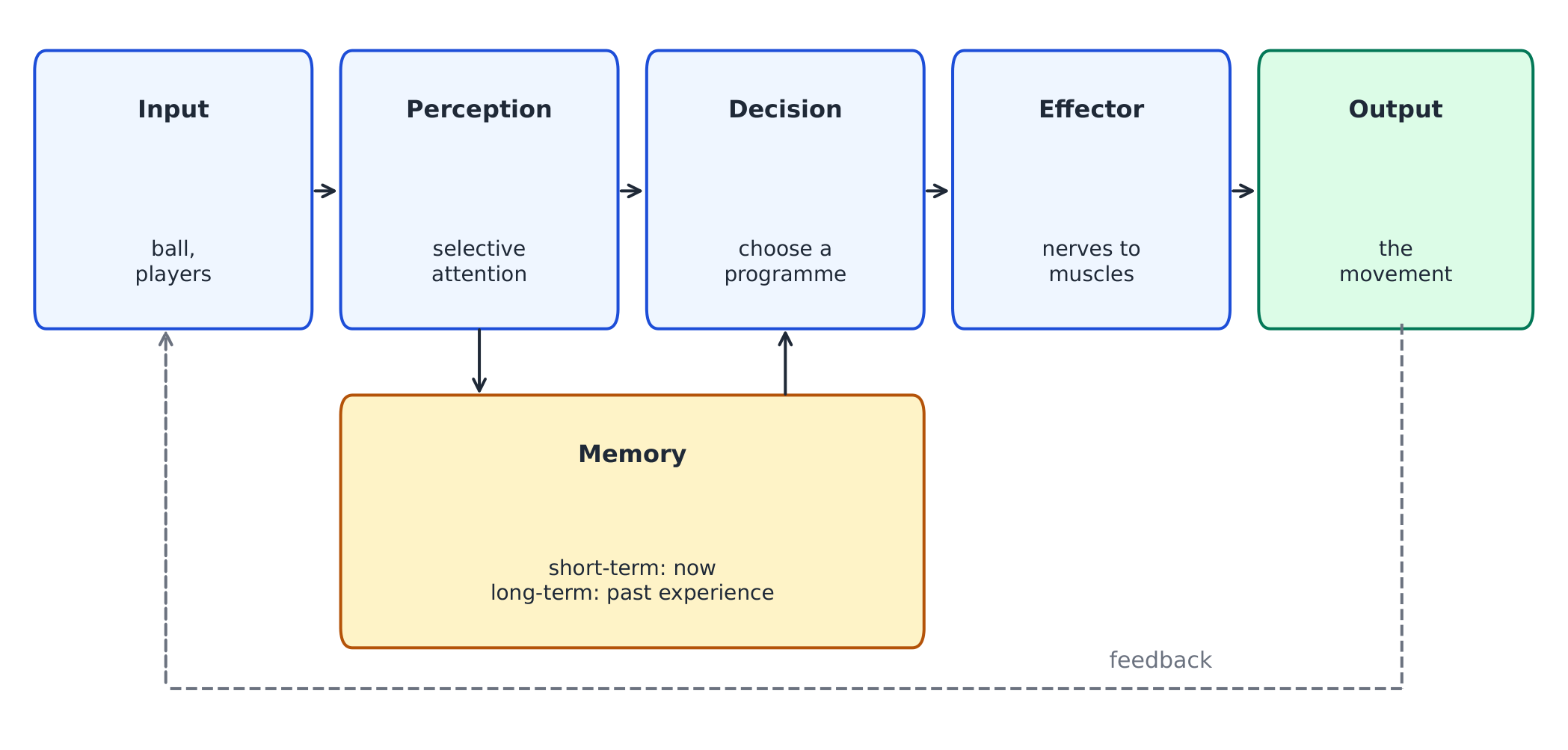
The information-processing model represents movement through linked stages. It is an explanatory model, not a literal claim that a performer is a computer:
Input. Information from the display (the ball, opponents, team-mates, the crowd) and from the body (proprioceptors) enters through the senses.
Perception. The brain interprets the information. Selective attention 选择性注意 filters out irrelevant information (the crowd) and focuses on relevant cues (the ball and the opponent's racket). This makes processing faster, because the brain can deal with only a little information at a time.
Memory.Short-term memory 短时记忆 holds the information being used now: capacity and duration depend on the task, rehearsal, chunking and interference. The historical 7 ± 2 estimate is not a universal limit on instructions or sporting cues; give a manageable number of meaningful cues and check understanding. Long-term memory 长时记忆 holds learned motor programmes and past experiences, over much longer periods; its contents are not always recalled accurately or promptly. The current situation is compared with past experience.
Decision. A response is chosen, and the matching motor programme 运动程序 is selected.
Output. Impulses travel along motor nerves (the effector mechanism) to the muscles, producing the movement.
Feedback. Information about the result returns to the start, so the next action can be adjusted.
Reaction time
Term
Meaning
Reaction time 反应时
Time from the start of a stimulus to the start of the response: the gun to the first movement
Movement time
Time from the start to the end of the movement
Response time
Reaction time + movement time
Simple reaction time is one stimulus with one possible response, such as a sprint start: about 0.15 to 0.2 s. Choice reaction time involves several stimuli, each with its own response, such as a goalkeeper deciding which way to dive.
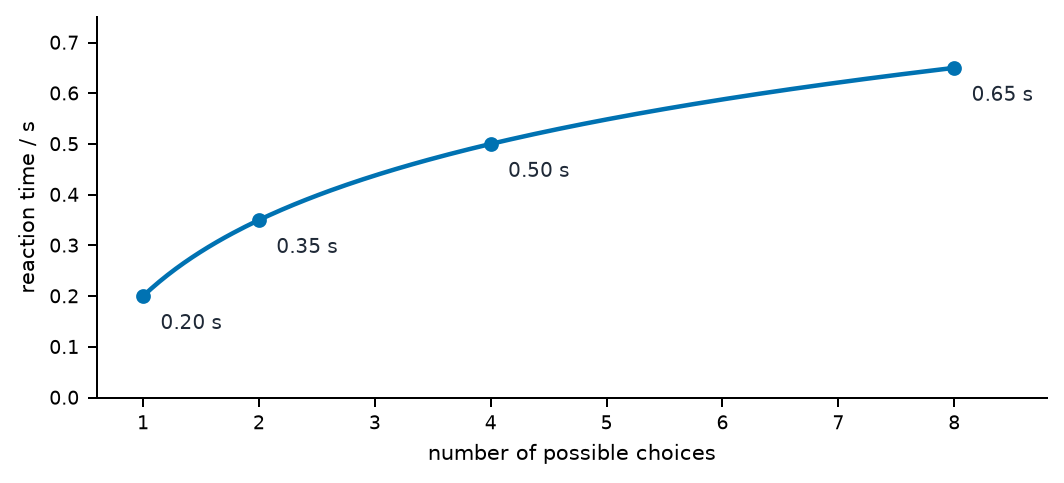
A Hick-type model: 0.20 + 0.15 log₂(N) seconds for N equally likely choices; coefficients are supplied, not universal athlete constants
Hick's law 希克定律 states that choice reaction time increases in a straight line with the logarithm of the number of choices. Each doubling of the number of choices adds about the same amount of time. Players use this: a tennis player who can serve to many places, with disguise, makes the receiver slower.
Reaction time is affected by age, sex, fatigue, arousal, the strength of the stimulus, practice, and anticipation 预判. Anticipation means predicting what will happen (where the ball will go: spatial) and when (temporal), so that processing starts early. Experts anticipate better because they pick up early cues from their opponent's body.
The psychological refractory period 心理不应期 is the delay when a second stimulus arrives before the first has been processed. A response-selection bottleneck is one explanation (the single-channel hypothesis); it does not mean all sensory information is processed one item at a time. The delay depends on tasks, timing and practice. A dummy or feint may engage a defender in selecting or initiating one response before the real action requires another; successful deception is not guaranteed.
Worked example. In a simplified football penalty, the ball travels 11 m at a constant 25 m/s. The following reaction and movement times are supplied assumptions.
Time for the ball to reach the goal = 11 ÷ 25 = 0.44 s.
The goalkeeper has two main choices (left or right). With Hick's law above, reaction time ≈ 0.35 s. A full dive to the corner takes about 0.45 s of movement time.
Response time = 0.35 + 0.45 = 0.80 s, which is longer than 0.44 s.
For this assumed flight and full-dive response, reacting only after the kick is too slow. Anticipation from relevant pre-kick cues could help, but an incorrect prediction can be costly.
The whole movement is planned in advance as a motor programme and runs without using feedback during it
Feedback during the movement is compared with the intended movement, and errors are corrected
Fast, well-learned, discrete skills: a golf swing, a tennis serve, a punch
Slower or continuous skills: balancing on a beam, steering a bicycle, dribbling
Too fast for feedback to change the action once started
Requires time for feedback to be used
Open-loop and closed-loop control
Most sports skills combine both: the main movement runs as a programme, while slower parts are adjusted.
Schema theory
How can a basketball player shoot accurately from a place on the court where they have never shot before? Schema theory 图式理论 (Schmidt) says that people do not store a separate programme for every movement. Instead, from many practice attempts they build general rules, called schemas, linking:
Schmidt's schema theory: general rules from many attempts let a performer scale a movement to a new situation
the initial conditions (where am I? where is the target?);
the response specifications (how much force, which direction?);
the sensory consequences (what did it feel and look like?);
the outcome (did it go in?).
A recall schema links conditions and the desired outcome to response specifications; a recognition schema supplies expected sensory consequences for evaluating the action and subsequent attempts. A very rapid movement can end before feedback changes it. A generalized motor pattern describes an underlying organisation, such as an overarm throw; subordinate patterns or task-specific versions adapt it to a particular implement, distance or context. Parameter changes include force and overall duration, rather than storing an unrelated programme for every attempt.
Schema theory predicts that varied practice can support adaptation to unpractised conditions. Treat this as a testable prediction: retained accuracy at new distances matters more than simply counting the variations offered.
Feedback
Feedback 反馈 is information about a movement and its result.
Faded and bandwidth schedules give less feedback over time, so learners build their own error detection
Type
Meaning
Example
Intrinsic feedback 内在反馈
From the performer's own senses, especially proprioception
Feeling a clean strike on the ball
Extrinsic (augmented) feedback 附加反馈
From an outside source: coach, video, scoreboard
The coach says, "Your elbow dropped"
Knowledge of results 结果反馈 (KR)
About the outcome
"The shot was 30 cm short"
Knowledge of performance 表现反馈 (KP)
About the quality of the movement
"Your arm was not straight at release"
Concurrent or terminal
During or after the movement
A rowing coach calling out stroke rate (concurrent); video after a jump (terminal)
Positive or negative
What was done well, or what was wrong
"Great follow-through"; "you leaned back"
Match feedback to the actual learner and task. Beginners often benefit from concise demonstrations and clear outcome information plus one actionable movement cue. Experts may use detailed video as well as intrinsic feedback. Positive should not mean inaccurate praise; useful correction describes an action without judging the learner as a person.
Too much feedback can harm learning. When feedback is given after every attempt, learners may depend on it and perform worse when it is removed (the guidance hypothesis). Faded feedback (given often at first, then less often) and bandwidth feedback (given only when the error is larger than an agreed amount) help learners develop their own error detection.
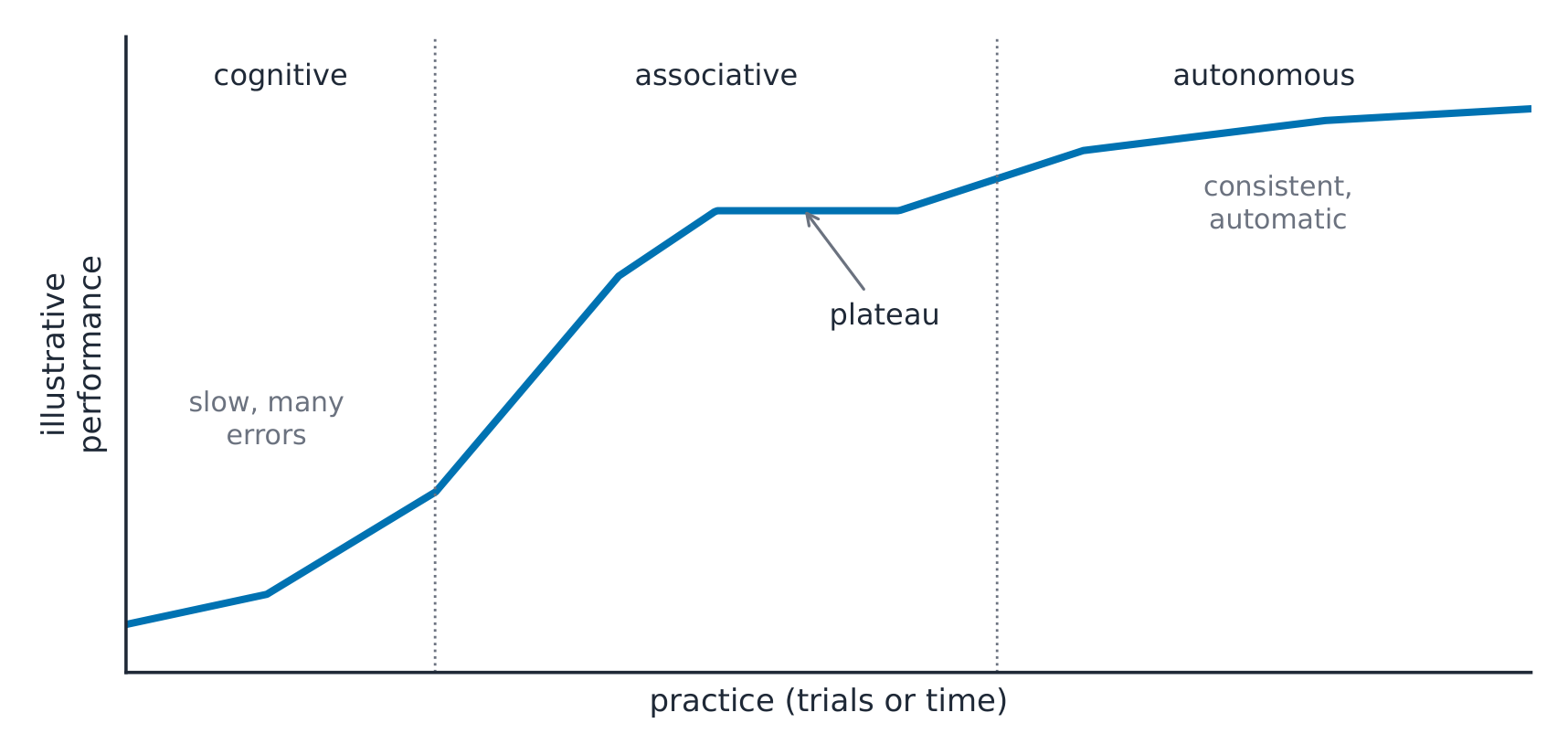
A schematic performance curve with a plateau; stage boundaries are not measured dates or inevitable score thresholds
Fitts and Posner described three stages of learning 学习阶段:
Stage
Learner
Coach should
Cognitive stage 认知阶段
Works out what to do; slow, jerky, many errors; needs to think about every part
Give demonstrations, simple instructions, guidance, and positive feedback
Associative stage 联结阶段
Practises and refines; fewer, smaller errors; begins to use intrinsic feedback
Give detailed feedback (KP), increase practice difficulty
Autonomous stage 自动化阶段
Movement is automatic, consistent and efficient; attention is free for tactics
Give occasional detailed feedback; use pressure and decision-making practice
Not every learner reaches the autonomous stage, and an expert can drop back to an earlier stage when changing their technique.
Learning curves and plateaus
A learning curve plots performance against practice. A plateau 平台期 is a period when performance stops improving despite practice. Causes include loss of motivation or boredom, fatigue, an insensitive outcome measure, inappropriate practice, and an increase in task difficulty. A plateau does not establish a permanent biological limit. Different explanations require different evidence. A coach can set new goals, vary practice, give rest and break the skill into new targets.
Learning or performance?
Performance is what is seen on one occasion; it can be affected by fatigue, motivation, prompts and luck. Learning 学习 is a relatively permanent change in the ability to perform, produced by practice. To measure learning rather than temporary performance, use:
a retention test 保持测验: the skill is tested after a delay (a day or a week) without feedback or prompts;
a transfer test 迁移测验: the skill is tested in a new situation, such as a different distance or under pressure.
Information processing and schema theory emphasise representations, selection and stored rules. Ecological dynamics instead examines the continuously changing relationship between a performer and the environment. An affordance is an opportunity for action relative to the performer's capabilities: a gap may be passable for one player but not another. Detecting a gap and moving into it are coupled; movement also changes the information available.
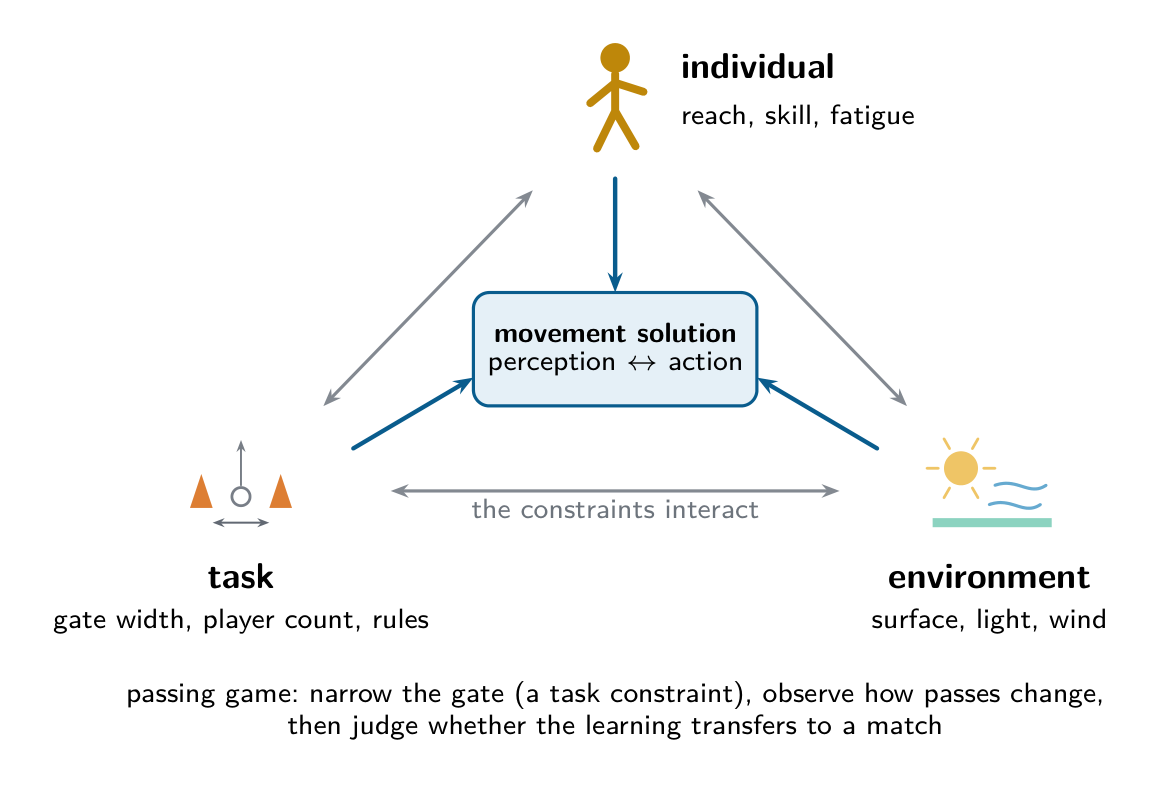
Affordances emerge from performer, task and environment
Perception–action coupling means that perception guides action while action alters what can be perceived. In a small-sided game a defender's movement changes a passing lane, and the ball carrier's movement changes that defender's options. A cone drill can train an action, but it may remove the live information needed to decide when that action is appropriate. Representative practice preserves the important information–movement relationship; it need not reproduce every detail of a match.
A moving body has many degrees of freedom: joints, muscles and timing relationships that could vary. Coordination organises these possibilities into a workable movement. A beginner may initially restrict joint motion; experience can permit more adaptable coordination. Self-organisation describes a movement pattern emerging from interactions among the performer, task and environment, rather than every joint angle being explicitly prescribed. It does not mean absence of coaching, goals, feedback or safety boundaries.
Three interacting constraints
Change a constraint, observe the response and evaluate whether learning transfers
Constraint
Practical example
What the coach can examine
Individual
Reach, strength, experience, fatigue or confidence
Whether a task offers achievable but meaningful options for this learner
Task
Court area, target size, player numbers, rules or equipment
Whether changing a rule invites a useful movement or merely rewards a shortcut
Environment
Surface, lighting, wind or nearby activity
Whether conditions change available information and safe action possibilities
For a low-risk supervised passing game, widening a target gate changes a task constraint; keeping a live defender preserves a perception–action demand. A coach might then narrow the gate as learners become more accurate. Changing gate width, defender numbers and equipment simultaneously makes it difficult to identify which change mattered. An equipment constraint can interact with individual reach: categories organise thinking rather than representing independent causes.
Non-linear pedagogy allows exploration of functional solutions under carefully designed constraints. A small change may produce little response until a learner discovers a new coordination pattern; progress need not be a straight line. Performance variability can reflect useful adaptation, random error or measurement noise. Judge whether variation achieves the goal across relevant conditions, not whether every attempt is mechanically identical. More variability is not always better, and unsafe solutions should not be encouraged.
A traditional linear pedagogy often uses a demonstration, an explicit movement template, sequenced practice and correction towards that template. It can give a novice clear structure. A constraints-led lesson changes meaningful opportunities and lets the learner discover suitable coordination. Real coaching can combine concise instructions, demonstration and exploration. To compare approaches fairly, define the skill, opportunity to practise and delayed/transfer outcomes.
8.7
注意控制
English
Choose the direction and width of focus
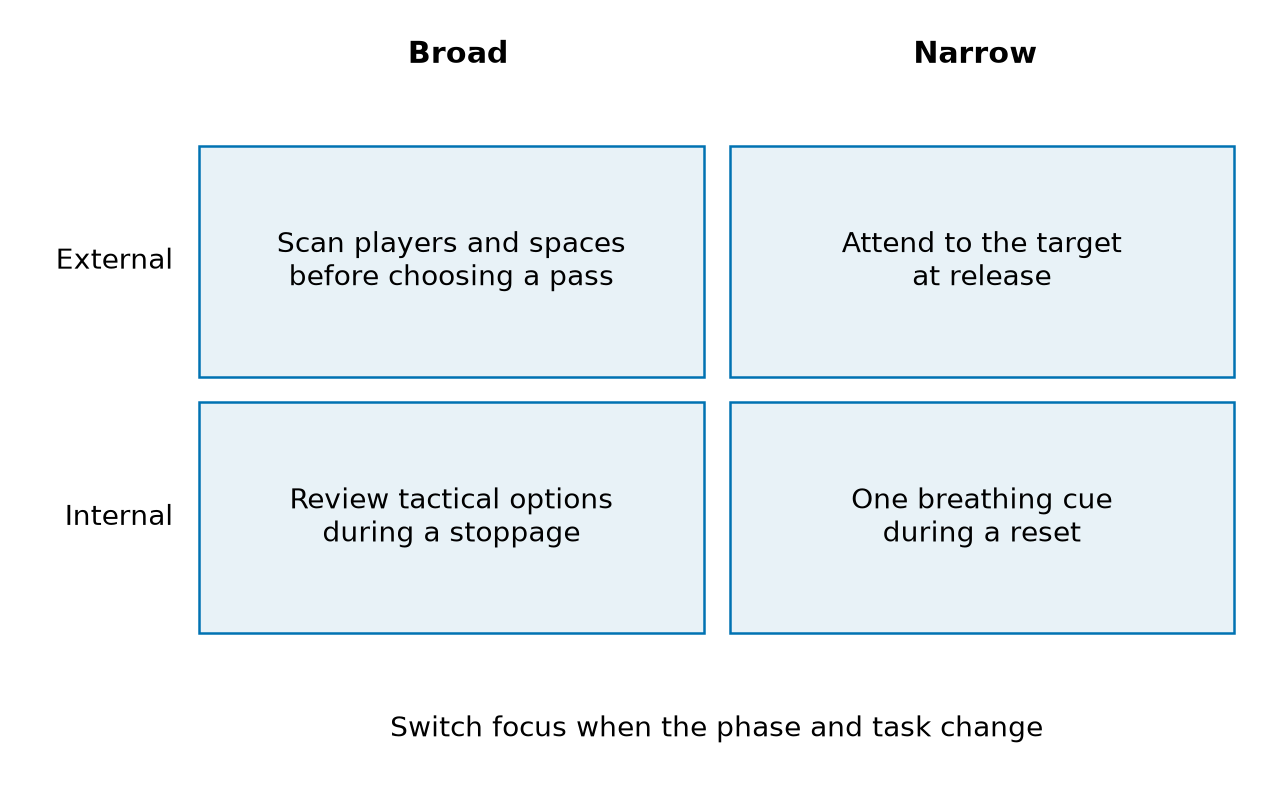
Attentional control concerns directing limited attention towards information relevant to the current action. Internal/external describes direction; broad/narrow describes width. These are separate dimensions, and a performer changes focus as demands change.
The appropriate focus depends on the phase and task, not a permanently superior quadrant
Focus
Sporting example
Possible limitation if held too long
Broad external
Scan several teammates, opponents and spaces before a pass
Missing the precise cue needed at release
Narrow external
Attend to a selected target at release
Failing to notice a changing defender earlier
Broad internal
Review several tactical options before a stoppage ends
Continuing analysis when action is needed
Narrow internal
Attend to one breathing cue during a reset
Excessive conscious control during a well-learned action
External distraction can be an irrelevant sound or sight; internal distraction can be worry about a previous error or unrelated thoughts. A teammate calling useful information is external but not necessarily a distractor. Identify relevance to the task, rather than classifying every noise as harmful. Losing concentration means attention has shifted away from the relevant demand; it need not mean all attention has vanished.
High arousal can narrow attention. This may help exclude irrelevant information in one phase, yet impair a broad scan when several options matter. A player may fixate on the ball and miss a teammate. Do not claim all arousal has the same effect or that one breathing cue guarantees recovery.
Controlled distraction introduces agreed, manageable irrelevant cues in safe practice so the performer can rehearse refocusing. For example, after establishing a target routine, add mild background sound and practise returning to the target cue. Obtain informed participation and maintain normal safety and communication signals; do not provoke distress or use startling hazards. Compare a stable task before and after, then check whether the strategy transfers without added prompts.
Task-specific self-talk, such as "scan, choose, pass", can cue a useful sequence. A process goal such as checking the defender before each pass directs attention to an action within the player's influence. Evaluate the cue with the performer: extra instructions may overload a novice or disrupt an automated action. Neither a mantra nor a goal replaces technical practice or guarantees the result.
8.8
练习与教学
English
Organising practice
Method
Description
Best for
Whole practice
The whole skill at once
Fast, simple or continuous skills that cannot be split, such as a cartwheel
Part practice
Parts practised separately
Complex skills with separable parts, such as a swimming stroke (arms, legs)
Whole–part–whole
Try the whole, practise a weak part, put it back
Most skills; keeps the feel of the whole movement
Progressive part
Learn part 1, then parts 1 and 2 together, and so on
Serial skills, such as a gymnastics routine or the triple jump
Massed practice
Long sessions, little or no rest
Simple, discrete skills; experienced, fit performers
Distributed practice
Short sessions with rest or other activity between
Beginners, complex or tiring skills; usually better for learning
Mental practice
Imagining the skill without moving (unit C.5)
All stages, with physical practice
How practice can be arranged in time.
Fixed practice repeats the same version of a skill (good for closed skills). Variable practice changes the conditions (good for open skills, and supported by schema theory).
Blocked and random practice
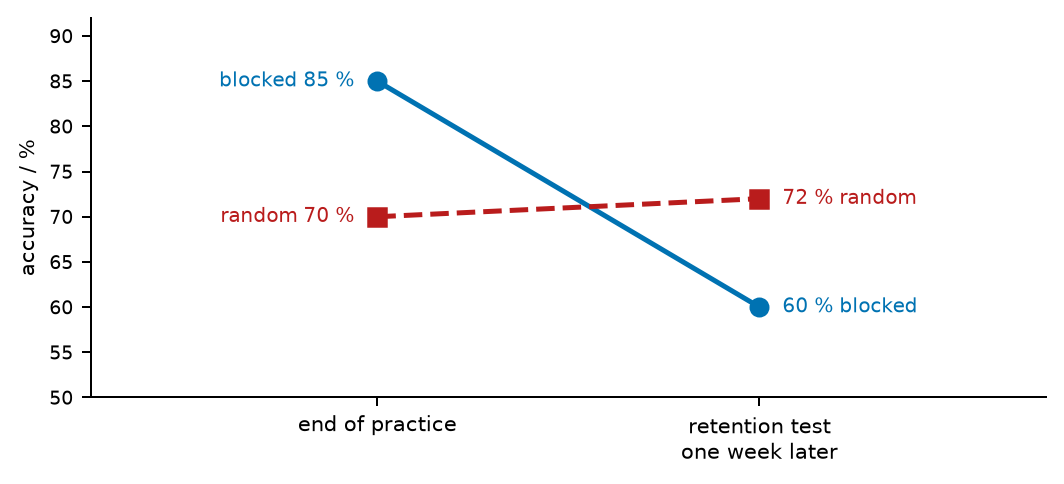
Scores illustrating one possible practice–retention contrast, not a guaranteed advantage of either schedule
In blocked practice, one skill is repeated many times before the next (20 short serves, then 20 long serves). In random practice, skills are mixed (short, long, short, flick...). Random practice can increase planning demands because successive tasks differ. This contextual interference 情境干扰 may reduce immediate scores and may aid retention or transfer in some conditions. Effects depend on skill complexity, experience, how schedules differ and the test; do not assume every sport or beginner benefits from maximum interference.
Worked example. In the figure, the blocked group fell from 85 % to 60 %, a drop of 25 percentage points, while the random group rose from 70 % to 72 %. A coach who judged by practice scores would choose blocked practice, but the delayed scores favour random practice in this dataset. Without baseline comparability, adequate independent participants and uncertainty, those two scores alone do not establish a causal or universal benefit. A gradual increase in variability may be appropriate when initial tasks overload learners.
Guidance
Type
Example
Strengths
Limitations
Visual guidance
Demonstrations, video, posters
Gives a clear picture; good for beginners
The demonstration must be accurate; too much detail confuses
Verbal guidance
Instructions and explanations
Can explain why; can be combined with visual
Too many words overload short-term memory
Manual guidance
The coach physically moves the learner's limbs
Gives the feel of the movement; builds confidence
Learner may come to depend on it; feel differs from real movement
Mechanical guidance
Appropriate equipment, such as a swimming float or a trampoline harness
Can support a task when correctly selected and supervised
Can create dependence
Four types of guidance
Transfer of learning
Transfer 迁移 is the effect of learning one skill on learning or performing another.
Positive transfer: one skill helps another, such as a throwing action helping a tennis serve.
Negative transfer: one skill hinders another, such as a badminton wrist action spoiling a tennis forehand.
Bilateral transfer: from one side of the body to the other, such as learning to kick with the weaker foot.
Proactive transfer (an earlier skill affects a later one) and retroactive transfer (a new skill affects one learned earlier).
Positive, negative and bilateral transfer: check the target performance rather than the names of the sports.
Transfer also occurs from practice to performance, between abilities and skills, from one learning stage to another, and from principles to specific skills. Representative pressure and decisions can support practice-to-match transfer; improved balance may support a new skill without automatically teaching it. Stable basic coordination can support a more autonomous version; learning the principle of creating space can guide a new passing activity. State what transfers, to which target, and what changes. Compare target performance with suitable starting evidence rather than assuming transfer from the names of two sports.
Distinguish skill and ability, classify a free throw and match dribble on three continua, and explain why a classification can depend on context.
Apply the information-processing model to a cricket batter. Explain selective attention and why a fixed 7-item memory limit should not be treated as a universal coaching rule.
Using the supplied model RT = 0.20 + 0.15 log₂(N) s, find RT for 1, 2, 4 and 8 equally likely choices. Distinguish reaction, movement and response time and give one limit of applying this equation to a real goalkeeper.
A model ball travels 11 m at 25 m/s; the supplied reaction and dive times are 0.35 and 0.45 s. Compare times. Repeat the comparison for a 7.0 m ball flight at 30 m/s and a supplied 0.60 s response. Explain a possible benefit and cost of anticipation.
Explain the psychological refractory period using a feint, without claiming that the whole brain can process only one stimulus at a time.
Compare open-loop and closed-loop control. Explain generalized and subordinate motor patterns, the four kinds of schema information and a limitation on online correction.
Apply ecological dynamics to a live passing task: explain affordances, perception–action coupling, degrees of freedom, self-organisation and useful versus unhelpful variability.
Propose one individual, one task and one environmental constraint for that task. Explain a controlled comparison of linear and non-linear teaching and how to assess learning.
Classify a coach's post-attempt comment "Your take-off foot was 20 cm behind the board"; then supply genuine outcome feedback. Explain faded/bandwidth feedback and one dependence risk.
Describe all three learning phases with suitable coaching. Give three plausible explanations for a plateau without claiming a permanent ability ceiling.
Recommend practice and guidance for a beginner learning a supervised low-risk component of front crawl. Compare whole, part, distributed, fixed/variable and blocked/random decisions, including safety and dependence limits.
In the practice graph, blocked accuracy is 85% then 60% at retention; random is 70% then 72%. Calculate both changes, both between-group gaps and the blocked relative decline. State what is and is not supported.
Explain skill-to-skill, practice-to-performance, abilities-to-skills, bilateral, stage-to-stage and principles-to-skills transfer, giving an example and one reason transfer may fail.
Classify broad/narrow and internal/external attention with examples. Explain internal/external distraction, arousal-related narrowing and a safe controlled-distraction/self-talk/process-goal strategy.
Answers.
A skill is a learned goal-directed movement such as a free throw; an ability is a supporting capacity such as coordination, influenced by development and experience as well as inheritance. A free throw is relatively closed, discrete and self-paced within a time limit. A match dribble is relatively open, continuous/serial and externally influenced. A stationary drill and live match impose different information and timing demands; neither a trait nor a sport label fixes all performance.
Input includes bowler/ball/body information; perception selects relevant cues; memory supplies relevant experience; response selection chooses a shot; motor signals activate muscles; movement and sensory/outcome feedback follow. Selective attention prioritises relevant cues under limited resources. Memory estimates depend on rehearsal, chunking and task; brief understandable cues need checking rather than a presumed universal seven-command allowance.
Log₂ of 1,2,4,8 is 0,1,2,3, giving 0.20,0.35,0.50,0.65 s. Reaction is stimulus to movement onset; movement time is onset to the defined endpoint; response time is their sum. Coefficients, equal probabilities and task conditions are supplied; anticipation, stimulus compatibility and changing probabilities limit direct real-match prediction.
First flight = 11/25 = 0.44 s; response = 0.35+0.45 = 0.80 s, exceeding flight by 0.36 s. Second flight = 7/30 = 0.2333… s; response 0.60 s exceeds it by 0.3667… s. In these models the full specified response cannot finish if started only at the strike. Early reliable cues can start a useful response sooner; deception or a wrong prediction can initiate the wrong movement. Real trajectories and required movements vary.
Closely timed stimuli can delay selection of a second response while the first is being handled. A feint may occupy response selection and/or initiate an action that must then change. This bottleneck account does not imply every sensory and motor process is serial, and a feint's effectiveness depends on timing and the defender's interpretation.
Open-loop components execute a prepared command without using feedback to change that component; closed-loop components use sensory comparison to adjust movement. A rapid strike and slower balance adjustment illustrate the difference; real skills combine them. A general throwing pattern can be parameterised into a particular implement/distance version. Schemas connect initial conditions, response specifications, sensory consequences and outcome; recall supports specification, recognition evaluation. Feedback arriving after release can inform a later throw but cannot change that released action.
A passing lane is an affordance relative to the player's ability and positions. Perception guides movement and movement changes the available lane information. Multiple joints/timing relationships provide degrees of freedom; coordinated solutions can self-organise through interaction with goals and constraints. Different successful passes may be functional variability; random misses or unsafe motion are not automatically desirable. A static cone task may omit the defender information essential to transfer.
Individual: current reach or experience; task: gate width or player numbers; environment: lighting or surface. Alter one planned constraint while holding relevant practice time, participants and outcome criteria comparable; record changes rather than assuming which constraint caused success. A linear lesson may explicitly model a sequence; a non-linear lesson may invite solutions through a meaningful gate change. Use baseline, delayed unassisted retention and a representative transfer test, adequate independent participants and uncertainty. Coaching and safety remain in both approaches.
The take-off-foot comment is augmented/extrinsic, terminal knowledge of performance: it describes a movement feature, not the final jump outcome. "The measured jump was 4.10 m" is knowledge of results. Feedback categories overlap. Giving every answer can encourage dependence; fading reduces frequency over time, while bandwidth feedback uses a predefined error threshold. Suitability depends on comprehension and task risk; withholding necessary safety feedback is not a learning strategy.
Cognitive: establishing the task and a workable pattern, with demonstration, few cues and simple feedback. Associative: refining consistency, with specific feedback and appropriate variation. Autonomous: less conscious movement control, with relevant decisions and occasional targeted feedback; experts can revisit conscious learning after a change. Fatigue suggests rest; monotonous or inappropriate practice suggests redesign; an insensitive score suggests better measurement. A plateau is an observed pattern, not proof of an unchangeable ceiling or an exact stage transition.
Within qualified supervision and safe water conditions, a simple component can be demonstrated, practised briefly with rest, then integrated into the whole stroke. Part practice helps only if the component can be meaningfully separated; excessive isolation can disrupt coordination. Whole–part–whole restores context. Begin with manageable conditions; add relevant variations as capability develops. Blocked repetitions can establish a task; mixed tasks may add useful demand but are not universally superior. Visual/verbal guidance should be concise. Floats or physical assistance require suitability, consent where relevant and supervision; they neither make a learner drown-proof nor eliminate dependence.
Blocked change = 60−85 = −25 percentage points; random = 72−70 = +2 points. Practice blocked advantage = 15 points; retention random advantage = 12 points. Blocked relative decline = 25/85×100 = 29.4118…%. The delayed scores favour random here and show why practice scores can mislead. Without comparable baselines, sample sizes, variability and controlled allocation they do not prove causality, universal schedule superiority or the amount of each person's learning. Learning is inferred from appropriate retained/adaptable capability, not measured directly by one percentage.
Skill-to-skill: an overarm throw may support a serve; practice-to-performance: live-decision passing practice may support a match; abilities-to-skills: balance may support learning a handstand; bilateral: experience on one side may help the other; stage-to-stage: a learned coordination pattern can support more autonomous execution; principles-to-skills: creating space can guide a new passing game. Specify source and target. Different timing, equipment, information or interference can limit transfer.
Broad external scans players/spaces; narrow external focuses a target; broad internal reviews several tactical possibilities; narrow internal attends to one breathing cue. Internal worry and irrelevant crowd noise can distract, whereas a useful teammate call is relevant external information. Arousal-related narrowing may omit needed peripheral cues; no one focus suits all phases. Safely introduce mild agreed distraction after basic competence, practise a chosen refocusing cue and set a process goal such as scanning before a pass. Keep communication/safety cues available and assess delayed transfer; do not induce distress or promise identical effects for everyone.
8.10
考试技巧
English
Apply information-processing and ecological models to a named action; explain what each contributes.
For constraints, identify the change, intended opportunity and evidence of adaptation.
Distinguish movement-quality feedback from outcomes, attentional width from direction, and learning from temporary performance.
Calculate from supplied assumptions with unrounded working; identify percentage-point and relative changes correctly.
Justify coaching by the task and learner. Use delayed unassisted retention and representative transfer evidence; phases are not age deadlines.