Scope and prerequisites
IB Language B first assessment 2020; English B focus. This supplemental reference covers only the listed preparation outcomes. School selections, full-guide procedures and required live or recorded performance are separate.
- Choose an appropriate text type and register 语域
- Organize an English response that addresses purpose, audience and required content
Prerequisites: Clear paragraphs; audience; purpose; present and future expressions.
Explain and choose the method
A proposal 提案 usually states a need, a practical plan and expected benefits. A friendly message can use a more personal tone.
Grammar and vocabulary should serve the message; a memorized opening cannot compensate for missing task content.
A proposal identifies a need, a practical plan and expected benefits. Use polite recommendations for a principal; a friendly message can address a peer directly. A complete response must meet every task cue. Word count 字数 does not compensate for missing content. The companion supplies separate original SL and HL models with counted final words and a cue checklist.
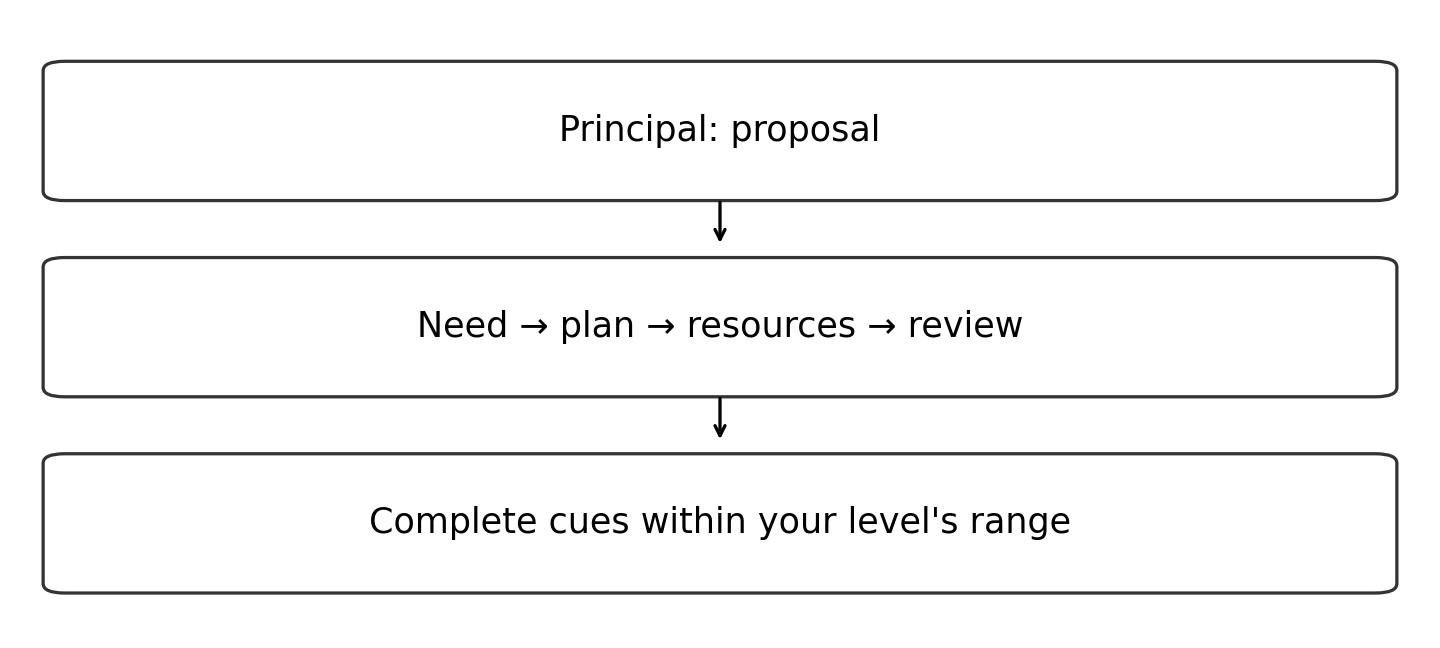
Existing worked example: For a proposal about a reading club, identify the purpose, meeting schedule, supervision and expected benefit. Use polite, specific recommendations. We recommend a supervised Thursday meeting is clearer than we must have a great club soon.
Complete original context
Original task: Write a proposal to your school principal for a weekly reading-and-repair club. Explain the need, meeting arrangements, supervision and resources, expected benefits, and how you would judge the first month's success. Address one practical concern and ask for a clear decision. Use the current course's level-appropriate word range: SL 250–400; HL 450–600. This is original teaching practice, not an official specimen task.
Independent practice and checked reasoning
Transfer 1
Choose a suitable text type and register. Plan all required content before writing.
Reasoning: A proposal with a title, purpose, short sections and polite recommendation suits the principal. Include need; weekly time/place; supervision/resources; benefits; first-month review; practical concern/response; requested approval. A casual chat with unexplained abbreviations would not fit this formal audience.
Transfer 2
Write the complete response within your level's word range. Compare it with the separate model, checking cues and relevant detail 细节 rather than memorising its opening.
Reasoning: Use the companion's complete SL or HL model as one possible response. Alternatives should meet the same audience, purpose, arrangements, supervision, benefits, review, concern and decision cues. Check actual final words and coherent language; classroom guidance is not an official criterion score.
Purpose and need
I propose a weekly reading-and-repair club that would help students use English instructions for a practical purpose. In ordinary reading lessons, we can sometimes identify vocabulary without checking whether we could carry out the process described. A club would make that gap visible. Students would need to explain a sequence, recognise a warning and ask for clarification before attempting a task. The aim would be careful communication, not the largest possible number of repaired objects.
Meeting arrangements
We recommend a one-month trial on Thursdays from four to five in the library meeting room. The first group should contain no more than twelve students, working in pairs. A teacher would supervise each meeting, with advice from a qualified repairer when tasks are selected. The library desk could maintain one sign-up list. Students could register online or on paper, so access would not depend on having a suitable device or understanding an unfamiliar form.
Resources and activities
The club would need short instruction texts, pencils, simple hand tools, spare screws and a labelled storage box. Before a session, the teacher would check that its task is suitable for the group and available equipment. Students should not bring mains-powered appliances or damaged batteries. Items requiring specialist safety checks would be referred to a professional. A clear refusal to attempt an unsafe repair would count as a responsible decision, rather than a failure of the club.
A typical meeting would begin with students reading an instruction sheet independently. Pairs would compare the required materials and order the steps. They would then identify one point where guessing could cause a problem and practise asking a precise question. Only after the teacher checks their understanding would they attempt a permitted task, such as replacing a loose handle screw. At the end, students would explain what they changed, what they could not establish and what should happen next.
Expected benefits and concerns
This process would connect reading, discussion and action. Students who are reluctant to speak may find a concrete task easier to discuss than an abstract topic. They would also practise describing faults and distinguishing evidence 证据 from assumptions. These are expected benefits that the trial should investigate, not guaranteed improvements for every participant.
Supervision is the main practical concern. A busy meeting could draw attention away from a student who needs help. We therefore propose the small group limit, one shared task per session and a clear rule that work stops when the teacher is assisting another pair. If the room becomes noisy or supervision is difficult, we should reduce the task range before adding places.
Review and decision
After four meetings, we would review attendance, students' explanations of the instructions, requests for clarification and the teacher's supervision notes. A short anonymous comment form could reveal obstacles that confident speakers overlook. We would then recommend whether to continue, revise or stop the trial. Please approve the meeting room and a planning discussion with the librarian and supervising teacher. No equipment should be purchased until that discussion confirms the tasks and available resources.
Classroom model: 509 words. Complete need and audience; weekly arrangement; supervision and resource detail; expected benefits qualified; practical concern and response; four-meeting evidence review; explicit decision and purchasing condition.
Transfer 3
Change the audience to a friend inviting them to join the club. Rewrite two opening sentences and explain the register change.
Reasoning: “Hi Mei, would you like to join our new reading-and-repair club on Thursdays? We could read short instructions together and learn a few safe repairs.” Direct address and a friendly invitation fit a peer. The time and activity stay clear; a formal request for the principal's approval would answer the wrong purpose.
Limits and next use
English B is language acquisition, not Language A literary criticism. Follow the SL or HL word range and task choice; do not pad the response with unrelated memorized phrases.
All tasks here are public original practice with authored guidance. They are not official questions or fresh diagnostics. Existing protected tests and mocks remain separate.