跳到主要内容

时间与空间;互文性 · 比较文学论点

IB 语言 A:文学 HL知识点 2

本主题的视频课程 打开视频页面
9:04

比较文学作品

两位国王听到了预言。在古代雅典,俄狄浦斯得知自己会杀死父亲并娶母亲为妻;他逃跑以躲避命运,却径直撞上…

英文讲解 · 可切换中英文字幕

2.1

比较文学作品(试卷 2)

English

Why it matters. Two kings hear a prophecy. One, in ancient Athens around 429 BC, is told he will kill his father and marry his mother; he runs away to escape it, and runs straight into it. The other, in Shakespeare's Scotland about two thousand years later, is told he will be king; he does not wait, but murders his way to the crown. Both plays ask the same question: are we free, or is our end already written? Comparing the two answers is a Paper 2 essay.

In this unit you will:

  • explain what Paper 2 asks and which works you may use;
  • use tools for analysing drama, such as the tragic hero, hamartia and dramatic irony;
  • follow the tragic arc in Macbeth and Oedipus Rex;
  • explain how the context of a work shapes its meaning;
  • plan and write a point-by-point comparative essay.

IB Diploma Programme English A: Literature HL (first assessment 2021). This topic prepares Paper 2, the comparative essay 比较论文, which SL and HL students both sit (1 hour 45 minutes, 30 marks; 35% at SL, 25% at HL). You get four general questions and answer one, comparing two works you have studied. You may not use a work you used in your individual oral or HL essay. The topic also covers the areas of exploration time and space (how context 语境 shapes a work) and intertextuality (how works speak to each other across time).

Must-know for Paper 2:

Area Key content
the paper 1 hour 45 minutes; one of four questions; two works; 30 marks
drama dramatic irony, soliloquy, stage directions, plot structure, the tragic hero
context when and where a work was written, and when and where it is read
essay a comparative thesis; point-by-point paragraphs; short quotations; a judgement
criteria A and B (10 marks each), C and D (5 marks each)
词汇 训练
English 中文 拼音
comparative essay/kəmˈpærətɪv ˈeseɪ/ 比较论文 bǐ jiào lùn wén
context/ˈkɒntekst/ 语境 yǔ jìng
2.2

戏剧分析工具

English

A play is written to be performed, so the audience learns everything from what characters say and do on stage. Tragedy, the form of both Oedipus Rex and Macbeth, has its own tools, which Aristotle first described in his Poetics. Use them to explain how each play builds pity and fear, not only to name what happens.

Feature What it is Example
tragic hero 悲剧英雄 a great person who falls because of a flaw or error Oedipus, Macbeth
hamartia 悲剧性缺陷 the hero's error or weakness Oedipus's anger and certainty; Macbeth's ambition
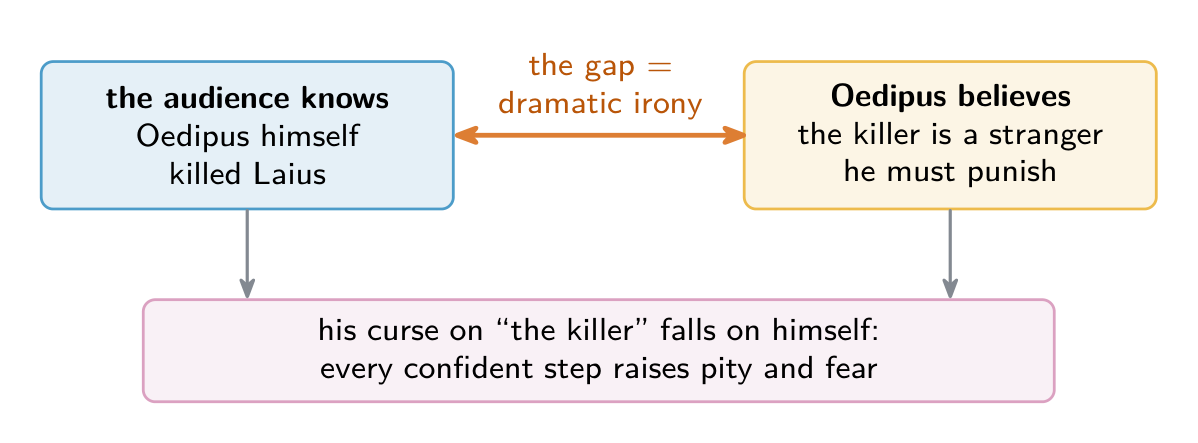
dramatic irony 戏剧性反讽 the audience knows something a character does not Oedipus curses the killer of Laius, not knowing it is himself
soliloquy 独白 a character alone on stage speaks their thoughts Macbeth's "Tomorrow, and tomorrow, and tomorrow" (Act 5)
foreshadowing 伏笔 early hints of what will come the witches' "Fair is foul, and foul is fair" (Act 1)
catharsis 净化 the audience's release of pity and fear at the end of a tragedy (Aristotle) the end of both plays
The first page of The Tragedie of Macbeth in the 1623 First Folio, printed in two columns beneath a decorative headpiece
The opening of Macbeth in the First Folio (1623): a play text is written to be performed, so read stage directions and speakers too
Dramatic irony as a gap: the audience knows Oedipus killed Laius, while Oedipus believes the killer is a stranger, so his curse falls on himself
Dramatic irony lives in the gap between what we know and what the hero knows.
词汇 训练
English 中文 拼音
tragic hero/ˈtrædʒɪk ˈhɪərəʊ/ 悲剧英雄 bēi jù yīng xióng
hamartia/ˈhæmɑːʃə/ 悲剧性缺陷 bēi jù xìng quē xiàn
dramatic irony/drəˈmætɪk ˈaɪrəni/ 戏剧性反讽 xì jù xìng fǎn fěng
soliloquy/səˈlɪləkwɪ/ 独白 dú bái
foreshadowing/fɔːˈʃædəʊɪŋ/ 伏笔 fú bǐ
catharsis/kæˈθɑːsɪs/ 净化 jìng huà
2.3

结构:悲剧发展轨迹

English

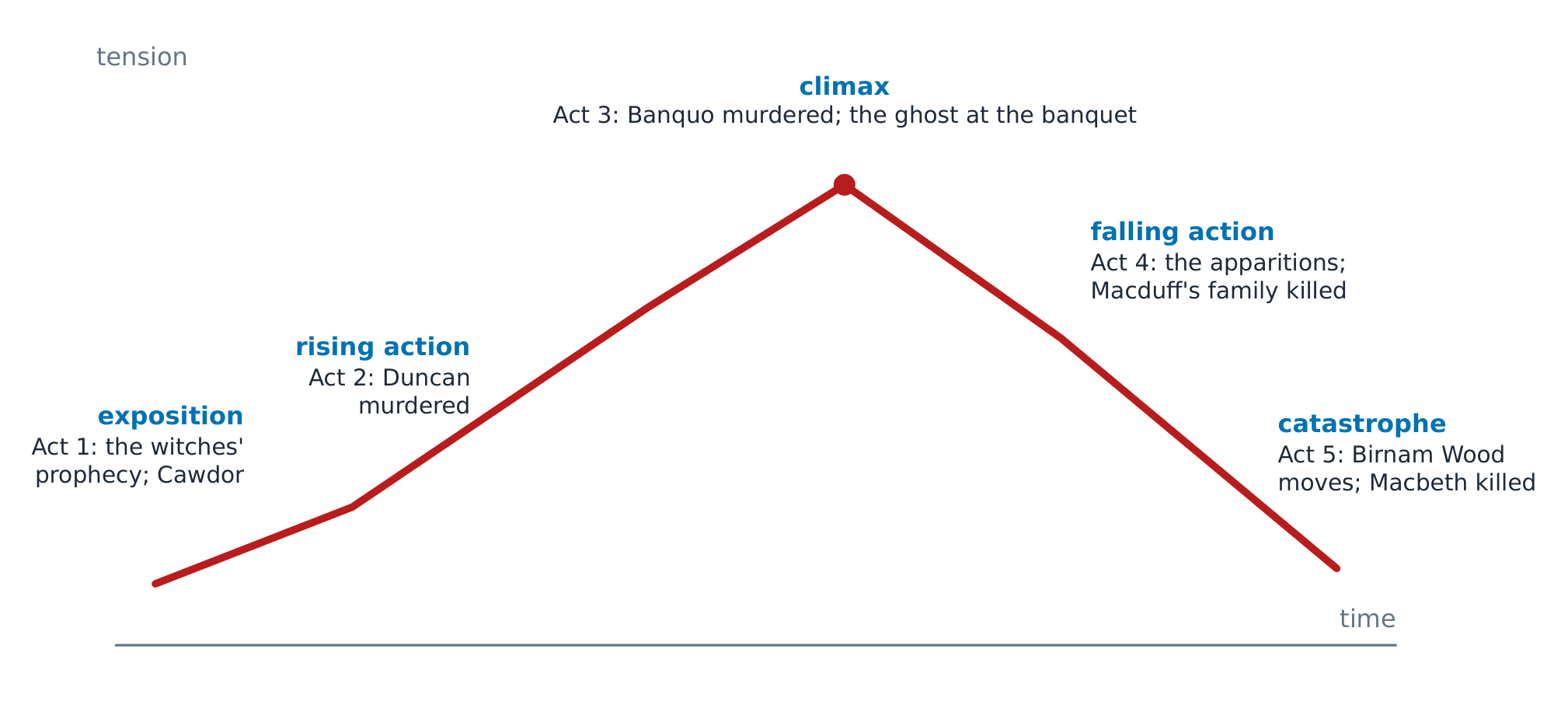
A five-part model (often called Freytag's pyramid) helps you track how a tragedy builds and falls.

Fuseli's three witches (about 1783): the prophecy starts Macbeth's inner conflict between ambition and conscience
Fuseli's three witches (about 1783): the prophecy starts Macbeth's rise and fall
Freytag's pyramid for Macbeth: exposition with the witches' prophecy (Act 1), rising action to Duncan's murder (Act 2), the climax at Banquo's murder and the banquet (Act 3), falling action with the apparitions and Macduff's family (Act 4), and catastrophe at Dunsinane (Act 5)
Macbeth's rise and fall act by act: the climax comes in the middle, not at the end

In Oedipus Rex the structure is different: the main events (the killing of Laius, the marriage to Jocasta) happened years before the play starts. The play is an investigation 调查: Oedipus searches for the truth, and every step towards it is a step towards his own ruin.

词汇 训练
English 中文 拼音
investigation/ɪnˌvestɪˈɡeɪʃn/ 调查 diào chá
2.4

背景:时间与空间

English

Sophocles wrote for a festival audience in Athens who already knew the story of Oedipus. They watched not to learn what happens, but how; this makes every line full of dramatic irony. Greek audiences also believed that the gods' oracles must come true.

A timeline of three audiences: Athens around 429 BC, where the audience knows the story and trusts oracles; London around 1606 under James I; and a reader today who may see the witches as Macbeth's desires
Each audience reads the prophecy through its own beliefs.

Shakespeare wrote Macbeth around 1606, soon after James VI of Scotland became King James I of England. James was interested in witchcraft and believed that kings ruled by God's will. A play in which killing a king brings chaos to the whole country spoke directly to its first audience. A modern reader may read the witches instead as a picture of Macbeth's own desires.

2.5

两部作品,一个问题

English

Question: "Discuss how two works you have studied present the conflict between fate and free will."

Oedipus Rex (Sophocles, c. 429 BC; in translation) Macbeth (Shakespeare, c. 1606)
the prophecy he will kill his father and marry his mother he will be Thane of Cawdor and then king
the hero's choice he leaves Corinth to escape it he and Lady Macbeth murder King Duncan
does the choice matter? his escape fulfils the prophecy the prophecy only names the end; he chooses the means
key technique dramatic irony: the audience knows from the start soliloquy: we hear him choose ("I have no spur ... but only / Vaulting ambition", Act 1)
the end he discovers the truth and blinds himself he trusts the witches' riddles and is killed by Macduff

Thesis: Both plays use a prophecy to test human freedom, but Sophocles shows a man whose free choices lead him into a fate he cannot escape, while Shakespeare shows a man whose fate is only a suggestion, so that his ruin is his own responsibility.

A line from fate decides to the hero chooses, with Oedipus Rex near fate and Macbeth near choice
The thesis as a picture: the two plays sit at different points on one line.
2.6

构建论文结构

English

Write point by point: each body paragraph compares both works on one idea (the prophecy; the hero's choices; the ending). Use linking words: similarly, whereas, in contrast, both.

Two essay plans: a block structure with two separate halves, and a point-by-point structure in which every paragraph compares both works

Worked paragraph.

Both playwrights let the audience see more than the hero, but they use this knowledge in opposite ways. Sophocles relies on dramatic irony: when Oedipus promises to find and punish the killer of Laius, the audience already knows that he is cursing himself, so every confident step he takes increases our pity and fear. Shakespeare, in contrast, gives Macbeth soliloquies in which we watch him decide. When he admits that he has "no spur" except "vaulting ambition", the audience sees that no god or witch forces his hand. The difference in technique reflects a difference in belief: for Sophocles' audience the oracle had to come true, while Shakespeare's play places the cause of tragedy inside the human mind.

2.7

标准

English
Criterion Marks It asks
A: knowledge, understanding and interpretation 10 Do you know both works well and interpret them in answer to the question?
B: analysis and evaluation 10 Do you analyse the writers' choices and compare their effects?
C: focus and organisation 5 Is the comparison clear, balanced and well structured?
D: language 5 Is your English clear, accurate and suitably formal?

Preparing: for each work, learn 10 to 15 short quotations or precise moments, grouped by idea (power, fate, guilt, family, gender). For a work in translation, refer to moments and techniques rather than exact wording, and name the translation you studied.

2.8

本课资料

English
  • International Baccalaureate, Language A: Literature guide (first assessment 2021).
  • Sophocles, Oedipus the King (about 429 BC), translated by R. Fagles (1984).
  • W. Shakespeare, Macbeth (about 1606), Arden Shakespeare third series, ed. S. Clark and P. Mason (2015).
  • Aristotle, Poetics, on hamartia and catharsis.
  • J. Shapiro, 1606: Shakespeare and the Year of Lear (2015), on James I and Macbeth.
2.9

常见错误

English
  • Writing about one work and then the other, with the comparison only at the end.
  • Retelling the plots instead of answering the question.
  • Using a work you already used in the individual oral or the HL essay.
  • Treating context as background facts instead of showing how it shapes the meaning.
  • Quoting exact wording from a work in translation as if it were the author's own words; name the translation and focus on moments and techniques.
  • Comparing only similarities; differences often make the strongest points.
2.10

关键术语

English
  • Tragic hero: a character of high status whose fall is caused partly by a flaw or error.
  • Hamartia: the tragic hero's flaw or error of judgement.
  • Dramatic irony: when the audience knows something a character does not.
  • Soliloquy: a speech in which a character, alone on stage, speaks their thoughts aloud.
  • Catharsis: the release of pity and fear that the audience feels at the end of a tragedy.
  • Context of production: the time, place and conditions in which a work was written.
2.11

自我检测

English
  1. How long is Paper 2, how many questions do you answer, and what is it worth at SL and HL?
  2. What is Oedipus's hamartia, and what is Macbeth's?
  3. Give one example of dramatic irony in Oedipus Rex.
  4. How might James I's belief in the divine right of kings shape the meaning of Macbeth?
  5. Write a thesis comparing how the two plays present fate and free will.
  6. Which two criteria carry 10 marks each in Paper 2?

Answers: 1. 1 hour 45 minutes; one of four questions, comparing two works, 30 marks; 35% at SL and 25% at HL. 2. Oedipus: his anger and his certainty that he can find the truth; Macbeth: ambition. 3. The audience knows that Oedipus is the murderer he is searching for while he curses the killer. 4. Killing a king appears as a crime against God and nature, so Macbeth's fall seems certain and deserved, and the play flatters a king descended from Banquo. 5. For example: "Both plays begin with a prophecy, but Oedipus Rex shows a man trapped by fate however he runs, while Macbeth shows a man who chooses to make a prophecy come true, so Shakespeare places the guilt in the will." 6. A (knowledge, understanding and interpretation) and B (analysis and evaluation).

这有帮助吗?

该知识点的互动课程

逐步完成,配合即时检查练习。

更多 IB 语言 A:文学 HL 知识点

登录或创建账户

IGCSE, A-Level & AP