跳到主要内容

读者、作者与文本 · 英语非文学分析

IB 语言 A:语言与文学 SL · 知识点 1

本主题的视频课程 打开视频页面
9:25

分析非文学文本

在2013中国,学生发起了一项反对食物浪费的线上运动,即“光盘行动”。海报展示了一个空盘子和一句简短标语。几个字……

英文讲解 · 可切换中英文字幕

1.1

分析非文学文本(试卷1)

English

Why it matters. In 2013 Chinese students started an online campaign called the Clean Plate campaign 光盘行动, against food waste in restaurants. Posters showed an empty plate and a short slogan, and restaurants were asked to offer half portions and take-away boxes. A few words and one picture made millions of people think again about what they left on the plate. Paper 1 asks you to explain how texts like that work.
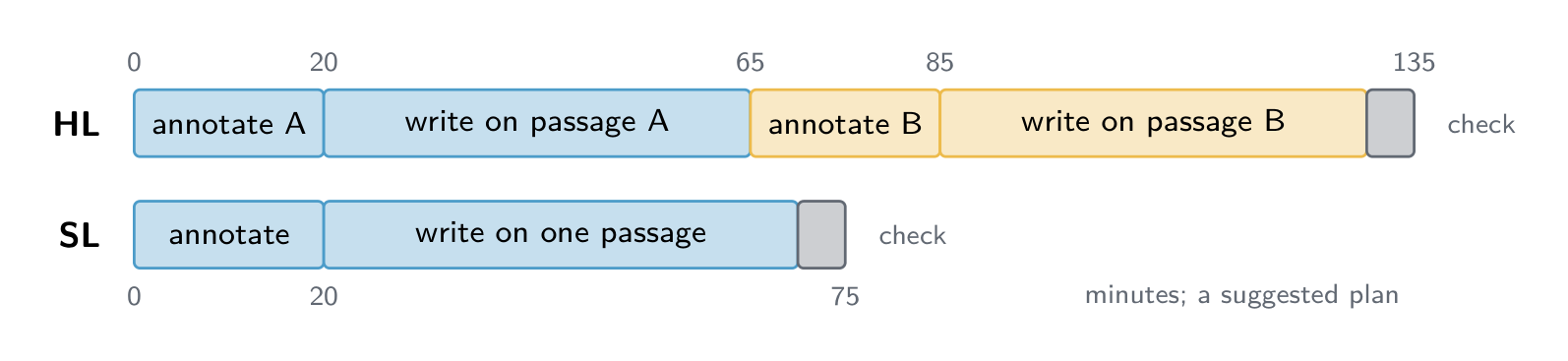
A suggested Paper 1 time plan: at HL 20 minutes annotating and 45 writing for each of two passages, then 5 minutes checking; at SL 20 minutes annotating, 50 writing and 5 checking
A suggested time plan: annotate first, then write, with a few minutes to check.

In this unit you will:

  • explain what Paper 1 asks at SL and HL and plan your time;
  • identify a text's type, audience, purpose, sender, context and register;
  • name language and visual features and explain their effects;
  • write an analysis with a thesis and claim–evidence–effect paragraphs;
  • plan an answer to an unseen opinion column.

IB Diploma Programme English A: Language and Literature SL (first assessment 2021). The course is organised in three areas of exploration 探究领域: readers, writers and texts, time and space, and intertextuality: connecting texts. This topic prepares Paper 1, the guided textual analysis 引导性文本分析 of non-literary texts 非文学文本: advertisements, speeches, opinion columns, infographics, cartoons, web pages and many more. HL students get two unseen texts and write an analysis of each (2 hours 15 minutes, 40 marks). SL students choose one of the two (1 hour 15 minutes, 20 marks). Each text comes with a guiding question 引导问题, such as "How does the writer use visual and verbal features to persuade the reader?"

Must-know for Paper 1:

Area Key content
context text type, audience, purpose, sender, place and time
language diction, register, sentence types, rhetorical devices
visuals layout, colour, typography, image, gaze, salience
structure order, headings, contrast, the movement of the text
writing a thesis that answers the guiding question; analysis paragraphs; a conclusion
词汇 训练
English 中文 拼音
Clean Plate campaign/kliːn pleɪt kæmˈpeɪn/ 光盘行动 guāng pán xíng dòng
area of exploration/ˈeərɪə ɒv eksplɔːˈreɪʃn/ 探究领域 tàn jiū lǐng yù
guided textual analysis/ˈɡaɪdɪd ˈtekstʃuːəl əˈnæləsɪs/ 引导性文本分析 yǐn dǎo xìng wén běn fèn xī
non-literary text/nɒn ˈlɪtərəri tekst/ 非文学文本 fēi wén xué wén běn
guiding question/ˈɡaɪdɪŋ ˈkwestʃn/ 引导问题 yǐn dǎo wèn tí
1.2

首要问题:谁、为什么、在哪里

English

Before you look at single words, answer five questions:

Question What it means Example: the poster below
text type 文本类型 what kind of text it is a public-information poster
audience 受众 who it is for students at one school
purpose 目的 what it wants to do: inform, persuade, entertain persuade students to refill bottles
sender 发出者 who made it, and with what authority the student council
context 语境 where and when it appears on a corridor wall, read while walking

Register 语域 is how formal or informal the language is. A government report uses a formal register; a poster for teenagers usually uses an informal one, with short sentences and the word "you".

词汇 训练
English 中文 拼音
text type/tekst taɪp/ 文本类型 wén běn lèi xíng
audience/ˈɔːdɪəns/ 受众 shòu zhòng
purpose/ˈpɜːpəs/ 目的 mù dì
sender/ˈsendə/ 发出者 fā chū zhě
context/ˈkɒntekst/ 语境 yǔ jìng
register/ˈredʒɪstə/ 语域 yǔ yù
1.3

语言特征

English

Every word in a short persuasive text has been chosen, and the table lists the features you will meet most often. Naming a feature is only the first step: say what it does for this audience and this purpose. A rhetorical question on a poster for teenagers works differently from the same question in a government report.

Feature What it is Typical effect
diction 措辞 the choice of words "slaughter" and "kill" give very different feelings
direct address 直接称呼 speaking to the reader as "you" makes the message personal
imperative 祈使句 a command: "Refill." asks for action now
rhetorical question 设问 a question with no expected answer makes the reader think and agree
rule of three 三项排比 three parallel items sounds complete and memorable
statistics 统计数据 numbers look objective and give authority
emotive language 情感性语言 words that cause strong feelings pushes the reader to care
alliteration 头韵 repeated first sounds makes a slogan easy to remember
metaphor 隐喻 describing one thing as another creates a picture in the reader's mind
hyperbole 夸张 deliberate exaggeration adds force or humour
词汇 训练
English 中文 拼音
diction/ˈdɪkʃn/ 措辞 cuò cí
direct address/daɪˈrekt əˈdres/ 直接称呼 zhí jiē chēng hū
imperative/ɪmˈperətɪv/ 祈使句 qí shǐ jù
rhetorical question/reˈtɒrɪkl ˈkwestʃn/ 设问 shè wèn
rule of three/ruːl ɒv θriː/ 三项排比 sān xiàng pái bǐ
statistics/stəˈtɪstɪks/ 统计数据 tǒng jì shù jù
emotive language/ɪˈməʊtɪv ˈlæŋɡwɪdʒ/ 情感性语言 qíng gǎn xìng yǔ yán
alliteration/əˌlɪtəˈreɪʃn/ 头韵 tóu yùn
metaphor/ˈmetəfɔː/ 隐喻 yǐn yù
hyperbole/haɪˈpɜːbəli/ 夸张 kuā zhāng
1.4

视觉特征

English

Many Paper 1 texts are multimodal 多模态: they combine words and images. Analyse the visual choices as carefully as the words:

Giant advertising screens at a busy crossing
Advertising screens: image, colour, size and placement work with the words to persuade
  • Layout 版面: what is at the top, in the centre, or large? The most noticeable element has salience 显著性.
  • Colour 色彩: colours link ideas (green with nature, red with danger) and connect parts of the page.
  • Typography 字体排印: bold, large or italic type makes some words louder.
  • Images: who or what is shown, from which angle? A person looking at the viewer makes a "demand"; a person looking away is "offered" for us to look at.
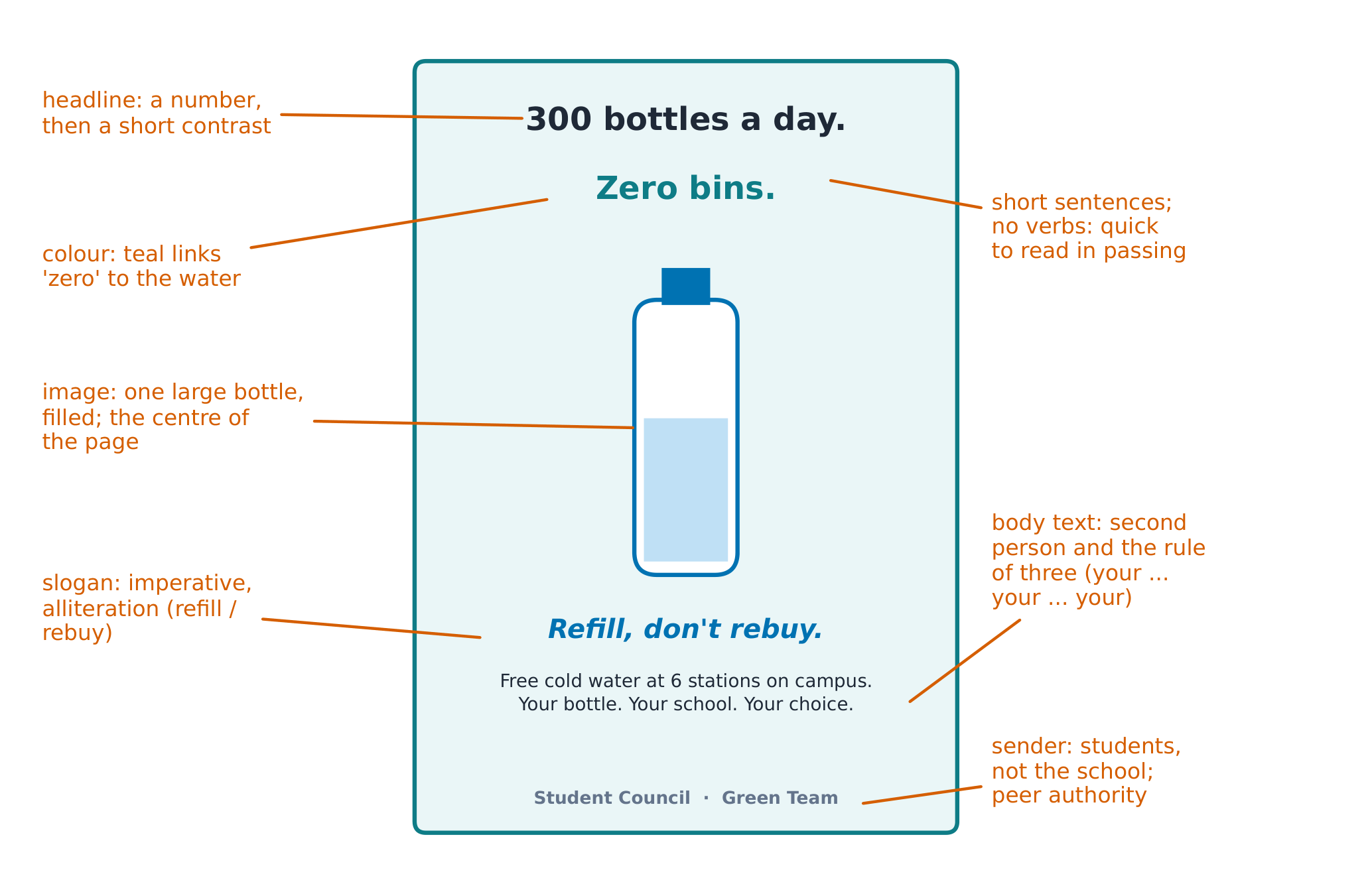
An original school poster: headline '300 bottles a day. Zero bins.', a large filled water bottle, the slogan 'Refill, don't rebuy.', body text and the student council as sender, with orange labels naming each feature

An annotated poster: each label names a feature and hints at its effect

词汇 训练
English 中文 拼音
multimodal/ˌmʌltɪˈməʊdl/ 多模态 duō mó tài
layout/ˈleɪaʊt/ 版面 bǎn miàn
salience/ˈseɪlɪəns/ 显著性 xiǎn zhù xìng
colour/ˈkʌlə/ 色彩 sè cǎi
typography/taɪˈpɒɡrəfi/ 字体排印 zì tǐ pái yìn
1.5

撰写分析文章

English

Paper 1 is marked on four criteria, equal in weight:

Criterion It asks
A: understanding and interpretation Do you understand the text and its meaning, with good evidence?
B: analysis and evaluation Do you explain how the features create meaning and effects?
C: focus and organisation Is the answer clear, focused and well structured?
D: language Is your English clear, accurate and suitably formal?

Use this structure:

  1. Introduction: text type, audience and purpose, then a thesis 论点 that answers the guiding question in one sentence.
  2. Body paragraphs (three or four): each has a point, a short quotation or a precise visual detail as evidence, the name of the feature, and an explanation of its effect on the reader.
  3. Conclusion: return to the thesis and say how the features work together.

Do not "feature spot": naming alliteration earns little unless you explain what it does for this text and this audience.

Claim, evidence and commentary boxes: commentary is the widest because the explanation earns most of the marks
Every body paragraph: a claim, evidence, and commentary on its effect.

Worked paragraph (the poster above; guiding question: How does the poster persuade students to change their behaviour?).

The poster opens with a statistic, "300 bottles a day.", followed by the contrast "Zero bins." The number makes the problem concrete and slightly shocking, while the two short, verbless sentences can be read in a second by a student walking past. The teal colour of "Zero bins." matches the water in the bottle, so the solution is visually linked to the goal before the reader has read the slogan. The imperative "Refill, don't rebuy." then turns the problem into a simple action, and its alliteration makes it easy to remember. Because the sender is the student council, not the school, the message feels like advice from peers rather than a rule.

词汇 训练
English 中文 拼音
thesis/ˈθiːsɪs/ 论点 lùn diǎn
1.6

练习

English

Read this original opinion column, written for a school magazine.

Ten minutes of nothing

When did you last sit for ten minutes without a screen? Not on the bus, not in the lunch queue, not in bed at midnight. We check our phones dozens of times a day. We call it "staying connected". But connected to what? This week, try an experiment: ten minutes, every evening, of nothing at all. No music, no messages, no scrolling. You may feel bored. Good. Boredom is the waiting room of every new idea.

Guiding question: How does the writer try to change the reader's habits?

Model plan.

  1. Thesis: the writer uses direct questions, a shared "we" and a final metaphor to make a small, possible change feel worth trying.
  2. The opening rhetorical question and the list of three places ("not on the bus, not in the lunch queue, not in bed") make readers check their own day.
  3. "We" and "dozens of times a day" include the writer in the problem, so the column sounds like a friend, not a teacher.
  4. The imperative "try an experiment" and the exact "ten minutes" make the action small and specific.
  5. The one-word sentence "Good." surprises the reader, and the metaphor "the waiting room of every new idea" changes boredom from a problem into an opportunity.
1.7

本课资料

English
  • International Baccalaureate, Language A: Language and Literature guide (first assessment 2021).
  • Xinhua and China Daily, reports on the Clean Plate campaign, January–February 2013.
  • G. Kress and T. van Leeuwen, Reading Images: The Grammar of Visual Design (2nd edition, 2006), on salience, demand and offer.
  • M. H. Abrams and G. Harpham, A Glossary of Literary Terms (11th edition, 2014).
1.8

常见错误

English
  • Feature spotting: naming a rhetorical question or alliteration without explaining its effect on this audience.
  • Ignoring the visual half of a multimodal text, or describing images without analysing them.
  • Forgetting context: who sent the text, to whom, where and why.
  • Retelling what the text says instead of analysing how it persuades.
  • Leaving the guiding question until the conclusion.
  • Writing in an informal register, with "you" and contractions, when the analysis should be formal.
1.9

关键术语

English
  • Non-literary text: a text such as an advertisement, speech, column, infographic or web page.
  • Guiding question: the question printed with each Paper 1 text, which points to one aspect to analyse.
  • Register: how formal or informal language is.
  • Multimodal: combining words with images, colour, layout or sound.
  • Salience: how strongly an element stands out and draws the eye.
  • Imperative: a sentence that gives a command.
1.10

自我检测

English
  1. How many texts, marks and minutes does Paper 1 have at HL and at SL?
  2. Name the five "first questions" to ask about a text.
  3. What is the difference between a "demand" image and an "offer" image?
  4. Rewrite as claim, evidence and effect: "The poster uses an imperative."
  5. In "Ten minutes of nothing", what is the effect of the one-word sentence "Good."?
  6. Name the three areas of exploration.

Answers: 1. HL: two texts, 40 marks, 2 hours 15 minutes; SL: one text, 20 marks, 1 hour 15 minutes. 2. Text type, audience, purpose, sender and context. 3. In a demand image the person looks at the viewer and seems to ask something of them; in an offer image the person looks away and is shown for us to look at. 4. For example: "The imperative 'Refill, don't rebuy.' turns the problem into one simple action, and its alliteration makes it easy to remember." 5. It surprises the reader, who expects boredom to be bad, and prepares the metaphor that turns boredom into an opportunity. 6. Readers, writers and texts; time and space; intertextuality: connecting texts.

这有帮助吗?

该知识点的互动课程

逐步完成,配合即时检查练习。

更多 IB 语言 A:语言与文学 SL 知识点

登录或创建账户

IGCSE, A-Level & AP