This handout teaches Reactivity 1.2, Energy cycles in reactions, for the course first assessed in 2025.
Prerequisites: enthalpy change, exothermic and endothermic reactions, and calorimetry from Reactivity 1.1; covalent bonds from Structure 2.2. You will use bond enthalpies and enthalpy data from the data booklet.
13.2
键焓
English
Where does the energy of a reaction come from?
Burning one mole of methane in a gas cooker releases about $800\ \text{kJ}$. No atoms are created or destroyed, so the energy must come from the bonds: forming the product bonds releases more energy in total than breaking the reactant bonds requires. Individual bond strengths alone are not enough: count how many bonds of each type occur. This unit shows how to calculate enthalpy changes from bond data and from energy cycles 能量循环 when they cannot be measured directly.
Breaking and making bonds
Breaking a bond needs energy: bond breaking is endothermic.
Making a bond releases energy: bond making is exothermic.
The bond enthalpy 键焓 is the energy needed to break one mole of a covalent bond, with the substances in the gaseous state. It is always positive. For example, $\text{H}_2(\text{g}) \rightarrow 2\text{H}(\text{g})$, $\Delta H = +436\ \text{kJ mol}^{-1}$.
The value for a bond such as C–H differs a little from one molecule to another, so the data booklet gives an average bond enthalpy 平均键焓: the mean over many compounds.
Calculating $\Delta H$ from bond enthalpies
$$\Delta H = \sum(\text{bonds broken}) - \sum(\text{bonds formed})$$
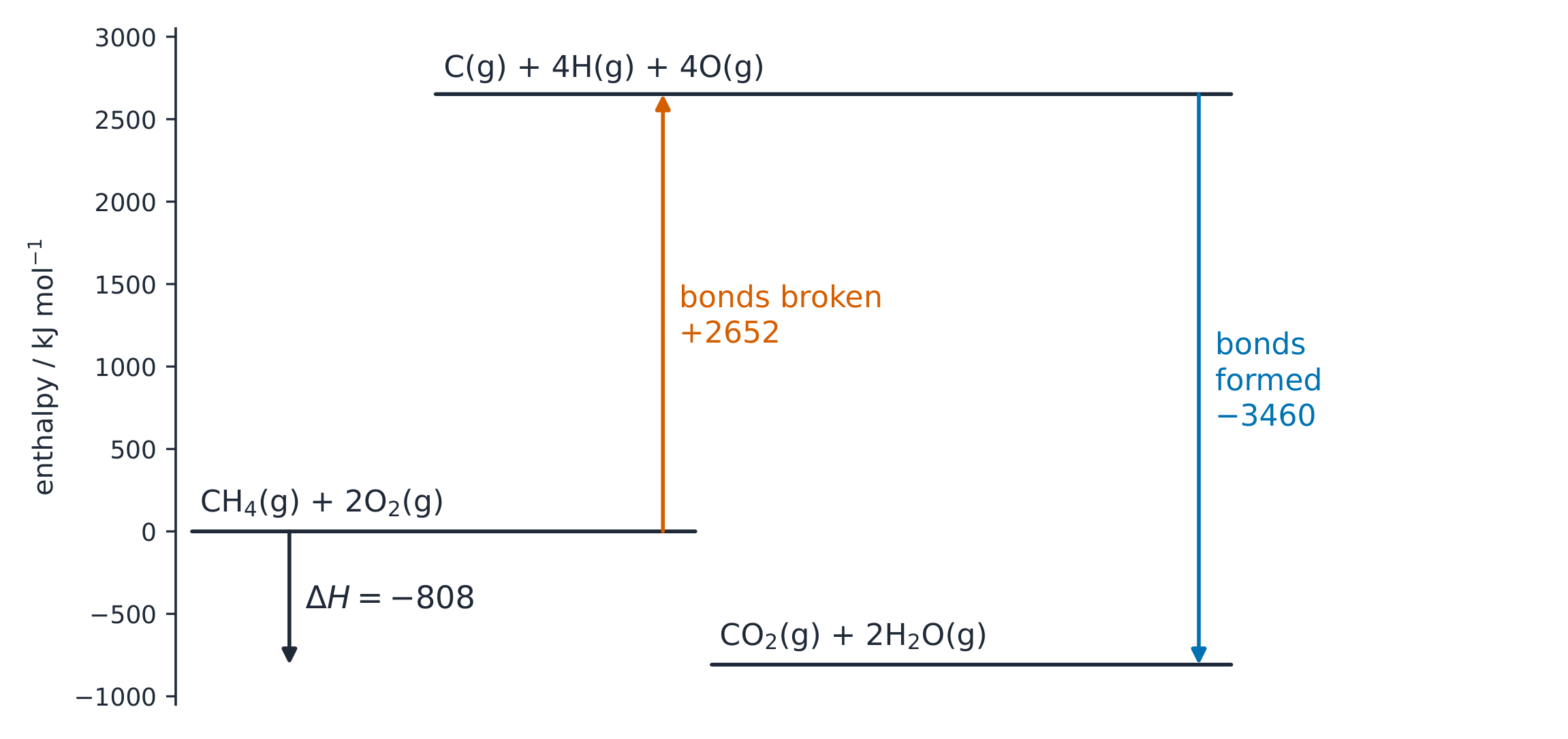
Worked example: $\text{CH}_4(\text{g}) + 2\text{O}_2(\text{g}) \rightarrow \text{CO}_2(\text{g}) + 2\text{H}_2\text{O}(\text{g})$.
Bonds broken
Energy / kJ
Bonds formed
Energy / kJ
4 C–H: $4 \times 414$
1656
2 C=O: $2 \times 804$
1608
2 O=O: $2 \times 498$
996
4 O–H: $4 \times 463$
1852
total
2652
total
3460
$\Delta H = 2652 - 3460 = -808\ \text{kJ mol}^{-1}$. More energy is released by forming bonds than is needed to break them, so the reaction is exothermic.
Every bond is broken to gaseous atoms, then the new bonds form; $\Delta H$ is the difference
Why the answer is only approximate
The measured value for this reaction is $-802\ \text{kJ mol}^{-1}$ (with water as a gas). The bond enthalpy answer differs because:
average bond enthalpies are used, not the values for these exact molecules;
bond enthalpies apply only to gases. If a substance is a liquid or solid, the energy to change its state is missing. With liquid water as a product the true value is $-890\ \text{kJ mol}^{-1}$.
Count a complete inventory before cancelling
For ethene hydrogenation, draw CH₂=CH₂ + H–H → CH₃–CH₃. A complete inventory breaks one C=C, four C–H and one H–H, then forms one C–C and six C–H. Using 614, 414, 436 and 346 kJ per mole respectively gives $(614+4\times414+436)-(346+6\times414)=-124\ \text{kJ mol}^{-1}$. Cancelling four identical average C–H contributions gives the same shortcut. This bookkeeping route through isolated atoms does not assert that a real reaction simultaneously breaks every bond, or that an average C–H value is identical in every molecule.
A complete bond inventory for ethene hydrogenation: −124 kJ mol⁻¹
A stronger comparable bond generally has a larger dissociation enthalpy and a shorter length, but bond type and environment matter. Neither bond polarity alone nor a bond count without bond energies determines the overall heat change. A negative reaction enthalpy also does not imply a fast reaction: activation barriers concern the pathway, not just its endpoints.
Put a phase correction on the correct side
Suppose supplied rounded data give a gas-phase reaction change of −808 kJ per mole of methane and water condensation releases 44 kJ per mole. Two moles of product water condense, so the estimate for liquid products is $-808+2(-44)=-896\ \text{kJ mol}^{-1}$. This remains an estimate from the supplied bond data, rather than the measured −890 value. Condensation releases energy; vaporizing a liquid reactant would require energy before its gaseous bonds could be broken. Write the extra state-change equation instead of guessing its sign.
Hess's law 盖斯定律: the enthalpy change of a reaction is the same whatever route is taken, as long as the initial and final conditions are the same. Enthalpy is a state function: it depends only on where you start and where you finish, like the difference in height between the bottom and the top of a mountain, whichever path you climb.
This lets you calculate enthalpy changes that cannot be measured directly. Build an energy cycle with the target reaction on one route and reactions with known $\Delta H$ on the other.
Both routes start with C(s) + O₂(g) and finish with CO₂(g): x − 283 = −394, so x = −111 kJ for the equation shown.
Working with equations
You can also combine equations directly, like algebra:
Reverse, multiply, add, cancel
If you reverse an equation, change the sign of $\Delta H$.
If you multiply an equation by a number, multiply $\Delta H$ by the same number.
Add the equations and their $\Delta H$ values; species that appear on both sides cancel.
Worked example: find $\Delta H$ for $\text{C}(\text{s}) + \tfrac{1}{2}\text{O}_2(\text{g}) \rightarrow \text{CO}(\text{g})$, which is difficult to isolate by direct combustion calorimetry because oxidation can also produce $\text{CO}_2$.
Keep (1) and reverse (2): $\text{CO}_2 \rightarrow \text{CO} + \tfrac{1}{2}\text{O}_2$, $\Delta H = +283$. Adding them, $\text{CO}_2$ cancels and $\tfrac{1}{2}\text{O}_2$ is left on the left:
$$\Delta H = -394 + 283 = -111\ \text{kJ mol}^{-1}$$
Worked example: three equations
Find $\Delta H$ for $2\text{C}(\text{s}) + \text{H}_2(\text{g}) \rightarrow \text{C}_2\text{H}_2(\text{g})$, given:
(1) $\text{C}(\text{s}) + \text{O}_2(\text{g}) \rightarrow \text{CO}_2(\text{g})$, $\Delta H = -394$
(2) $\text{H}_2(\text{g}) + \tfrac{1}{2}\text{O}_2(\text{g}) \rightarrow \text{H}_2\text{O}(\text{l})$, $\Delta H = -286$
Check that the oxygen, $\text{CO}_2$ and water cancel: $\tfrac{5}{2}\text{O}_2$ on each side, $2\text{CO}_2$ on each side, one $\text{H}_2\text{O}$ on each side.
Link a measured heat change to a cycle
A cycle can use an enthalpy change obtained by calorimetry. Use an insulated cup and lid, stir, start the solutions at the same temperature and record a temperature–time series. Extrapolate appropriate pre- and post-reaction trends to the mixing time to estimate the corrected temperature rise; a single observed maximum can miss cooling during measurement.
Calorimetry: measure the temperature change of a known mass of solution
In a neutralization experiment, 0.0500 mol of water forms in $\mathrm{HCl(aq)+NaOH(aq)\rightarrow NaCl(aq)+H_2O(l)}$. The total solution mass is 100.0 g, its specific heat capacity is $4.18\ \mathrm{J\,g^{-1}\,K^{-1}}$ and its corrected temperature rise is 5.00 K. Neglect the cup's heat capacity and any remaining heat exchange:
The warming solution gains heat, so the reaction transfers energy to the surroundings and has a negative enthalpy change. This is an experimental estimate, not automatically a standard value. A Hess sum using this measured arrow must retain its states, conditions and reaction amount; reversing or scaling the equation also reverses or scales its enthalpy.
Match states, coefficients and reaction amount
A valid cycle returns to precisely the same substances, amounts, states, temperature and pressure. Water vapour cannot cancel against liquid water without including condensation or vaporization. Likewise, carbon graphite and diamond are different initial states. A cycle diagram is a map of alternative processes, not a time trace or a mechanism.
ΔH scales and changes sign with the equation as written
For $2\text{H}_2(\text{g})+\text{O}_2(\text{g})\rightarrow2\text{H}_2\text{O}(\text{l})$, supplied $\Delta H=-572$ kJ applies to the equation as written. Halving it gives −286 kJ for one mole of water; reversing and doubling the original gives +1144 kJ for decomposing four moles of water. If 0.250 mol of water forms, the corresponding heat change is $0.250(-286)=-71.5$ kJ. A molar value and the heat of a particular sample are different quantities.
Explain, in terms of bonds, why the combustion of methane is exothermic.
Use bond enthalpies (H–H 436, Cl–Cl 242, H–Cl 431 kJ mol$^{-1}$) to calculate $\Delta H$ for $\text{H}_2(\text{g}) + \text{Cl}_2(\text{g}) \rightarrow 2\text{HCl}(\text{g})$.
Use bond enthalpies (C=C 614, H–H 436, C–C 346, C–H 414 kJ mol$^{-1}$) to calculate $\Delta H$ for $\text{C}_2\text{H}_4(\text{g}) + \text{H}_2(\text{g}) \rightarrow \text{C}_2\text{H}_6(\text{g})$.
Give two reasons why an enthalpy change calculated from average bond enthalpies differs from the measured value.
State Hess's law.
Given $\text{S}(\text{s}) + \text{O}_2(\text{g}) \rightarrow \text{SO}_2(\text{g})$, $\Delta H = -297$, and $2\text{SO}_2(\text{g}) + \text{O}_2(\text{g}) \rightarrow 2\text{SO}_3(\text{g})$, $\Delta H = -198\ \text{kJ mol}^{-1}$, calculate $\Delta H$ for $\text{S}(\text{s}) + \tfrac{3}{2}\text{O}_2(\text{g}) \rightarrow \text{SO}_3(\text{g})$.
A supplied enthalpy change for $2\text{H}_2(\text{g})+\text{O}_2(\text{g})\rightarrow2\text{H}_2\text{O}(\text{l})$ is −572 kJ. Find the change for decomposition of four moles of water and the heat released when 0.250 mol of water forms.
Explain why H₂O(l) on one side of a Hess sum cannot simply cancel against H₂O(g) on the other. If a gas-product estimate is −808 kJ per mole of methane and condensation is −44 kJ per mole of water, find the liquid-product estimate.
For $\text{CH}_3\text{Cl}(\text{g})+\text{H}_2(\text{g})\rightarrow\text{CH}_4(\text{g})+\text{HCl}(\text{g})$, supplied average C–H, H–H and H–Cl values are 414, 436 and 431 kJ per mole. A gas-phase reaction enthalpy is −70 kJ per mole. Estimate the C–Cl bond enthalpy within this model.
Supplied teaching data give A→B +35 kJ and A→C −80 kJ for the same amount and conditions. Find B→C and C→B; explain why a catalyst cannot change either endpoint difference.
A learner calls a reaction exothermic because it breaks many weak bonds and says its average-bond answer proves the mechanism. Explain both errors. Draw the full bond inventory for ethene hydrogenation before using the shortcut.
Answers.
Breaking 4 C–H and 2 O=O absorbs 2652 kJ; forming 2 C=O and 4 O–H releases 3460 kJ. Net release: 808 kJ per mole methane.
Cancel four matching average C–H terms: $614+436-346-2(414)=-124\ \text{kJ mol}^{-1}$. The full inventory is explained above.
The supplied values average different molecular environments; gases-only bond data also omit any required state-change steps.
The enthalpy change of a reaction is independent of the route taken, provided the initial and final conditions are the same.
Keep the first equation and halve the second: $\Delta H = -297 + \tfrac{1}{2}(-198) = -297 - 99 = -396\ \text{kJ mol}^{-1}$.
Reverse and double the original: decomposition of four moles gives $+1144$ kJ. Formation of 0.250 mol gives $0.250(-572/2)=-71.5$ kJ, so 71.5 kJ is released.
Different phases have different enthalpies. Add the state-change equation; two product water molecules per methane give $-808+2(-44)=-896\ \text{kJ mol}^{-1}$. This is still the stated average-bond estimate.
Three matching C–H contributions cancel. With $x=D(\mathrm{C-Cl})$, $-70=x+436-414-431=x-409$, giving $x=339\ \text{kJ mol}^{-1}$. The number is an estimate, not an exact bond measurement.
Reverse A→B then add A→C: B→C gives $-35-80=-115$ kJ; the reverse gives +115 kJ. A catalyst supplies another pathway but does not change these specified endpoints.
Bond breaking absorbs energy; compare total absorbed with total released. Break C=C, 4 C–H and H–H; form C–C and 6 C–H. Cancelling four average C–H terms gives −124 kJ/mol. This route is bookkeeping, not proof of a mechanism.
13.5
考试技巧
English
Write broken minus formed, count every bond and use gaseous states. Cancel matching average terms only after checking the full inventory.
Reverse an equation: reverse its sign. Multiply coefficients: multiply its enthalpy. Match phases and state the mole basis.