This handout covers D4.3: human causes of climate change, reinforcing feedbacks, boreal carbon balance, polar habitats, ocean productivity, range shifts, coral reefs and carbon sequestration.
Prerequisites: energy transfer, carbon cycling, ecological interactions, inheritance and selection. Named research examples are linked separately; they are not datasets or examination questions.
34.2
气候证据关注的是长期模式,而非某一天的天气
English
Weather is a short-term atmospheric state; climate concerns distributions over longer periods and regions. A cold day in one town cannot refute a global warming trend. Equally, one unusually hot day cannot by itself establish a long-term trend or attribute its whole temperature to one cause.
Anomalies are differences from a baseline; one cold year does not overturn a trend
Compare like-for-like records: location, season, measurement method, reference period and uncertainty matter. A temperature anomaly is a difference from a stated baseline, not the absolute temperature. A change from anomaly +0.4 to +1.0 degrees Celsius is a rise of 0.6 degrees, not a 0.6-degree absolute temperature or a meaningful universal percentage warming.
Antarctic ice-core records show associations between atmospheric carbon dioxide and reconstructed temperature over long timescales. A positive correlation does not by itself determine causal direction or exclude feedback and common drivers. Independent physical evidence that greenhouse gases absorb and emit infrared radiation, combined with other observations and modelling, supports a causal warming role. Past natural climate change does not exclude present human influence.
34.3
人类活动增加大气中的二氧化碳和甲烷
English
Burning fossil fuels transfers carbon from long-term geological stores to the active atmosphere–ocean–biosphere system. Deforestation can release stored carbon and reduce future uptake. These changes can raise atmospheric carbon dioxide even while oceans and vegetation absorb some emissions; an absorbing sink need not remove every added molecule.
Carbon dioxide measured at Mauna Loa since 1958: a yearly ripple on a steady riseSchematic: most of the Earth's infrared falls in bands absorbed by water vapour and carbon dioxide
Methane sources associated with human activity include leaks during fossil-fuel production and transport, anaerobic decomposition in landfills and flooded rice fields, and microbial digestion in ruminants. Methane is not released only by industry, and carbon dioxide is not produced only by respiration. Distinguish an emission rate from the resulting atmospheric concentration, which also depends on removal.
Greenhouse gases absorb and emit infrared radiation at relevant wavelengths. Raising their concentrations changes radiative transfer and the energy balance; they do not simply form a solid roof or reflect all outgoing radiation. The natural greenhouse effect makes Earth's surface warmer than it would otherwise be; increasing it changes conditions further. Ozone depletion is a different process.
For a surface budget, incoming power 200 units and reflected power 50 give absorbed power $200-50=150$ and reflected share $50/200=25\%$. With incoming 240 and reflected 72, absorption is 168 and reflection 30%. For 180 and 36, absorption is 144 and reflection 20%. These simple budgets isolate reflection; they are not complete planetary temperature models.
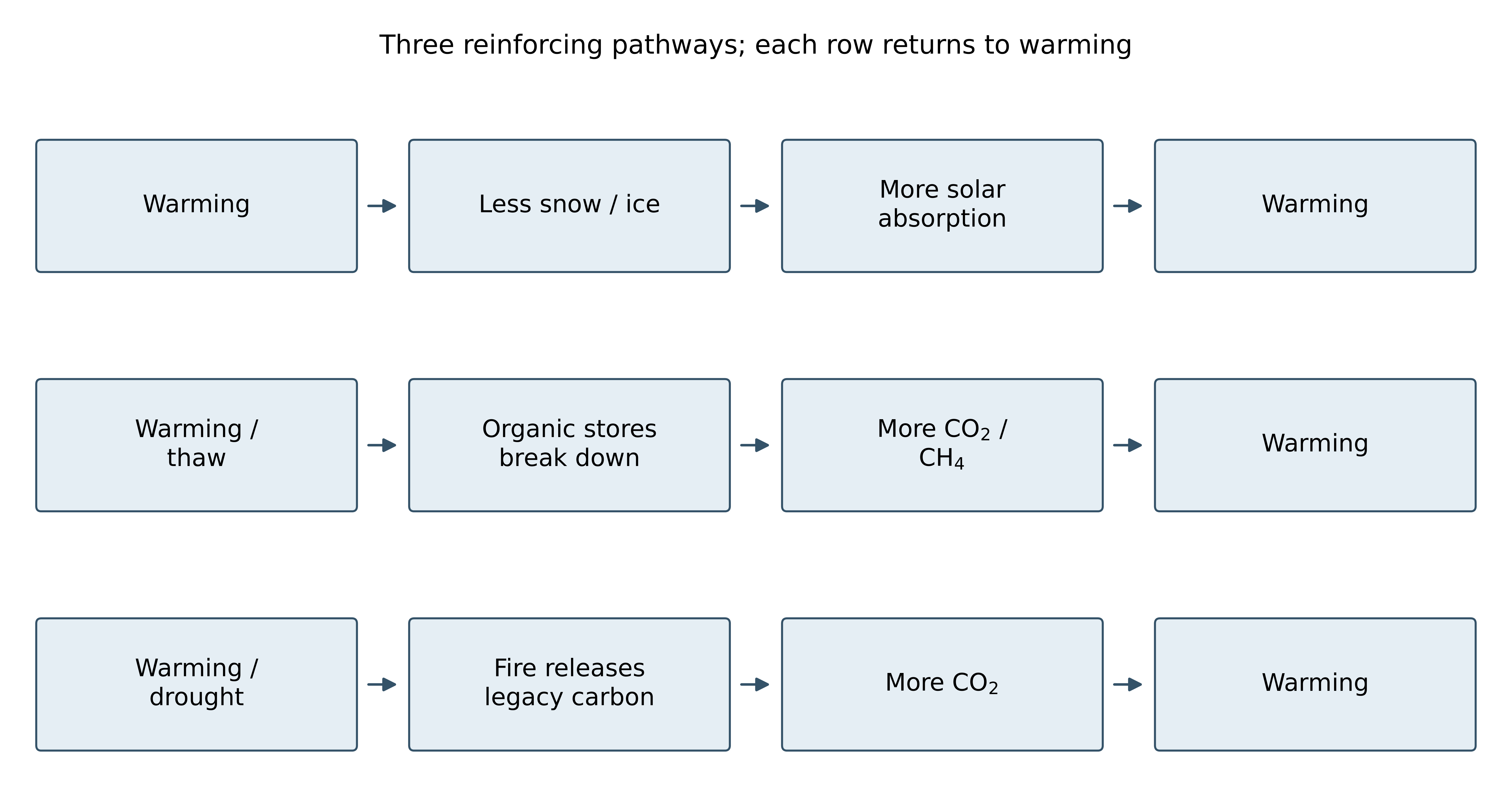
A positive feedback reinforces a change. It is not a claim that the outcome is beneficial or that a variable must become numerically positive. Identify an initial change, an intervening mechanism and an effect that strengthens the initial change.
Loss of reflective snow and ice can expose darker surfaces, increasing absorbed solar energy and promoting further warming and melting. Warming and thaw can expose previously frozen organic material to microbial decomposition. Aerobic pathways release carbon dioxide; waterlogged low-oxygen conditions can support methane production. Ice or frozen soil does not have to contain a pre-made store of every gas later produced.
Peat warming or drying can accelerate decomposition of accumulated organic matter. Drought and fire can release carbon stored in vegetation and soils, while damaged vegetation may take up less carbon. More greenhouse gas can then strengthen warming. Rates depend on moisture, oxygen, substrate and community: decomposition does not rise without limit at every temperature.
Each row closes back to warming. These are causal pathways, not measured rates or a claim that every location responds identically.
Carbon-rich deep water can release carbon dioxide when circulation brings it toward the surface. Warming can reduce gas solubility; circulation and biological processes also change exchange. This can contribute to feedback, but it does not mean the whole modern ocean is automatically a net carbon source. Local exchange and the global net balance are different quantities.
34.5
北方针叶林可能从碳汇转变为碳源
English
Taiga stores carbon in living biomass and organic soils. Warmer conditions, reduced winter snowfall and drought can stress trees, reduce primary production and contribute to forest browning. Fire can burn vegetation and older stored soil carbon, sometimes called legacy carbon. More frequent severe fires can leave less time to rebuild stocks between disturbances.
A sink takes up more carbon than it releases over the stated boundary and interval; a source releases more than it takes up. A large standing carbon stock is not automatically a current sink. Crossing a threshold into repeated loss can reinforce warming and make recovery harder, illustrating a possible tipping process.
Walker and colleagues' boreal-soil research used radiocarbon evidence after Canadian fires to investigate combustion of legacy carbon, including vulnerability in dry, younger forests. This supports a mechanism of loss; it does not supply one universal age or temperature at which every boreal forest tips.
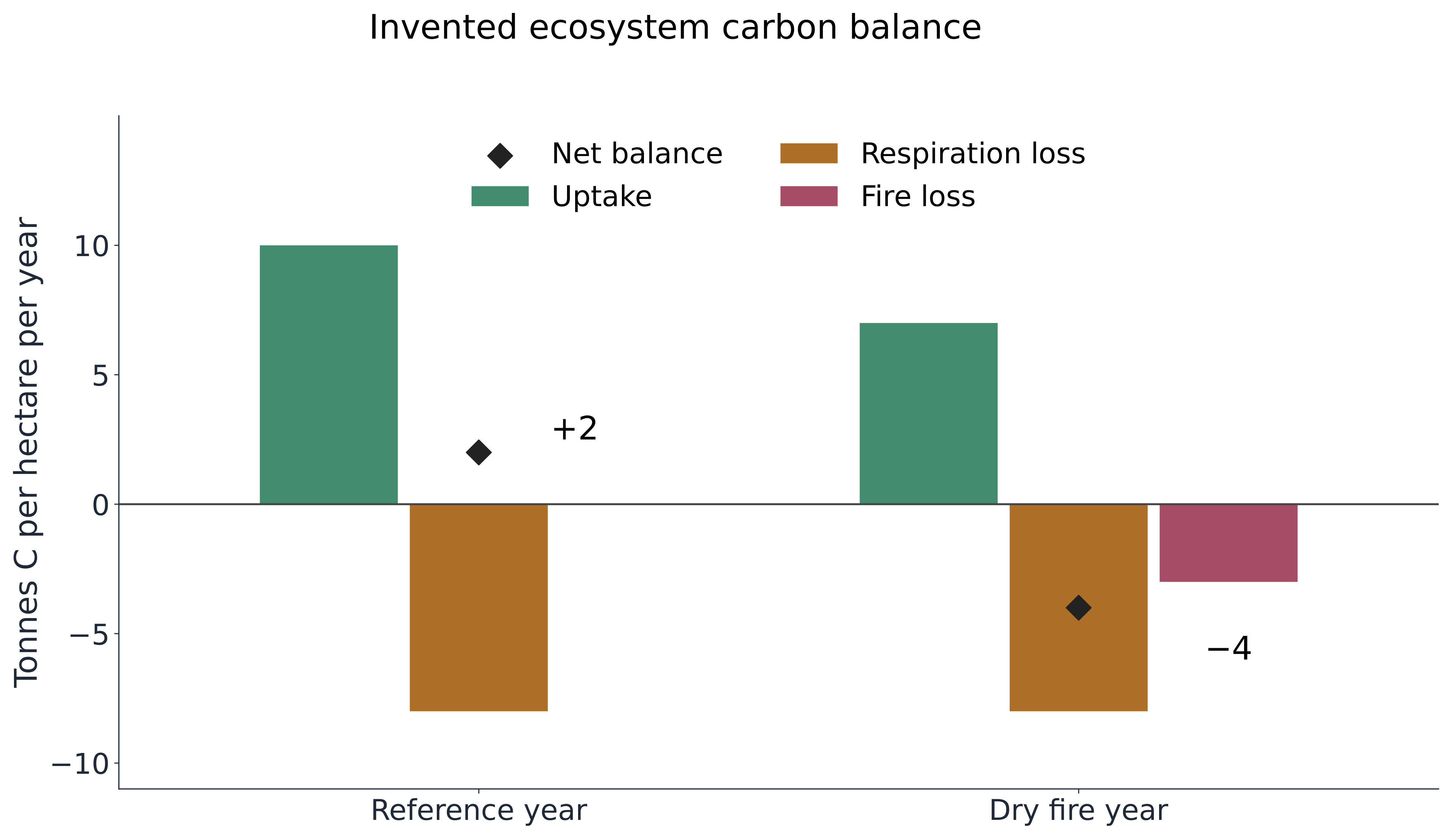
For a defined hectare, annual uptake is 10 tonnes C and respiratory loss 8, with no fire: net gain is 2 tonnes C. During a dry fire year, uptake 7, respiration 8 and combustion loss 3 give $7-8-3=-4$ tonnes C: a net source over that year. Even without fire, $7-8=-1$ would remain a loss under those conditions.
Positive net balance means carbon retained by this defined ecosystem. Combustion is counted separately from respiration; other exchanges are excluded by the model.
Report carbon mass consistently: tonnes of C are not tonnes of carbon dioxide. A one-year source observation does not by itself prove permanent collapse; repeated measurements of biomass, soils, production, respiration and disturbance are needed.
34.6
极地冰层消融改变繁殖平台及食物获取途径
English
Landfast sea ice is attached to the coast or another fixed feature; drifting sea ice moves with winds and currents. Both are sea ice, distinct from a land-based glacier. Habitat consequences depend on ice position, season and persistence, not just the annual total area.
Emperor penguins need the sea-ice platform to last until chicks can swim (schematic timing)
Emperor penguins, Aptenodytes forsteri, commonly breed on stable Antarctic sea ice. Early breakup can remove the platform before chicks develop waterproof plumage, causing breeding failure. Fretwell and colleagues' satellite study reported evidence of probable failure at four of five colonies studied in the Bellingshausen Sea region during 2022. That regional result is not a claim that every Antarctic colony failed or every chick was directly observed.
Arctic walruses use sea ice as resting platforms near feeding areas over continental shelves. Retreat beyond suitable shallow feeding grounds can increase travel costs or concentrate animals at coastal haulouts. Calves and yearlings can be vulnerable to trampling during disturbance of crowded groups. Walruses feed on benthic organisms, not ice; see the Marine Mammal Commission's account.
34.7
海洋变暖和环流影响营养输送及生产力
English
Sunlit surface waters can support photosynthesis but become depleted of mineral nutrients. Upwelling and mixing bring nutrient-rich deeper water into the illuminated layer. Temperature, salinity, winds and currents influence this supply; warm water does not manufacture extra nitrate merely by being warm.
Mixing delivers deep nutrients to the sunlit layer; stronger stratification cuts that supply
A warmer, less dense surface layer can strengthen stratification and reduce vertical mixing with deeper water. Changes in currents or wind-driven upwelling can alter timing and extent of nutrient delivery. Where nutrient supply limits producers, reduced delivery can lower primary production and the energy entering marine food chains. Effects are regional: do not conclude that every current weakens or every coastal upwelling system changes in the same way.
In a comparison, production falls from 500 to 400 units per square metre per year: a reduction of $100/500=20\%$. At an assumed transfer fraction of 0.10, the next trophic level receives 50 then 40 corresponding units. That is a conditional energy-flow model, not a universal efficiency or a direct prediction of fish catch.
34.8
变暖可能导致物种分布向高纬度或高海拔迁移,但无法保证其成功逃逸
English
A species may establish at a cooler leading edge while losing suitable conditions at a warmer trailing edge. A range shift is a distributional change, not an individual tree walking north or an automatic genetic adaptation. Dispersal, establishment, soil, partners, competition and habitat barriers constrain the response.
Freeman and Class Freeman's New Guinea mountain resurveys documented upslope shifts compared with earlier surveys. Near a summit, moving upward can reduce available habitat; a mountain is not an unlimited staircase. Match survey effort, season and detection when comparing boundaries.
North American trees show varied responses. Sittaro and colleagues' Quebec inventories reported predominantly northward shifts among the studied species, with variation and lag behind warming. Zhu and colleagues' adult–seedling comparison found patterns consistent with contraction for many eastern US species. Juvenile/adult differences suggest recruitment changes but are not identical to tracking every boundary through time. These findings oppose a universal claim that all tree ranges simply move north together.
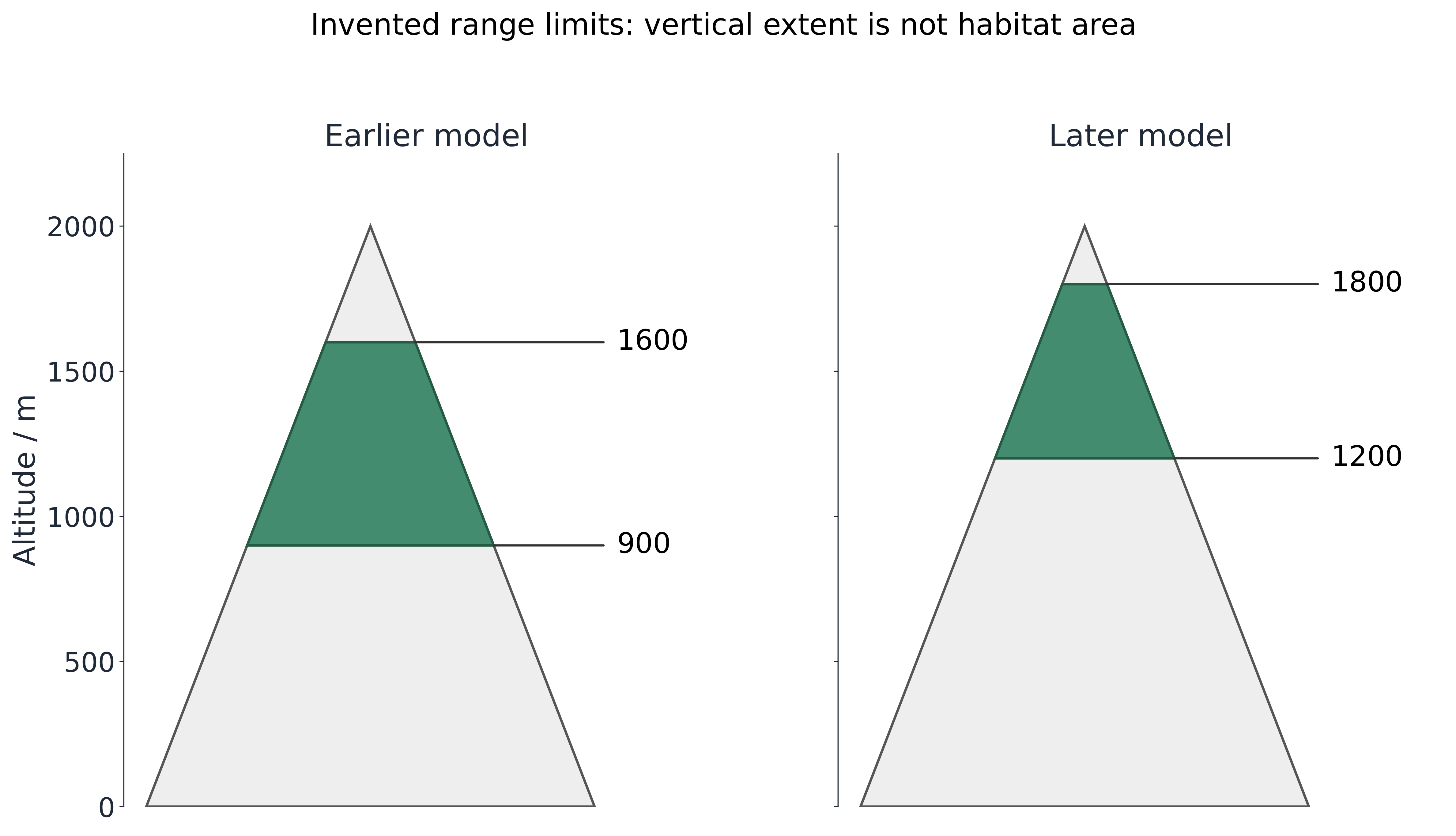
Vertical extent is not habitat area. The model illustrates a constraint, not measured New Guinea bird distributions.
In the model, limits 900–1600 m give a 700 m vertical extent; later limits 1200–1800 m give 600 m. The lower boundary rises 300 m, the upper 200 m, and extent contracts by $100/700\times100\approx14.3\%$. Actual area requires topography and habitat mapping, not simply subtraction of heights.
34.9
珊瑚白化和钙化减少是不同的威胁
English
Reef-building corals are animals with photosynthetic symbionts that supply much of their organic nutrition. Heat stress can disrupt the association and cause loss of symbionts or their pigments: bleaching. The underlying pale skeleton becomes conspicuous. A bleached coral is stressed but not automatically dead; prolonged or repeated stress can cause mortality and reduce recovery.
A bleached coral: heat stress made it expel its symbiotic algae, so the white skeleton shows through the clear tissue; if the stress lasts, the coral can starve and die
Rising carbon dioxide also changes seawater chemistry. Dissolved carbon dioxide increases hydrogen-ion concentration and lowers pH; carbonate availability can decline, making calcium-carbonate skeleton formation more difficult. Acidification means a pH decrease, not necessarily a value below 7. It is not the same mechanism as heat-induced bleaching. See NOAA's ocean-acidification explanation.
Loss of coral cover and structural complexity can remove feeding, shelter and breeding habitats, affecting the wider reef food web. Pollution, disease and destructive disturbance interact with warming and chemistry. Reduced local pressures may improve resilience but cannot by themselves remove global greenhouse-gas forcing.
34.10
碳封存与生态适应解决问题的不同方面
English
Mitigation 减缓 addresses causes, for example reducing fossil-fuel emissions or increasing durable carbon uptake. Adaptation 适应 reduces harm from impacts, for example reconnecting suitable habitats or adjusting water management. One project can contribute to both, but an adaptation measure does not automatically reduce atmospheric greenhouse gases.
Cause, climate change and impact boxes with mitigation acting on the cause and adaptation on the impact
Afforestation establishes forest on land not recently forested; forest regeneration restores tree cover through recovery. Growing vegetation takes up carbon, but net sequestration depends on soil disturbance, respiration, harvest, fire risk, management and what would otherwise happen. Carbon is not stored permanently merely because a seedling is planted.
Plantations of non-native trees can produce rapid biomass growth under suitable conditions; native regeneration can support habitat and ecological functions. Compare the same timescale, boundary, baseline, biodiversity effects and permanence risks. Species choice, water demand and reflectivity matter; neither approach is automatically best everywhere.
Restoring peat-forming wetlands can raise water tables and slow aerobic decomposition, allowing organic matter to accumulate when production exceeds loss. Peat formation occurs in temperate and boreal zones and can be rapid in suitable tropical systems. Rewetting can also affect methane emissions, so carbon storage and total climate effects need explicit accounting rather than a blanket zero-emission claim.
Policy comparisons require evidence about effectiveness, cost, equity and uncertainty. A cheap intervention that displaces emissions elsewhere may have little net benefit. State which criterion is being judged and whether the estimate includes construction, maintenance, land-use change and later carbon release.
Distinguish weather, climate, a temperature anomaly and a causal inference. Why does ice-core correlation alone not establish the whole greenhouse mechanism?
Explain human carbon dioxide and methane sources, concentration versus emission rate, and infrared absorption/emission. For incoming 240 and reflected 72 power units, calculate absorption and reflected percentage.
Explain three reinforcing feedbacks, including snow/ice, permafrost/peat and fire. Explain how deep-water carbon release can contribute without the whole ocean necessarily becoming a net source.
Explain a boreal sink-to-source mechanism and legacy carbon. A model hectare takes up 1,200 kg C annually, loses 900 by respiration and 450 in fire. Calculate net balance and interpret its sign and timescale.
Compare emperor penguin and walrus ice-habitat dependence. Give a limitation of the regional penguin study and explain why seasonal timing and location matter.
Explain stratification, upwelling and nutrient limitation. Calculate the percentage production fall from 500 to 400 and corresponding next-level supply under assumed 10% transfer; state a limit.
Use the New Guinea and North American examples to evaluate a universal northward/upslope escape claim. Calculate changes in model lower/upper limits and vertical extent; why is extent not area?
Distinguish heat-induced coral bleaching from acidification and reduced calcification. Explain how coral loss can affect the wider ecosystem without assuming all bleached colonies are dead.
Distinguish mitigation and adaptation. Compare afforestation, native regeneration and peatland restoration using boundaries, time, permanence, biodiversity and possible methane effects.
For incoming 180 and reflected 36 units, calculate reflection and absorption. Explain why this budget alone cannot predict a unique temperature or a policy's full climate effect.
Design a repeated comparison of ecological responses along a climate gradient, controlling sampling effort and timing. Distinguish range movement, plasticity and evidence of evolution; identify a confounder.
34.12
例题答案
English
Weather is short term; climate is a longer distribution. An anomaly uses a baseline. Association can involve feedback or common drivers; radiative physics and independent observations support greenhouse causation.
Fossil burning/land change add carbon dioxide; fuel leaks, anaerobic systems and ruminants add methane. Concentration includes removal as well as input. Gases absorb/emit infrared. Absorption $=240-72=168$; reflection $=72/240=30\%$.
Ice loss increases absorption; thaw/peat change supports microbial gas release; drought/fire releases stored carbon and can reduce uptake. These can reinforce warming. Deep-water ventilation and solubility affect exchange, while the global ocean can still absorb carbon overall.
Drought/browning reduce uptake; frequent fire can combust legacy stores. Net $=1200-900-450=-150$ kg C per hectare over the year: a source. A single year does not establish irreversible collapse or a permanent source.
Penguins need a stable platform until fledging; early breakup risks chicks. Walrus platforms support resting near benthic feeding; crowding/longer journeys add risks. The 2022 result concerns five studied regional colonies, with probable failure inferred from imagery; it is not a census of all Antarctic chicks.
Surface stratification can reduce deep nutrient delivery; changed winds/currents alter upwelling. Production fall $=100/500=20\%$; 10% model supply is 50 then 40. Efficiency and regional response vary; catch cannot be read directly from these values.
Responses vary with dispersal, recruitment, barriers and survey design; some ranges lag or contract. Lower limit rises 300 m; upper 200 m. Extent 700 → 600 m contracts $100/700\times100\approx14.3\%$. Area needs topographic habitat mapping.
Heat disrupts symbiosis/pigments; prolonged stress can kill. Carbon dioxide lowers pH and carbonate availability, hindering skeleton formation; pH need not fall below 7. Lost structure and production affect other species. Bleaching can be reversible under suitable conditions.
Mitigation addresses drivers; adaptation reduces harm. Compare net additional uptake and avoided losses, baseline, duration, water/soil/biodiversity effects and reversal risk. Plantations are not universally best; native regeneration is not automatically fastest. Rewetting can reduce oxidation while changing methane release.
Reflection $=36/180=20\%$; absorption $=180-36=144$. Outgoing radiation, heat transfer and other budget terms are omitted; a policy also needs full boundaries and evidence of net effects.
Match season, survey effort, methods and habitat; repeat sites and measure temperature plus population responses. A shifted distribution or individual timing response alone is not genetic evolution. Land-use change, detection or food shifts can confound climate attribution.
34.13
考试技巧
English
Trace a specified pressure to a biological mechanism and population or ecosystem consequence. State baseline, units, boundary and timescale. Distinguish a model from real study evidence and a plausible mechanism from unique causal proof.