This handout covers D3.2: inheritance through gametes, genetic crosses, genotype and phenotype, dominance patterns, human examples, pedigrees, continuous variation and box plots.
Prerequisites: chromosome sets, meiosis, fertilization and gene expression. Probabilities predict possible outcomes, not a fixed order of offspring.
30.2
配子传递等位基因,受精恢复两套染色体
English
Two parents can share a phenotype yet produce an offspring with a different phenotype. The explanation can be inheritance of recessive variants, rather than a new mutation in every such offspring.
A homologous pair carries the same genes at the same loci, but the alleles (versions) may differ
An allele 等位基因 is a variant of a gene. In a diploid cell, an autosomal gene normally has two copies, one on each member of a homologous chromosome pair. The copies may carry the same or different alleles. A gamete receives one member of each pair and hence one allele at each ordinary autosomal locus. Fertilization combines two haploid contributions and restores the diploid complement.
The genotype 基因型 records the alleles carried at the locus or loci being considered. AA and aa are homozygous; Aa is heterozygous. A capital letter does not mean a physically larger chromosome or a more common allele. A gene specifies a locus and function; its alleles are alternative versions, not two unrelated genes simply because their letters differ.
In flowering plants, controlled crosses transfer pollen from a chosen parent to a receptive stigma. For a flower capable of selfing, remove its anthers before pollen release where appropriate, protect it from unintended pollen, apply the chosen pollen and label the cross. Bagging and suitable controls help detect contamination. The female gamete is within an ovule in the ovary; applying pollen directly to a leaf does not carry out the intended cross.
A controlled plant cross, and the P, F1 and F2 generations
The P generation is the parental generation. Its offspring are F1; crossing or selfing appropriate F1 individuals produces F2. These labels describe relationships, not automatically pure-breeding genotypes. Controlled crosses investigate inheritance and develop varieties; selection for one trait can have trade-offs.
Write four things before a Punnett grid: parental genotypes, the phenotype key, possible gametes, and the inheritance assumptions. Put one parent's gametes along each edge and combine one from each to fill a cell. Each grid cell represents a possible fertilization, not one compulsory individual in a family.
30.4
表型取决于基因型,有时也受环境影响
English
Phenotype is an observable characteristic, including a measurable biochemical trait. A phenotype may depend mainly on inherited sequence in the stated context, mainly on an environmental event, or on interaction between the two. Ordinary ABO type is useful for a relatively simple inherited trait. A scar from an injury illustrates an acquired effect; height reflects many genes and environmental conditions such as nutrition.
Hydrangea flowers are blue on acid soil and pink on alkaline soil: the environment changes the phenotype
Avoid claiming that every phenotype uniquely identifies genotype. With complete dominance, both AA and Aa can have the same phenotype. Nor does an identical genotype require identical measured values in every environment.
Phenotypic plasticity is the capacity for one genotype to develop different traits in different conditions through changes in expression and development. Sun-exposed and shaded leaves on a plant can differ in structure; changes in skin pigmentation after UV exposure provide another context. Such changes do not require a new inherited DNA sequence. Some are reversible, whereas a developed structure may persist after the environment changes. Plasticity is not proof that an acquired trait will be genetically inherited.
Phenotypic plasticity: the same genotype develops different leaves in sun and shade.
30.5
完全显性可用于预测指定杂交的概率
English
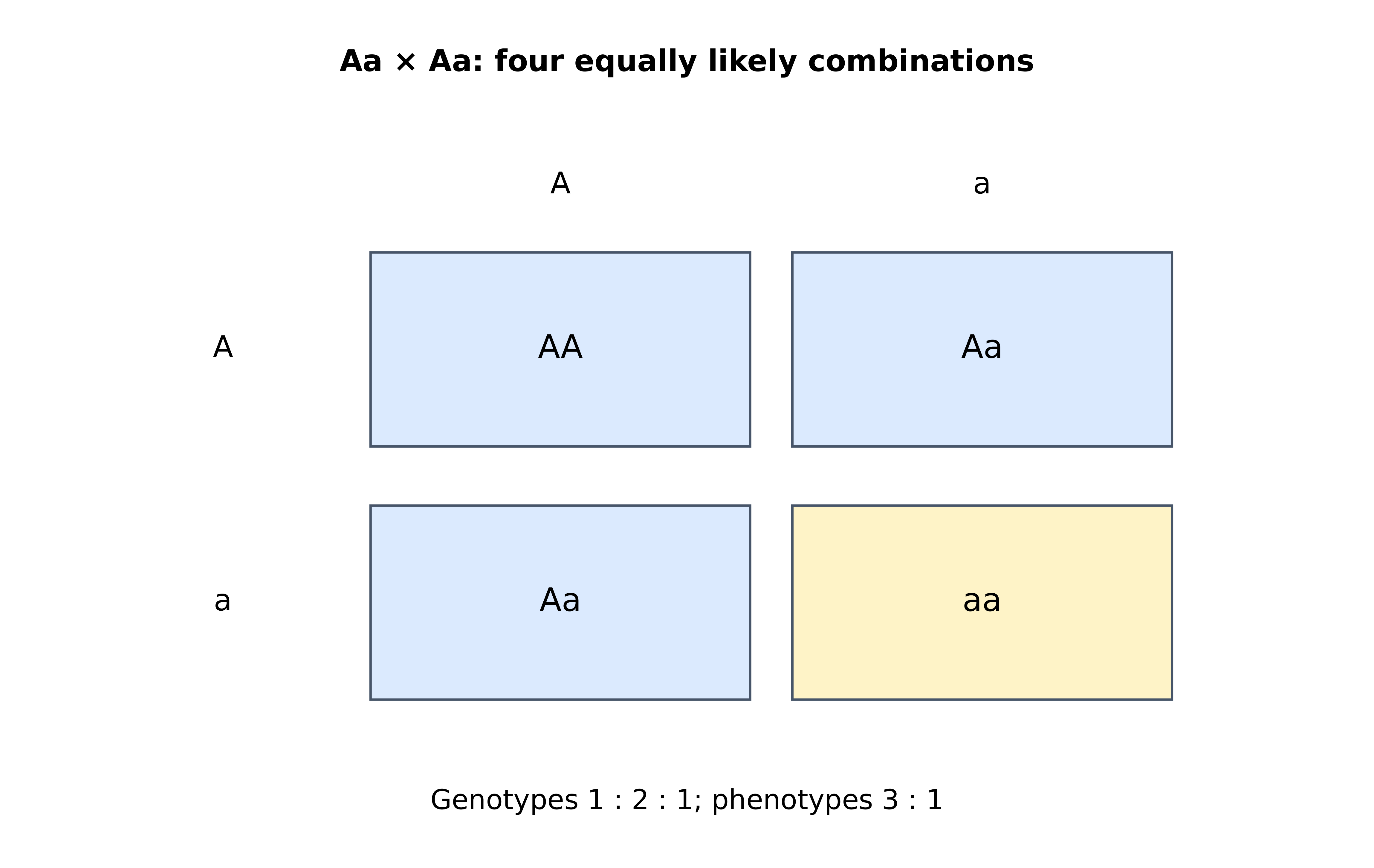
In a plant, A gives purple flowers and aa gives white flowers under complete dominance. A heterozygote makes A and a gametes in equal proportions in the normal segregation model. Crossing Aa × Aa gives AA, Aa, Aa and aa: genotype probabilities 1/4, 1/2 and 1/4; phenotype probabilities 3/4 purple and 1/4 white.
The four cells are equally likely under the stated model. They do not prescribe the order or exact composition of a four-offspring family.
A test cross with aa distinguishes possible dominant-phenotype genotypes through offspring evidence. AA × aa predicts all Aa. Aa × aa predicts half Aa and half aa. Observing white offspring supports the heterozygous interpretation under this model; observing only purple offspring in a small sample does not prove AA with certainty.
For Aa × Aa and 20 offspring, the expected number of aa is $20\times1/4=5$. A real count can differ through sampling. Under independent fertilizations, the probability that two specified offspring are both aa is $(1/4)^2=1/16$; it is not 1/2 because two offspring were mentioned. A previous outcome does not force the next one to complete a ratio.
Dominance describes the heterozygote phenotype. It does not mean stronger, healthier, evolutionarily preferable or common. One functional allele may supply enough enzyme for the dominant phenotype in a particular case; other molecular mechanisms and dominance patterns exist.
探索
Aa × Aa:概率而非出生顺序
简单的完全显性模型预测的是概率,不是后代出现的固定顺序。
30.6
PKU将隐性基因型与代谢及环境联系起来
English
Classic phenylketonuria, PKU, is commonly caused by variants affecting the PAH gene. Its product, phenylalanine hydroxylase, normally helps convert phenylalanine to tyrosine. Reduced activity can allow phenylalanine to accumulate and harm development if the condition is untreated. This is a metabolic explanation, not a claim that phenylalanine is always an unwanted substance: it is also an essential amino acid.
Blood from an infant's heel is spotted on a card for the PKU screening test: early diagnosis lets a low-phenylalanine diet prevent harmA dominant allele shows with one copy; a recessive needs two
The ordinary teaching model is autosomal recessive. Two unaffected carriers can have an affected child if each contributes a disease-associated allele. Using A for adequate function and a for the recessive variant, Aa × Aa gives a 1/4 aa probability per pregnancy under the model. Human disease-associated variants are more diverse than a single letter suggests.
Dietary management can change the consequences of the genotype; it does not change an aa genotype into AA. This illustrates genotype–environment interaction. Actual screening and treatment depend on clinical assessment, rather than a classroom Punnett grid. MedlinePlus explanation of PKU genetics.
30.7
复等位基因与ABO血型区分群体多样性与单一基因型
English
A gene can have many alleles in a population, including variants originating through nucleotide substitutions. A SNP is a single-nucleotide variant at a locus; it need not cause disease. One diploid individual still normally carries only two alleles of an autosomal gene, even if dozens exist in the wider gene pool.
A gel-card blood-group test: red cells clump in a column when they carry the antigen its antibodies recognise; this sample is O positiveIAi × IBi: all four blood groups appear, each with probability 1/4
For the ordinary ABO model, use $I^A$, $I^B$ and $i$. $I^AI^A$ or $I^Ai$ gives type A; $I^BI^B$ or $I^Bi$ gives B; $I^AI^B$ gives AB; ii gives O. The A and B alleles are codominant in the heterozygote, and each is dominant over i in this model. AB cells express both A and B antigen features, rather than one intermediate antigen called “half A”.
An $I^Ai\times I^Bi$ cross gives four equally likely genotypes: $I^AI^B$, $I^Ai$, $I^Bi$ and ii. Thus AB, A, B and O each have probability 1/4. An $I^AI^B\times ii$ cross gives half A and half B, with no ordinary-model AB or O offspring. These simplified crosses concern ABO phenotype; they are not a full account of every blood-group system or rare expression exception.
30.8
不完全显性与共显性的区别
English
In a model of four-o'clock flowers, Mirabilis jalapa, homozygous red and white parents produce pink heterozygotes. This is incomplete dominance: the heterozygote phenotype is intermediate. Use distinct superscript allele symbols, such as $C^R$ and $C^W$, rather than implying that one must completely dominate.
Blended look or both shown
Crossing two pink heterozygotes gives 1/4 $C^RC^R$ red, 1/2 $C^RC^W$ pink and 1/4 $C^WC^W$ white. Both genotype and phenotype ratios are 1:2:1. The alleles have not permanently blended into one pink allele: red and white phenotypes can reappear in offspring.
Codominance instead gives distinguishable contributions of both alleles, as in ABO type AB. Dominance categories describe a defined phenotype. Molecular measurements can reveal differences that an outward category hides, so always state which characteristic the cross predicts.
30.9
性染色体改变X连锁等位基因的遗传方式
English
In the common human XX/XY model, eggs carry X and sperm carry X or Y. The sperm's sex chromosome therefore contributes to whether the zygote is XX or XY. These chromosomes influence male-typical or female-typical development through gene regulation; actual developmental variations mean the simplified chromosome model does not describe every individual in full.
Two colour-vision test plates: people with red–green colour blindness, an X-linked recessive trait, see 21 or no number at all on the secondBecause the gene is on the X chromosome, a carrier mother's sons may be colour-blind while her daughters are only carriers — a different result by sex
The X chromosome carries many more genes than the Y. A typical XY individual has one copy of most X-linked loci, so there is no second corresponding allele on Y to mask a recessive effect. Do not write a haemophilia allele on Y when the relevant gene is X-linked.
Haemophilia A and B provide X-linked examples involving clotting-factor genes. Write $X^H$ for the model normal allele and $X^h$ for the disease-associated allele. An $X^HX^h$ parent crossed with $X^HY$ gives equal model probabilities of $X^HX^H$, $X^HX^h$, $X^HY$ and $X^hY$. Half of sons are predicted to inherit the affected genotype; one quarter of all offspring are affected sons if X- and Y-bearing fertilizations are equally likely.
An affected father passes his X to daughters and Y to sons in this model, so he does not transmit his X-linked allele directly to sons. Females can also have haemophilia; heterozygotes can have bleeding symptoms, including through X-inactivation effects. The simple recessive grid must not become “females are always symptomless”. MedlinePlus inheritance explanation.
30.10
系谱检验模型而非仅凭一人证实
English
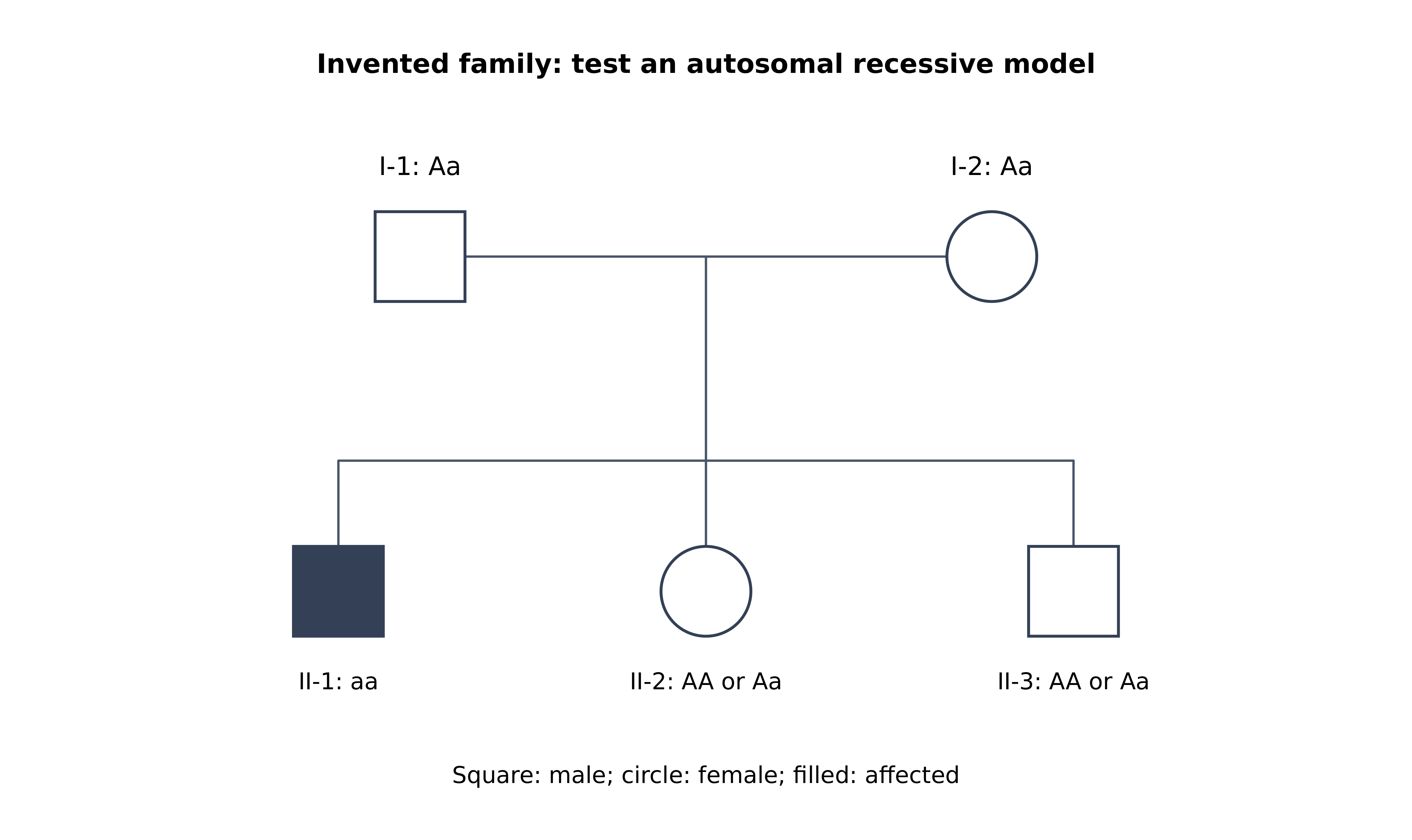
A pedigree records relationships and a defined trait across generations. In the conventional diagrams here, squares represent males, circles females and filled symbols the studied affected phenotype. State any additional symbol key. A horizontal connection joins parents; vertical descent and a sibling line show their children. Number individuals so an inference refers to a specific person.
This is an explicitly simplified, fully penetrant autosomal model with no new mutation. The family pattern is used to test that model, not to diagnose a real family.
Under a fully penetrant autosomal recessive model, two unaffected parents with an affected aa child must each supply a, so both are Aa. An unaffected sibling can be AA or Aa. Among unaffected offspring of Aa × Aa, the conditional probability of being Aa is $2/3$, because the two Aa possibilities are compared with the three unaffected possibilities, not all four outcomes.
An affected child of unaffected parents is inconsistent with a simple fully penetrant dominant model without new mutation, but real pedigrees can involve new variants, incomplete penetrance or other mechanisms. Small families can fit more than one inheritance pattern. Male-to-male transmission argues against ordinary direct X-linked transmission; absence of an affected son in one small family does not establish X linkage.
Inferring a general model from several observed families is inductive reasoning. Using an assumed model to infer a parent's required genotype is deductive reasoning. Distinguish the provisional model from deductions conditional on it. Close relatives can share the same rare recessive allele through common ancestry, increasing the chance of a homozygous child; that is a genetic reason behind restrictions on close-relative marriage in many societies, not a claim that every such child must be affected.
30.11
连续变异需要适当的测量与统计描述
English
ABO types are discrete categories. Skin pigmentation varies continuously and is influenced by many genes and environmental factors, including UV exposure. Height is another continuous measurement. A measurement rounded to whole centimetres is still sampling an underlying continuous variable; discrete recorded numbers do not make the underlying biology an ABO-like category.
Discontinuous variation falls into separate groups; continuous variation is a smooth range
For a numerical sample, the mean uses all values, the median is the middle after sorting, and the mode is the most frequent value, if one exists. Do not assign a numerical mean to arbitrary ABO category codes and treat it as a meaningful biological average.
A height sample in cm is 150, 152, 154, 156, 158, 160, 162, 164, 166, 190. The sum is 1612 cm, so mean is 161.2 cm. Median is $(158+160)/2=159$ cm. There is no mode because no value repeats. The unusually high value pulls the mean upward more than the median; investigate recording errors without deleting a valid observation merely because it is inconvenient.
30.12
箱线图区分观测到的极值与须的端点
English
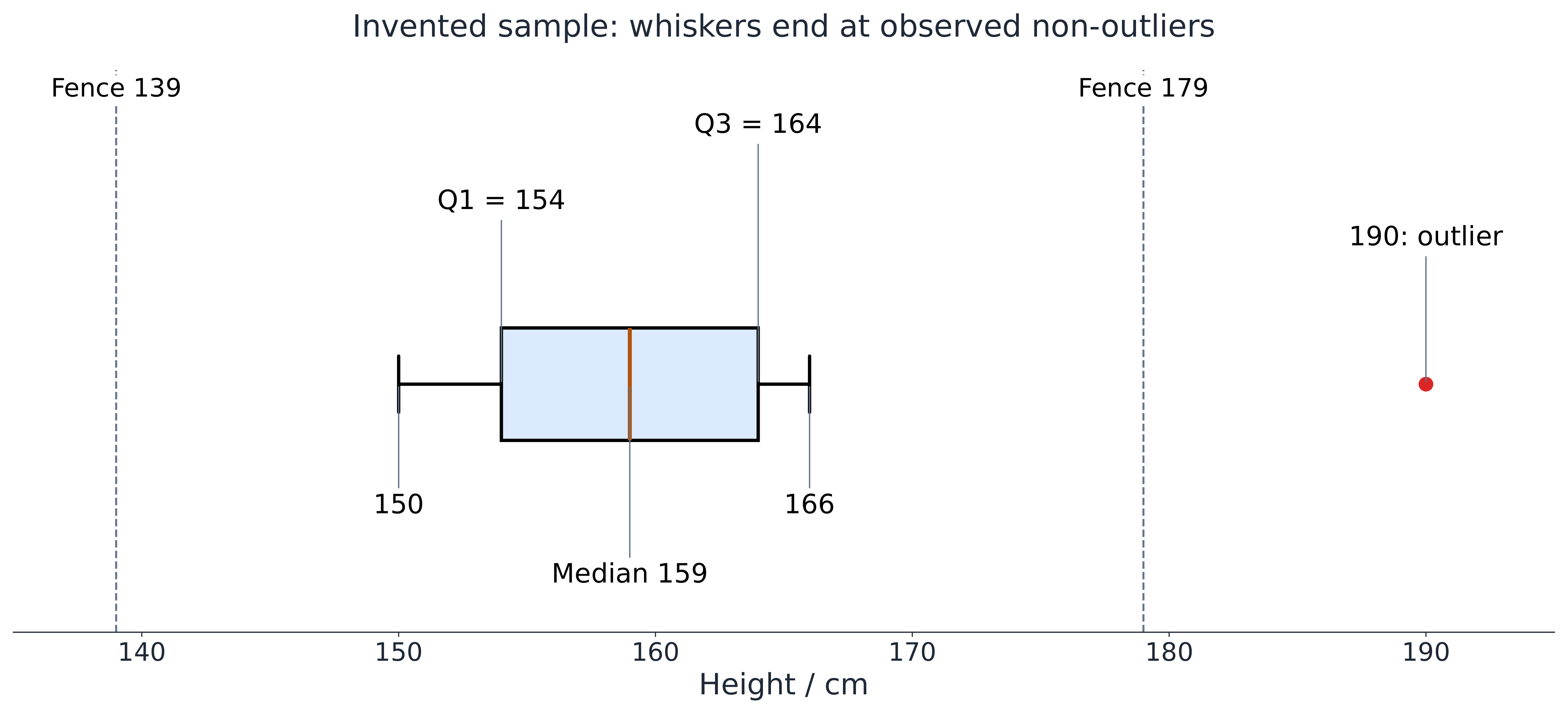
Using the median-of-halves convention for this ten-value sample, the lower five have median 154 cm and the upper five median 164 cm. Therefore $Q_1=154$, median 159 and $Q_3=164$ cm; interquartile range, IQR, is 10 cm.
Outlier fences are $Q_1-1.5\mathrm{IQR}=139$ cm and $Q_3+1.5\mathrm{IQR}=179$ cm. The 190 cm observation is above the upper fence and is plotted separately. Whiskers extend to the most extreme observed non-outliers, here 150 and 166 cm, not to the fence values if no observation lies there.
The sample maximum is 190 cm even though the upper whisker is 166 cm. State the quartile convention; different software conventions can give different quartiles for small samples.
Label units and distinguish minimum/maximum observations, quartiles, median and outliers. A point exactly on a fence is not beyond it. A box plot does not show every data value or necessarily reveal multiple clusters, so retain the underlying data where possible.
30.13
练习
English
Define allele, genotype, homozygous and heterozygous. Explain how gametes and fertilization transmit two autosomal alleles to a diploid offspring.
Outline a controlled cross between two flowering plants and distinguish P, F1 and F2. Why should unintended self-pollination be controlled?
Compare genotype and phenotype using one simple inherited example, one environmental effect and one interaction. Explain phenotypic plasticity without claiming that the DNA sequence must change.
For Aa × Aa with complete dominance, give genotype and phenotype probabilities, the expected aa count among 20 offspring, and the probability that two specified offspring are both aa. Contrast Aa × aa.
Explain the metabolic basis and recessive inheritance model of PKU. Why can dietary management change consequences without changing the genotype?
For $I^Ai\times I^Bi$, give the ordinary-model ABO outcomes. Contrast $I^AI^B\times ii$. Why can a population have three ABO alleles when one person has only two?
Two pink Mirabilis heterozygotes are crossed. Give genotype and phenotype ratios and distinguish this from codominance. Do the alleles permanently blend?
For $X^HX^h\times X^HY$, give the four possible offspring genotypes. State the probability of an affected son among sons and among all offspring. Explain why an affected father does not directly pass his X-linked allele to a son in the model.
Under a fully penetrant autosomal recessive model without new mutation, two unaffected parents have an affected child. Infer their genotypes and the carrier probability for an unaffected sibling. Distinguish the inductive model choice from a deduction conditional on it.
For 150, 152, 154, 156, 158, 160, 162, 164, 166 and 190 cm, calculate mean, median, mode, quartiles and IQR using the stated convention. Find outlier fences and distinguish the observed maximum from the upper whisker.
Explain why skin pigmentation is a continuous phenotype and why a rounded height measurement is not an ABO-like category. Give a reason to retain the underlying data alongside a box plot.
30.14
例题答案
English
An allele is a gene variant; genotype records the alleles carried. Homozygotes have matching alleles at the locus and heterozygotes different ones. Normal gametes carry one allele of each ordinary autosomal pair; fertilization combines two haploid contributions.
Choose parents, prevent unintended pollen/selfing where appropriate, apply selected pollen to a receptive stigma, protect and label the cross, and use controls. P are parents; their offspring F1; suitable F1 crossings/selfings yield F2. Labels alone do not specify homozygosity.
Ordinary ABO illustrates relatively simple inherited variation; an injury scar an acquired environmental effect; height gene–environment interaction. Plasticity changes expression/development of one genotype in different conditions, without requiring an inherited base-sequence change. AA and Aa can share a phenotype under complete dominance.
AA:Aa:aa = 1:2:1; dominant:recessive = 3:1. Expected aa $=20/4=5$; two specified aa offspring $=(1/4)^2=1/16$. Aa × aa predicts half Aa, half aa. These are probabilities/expectations, not compulsory family counts.
Reduced PAH activity impairs conversion of phenylalanine to tyrosine; accumulation can harm development. In the autosomal recessive model, two carriers have 1/4 affected probability per pregnancy. Management changes exposure/metabolic consequences, not aa into AA; real variants and clinical needs require more than a grid.
First cross: AB, A, B and O each 1/4. AB × O: half $I^Ai$ type A, half $I^Bi$ type B. Three population alleles do not require three copies in one diploid genotype. A and B are codominant; both dominate i in the ordinary model.
$C^RC^R:C^RC^W:C^WC^W=1:2:1$ gives red:pink:white = 1:2:1. Pink is intermediate; codominance gives distinguishable contributions of both alleles, such as ABO AB. The alleles segregate without permanent blending.
Equal probabilities of $X^HX^H$, $X^HX^h$, $X^HY$ and $X^hY$. Affected probability is 1/2 among sons, 1/4 among all offspring under equal sex-chromosome fertilization. A father gives Y to sons and X to daughters. Females can also be symptomatic; the simplified model does not exclude that.
Each unaffected parent supplies a to the aa child: both are Aa. Among unaffected siblings, AA, Aa and Aa give carrier probability 2/3. Inferring a model is induction; genotypes follow deductively under its assumptions.
Sum 1612; mean 161.2 cm; median 159 cm; no mode. $Q_1=154$, $Q_3=164$, IQR 10 cm. Fences 139 and 179 cm; 190 is an outlier. Observed minimum/maximum are 150/190; non-outlier whiskers end at 150/166 cm. The upper fence is not an observed whisker endpoint.
Many genes and environment affect pigmentation continuously. Rounding changes recording, not the underlying characteristic. A box plot can hide clusters and individual errors; retain the data.
30.15
考试技巧
English
Write parents, gametes, phenotype key and assumptions before a grid. Distinguish genotype/phenotype and dominance/frequency. State the conditioning group for pedigree and X-linked probabilities. Label plot units, quartile convention, fences and observed whiskers.