跳到主要内容

D.2.3 · 水势

IB 生物 SL · 知识点 28

本主题的视频课程 打开视频页面
4:31

水势

植物组织在不同溶液中可能增重或失重。净水分移动的方向取决于水势 水势差,而非是否……

英语旁白 · 英中内嵌字幕

28.1

范围与先修条件

English

This handout covers D2.3: solvation, osmosis, responses of cells with and without walls, tissue investigations and isotonic applications. It retains the existing qualitative introduction to water potential.

Prerequisites: water polarity, membranes, diffusion and plant-cell structure.

28.2

溶剂化将水的极性与溶解的粒子联系起来

English

A potato strip can become firm in one solution and flexible in another. To explain this, begin with interactions between water and dissolved particles, then ask what can cross the cell membrane. The cell wall and any pressure that develops also matter.

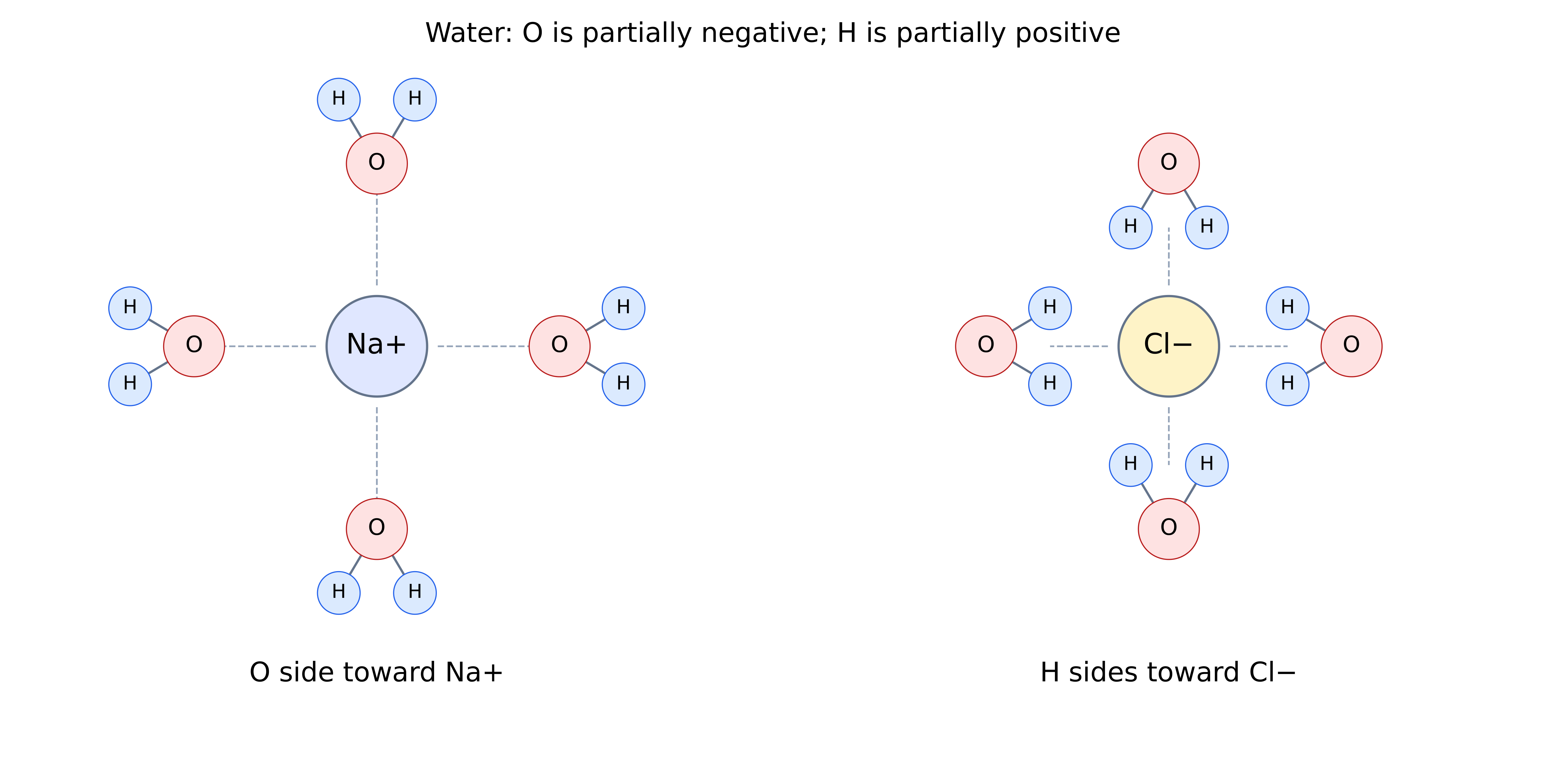
Water is polar: oxygen has a partial negative charge and the hydrogen atoms have partial positive charges. In a solution of sodium chloride, water molecules orient their oxygen side toward sodium ions and their hydrogen sides toward chloride ions. Attractions between ions and water help surround and separate the ions. The dissolved salt is not present only as intact solid grains hidden between water molecules.

Water molecules orienting differently around positive and negative dissolved ions
These schematic hydration arrangements show orientation, not a fixed number or permanent shell of neighbouring water molecules. Dashed attractions are not new covalent bonds.

Polar molecular solutes can interact with water through hydrogen bonding. For example, the hydroxyl groups of glucose can form hydrogen bonds with surrounding water. Glucose dissolving does not require the glucose molecule to split into sodium-like ions. Solvation is the surrounding of solute particles by solvent molecules; water is the solvent in these examples.

Do not describe all solute–water attractions as hydrogen bonds. An ion attracts the appropriately charged region of a polar water molecule; suitable polar groups on molecular solutes can participate in hydrogen bonding. The interactions and particle properties influence how readily substances dissolve.

28.3

渗透作用比较选择性透过膜两侧的溶液

English

Osmosis is the net movement of water through a selectively permeable membrane. For solutions at equal pressure, with solute particles that cannot freely cross that membrane, water moves overall from the less concentrated solution toward the more concentrated solution. Use solute concentration to state this comparison. Individual water molecules move both ways, but unequal rates produce a net transfer.

Three panels across a membrane: diffusion, with many particles on the high side moving to the low side; osmosis, with small water molecules crossing a partially permeable membrane from dilute to concentrated while large solute molecules cannot pass; active transport, with a carrier protein using energy to move ions from low to high concentration.
Diffusion and osmosis go down a gradient with no energy; active transport goes against it, using energy from respiration.
A container split by a partially permeable membrane, with few solutes and much water on the higher-water-potential side and many solutes on the lower side; water crosses towards the lower water potential
Water crosses to the lower water potential; the solute is too big to cross the partially permeable membrane

The membrane is essential. Mixing two solutions without a separating membrane also permits solute diffusion; it is not the same experiment. A selectively permeable membrane can allow water through while restricting particular dissolved particles. Many cells also have water-channel proteins, but a channel does not actively pump water against the relevant gradient.

Tonicity is a comparison relative to a particular cell and membrane. A hypotonic external solution favours net water entry, a hypertonic one favours net water loss, and an isotonic one produces no sustained net change in cell volume under the specified conditions. In a simple classroom model these correspond to lower, higher and equal effective solute concentration outside, respectively.

The qualification about effective solutes matters: equal total solute concentration does not always give equal tonicity if one solute readily enters cells. State the membrane conditions rather than assuming every dissolved substance has the same effect. A solution is not simply “hypertonic” without a comparison.

At dynamic equilibrium, exchange continues but opposing transfers balance. A steady cell volume does not show that all water molecules have stopped. Osmosis itself does not require ATP expenditure to drive water movement, although cells can use energy to regulate solute distributions or remove excess water.

28.4

无细胞壁细胞可能膨胀、破裂或皱缩

English

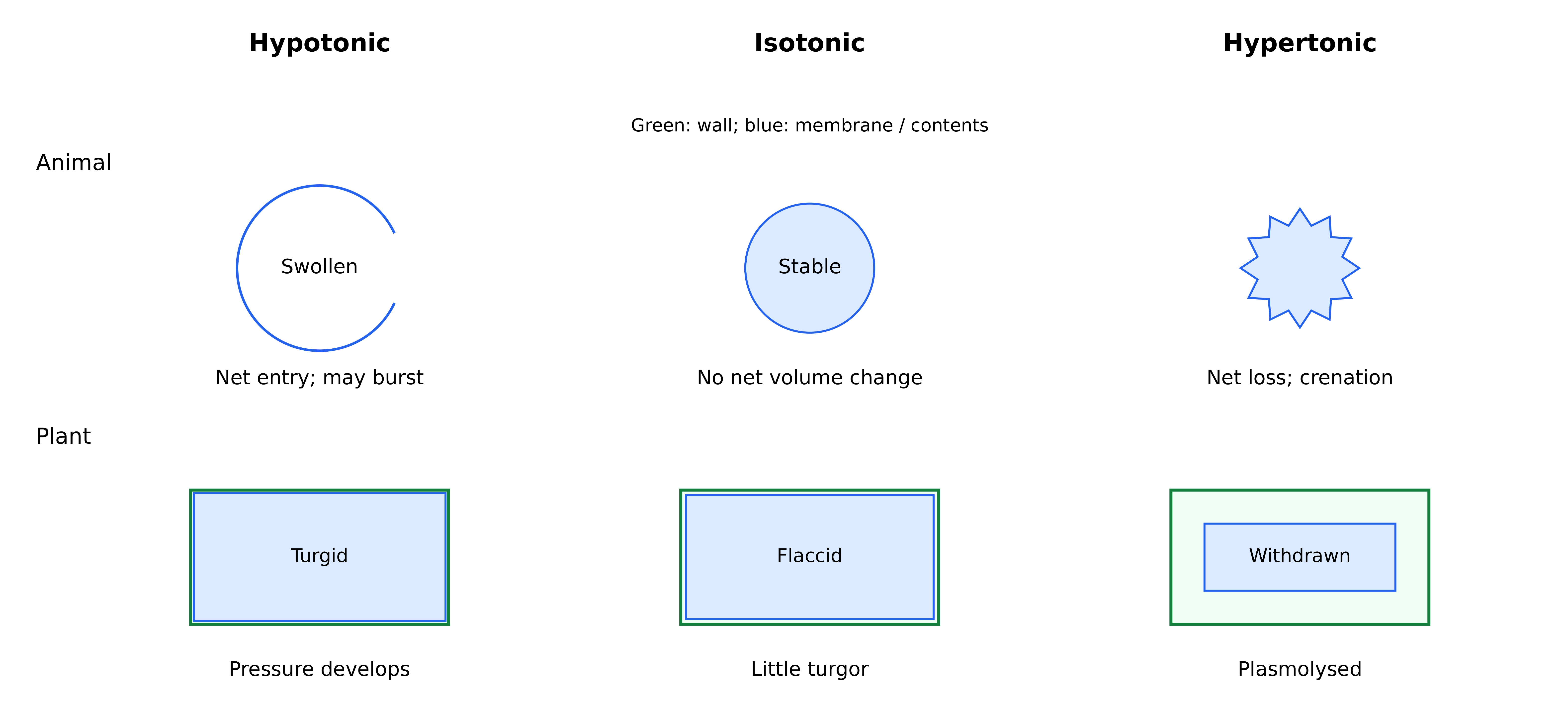
An animal cell lacks a rigid surrounding cell wall. In a sufficiently hypotonic medium it takes up net water and swells; its membrane can eventually rupture. This is lysis. The cell cannot build up the same wall-supported turgor as a plant cell. It is the osmotic gain and limited capacity to expand that matter, not the outside solution physically cutting the membrane.

Red blood cells: in a hypotonic solution net water enters and the cell swells and may burst; in an isotonic solution volume stays steady; in a hypertonic solution net water leaves and the cell shrinks with a crenated outline
Without a wall an animal cell lyses or crenates; it cannot become turgid or plasmolysed

In a hypertonic medium, net water loss reduces cell volume. A red blood cell can develop an irregular, shrunken outline called crenation. This differs from plasmolysis: the latter specifically involves the cell contents and membrane pulling away from a cell wall.

In an isotonic environment, an animal cell can maintain a relatively stable volume while water exchange continues. Multicellular animals regulate tissue fluid so that damaging sustained osmotic swelling or shrinkage is avoided. Isotonic does not mean chemically identical in every respect to the cytoplasm; ions, proteins and other substances can have different distributions.

Freshwater unicellular organisms face a different problem: their surroundings are commonly hypotonic relative to their contents. In organisms such as freshwater Paramecium, contractile vacuoles collect excess water and periodically expel it. Energy-dependent cellular processes support this removal. The water initially entered down an osmotic gradient; the organism does not stop all osmosis simply by living in freshwater.

28.5

植物细胞壁改变水进入细胞后的结果

English

A plant cell in a hypotonic medium takes up water. Its vacuole and contents expand, pressing the plasma membrane against the wall. The wall resists further expansion and turgor 膨压 develops: pressure of cell contents against the wall. The wall's opposing force limits net entry; it is not a selectively permeable lid that closes every pore.

Elodea leaf cells packed with green chloroplasts (light micrograph)
Animal and plant cell responses compared in hypotonic, isotonic and hypertonic environments
The plant wall remains outside the membrane. The plasmolysed model shows the membrane and contents withdrawn from the wall; the wall itself has not shrunk to match them.

A turgid cell helps support soft plant tissues. Loss of turgor can make tissue less firm and contribute to wilting. In a simplified isotonic comparison with little wall-supported pressure, a plant cell is flaccid rather than fully turgid. Its wall still exists; absence of strong turgor does not mean the wall has dissolved.

In a sufficiently hypertonic medium, water leaves, the vacuole and cell contents shrink, and the membrane can detach from the wall. This is plasmolysis. The wall is relatively permeable to water and many small solutes; the plasma membrane is the main selective boundary for the osmotic comparison.

If a suitable plasmolysed cell is returned to a hypotonic medium, water can re-enter and restore contact and turgor. This is not a guarantee that every damaged cell will recover: exposure duration and membrane injury matter. State the observed structure and the direction of net water movement before naming the condition.

词汇 训练
English 中文 拼音
turgor/ˈtɜːɡə/ 膨压 péng yā
28.6

通过受控比较研究组织质量与长度

English

Cut plant-tissue pieces from a comparable source, with a consistent diameter and length. Randomly allocate pieces across teacher-approved solution concentrations. Record initial mass or length, expose them for the same time at a controlled temperature, then measure again. Keep solution volume adequate and consistent, and cover containers when evaporation could change concentration.

Potato-tissue percentage mass change decreases with external solution concentration and crosses zero between 0.20 and 0.30 mol per litre *The dashed interpolation joins the neighbouring means around zero. *

For mass, blot in a consistent way before weighing so surface solution does not masquerade as water gained by tissue. Avoid squeezing different pieces with different force. Use the same measurement procedure and record instrument resolution. For length, measure comparable axes and avoid treating a curved strip's straight-line distance as its full length.

Use independent tissue pieces as replicates at each concentration. Reweighing the same piece improves a measurement check but does not supply another independent biological sample. Tissue source, age, damage, initial water status and variation among pieces can affect results. A whole tissue is not one perfectly uniform cell compartment.

Percentage change allows a fairer comparison when starting sizes differ:

$$\text{percentage mass change}=\frac{m_{\mathrm{final}}-m_{\mathrm{initial}}}{m_{\mathrm{initial}}}\times100.$$

A sample changes from 5.00 g to 5.40 g. The increase is 0.40 g and the percentage change is $0.40/5.00\times100=+8\%$. A 4.00 g piece changing to 4.20 g gains $5\%$. The first has the larger proportional gain. A piece changing from 3.00 g to 3.36 g gains 12%, but the reverse change is $-0.36/3.36\times100\approx-10.7\%$: the denominator changes.

Bars of percentage mass change for samples: 5.00 to 5.40 grams is plus 8 percent, 4.00 to 4.20 grams plus 5 percent, 3.00 to 3.36 grams plus 12 percent, and the reverse 3.36 to 3.00 grams minus 10.7 percent, though the mass change is the same 0.36 grams
Percentages compare fairly, and the base matters: +12% one way, −10.7% back

Use the same structure for percentage length change, replacing masses with lengths in consistent units. A strip going from 40.0 mm to 42.0 mm has gained $2.0/40.0\times100=5.0\%$. A mass and a length percentage need not be equal because volume, shape and tissue structure can change differently.

探索

增重相同,百分比变化却不同

A从5.00 g变成5.40 g,增加8%。比较另一个示例:从2.00 g同样增加0.40 g,增幅为20%。用各自初始质量作为基准,探索减重和零净变化。

28.7

估计零变化点并描述不确定性

English

Plot mean percentage change against external solute concentration, with units and clearly identified uncertainty bars. For a series at 0.00, 0.10, 0.20, 0.30, 0.40 and 0.50 mol/L, means are +12, +8, +4, −2, −6 and −10%. The zero crossing lies between 0.20 and 0.30 mol/L.
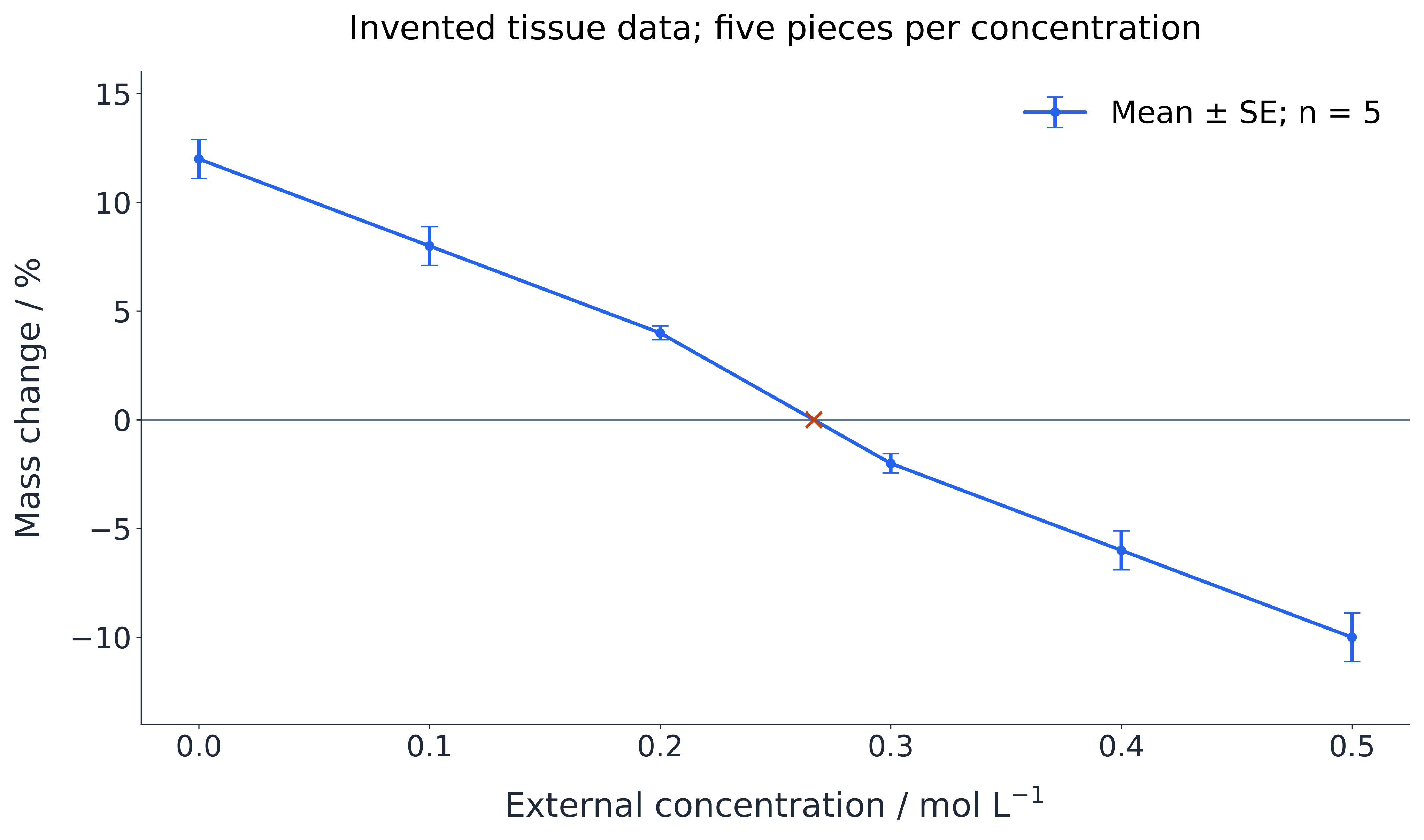
Tissue mass-change data with standard-error bars and a zero crossing between sampled concentrations *Each concentration has five independent pieces. *

If the relationship is approximately linear over that small interval, the crossing estimate is

$$c_0=0.20+\frac{4}{4+2}(0.30-0.20)\approx0.267\ \mathrm{mol/L}.$$

This is interpolation between neighbouring data, not proof of an exact constant for every cell. Sample closer to the crossing with more independent pieces to improve the estimate. A curve that is not locally linear requires a more appropriate fit; do not extrapolate a straight line far outside the measured range.

Standard deviation, SD, describes spread among individual results. Standard error, SE, describes uncertainty in an estimated mean under the sampling model; for independent results it can be calculated as SD divided by the square root of sample size. The course does not require memorizing these statistical formulae. Identify which statistic a graph shows rather than calling all bars simply “error”. More independent pieces can reduce SE without reducing biological variation as measured by SD.

For five changes of 3, 4, 5, 4 and 4%, the mean is 4%. The sample SD is about 0.71 percentage points and the SE about 0.32 percentage points. A separate set of five independent results with SD 2.0 percentage points has SE about 0.89. Compare spread and uncertainty of the mean separately. Overlapping SE bars alone are not a complete significance test.

A zero net tissue-mass change is consistent with an isotonic condition for that tissue and time interval. It does not show that all molecular exchange stopped, that every cell has the same internal concentration, or that solute and pressure contributions have been measured separately. Leakage of solute, damaged membranes or surface-water errors can also affect the result.

28.8

等渗溶液在医疗应用中保护细胞

English

In intravenous fluid treatment, the effective osmotic properties of a fluid matter because large sustained water transfers across cell membranes can harm cells. Appropriately chosen isotonic fluids can help avoid osmotic swelling or shrinkage. Actual fluid selection also depends on composition, purpose and the patient's condition. A manufacturer’s isotonic sodium chloride label gives one clinical example.

Organs prepared for transplantation are bathed or perfused with controlled preservation solutions. Avoiding damaging osmotic shifts is one requirement. Temperature, oxygen supply where relevant, metabolism and chemical composition also affect preservation. This example applies the membrane principle rather than supplying a recipe for a clinical fluid.

28.9

水势联系溶质效应与细胞压力

English

Water potential 水势 compares the tendency of water to move relative to a reference. Net water movement is from higher toward lower water potential through a suitable water-permeable pathway. Dissolved solute lowers this tendency, while pressure can oppose the effect of solute in a turgid plant cell.

This explains why a cell containing solutes can stop gaining net water before its internal solute concentration equals the external concentration. Pressure supported by the wall changes the overall balance. A cell at equilibrium can still exchange water molecules in both directions.

词汇 训练
English 中文 拼音
water potential/ˈwɔːtə pəˈtenʃl/ 水势 shuǐ shì
28.10

练习

English
  1. Explain how water molecules orient around sodium and chloride ions. How does glucose solvation differ from salt dissociation?
  2. Define osmosis using a membrane and an appropriate solute comparison. What does isotonic mean, and why does it not mean that water molecules stop moving?
  3. Predict the initial net water movement and possible outcomes for a red blood cell in hypotonic and hypertonic media. Distinguish crenation from plasmolysis.
  4. Explain how a freshwater unicellular organism with contractile vacuoles can persist despite continual osmotic water entry.
  5. Describe how a plant cell becomes turgid and how plasmolysis differs. Why is the plasma membrane, rather than the wall alone, the relevant selective boundary?
  6. A sample changes from 5.00 to 5.40 g; another changes from 4.00 to 4.20 g. Calculate and compare percentage changes. A third gains mass from 3.00 to 3.36 g and then returns to 3.00 g: compare the forward gain with the reverse decrease.
  7. A tissue strip changes from 50.0 to 47.5 mm. Calculate percentage length change. Give four controls for a comparison across external solute concentrations.
  8. Mean percentage changes are +3% at 0.20 mol/L and −5% at 0.30 mol/L. Estimate the zero crossing by local linear interpolation and give one limitation.
  9. Five independent pieces have mean change 4%, SD 2.0 percentage points. State the approximate SE and explain what SD and SE describe. Would reweighing the same piece five times provide five independent pieces?
  10. Explain two medical applications of controlled isotonic solutions. Why is isotonicity alone not a complete treatment or preservation protocol?
  11. A tissue sample shows zero net mass change. Give one supported inference and three conclusions that cannot follow from that result alone.
28.11

例题答案

English
  1. Oxygen faces positive sodium; hydrogen faces negative chloride: ions attract polar water. Glucose’s polar groups hydrogen-bond with water without dissociating into ions. Solvation surrounds particles; it does not universally break covalent molecules into ions.
  2. Net water transfer through a selectively permeable membrane is toward more concentrated effective solute in the equal-pressure model. Isotonic means no sustained net volume change, with balanced bidirectional exchange. Permeant solutes complicate comparisons using total concentration.
  3. Hypotonic: net entry, swelling and possible lysis. Hypertonic: net loss and red-cell crenation. Plasmolysis involves membrane and contents withdrawing from a wall; animal cells lack that wall.
  4. Contractile vacuoles collect and expel excess water, supported by energy-dependent processes. Removal balances persistent osmotic entry; water did not initially enter through an ATP pump, nor did osmosis stop.
  5. Net entry expands contents against a resisting wall, developing turgor. Sufficient net loss can withdraw contents from the wall: plasmolysis. The wall passes water and many small particles; the membrane restricts particular solutes.
  6. Gains are $0.40/5.00\times100=8\%$ and $0.20/4.00\times100=5\%$. The third sample gains 12%, then loses $0.36/3.36\times100\approx10.7\%$ of its new initial mass. The forward and reverse percentages use different denominators.
  7. $(47.5-50.0)/50.0\times100=-5.0\%$. Control tissue source/initial condition, dimensions, temperature, duration, solution volume and measuring/blotting. Choose four and explain their effects on comparability. Use adequate independent pieces, not repeated readings of one piece.
  8. The fraction across the interval is $3/(3+5)=3/8$; $c_0=0.20+(3/8)\times0.10=0.2375\ \mathrm{mol/L}$, reasonably reported about 0.24 given these data. Local linearity is assumed; variation, leakage, tissue differences and measurement uncertainty limit the estimate.
  9. $\mathrm{SE}=2.0/\sqrt{5}\approx0.89$ percentage points. SD describes individual-piece spread; SE the estimated mean's uncertainty under the independence model. Repeated weighing of one piece is not biological replication and cannot replace independent pieces.
  10. Isotonic intravenous fluids help avoid damaging cell-volume shifts; controlled preservation solutions protect organs against osmotic damage. Composition, physiological purpose and preservation conditions also matter. Isotonicity alone neither specifies treatment nor guarantees indefinite organ survival.
  11. Zero net change is consistent with balanced transfer under the conditions. It proves neither stopped molecular motion, identical values in every cell, nor separate solute/pressure measurements. Consider surface water, leakage and damage.
28.12

考试技巧

English

State the membrane, net movement and structural outcome. Distinguish crenation from plasmolysis and equilibrium from stopped exchange. Use initial values for percentage changes; identify SD or SE and uncertainty in a zero crossing.

这有帮助吗?

更多 IB 生物 SL 知识点

登录或创建账户

IGCSE, A-Level & AP