A germinating seed can use oxygen without breathing through lungs, and a muscle can make ATP when oxygen delivery cannot meet its immediate demand. Both observations concern chemical reactions in cells. To explain them, follow energy transfers, carbon atoms and electron carriers, rather than treating respiration as another word for moving air.
This unit covers C1.2 SL and HL: ATP, its uses and recycling, respiratory substrates, aerobic and anaerobic pathways in humans, and measuring respiration.
Prerequisites are enzyme-controlled pathways, oxidation, membrane transport and rate calculations. Scope follows the IB Biology guide.
Exam tips: Write the quantity measured, its units, the control correction and the normalization. Separate ventilation, gas exchange, oxygen uptake and ATP production. ATP hydrolysis has an overall energy release; isolated bond breaking does not.
17.2
ATP连接能量释放与细胞功
English
ATP 三磷酸腺苷 stands for adenosine triphosphate. It is a nucleotide containing adenine, ribose and three phosphate groups. Adenosine is adenine plus ribose; ADP, adenosine diphosphate, has two phosphate groups. ATP is a transferable, short-term energy currency, not the main long-term energy store of a whole organism.
Aerobic respiration releases energy steadily for sustained exercise.Respiration adds a phosphate to make ATP; the cell breaks it off again to release energy
Hydrolysis of ATP to ADP and inorganic phosphate releases energy overall under cellular conditions. Cells couple this reaction to processes that need energy. Breaking a phosphate bond alone does not release energy: bond breaking requires energy, and the overall hydrolysis, including formation and interactions of the products, has a favourable net energy change.
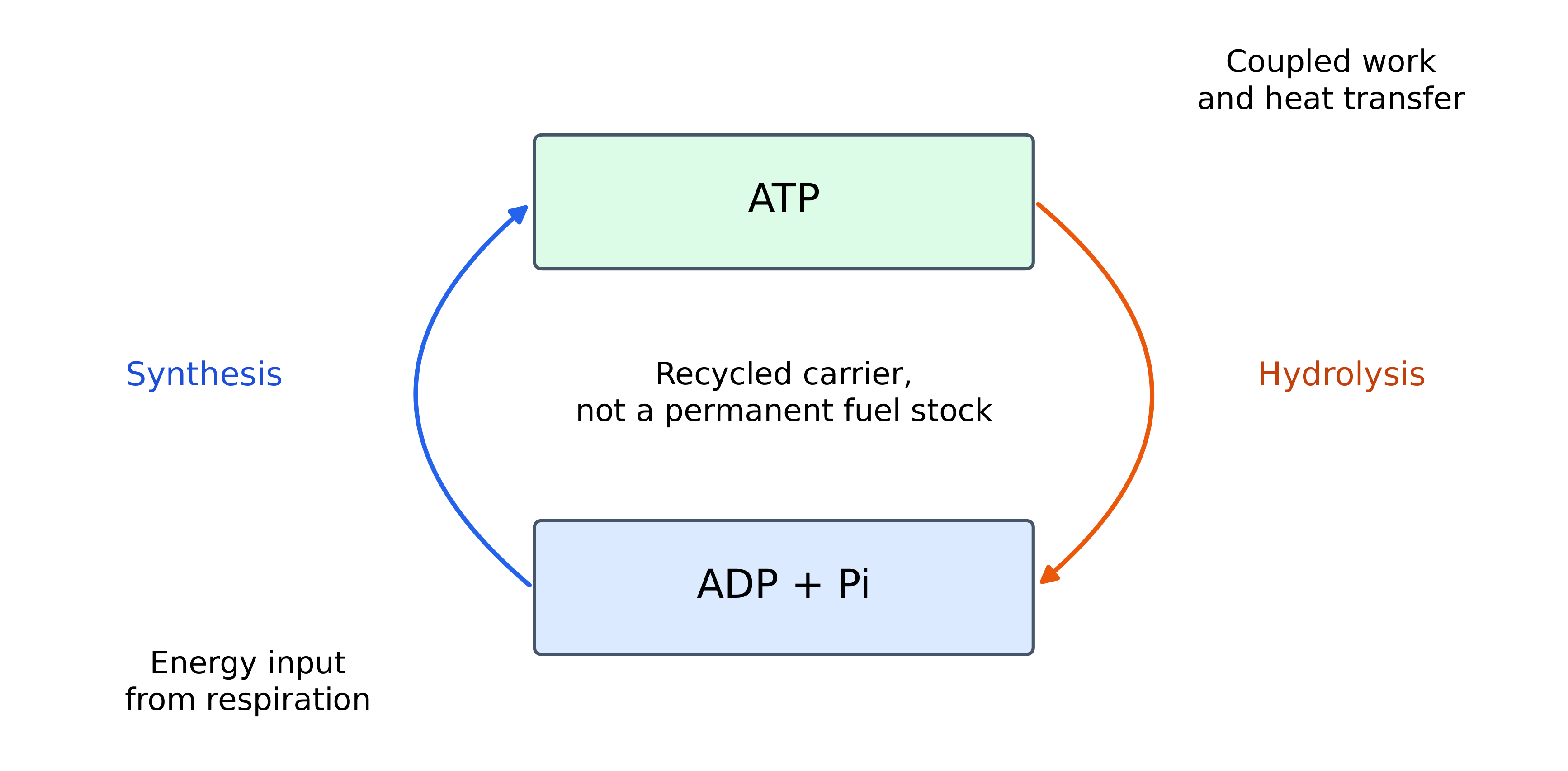
Energy from respiration can drive phosphorylation of ADP, rebuilding ATP from ADP and inorganic phosphate. ATP synthesis requires energy; ATP hydrolysis can support a coupled process. A cycling ATP supply links where energy becomes available to where it is needed. ATP is rapidly regenerated and used; a cell cannot rely on one permanent stock that is never replenished.
ATP can support active transport against an electrochemical gradient, macromolecule synthesis, muscle movement and chromosome movement during cell division. Specific proteins couple ATP use to each process; ATP does not release a free energy packet that acts at a distance. Different processes need not use the same ATP amount.
Pi is inorganic phosphate. The arrows represent coupled transfers. ATP is rebuilt using an energy supply; its hydrolysis can support work, with some energy dissipated as heat.
A cell makes and uses 600 ATP molecules per second while its average ATP pool stays at 120 molecules. Its turnover corresponds to $600/120=5$ pool-equivalents per second. A constant ATP concentration therefore does not imply no ATP use. If use remains high while synthesis falls, the pool can decline and energy-dependent work becomes harder to sustain.
Respiration 呼吸作用 transfers energy from organic substrates through enzyme-controlled reactions and supports ATP production. Glucose and fatty acids are principal substrates; other organic compounds can also enter respiratory metabolism after suitable conversion. The cell does not create energy. It transfers energy from chemical substrates into usable chemical forms, work and heat.
The four stages and where each happens; reduced NAD and FAD carry hydrogen to the inner membrane where most ATP is made
Ventilation moves air into and out of an organ such as a lung. Gas exchange moves gases across a surface, often by diffusion. Cellular respiration consists of chemical reactions. A plant cell or a seed can respire without lungs, and lung ventilation alone is not ATP synthesis. Photosynthetic cells also respire, including when light is unavailable.
In aerobic respiration, oxygen is required for sustained complete oxidation of substrates through the aerobic system. For glucose, the simplified word equation is:
Energy released by the overall process supports ATP production; some becomes heat. ATP is not a carbon-containing waste product in that word equation, and heat is not matter. The balanced overall chemical equation is $C_6H_{12}O_6+6O_2\rightarrow6CO_2+6H_2O$. It summarizes many reactions, not a single explosive step.
In human cells, glycolysis begins in the cytosol and aerobic stages depend on mitochondria. Oxygen-rich blood cannot make a cell with no functioning aerobic machinery carry out all those mitochondrial reactions. Conversely, the cytosol can still support a limited ATP-producing pathway without mitochondrial participation.
When oxygen supply cannot support the required aerobic rate, human cells can obtain ATP through anaerobic metabolism of carbohydrate, with lactate as a final product. The simplified word equation is glucose → lactate. This pathway yields much less ATP per glucose than complete aerobic respiration; a larger fraction of the substrate's chemical energy remains in the organic product.
A hard sprint relies on anaerobic respiration, building up lactic acid.Without oxygen, pyruvate becomes lactate (mammals) or ethanol (yeast); this regenerates NAD for glycolysis
The anaerobic pathway occurs in the cytosol and does not require mitochondria. Aerobic respiration of glucose includes cytosolic and mitochondrial stages, requires oxygen for the system to continue, and has carbon dioxide and water as overall products. Fatty acids can support aerobic respiration but cannot replace glucose in the human lactate-producing pathway.
Feature
Human aerobic glucose respiration
Human anaerobic glucose metabolism
Oxygen requirement
Needed for sustained aerobic operation
Not required for the ATP-producing pathway
Location
Cytosol followed by mitochondrial stages
Cytosol
Overall carbon-containing product
Carbon dioxide
Lactate
ATP per glucose
Much larger yield
Small yield; two net ATP in the full pathway
Mitochondria
Required for aerobic stages
Not required
A cell can use aerobic and anaerobic routes at the same time; this is not necessarily an instantaneous all-or-nothing switch. Lactate can be transported and used in later metabolism, so calling it a permanently useless poison is misleading. Aerobic respiration can use carbohydrate or fatty acids, while the anaerobic comparison here specifically concerns human carbohydrate metabolism.
17.5
呼吸计需控制气体体积、温度与压强
English
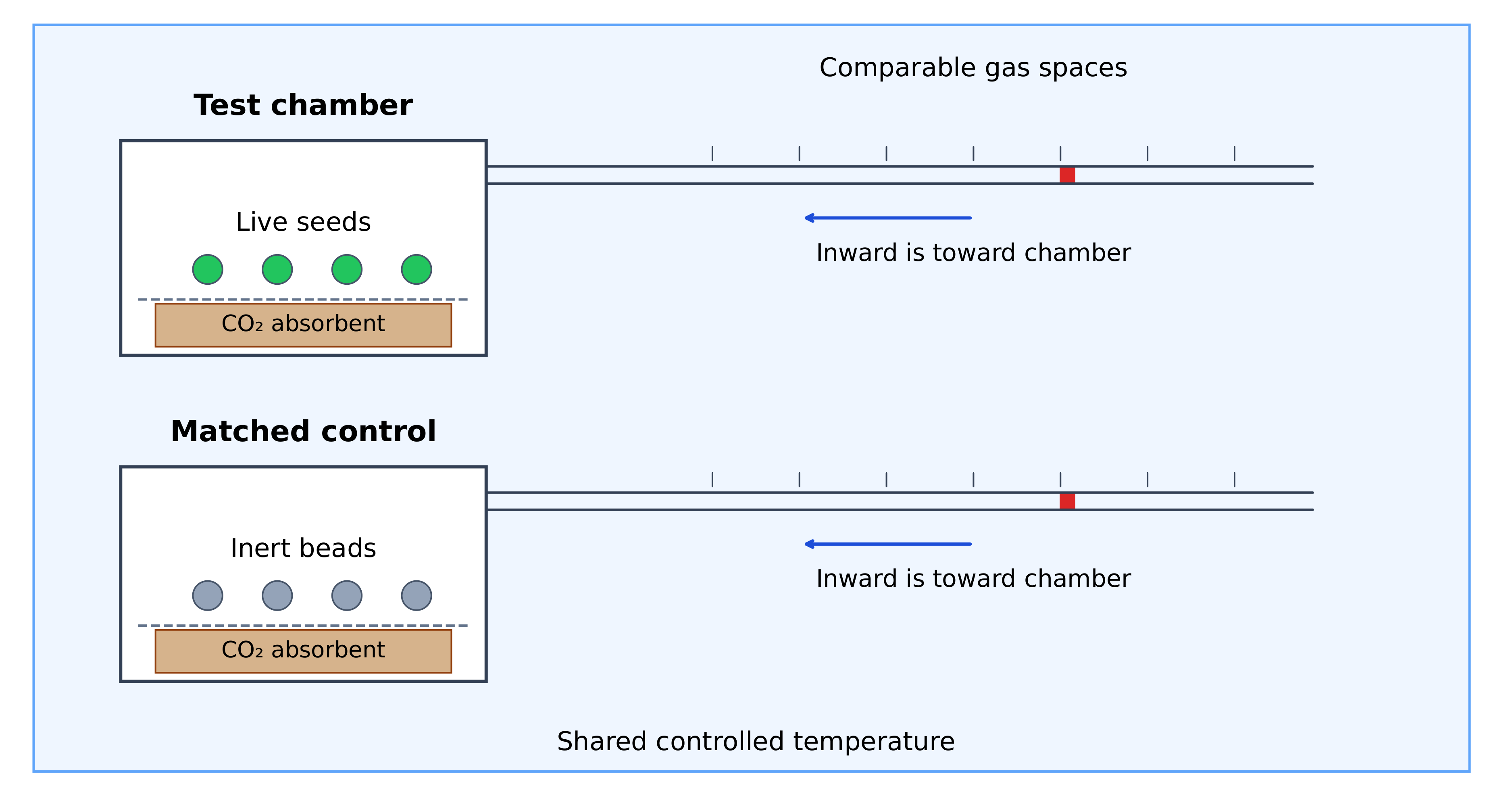
A sealed respirometer can estimate oxygen uptake by a living sample. A suitable carbon dioxide absorbent removes carbon dioxide produced by respiration. As oxygen is removed from the gas phase, the resulting pressure/volume change moves a liquid marker in a capillary. Under controlled conditions this provides an oxygen-uptake estimate; it does not directly count ATP molecules or measure every anaerobic reaction.
Temperature changes alter gas volume and pressure. External pressure changes, leaks, unequal starting gas spaces and incomplete equilibration can also move a marker or distort the result. A matched control with non-respiring material helps estimate background drift. Use comparable occupied volume and gas space, the same absorbent arrangement and a common temperature-controlled bath. A control is not made equivalent simply by giving glass beads the same mass as seeds.
Keep absorbent physically separated from organisms. Compare matched gas spaces, allow equilibration and account for background drift before attributing movement to oxygen uptake.
Use germinating seeds or another approved sample under a school protocol. Keep corrosive absorbent separated from living material with a suitable barrier, and follow the risk assessment. Set the starting marker position after equilibration, seal as required, use a fixed interval and check leaks. Repeated measurements on the same sample describe repeatability; independent biological samples are needed to estimate variation between samples.
If a calibrated apparatus indicates 0.80 cubic centimetres of oxygen uptake in 4.0 minutes for 2.0 g of tissue, the mass-specific rate is
$$\frac{0.80}{4.0\times2.0}=0.10\ \text{cubic centimetres per minute per gram}.$$
Normalizing for time and mass supports comparison, but does not remove differences in species, developmental stage, water content or tissue condition. State the mass basis and use comparable samples. An oxygen-uptake rate alone is not a direct measure of useful energy retained as ATP because substrates, coupling and maintenance costs can differ.
17.6
计算速率前先将标记物的位移换算为体积
English
For a uniform capillary, gas-volume change is cross-sectional area multiplied by displacement. If radius is $r$ and corrected distance is $d$, the volume is $\pi r^2d$. Keep all lengths in consistent units. A displacement in millimetres is not a volume in millilitres, and confusing radius with diameter changes the calculated area by a factor of four.
Turn a marker distance into a gas volume with pi r squared d before dividing by time and mass
In an apparatus, radius is 1.0 mm, inward test displacement is 30.0 mm and matched inward control drift is 6.0 mm. Under the stated subtraction model, corrected displacement is $30.0-6.0=24.0$ mm. Volume is $\pi(1.0)^2(24.0)\approx75.4$ cubic millimetres, or 0.0754 cubic centimetres. Over 4.0 minutes with 1.5 g of sample, rate is about $0.0754/(4.0\times1.5)=0.0126$ cubic centimetres per minute per gram, or 0.013 to two significant figures.
Subtract drift with its sign: if the control moves outward while test moves inward, using both positive magnitudes and subtracting them can be wrong. Define a positive direction and justify that the control estimates the relevant shared drift. Large or unstable drift suggests the apparatus needs improvement, rather than that any subtraction automatically recovers a valid respiration rate.
For a temperature investigation, compare fresh equivalent samples at several controlled temperatures after equilibration. Hold sample type, germination stage, mass basis, gas space, oxygen availability and measurement interval suitably constant. Repeat and plot the rate against temperature with variation shown. A rate change can reflect enzyme activity and sample physiology; high temperature can damage the tissue. Do not infer an exact optimum from two temperatures or confuse three readings on one seed group with three independent groups.
State ATP's full name and components. Explain how ATP synthesis and hydrolysis connect respiration with two named cellular processes, and correct “breaking the phosphate bond itself releases energy”.
A cell maintains a pool of 150 ATP molecules while synthesizing and using 750 per second. Calculate pool-equivalents used per second. Explain why a steady concentration does not mean no ATP turnover.
Distinguish ventilation, gas exchange and cellular respiration. Explain why a seed and a plant cell in darkness can respire.
Compare human aerobic and anaerobic glucose pathways by oxygen requirement, location, products, mitochondrial requirement and relative ATP yield. Write simple word equations and state whether fatty acids can replace glucose in the lactate pathway.
Explain why respiration transfers rather than creates energy, why oxidation need not involve a flame, and why oxygen uptake alone does not give the exact ATP output.
Describe how a respirometer with carbon dioxide absorbent estimates oxygen uptake. Identify two non-respiratory causes of marker movement and the role of a matched inert-material control.
A sample of mass 1.5 g uses 0.96 cubic centimetres of oxygen in 4.0 minutes. Calculate its mass-specific uptake rate and give the units.
Capillary radius is 0.50 mm. Test and matched control move inward by 40.0 and 8.0 mm in 5.0 minutes. Sample mass is 0.80 g. Under the subtraction model, find corrected volume in cubic centimetres and mass-specific rate. What error follows from using the diameter as the radius?
Plan a temperature comparison using germinating seeds. Explain equilibration, comparable sample/gas-space conditions, repeats and absorbent separation.
A control moves outward by 2 mm while the test moves inward by 10 mm. Taking inward as positive, find corrected displacement. Why would large erratic control movement still undermine the experiment?
Three independent seed samples give mass-specific rates 0.09, 0.11 and 0.10 in the same units. Calculate the mean and range. State why normalizing by mass does not remove all differences between samples and why the range is not automatically a confidence interval.
17.8
例题答案
English
Adenosine triphosphate contains adenine, ribose and three phosphates; adenosine is adenine plus ribose. Respiration supports ATP synthesis from ADP and inorganic phosphate. Coupled hydrolysis supports active transport, macromolecule synthesis or movement of muscles/chromosomes. Hydrolysis releases energy overall, but isolated bond breaking requires energy; formation and interactions of products determine the net change.
$750/150=5$ pool-equivalents per second. Equal synthesis and use maintain the pool while individual molecules cycle rapidly. If synthesis falls without a matching fall in use, ATP concentration can decline and ATP-dependent functions are limited.
Ventilation moves air; gas exchange transfers gases across a surface; respiration is cellular chemistry supporting ATP production. Seeds use stored substrates in living cells. Plant cells also respire in darkness: respiration differs from photosynthesis and does not require lungs.
Aerobic: glucose + oxygen → carbon dioxide + water; oxygen required, cytosolic glycolysis then mitochondrial stages, much greater ATP yield. Human anaerobic: glucose → lactate; cytosol, no mitochondria required, no oxygen required for that pathway, two net ATP per glucose. Both routes can operate simultaneously. Fatty acids do not replace glucose in the lactate-producing route.
Chemical energy in substrates is transferred to ATP, work and heat rather than created. Enzyme-controlled steps can proceed without combustion or a visible flame. Oxygen uptake measures one gas flux; substrates, energy coupling and other costs vary, so it is not an exact count of ATP made.
Absorbent removes respiratory carbon dioxide; oxygen uptake then reduces gas-phase amount and moves the marker under controlled conditions. Temperature/pressure drift, leaks or poor equilibration can distort movement. A non-respiring control with comparable gas space and apparatus estimates shared drift. Keep absorbent separated from organisms.
$0.96/(4.0\times1.5)=0.16$ cubic centimetres per minute per gram. Divide by both duration and sample mass; retain the mass basis when comparing samples.
Corrected distance $40.0-8.0=32.0$ mm. Area $\pi(0.50)^2\approx0.7854$ square millimetres; volume $0.7854\times32.0\approx25.13$ cubic millimetres $=0.02513$ cubic centimetres. Rate $0.02513/(5.0\times0.80)\approx0.00628$, or 0.0063 cubic centimetres per minute per gram to two significant figures. Using diameter 1.0 mm as radius would multiply area, volume and rate by four.
Equilibrate equivalent samples in controlled baths before resetting/sealing markers as required and timing uptake. Match species/stage, mass basis, gas space, oxygen availability and duration; use matched controls and independent samples with repeats. Separate absorbent by a suitable barrier under the school protocol. Bath expansion or tissue damage can distort the comparison.
Test $+10$ mm; control $-2$ mm; corrected displacement $10-(-2)=12$ mm. The subtraction assumes control drift represents the test's shared background. Large unstable changes can indicate leaks or poor equilibration, and subtraction cannot guarantee a valid oxygen estimate.
Mean $(0.09+0.11+0.10)/3=0.10$; range $0.11-0.09=0.02$ in the stated units. Mass normalization leaves differences in tissue type, stage, water content and condition. Range describes observed spread; a confidence interval needs a defined statistical method and assumptions.