Two birds can feed in the same tree yet take different foods, use different branch sizes or forage at different times. Sharing a habitat does not establish identical roles, and different feeding observations do not by themselves prove that competition caused the difference. An explanation needs resources, conditions, interactions and evidence.
This unit covers all B4.2 SL and HL understandings: niches, oxygen requirements, photosynthetic, holozoic, mixotrophic and saprotrophic nutrition, archaeal nutritional diversity, hominid dentition, herbivory and predation adaptations, forest plant forms, fundamental/realized niches and competitive exclusion. There is no additional higher-level content in B4.2. Prerequisites are respiration, photosynthesis, digestion, adaptations and population sampling. Scope follows the IB Biology guide.
15.2
生态位包括资源、环境和相互作用
English
An ecological niche 生态位 describes a species' role and its biotic and abiotic relationships affecting growth, survival and reproduction. It includes how the organism obtains food or other resources, which conditions it tolerates and how it interacts with competitors, consumers and partners. Habitat is the place occupied; niche describes how the species lives there. Trophic level describes one aspect of feeding position, not the entire niche.
For an insect-feeding bird, useful niche variables could include prey sizes, feeding times, branch positions, nesting sites and temperature tolerance. For a plant, light acquisition, water and mineral use, pollination, herbivory and competitive interactions matter. A species can change resource use with season, age or resource availability; a niche is not a single immutable food label.
Resource partitioning 资源分割 means differences in resource use that can reduce overlap among organisms. Different prey sizes, feeding heights or times may permit coexistence. However, observations of different use cannot alone distinguish competition from inherited preferences, unequal resource availability or other causes. Sample the alternatives rather than selecting only observations that fit a story.
Resource partitioning: three bird species feed in different parts of the same tree
For a non-destructive field comparison at permitted sites, record the species and identification confidence, resource category, time, abiotic conditions and sampling effort (for example, minutes observed). Repeat comparable observations at several locations selected without favouring the expected result; use an attributed dataset if fieldwork is unsuitable.
Obligate aerobes require oxygen for growth under the stated conditions. Facultative anaerobes can grow with oxygen and also without it, changing metabolic pathways as conditions permit. Obligate anaerobes grow in the absence of oxygen and cannot grow under sufficiently oxygenated conditions; oxygen can be toxic to them. This does not mean that every anaerobic cell dies instantly on contact with one oxygen molecule.
Aerobic respiration needs oxygen and gives a lot of energy; anaerobic gives much less
Category
Oxygen available
Oxygen absent
Obligate aerobe
Can grow if other requirements are met
Sustained growth requires oxygen
Facultative anaerobe
Can use aerobic metabolism
Can grow using suitable oxygen-independent pathways
Obligate anaerobe
Growth is inhibited under oxygenated conditions
Can grow if other requirements are met
“Oxygen-independent” does not mean “without any chemical reactions” or always “without respiration”. Anaerobic respiration and fermentation are different metabolic possibilities; detailed classification is not needed here. Also, an organism can be heterotrophic and aerobic, or heterotrophic and anaerobic. Carbon source and oxygen requirement are separate questions.
In a supplied dataset, strains X, Y and Z have population increases of 80/0, 90/35 and 0/70 arbitrary units with/without oxygen. Under otherwise suitable matched conditions, X fits the obligate-aerobe model, Y the facultative model and Z the obligate-anaerobe model. A single negative treatment could instead reflect another missing requirement, so controls and repeat observations matter.
15.4
光合作用利用光能和无机碳合成有机物
English
Photosynthetic plants, algae and groups such as cyanobacteria use light energy to support synthesis of organic compounds from carbon dioxide. These compounds provide carbon skeletons and stored chemical energy; they can be used in respiration or biosynthesis. Mineral ions and water are required, but minerals are not the plant's main source of organic food carbon.
Photosynthesis takes in carbon dioxide and water and makes glucose and oxygen, using light
Keep energy and matter separate. Light supplies energy, while carbon dioxide supplies carbon. A plant does not convert sunlight atoms into sugar atoms or obtain most of its dry mass from mineral particles. Photosynthetic organisms also respire; darkness stops light-driven reactions rather than every metabolic process immediately.
Not every organism containing photosynthetic partners obtains nutrition in the same way. Reef corals remain animals that obtain organic material from their symbionts and from heterotrophic feeding. Avoid classifying all green-looking organisms by colour alone; investigate the actual carbon and energy pathways.
15.5
动物性营养和腐生营养的消化发生在不同位置
English
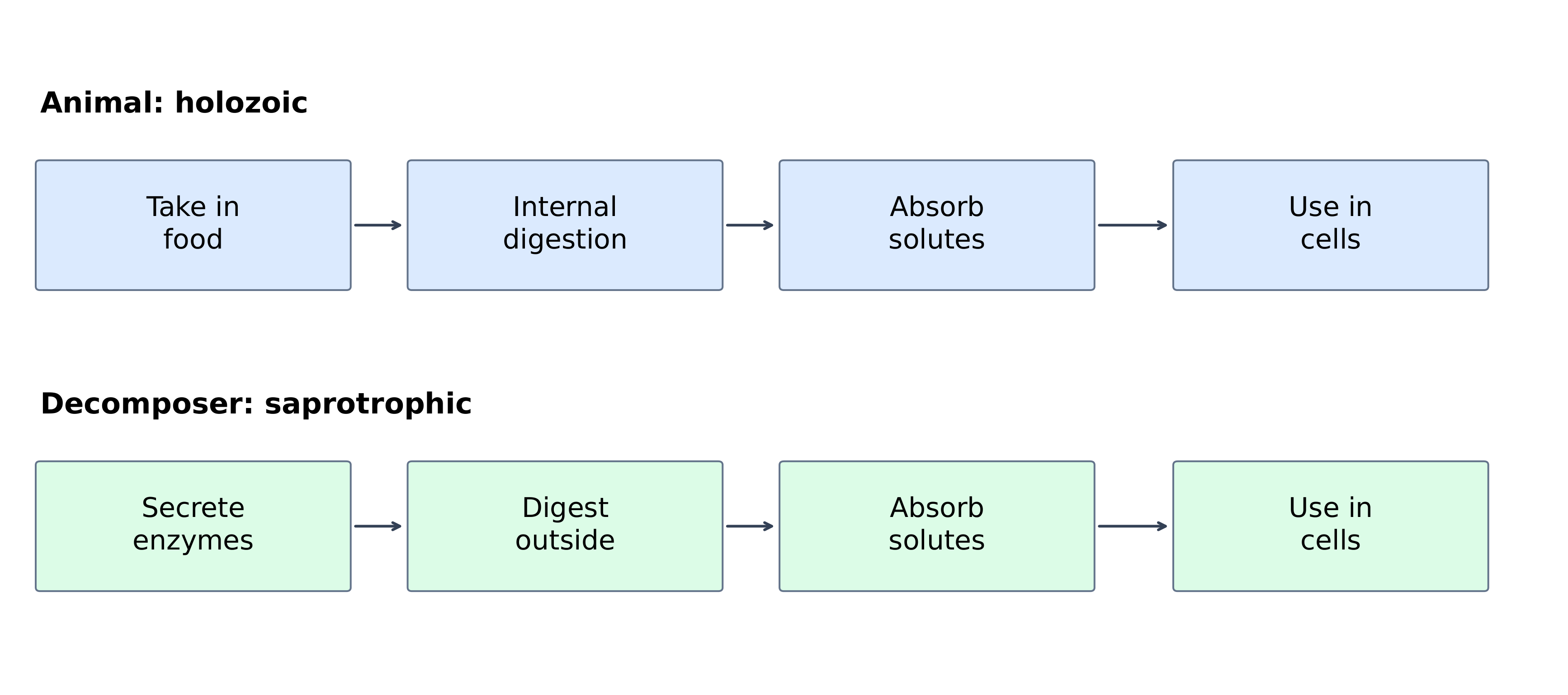
All animals are heterotrophic: they obtain organic carbon from other organisms or their products. In holozoic nutrition, food is ingested, digested inside the animal, absorbed and assimilated. Ingestion brings material into the feeding system; digestion breaks large molecules into absorbable forms; absorption crosses into internal tissues or transport; assimilation incorporates absorbed material into the organism's metabolism and structures. Egestion removes unabsorbed food, while excretion removes metabolic waste.
A fungus: the fly agaric, a mushroom
For example, protein in food is hydrolysed to smaller products; absorbed amino acids can be used to synthesize the animal's own proteins. Merely passing food through the mouth is not absorption. Animal feeding is diverse: heterotrophy does not require every animal to have an identical digestive tract or feeding mechanism.
Saprotrophic fungi and bacteria secrete enzymes onto dead organic material, digesting it extracellularly. Soluble products are then absorbed across cell surfaces and used in metabolism. A fungal hypha does not need to swallow a whole dead leaf before digestion begins. Saprotrophs contribute to decomposition and nutrient cycling, although not all fungi or bacteria are saprotrophs.
Trace where enzymes act and where soluble products cross a cell or tissue boundary.
In an animal budget, 100 units of organic food are ingested, 25 are egested and 5 of the absorbed units later leave in a specified metabolic-waste category. Absorption is 75 units; 70 remain after that stated waste loss. The remaining 70 are not automatically all new biomass: respiration, maintenance and other transfers still matter. State whether a budget concerns matter or energy before subtracting terms with different meanings.
15.6
混合营养生物兼具多种营养方式
English
Some protists can combine photosynthetic carbon acquisition with heterotrophic uptake. Euglena gracilis is a useful freshwater example: its chloroplasts permit photosynthesis, and it can take up dissolved organic substrates under appropriate conditions. Heterotrophy here need not mean engulfing visible prey. A growth study compared light and organic-carbon conditions; its treatment design supports distinguishing the two contributions rather than inferring nutrition from green colour alone.
Facultative mixotrophs can alter their reliance on modes, including growth using one mode when conditions allow. Obligate mixotrophs require contributions from both modes under the conditions defining that dependence. Do not assume every mixotroph can live indefinitely in darkness, or that “both” means exactly half its carbon comes from each route.
A factorial comparison starts each treatment with the same population: light/no added organic substrate gives an increase of 20 units; dark/organic gives 15; light/organic gives 32; dark/no organic gives 0. Growth under both single-source conditions is consistent with nutritional flexibility. The combined value need not equal $20+15$: light, substrate, respiration and other limits interact. Confirm that substrate is available, account for stored reserves or carryover, verify viability and match other nutrients and temperatures.
Growth under light alone and under substrate alone shows flexibility; the combined treatment need not equal the sum
15.7
古菌具有多样的能量和碳代谢途径
English
Archaea form a domain separate from Bacteria and Eukaryota. They are not all confined to extreme habitats, and the domain does not have one universal feeding mode. Different archaea obtain energy from light, oxidation of inorganic chemicals or oxidation of carbon compounds. This diversity matters in environmental cycling and ATP production.
Energy source and carbon source are separate questions (organisms A, B and C)
Energy source does not by itself identify carbon source. An organism using light to help make ATP need not fix carbon dioxide like a green plant. Some archaea use organic carbon while benefiting from light-driven energy processes; other archaeal pathways couple inorganic chemical energy sources with carbon fixation. State what supplies energy and what supplies carbon as two pieces of information.
For organisms A, B and C: A uses light plus organic carbon; B obtains energy by oxidizing an inorganic substance and uses carbon dioxide as carbon source; C obtains both usable chemical energy and carbon from organic compounds. A is not demonstrated to be photoautotrophic merely because it uses light. Naming archaeal species or memorizing every biochemical pathway is unnecessary for this comparison.
15.8
牙齿结构支持对食性的推断,但存在局限
English
Hominidae is the great-ape family, including humans and extinct relatives. Human dentition illustrates an omnivorous pattern: incisors bite, canines contribute tearing, and premolars/molars crush and grind varied foods. Tooth size, shape, relief and enamel can indicate food-processing capabilities. They do not directly give the percentage of meat, fruit or leaves eaten by an individual.
The four kinds of teeth: incisors and canines at the front, premolars and molars at the back
Compare an attributed model or digital skull collection using consistent views and scale. Locate front teeth, canines, premolars and molars; distinguish an absent tooth from its preserved socket. The Smithsonian account of SK 46, a Paranthropus robustus specimen, describes large cheek teeth relative to front-tooth sockets. This supports substantial processing of plant material, but should not become a claim that the species never consumed any other food or that every meal required maximal chewing force.
Living predominantly plant-feeding great apes can still have conspicuous canines; canines can also serve social display or defence. Therefore “large canine equals obligate carnivore” is an invalid shortcut. Dietary reconstruction combines dentition with wear, isotopes and ecological evidence. Anatomy indicates capacity; wear records use over particular timescales, and each dataset has sampling limits.
For a planar model, total cheek-tooth area 120 square millimetres and front-tooth area 30 give a ratio of 4. A second model with 90 and 45 gives 2. These are area ratios, not species identifications or a direct four-to-one ratio of plants to meat in the diet. Compare like ages, preservation and measurement conventions.
15.9
食草动物与植物相互影响取食成功率
English
Chewing mouthparts, such as grasshopper mandibles, cut or crush plant tissue. Piercing/sucking mouthparts, such as aphid stylets, reach fluids including phloem sap without removing a whole leaf piece. Both exploit plant resources, but the access mechanism and plant tissue affected differ. Mouthpart shape should be connected to the food's location and properties.
Chewing removes tissue; a piercing stylet reaches phloem sap and leaves the surface mostly intact
Plants resist feeding with physical structures such as thorns, tough tissues or hairs, and with toxic or deterrent secondary compounds in leaves or seeds. Some herbivores have metabolic pathways that detoxify particular compounds. This can permit feeding that would harm another species, but it is not universal immunity to every toxin or concentration. Defence and detoxification require resources and can involve trade-offs with growth or other functions.
Distinguish a proposed defensive function from evidence of its effect. In a supplied model, equally sized leaves with a tested compound suffer mean losses of 8% area versus 20% in a matched comparison. The difference is 12 percentage points, or 60% less relative loss. Attribution to the compound needs comparable leaf age, toughness, herbivore exposure and other factors; naturally different plant species do not isolate one chemical mechanism.
15.10
捕食包括寻找、捕获、杀死和抵抗
English
Predators require ways to detect suitable prey and overcome it. Physical features can include sensory organs, claws, jaws or capture webs; chemical features can include venom; behavioural features include stealth, pursuit and ambush. Link a feature to a stage: detecting a signal is not yet capturing prey, and a claw's presence does not explain how prey is located.
Each predator feature and each prey defence belongs to a stage; defences change the odds at that stage
Prey resistance can include camouflage, protective structures, chemical deterrents, vigilance, escape or group responses. These change probabilities, not guarantee survival in every encounter. Concealment can be useful against a visually hunting predator but less effective against another sensory system. A defence can also carry costs, such as reduced feeding time during vigilance.
In a sequence of 100 encounters, a predator detects 60, captures 30 and successfully kills 24. Detection success is 60% of encounters; capture conditional on detection is $30/60=50\%$; killing conditional on capture is $24/30=80\%$. Overall killing success is 24%, not 80%. Choose the denominator matching the claim.
15.11
森林植物通过多种方式到达或利用光线
English
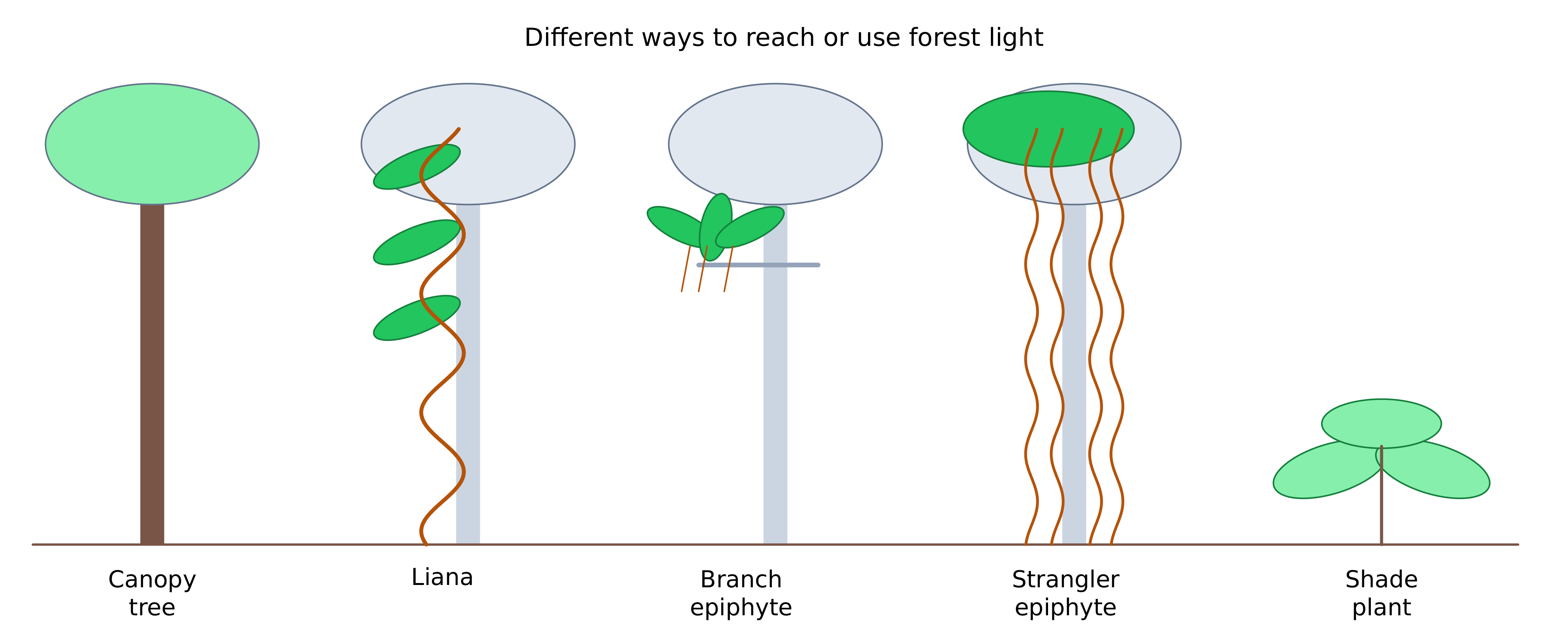
Canopy trees invest in supporting trunks that raise crowns into strong light. Lianas climb existing supports, reducing the need for an equally massive self-supporting trunk while connecting foliage to resources obtained by their own roots. Epiphytes establish on branches; they use the host as support and need their own water/nutrient supply, rather than automatically parasitizing its transport tissues.
Strangler epiphytes, including some figs, establish high on a tree and send roots toward the ground. Growing roots and stems can surround the host and compete for light or below-ground resources; effects develop over time. Not every epiphyte is a strangler, and beginning on a branch does not by itself demonstrate parasitic uptake.
Shade-tolerant shrubs and herbs can persist near the forest floor by using lower light efficiently and having suitable photosynthetic and respiratory characteristics. They do not grow in zero light without any energy source. A broad leaf can intercept light but also costs material and loses water; architecture, physiology and light availability must be considered together.
Trees, climbers, branch epiphytes, stranglers and shade plants represent different strategies, not five obligatory stages in one life cycle.
15.12
基础生态位与实际生态位是解释性模型
English
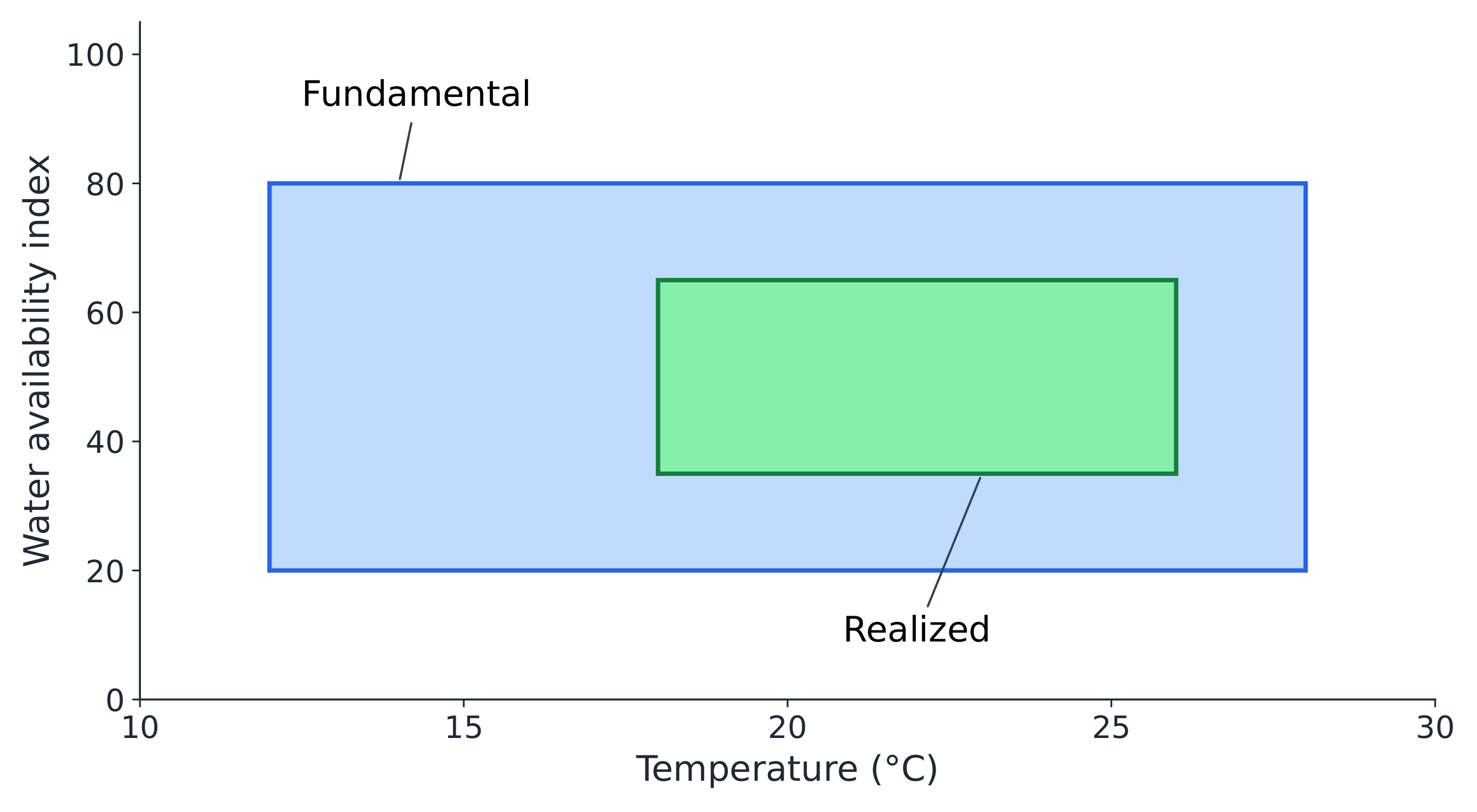
A fundamental niche describes potential conditions and resources under which a species can maintain itself, based on its adaptations and tolerances in the stated model. In a competition-focused model, this means removing restrictive competition while retaining other essential requirements. It does not mean removing all organisms, including food or necessary partners.
The realized niche is the extent actually occupied or used under the interactions present. Competition may exclude a species from otherwise suitable sites or restrict both species to parts of their potential ranges. A diagram of a smaller realized region inside a fundamental region illustrates competitive restriction; it is not a proof that all interactions are harmful. Facilitation, dispersal, history and detection also influence field occupancy.
The inner region represents a competition-focused model, not universal measured limits.*
To test competitive restriction, use supplied simulations or an approved controlled comparison with and without the competitor, keeping abiotic conditions and resources comparable. If the focal species expands its use when competition is reduced, that supports a competition effect. Alternative mechanisms, indirect effects and time scale still need evaluation. Do not introduce competitors or remove native species merely to demonstrate the model.
15.13
竞争排斥取决于生态位重叠及环境条件
English
When two species depend on the same limiting resources in a stable, sufficiently uniform closed model, one can prevent the other from maintaining a population. Competitive exclusion describes this outcome; a finite observation of unequal numbers is not by itself proof of permanent elimination. Competition can also restrict both species' realized resource use, allowing coexistence where relevant differences or changing conditions matter.
Feeding observations are A: 18, 9, 3 across three categories, and B: 3, 9, 18. Both totals are 30. Their proportions are 60/30/10% and 10/30/60%. All three categories are shared, although preferences differ. If a comparison index is explicitly defined as the sum of the smaller proportional use in each category, its value is $10+30+10=50\%$. This describes observed proportional overlap, not a measured strength of competition.
Proportional overlap: add the smaller share in each category
Observed use of one category is $14/35=40\%$ versus $5/50=10\%$. This cannot rank overall specialization: other resource use, availability, sampling coverage and niche dimensions are unknown.
Exam tips
State the mode, mechanism and denominator. Separate dietary capacity from actual diet, observed overlap from causal competition, and one food category's frequency from total niche breadth.
15.14
练习
English
Use supplied data or non-destructive approved observations.
Distinguish niche, habitat and trophic level. Give four niche dimensions and explain why resource partitioning alone does not prove competition caused the difference.
Interpret growth increases with/without oxygen: X 70/0, Y 85/25, Z 0/60. Assign oxygen-requirement models and name a control and a limit.
State the carbon and energy sources in photosynthesis. Correct: “Plants eat soil minerals and stop all respiration at night.”
Compare holozoic and saprotrophic pathways, distinguishing ingestion, digestion, absorption, assimilation, egestion and excretion. Of 120 food-matter units, 30 are egested and 6 of the absorbed units later leave as specified metabolic waste. Find absorption and the remaining stated balance; is it all new biomass?
Explain mixotrophy and obligate/facultative dependence. In matched treatments, growth occurs with light/no organic addition and dark/organic addition. What does this support, and why need combined growth not equal their sum?
Archaea A uses light/organic carbon, B inorganic oxidation/carbon dioxide, C organic oxidation/organic carbon. Separate carbon and energy sources; which are heterotrophic in this model?
Explain how hominid dentition can support but not uniquely determine dietary reconstruction. Model cheek/front areas are 150/30 and 100/50 square millimetres: calculate ratios and reject a diet-percentage inference.
Compare chewing and piercing/sucking herbivores and two plant defences. Mean area losses with/without a tested compound are 6%/15%. Find point and relative differences; discuss detoxification and a confounder.
Give physical, chemical and behavioural predator/prey adaptations. Of 200 encounters, 100 lead to detection, 40 to capture and 30 to killing. Find detection, conditional capture, conditional killing and overall killing percentages.
Compare canopy trees, lianas, epiphytes, strangler epiphytes and shade plants. Explain why neither every epiphyte is a parasite nor every forest-floor plant receives zero light.
Explain fundamental and realized niches in a competition model, including essential partners and two other causes of absence. What comparison could test competitive restriction without a destructive field manipulation?
Supplied model populations end at A 80 and B 8 together, while each persists alone. Does this already establish permanent exclusion? Explain possible competitive outcomes and what further evidence is needed.
C uses resource counts 16, 8, 16; D uses 4, 12, 24. Find proportions and the defined overlap index (sum of category-wise minima). Can one category's 40% versus 10% identify the narrower-niche specialist?
15.15
例题答案
English
Habitat is place, trophic level is feeding position, niche includes resource use/conditions/interactions. Examples: prey size, feeding time, branch height, nesting site or temperature tolerance. Differences can reflect resource supply, preferences or other factors; competition needs an appropriate comparison and repeated evidence.
X fits obligate aerobe; Y facultative anaerobe; Z obligate anaerobe under the model. Match nutrients, temperature, starting cells and measurement duration and verify oxygen conditions. Negative growth can reflect another unmet requirement, and categories do not imply every exposed cell instantly dies.
Light supplies energy; carbon dioxide supplies carbon for organic synthesis. Minerals provide essential inorganic nutrients, not most organic food carbon. Photosynthetic organisms respire in light and darkness; photosynthesis and respiration are different processes.
Holozoic feeding ingests before internal digestion and absorption; saprotrophs secrete extracellular enzymes then absorb soluble products. Assimilation uses absorbed material in metabolism/structures. Egestion removes unabsorbed food; excretion removes metabolic wastes. Absorption $120-30=90$ units; after the specified waste $90-6=84$. Respiration/maintenance and other transfers prevent calling all 84 new biomass; keep matter and energy terms distinct.
Mixotrophy combines photosynthetic and heterotrophic capacities; obligate dependence needs both under defining conditions, whereas facultative use is flexible. Growth in both single-source treatments supports flexibility if other requirements/viability match. Contributions interact and need not be additive; green colour alone is insufficient evidence.
A: light energy, organic carbon, heterotrophic. B: energy from inorganic oxidation, carbon dioxide carbon, autotrophic in the model. C: organic oxidation supplies energy and organic compounds supply carbon, heterotrophic. Archaeal diversity cannot be reduced to “all photosynthetic” or “all extreme-habitat anaerobes”.
Tooth form/area, relief and enamel indicate processing capabilities; compare scaled, consistently oriented models and preservation. Ratios are $150/30=5$ and $100/50=2$. They do not give proportions of plant/meat in the diet. Combine anatomy with wear, isotopes and ecological context; conspicuous canines are not proof of carnivory.
Mandibles cut/crush tissue; stylets pierce and withdraw fluids. Physical barriers and toxic/deterrent compounds can reduce feeding, while some animals detoxify particular compounds at a cost. Difference $15-6=9$ percentage points; relative reduction $9/15\times100=60\%$. Leaf age/toughness, herbivore exposure or other chemistry can confound an uncontrolled comparison.
Examples include sensory detection/claws or webs, venom, stalking/ambush; prey camouflage, armour, deterrent chemicals, vigilance or escape. Detection $100/200=50\%$; capture given detection $40/100=40\%$; killing given capture $30/40=75\%$; overall $30/200=15\%$. Conditional 75% is not overall success; each stage has a different denominator.
Trees support their crowns; lianas climb with their own soil connections; epiphytes use branches as support and obtain their own resources; strangler epiphytes develop ground-reaching roots and can compete with hosts; shade plants use low light efficiently. Support alone does not show parasitic uptake. Low light differs from none; traits have costs and conditions.
Fundamental niche is potential persistence under stated tolerances/resources without restrictive competition in this model; essential food/partners remain. Realized niche reflects interactions/actual use. Dispersal, disturbance, predators, facilitation or detection affect observed absence. Use supplied simulations or approved controlled comparisons with/without competitors and matched abiotic/resource conditions, with replication and sufficient time.
B remains at eight, so no permanent exclusion has yet been established. Both species persisting alone but B declining together supports competitive restriction if conditions match. Longer population trajectories, resource and demographic data are needed to distinguish eventual exclusion from stable coexistence or transient dynamics. Resource partitioning or changing conditions may allow coexistence; the model's assumptions matter.
Both totals are 40. C: 40/20/40%; D: 10/30/60%. Defined overlap $10+20+40=70\%$. This index describes the observations, not competition intensity. A single category's 40% versus 10% cannot rank overall specialization without the other resource distribution, availability, effort and niche dimensions.