This unit covers B3.2 SL understandings: capillaries, arteries and veins, pulse and coronary evidence, absorbed nutrients, transpiration-driven xylem transport and dicot stem/root tissue plans.
Prerequisites: membranes, diffusion, osmosis, pressure and gas exchange. Scope follows the IB Biology guide, first assessment 2025. An artery's direction, a vessel's wall and a fluid's pressure answer different questions; keep them separate.
13.2
毛细血管提供广泛的薄层交换表面
English
A heart can move several litres of blood per minute, yet most body cells are not directly bathed in blood. Materials must cross vessel walls and the surrounding tissue fluid before entering cells. Capillaries connect the delivery system to these local exchanges.
Many narrow branches give a large total exchange area and slow flow; each wall is one cell thick
Branching creates a large collective exchange area. Each capillary has a narrow lumen, bringing red cells close to its thin endothelial wall and keeping diffusion distances short. Many parallel branches give a large combined cross-sectional area, so average blood velocity is much lower than in the main arteries for the same total flow. Do not confuse one capillary's small area with the combined area of the whole capillary bed.
The endothelium is one cell layer thick, supported by a basement membrane. Permeability varies with capillary type. Fenestrations in some capillaries provide additional routes for rapid fluid and small-solute exchange, as in specialized kidney or intestinal regions. These are not unrestricted openings that normally let all blood cells pass. Dissolved substances can cross through suitable pathways; oxygen can diffuse through membranes. Size, charge, gradients and the barrier all influence exchange.
For a controlled comparison, flow volume per time equals average velocity multiplied by total cross-sectional area. If flow stays constant while total area rises fivefold, average velocity becomes one fifth. The slower passage can allow exchange time, but adequate gradients, perfusion and permeability are still required. A narrow vessel is not automatically a low-resistance pathway when considered individually.
13.3
动脉和静脉的管壁与管腔比例不同
English
An artery carries blood away from the heart; a vein returns blood toward it. These definitions do not specify oxygen content: pulmonary arteries carry relatively oxygen-poor blood to lungs, while pulmonary veins return oxygenated blood. Vessel names follow direction.
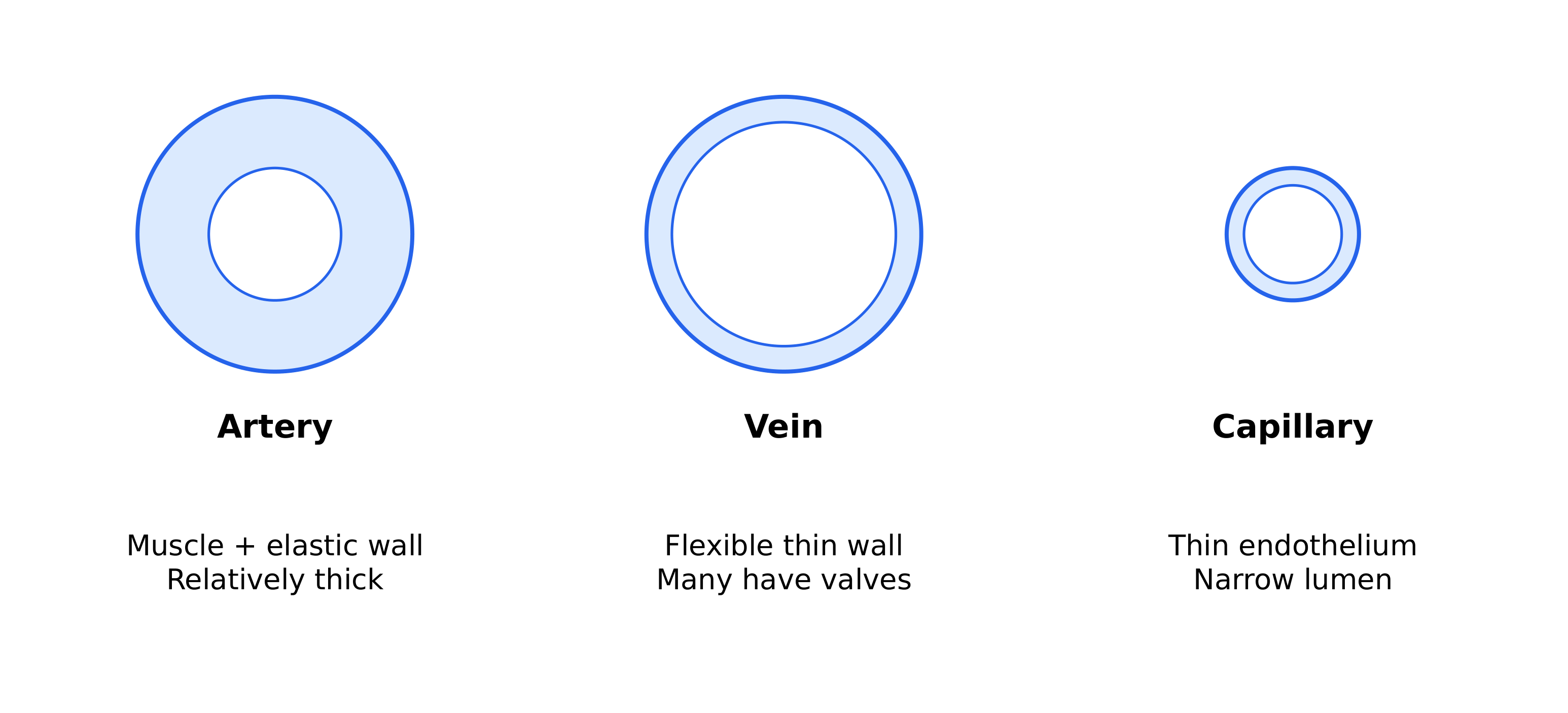
Three tubes, one grammar: lining, muscle coat, outer sheath — each layer named for its job
Feature
Artery compared with a similar-sized vein
Wall
Usually thicker, with more smooth muscle and elastic tissue relative to the lumen
Pressure
Usually higher and more pulsatile in the systemic arterial circuit
Lumen
Often smaller relative to the wall; compare matched vessel sizes
Vein return
Thinner, more compliant wall permits compression by surrounding skeletal muscles
Valves
Many veins, especially in limbs, have valves limiting backward flow; not every vein has them
Arterial walls withstand pressure and stretch as blood enters during ventricular ejection. Elastic recoil helps maintain pressure and flow between beats. Smooth muscle can alter vessel diameter and therefore resistance and distribution. This is not a second independent heartbeat in every artery.
Veins return blood at lower pressure. Skeletal muscle contraction can compress a vein; valves favour movement toward the heart and limit reverse flow when pressure changes. The vein wall's flexibility permits this compression. Valves do not themselves squeeze blood, and the heart, respiratory movements and pressure differences also contribute to return.
Compare equivalent vessel sizes and use several structural clues; colours do not identify oxygen content.
On a micrograph, compare wall thickness relative to lumen diameter, muscle/elastic tissue and whether the lumen appears collapsed. Section angle and processing can distort shape. A rounded lumen alone is insufficient evidence. In a matched comparison, A has wall thickness 0.30 mm and lumen diameter 1.20 mm; B has 0.10 mm and 2.00 mm. Wall/lumen ratios are 0.25 and 0.05, supporting A as the artery when other tissue features agree.
13.4
脉搏测量通过规定的采样范围估算心率
English
An arterial pulse is a travelling pressure wave associated with ventricular ejection; it is not a discrete packet of blood taking one second to reach each location. In an approved classroom activity, lightly feel the radial pulse at the wrist with fingertips, count over a timed interval and convert to beats per minute. Use voluntary resting measurements and avoid pressing hard. Follow the institution's protocol; a sensor can provide a comparison method.
Heart rate response to steady submaximal exercise
Counts of 18, 19 and 18 beats in three separate 15-second intervals give 72, 76 and 72 beats per minute. Their mean is about 73.3 beats per minute. One missed beat changes a 15-second estimate by 4 beats per minute, whereas one missed beat over 60 seconds changes it by 1. Longer sampling reduces this particular conversion error, although rate can genuinely vary over the interval.
Keep posture, rest period and timing method consistent. Repeat and report variation. Repeated measurements from one person estimate that person's variability and measurement repeatability, not differences among independent people. A pulse count does not directly measure stroke volume, blood pressure or cardiac output. Use supplied data if a physical measurement is unsuitable.
13.5
冠状动脉闭塞影响心肌自身的供血
English
Coronary arteries supply the myocardium with oxygen and nutrients. Blood inside a heart chamber cannot adequately supply the thick muscle wall by diffusion alone. Atherosclerotic plaque can narrow coronary arteries and limit flow. Plaque disruption can trigger a thrombus that acutely obstructs supply. Reduced oxygen delivery limits aerobic ATP production, impairing contraction; prolonged severe ischaemia can kill heart muscle. The NHLBI explanation of coronary disease distinguishes plaque-related disease from other coronary mechanisms.
Coronary heart disease narrows the artery; several risk factors raise it and a healthy lifestyle lowers it
Evaluate epidemiological claims with denominators, time periods and comparison groups. In a ten-year cohort, 30 of 600 participants in exposure group A develop an outcome, compared with 12 of 600 in B. Risks are 5% and 2%; the difference is 3 percentage points and the risk ratio is 2.5. A ratio is not a 250-percentage-point difference. Check age, smoking, activity, socioeconomic factors, measurement methods and loss to follow-up before interpreting the association.
A correlation coefficient describes the direction and strength of a specified relationship, not proof of causation. A strong positive correlation between a dietary exposure and coronary outcomes could be influenced by confounding. A weak linear correlation does not rule out every nonlinear relationship, poorly measured effect or subgroup pattern. Mechanistic evidence and well-designed controlled or longitudinal studies can strengthen causal evaluation; one food test or sample percentage cannot do that alone.
13.6
吸收的营养物质经消化后进入运输系统
English
Digestion 消化 breaks large food molecules into smaller absorbable products. Absorption 吸收 moves products across an exchange epithelium into the body. Enzymes act on substrates; transport proteins and gradients govern crossing. Large area and thin intestinal exchange surfaces support absorption. Sugars and amino acids can enter blood; much absorbed dietary lipid is packaged and initially enters intestinal lymph. These routes are not identical for every nutrient.
A villus is adapted for fast absorption: microvilli, a thin wall, a rich blood supply and a lacteal
Carbohydrases yield smaller sugars; proteases yield peptides and amino acids; lipases yield fatty acids and monoacylglycerols during intestinal fat digestion. Bile aids emulsification and alkaline intestinal conditions but is not an enzyme. A positive Benedict test for reducing sugars, iodine test for starch, Biuret test for protein or ethanol emulsion test for lipid indicates a component under controlled conditions, rather than proving that a food causes health or illness. Use positive/negative controls, approved heating and keep ethanol away from flames. Nutrient identification, absorption and epidemiological causation are different levels of evidence.
At a moist mesophyll cell wall, evaporation replaces liquid water with vapour that can diffuse out through stomata. As water leaves wall pores, the curved air–water interfaces produce tension in the remaining liquid. Water is drawn from the xylem toward these walls, transmitting a pulling force through a cohesive water column. Cohesion between water molecules helps the column remain continuous; adhesion to hydrophilic walls also supports the system.
Transpiration at the leaf pulls the whole water column up the xylem; cohesion (hydrogen bonds) keeps it togetherA potometer: as the shoot takes up water, the air bubble moves along the capillary tube
The xylem sap can be under negative pressure relative to atmospheric pressure. This is a pull transmitted through liquid, not a vacuum above every leaf and not a leaf muscle pushing water upward. Movement follows water-potential differences through the soil–plant–atmosphere pathway. The pressure component is one contribution; solute conditions also matter. Evaporation is powered by environmental energy, while regulation by living tissues influences the flow.
Xylem vessel elements are dead at maturity and lack cytoplasm and a plasma membrane. Their hollow lumens and absent or perforated end walls reduce resistance along the vessel. Lignified walls withstand tension and resist collapse. Pits are wall regions permitting lateral exchange between conducting elements and adjacent tissues; they are not simply large holes in every side wall without any intervening structure. Cavitation and embolism can interrupt conducting pathways, so continuity is a functional requirement rather than an absolute guarantee.
In a pressure comparison at the same height and solute conditions, a leaf xylem pressure of −0.8 MPa is lower than a root xylem pressure of −0.2 MPa. The pressure difference favours movement toward the leaf; the magnitude is 0.6 MPa. This simplified comparison omits gravitational and other water-potential contributions. Water does not move upward because “negative numbers rise”.
13.8
双子叶植物茎和根的横切面中输导组织排列方式不同
English
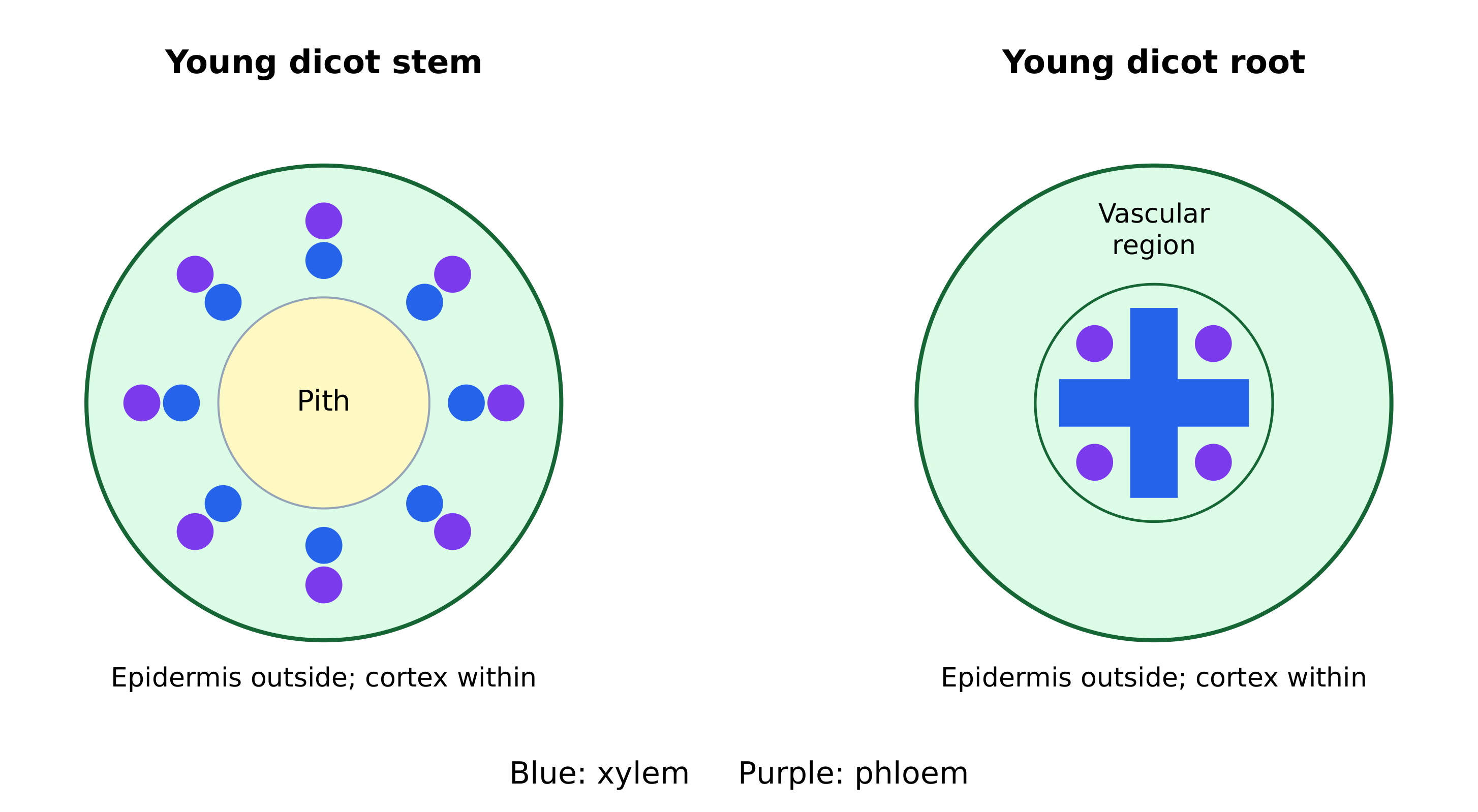
A young typical dicot stem has an outer epidermis, cortex and vascular bundles arranged around a central pith. Within each bundle, xylem lies toward the centre and phloem toward the outside; a cambial region can lie between. Xylem carries water/minerals and supports the stem; phloem translocates organic solutes. Cortex and pith include storage and supporting tissues. Mature woody stems can look different after secondary growth.
A vascular bundle in a dicot stem: large xylem vessels below, smaller phloem cells above
In a typical young dicot root, the epidermis surrounds a broad cortex and the central vascular cylinder. Xylem often forms a central star or cross, with phloem between its arms. The endodermis surrounds the vascular cylinder and controls access through the apoplastic route. Do not copy the stem's ring of separate bundles into a root. Actual patterns vary with species and age; use the supplied micrograph rather than treating the schematic as universal.
Blue marks xylem and purple marks phloem. These plans show tissue distribution, not individual conducting cells.
Draw a low-power plan with continuous tissue boundaries, correct relative positions and clear labels. Annotate a tissue's function separately from its appearance. Do not draw every cell, sieve pore or nucleus in a tissue plan. Higher-power cellular drawings answer a different question. Calibrate any measurements: a 12-mm image of a 0.60-mm stem has magnification 20; a 3.0-mm cortex region in that image corresponds to 0.15 mm in the specimen.
13.9
练习
English
Explain structures and mechanisms alongside calculations.
Explain four capillary exchange adaptations: branching, lumen, endothelium and fenestrations. At constant flow, predict velocity when combined cross-sectional area increases eightfold.
Compare arterial/venous direction, walls, lumens, pressures and return mechanisms. Wall/lumen measurements are A: 0.24/0.96 mm; B: 0.08/1.60 mm. Calculate ratios, identify the likely artery and state a limitation.
Three 20-second counts are 23, 24 and 25 beats. Calculate rates and mean. Quantify one counting error; explain the replication limit.
Ten-year outcomes: 24/400 exposed versus 8/400 comparison participants. Calculate risks, difference and ratio. Explain coronary occlusion and two limits on causal inference.
Distinguish digestion, absorption and transport, with blood/lymph examples. Why does a food test not establish a health outcome?
Trace mesophyll evaporation to upward xylem flow. Explain four xylem vessel adaptations.
Compare young dicot stem/root tissue plans. An 18-mm image represents a 0.90-mm specimen; an image cortex region measures 4 mm. Calculate magnification and actual region width.
Compare −0.9 and −0.3 MPa xylem pressures under otherwise equal conditions. State flow tendency, pressure difference and one model limit.
Correct: every vein has valves; arteries always carry oxygenated blood; one narrow capillary means fast flow through the whole bed.
Plan reliable micrograph vessel identification and resting pulse measurement: controls, replication and limits.
Distinguish bulk flow from membrane crossing, using nutrients, tissue supply or plant water movement.
13.10
例题答案
English
Branching increases collective exchange area; narrow lumens bring red cells close to walls; one-cell-layer endothelium shortens distance; fenestrations support selected rapid exchange in some capillaries. At constant flow, eightfold total area gives one-eighth average velocity. Barrier type and gradients still matter.
Arteries carry away; veins return. Ratios: $0.24/0.96=0.25$ and $0.08/1.60=0.05$. A fits an artery’s thicker muscular/elastic wall. Compliant veins permit muscle compression; valves in many veins limit backflow. Compare matched sizes and account for section angle/collapse.
Rates $23(3)=69$, $24(3)=72$, $25(3)=75$ beats per minute; mean 72. One missed beat alters a 20-second estimate by 3 beats per minute. Repeats from one person measure within-person variation and repeatability, not independent population replicates.
Risks $24/400=6\%$ and $8/400=2\%$; difference 4 percentage points; ratio 3. Coronary narrowing or a thrombus reduces myocardium supply, limiting aerobic ATP and potentially causing cell death. Confounding such as age/smoking and biased exposure/outcome measurement can affect association; correlation alone does not demonstrate causation.
Digestion produces absorbable products; absorption crosses an epithelium; bulk transport distributes material. Sugars/amino acids enter blood; much packaged lipid initially enters intestinal lymph. Food tests detect components, not causal health outcomes. Bile assists fat processing but is not an enzyme.
Evaporation generates wall-pore tension, pulling water from xylem through cohesive sap. Hollow dead elements remove obstructions; open/perforated ends permit longitudinal flow; lignin resists collapse; pits permit lateral exchange. Adhesion supports wall contact. Evaporation, not ATP pumping within vessels, drives the pull.
Stem: peripheral bundles, xylem inward/phloem outward, cortex and central pith. Root: central often star-shaped xylem, phloem between arms, surrounding cortex/epidermis. Magnification $18/0.90=20$; actual width $4/20=0.20$ mm. Use the actual section because species and age alter patterns.
The −0.9 MPa region has lower pressure; the difference has magnitude 0.6 MPa. Under the stated conditions pressure favours flow toward it. Whole-plant movement also depends on height, solute conditions, resistance and continuity of the pathway.
Many veins have valves but not all. Pulmonary arteries are relatively oxygen-poor; direction defines an artery. Each capillary is narrow, but many parallel branches have large combined area, lowering average velocity at the same total flow.
Match vessel size, compare wall/lumen and tissues, calibrate and note section distortions. For pulse standardize rest, posture, timing and method; repeat and compare a sensor. Neither method alone gives oxygen content, stroke volume or blood pressure. Separate within-person repeats from independent participants.
Blood flows in bulk down pressure gradients. Membrane crossing depends on permeability, gradients and transport proteins/energy coupling. Nutrients reaching capillaries still need tissue/cell exchange. Xylem bulk flow likewise differs from water entry across living root membranes.
Exam tips
Name vessel direction and tissue function. Compare like-for-like measurements; separate sample repeats from independent participants and bulk flow from membrane crossing.