Treatment models and outcome evidence
Scope and prerequisites
Supported GRE topic 9 (CL.2). Use the overview measurement lesson VI when interpreting research evidence. Existing official questions are traced in bank_review_form.yaml; original tasks below are not ETS items.
Concepts and method
counterconditioning 对抗性条件作用: Replacing a conditioned response by pairing the stimulus with an incompatible response such as relaxation. common factors 共同因素: Ingredients shared across therapies, such as alliance and expectancy, proposed to explain comparable outcomes.
Each therapy family proposes a mechanism. Psychodynamic work targets unconscious conflict and early relationships, using transference; object-relations variants emphasise early relationships in particular. Behavioural treatment applies learning principles: systematic desensitisation traditionally pairs a graded fear hierarchy with relaxation (counterconditioning), while exposure approaches need not use relaxation pairing. Cognitive-behavioural therapy identifies and tests distorted thoughts and adds behavioural activation. Person-centred work offers empathy, unconditional positive regard and congruence; Gestalt work stresses the here and now. Biological treatment includes medication and, for severe depression, electroconvulsive therapy.
Match technique to mechanism and presentation: specific phobia points to graduated exposure; obsessive-compulsive disorder to exposure with response prevention; depression to cognitive restructuring plus activity scheduling. A therapist rooted in object relations will emphasise early life relationships, not medication or cognitive distortion lists.
Outcome claims need controls because of spontaneous remission and regression to the mean: people seek help at their worst and improve anyway. A randomised controlled trial with a waitlist or placebo comparison separates treatment gain from natural course. Efficacy is performance under controlled conditions; effectiveness is performance in ordinary practice. Meta-analysis pools trials for a more stable estimate.
When bona fide therapies show comparable mean outcomes, the common-factors hypothesis credits shared ingredients such as the working alliance, expectancy and empathy rather than branded techniques. Comparable means do not prove identical mechanisms, and a single trial cannot settle the question either way.
Mechanism and outcome are different claims. An intervention may improve an outcome without the study establishing its proposed mechanism. A waitlist comparison controls some natural change, but not all attention and expectancy differences. An active comparison can address some of those differences. Compare allocation, attrition, outcome definition and follow-up before attributing benefit to a particular technique. Similar sample means do not demonstrate equivalence without an appropriate design and uncertainty analysis.
Worked reasoning
A therapist rooted in object relations theory emphasises early life relationships. A phobia treated by a relaxation-paired hierarchy is counterconditioning. A treated group improving from pre-test to post-test shows change, not efficacy: without a control, regression to the mean and spontaneous remission remain open.
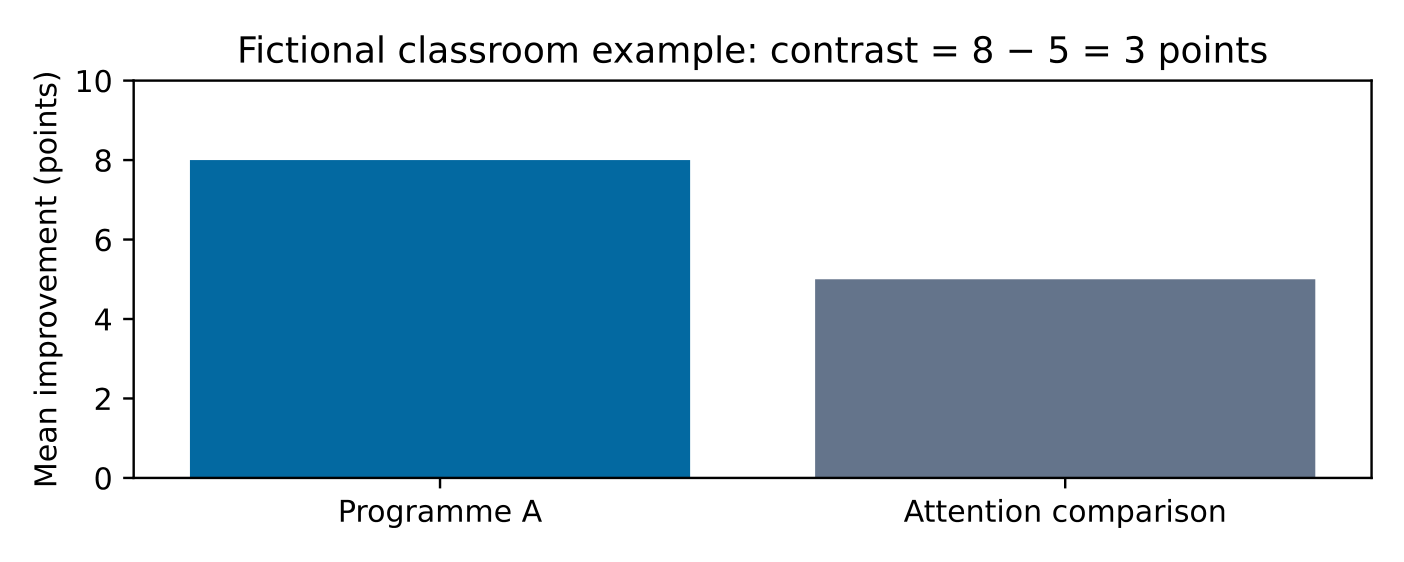
In a fictional randomized study, mean improvement is 8 points in programme A and 5 in an attention comparison. What contrast is relevant?
Between-group difference in mean improvement=8−5=3 points. The 8-point within-group gain includes changes also occurring under the comparison. The contrast may support a relative effect under the study conditions, but precision, missing data and outcome meaning are still needed. It does not establish the mechanism or superiority in all practice settings.
Independent transfer
A review combines ten small trials, all drawn from one type of clinic. Why does having ten studies not ensure a universal conclusion?
Attempt independently, then use the matching skill sheet solution.
Review and source limits
Avoid this error: Inferring causation from a before-and-after gain without a control, or treating comparable means as proof of identical mechanisms. Teaching scope comes from teaching.yaml and the source/key/crop review in bank_review_form.yaml. Detailed current diagnostic criteria require an authenticated manual; neither historical ETS practice nor this educational reference certifies them.