Diagnostic systems and disorder classification
Scope and prerequisites
Supported GRE topic 8 (CL.1). Use the overview measurement lesson VI when interpreting research evidence. Existing official questions are traced in bank_review_form.yaml; original tasks below are not ETS items.
Concepts and method
diagnostic criteria 诊断标准: The listed symptom, duration, impairment and exclusion requirements for a classification. diathesis-stress model 素质-应激模型: An account of how vulnerability and environmental stress jointly affect risk.
The recorded framework is DSM-5-TR. Clinical classification describes patterns; a category does not establish the cause of a presentation. Historical ETS items must be interpreted against their recorded source version.
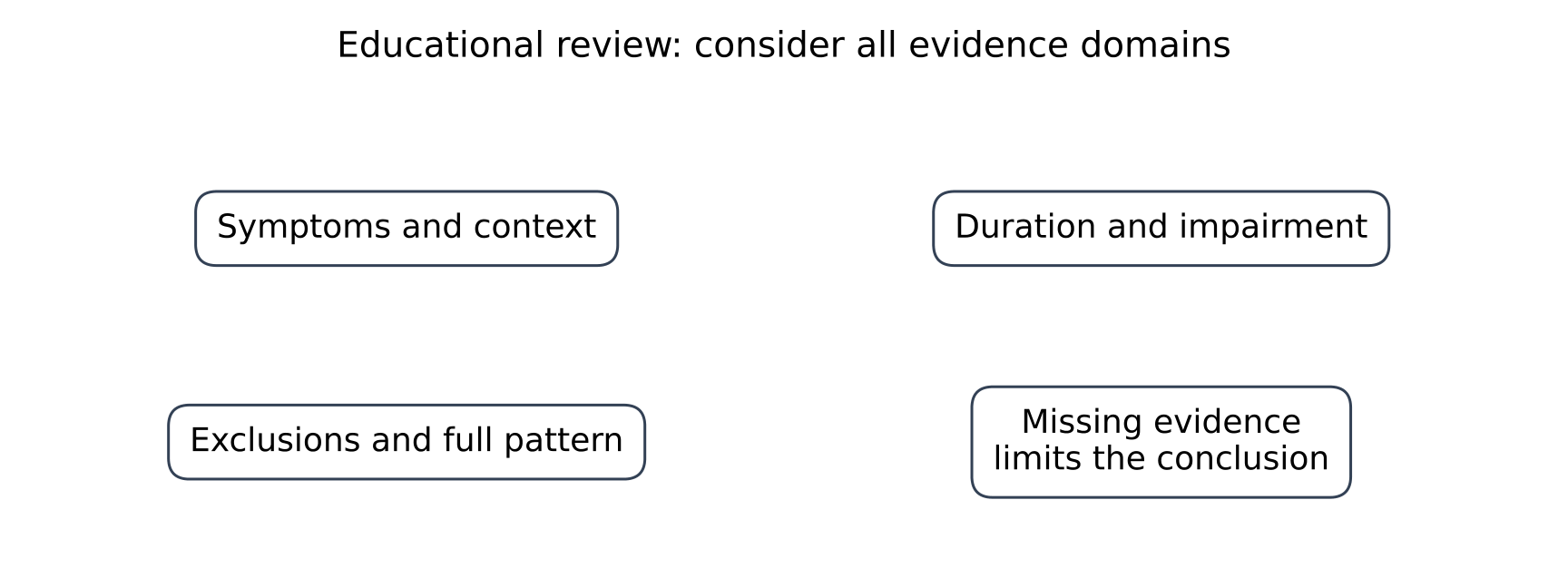
Symptoms, duration, clinically significant distress or impairment, context and exclusions must be considered together. A short duration does not by itself establish acute stress disorder or any other diagnosis.
The diathesis-stress model examines how vulnerability and environmental stress jointly affect risk. Neither a family history nor a later event establishes an inevitable outcome or a universal necessity/sufficiency rule.
Common educational distinctions include added experiences versus reduced functions in symptom descriptions, and episodic presentations versus enduring patterns. Full current criteria require an authenticated manual; the available GRE practice book is not that manual.
The recorded teaching names DSM-5-TR; the historical ETS practice form is not authority for every current diagnostic criterion. A diagnosis requires its complete pattern and exclusions under the applicable manual. Duration is one piece of evidence, never a sufficient decision rule. Predisposition and stress are risk concepts: neither a family history nor an adverse event makes an outcome inevitable. Avoid classifying real people in classroom practice.
Worked reasoning
A fictional vignette supplies a recent adverse event and two symptoms but omits impairment, exclusions and a full assessment. What conclusion is justified?
The vignette identifies relevant evidence and missing information. It cannot establish a diagnosis. A duration threshold alone cannot turn a short account into an alternative disorder. The correct educational response is to name the missing criterion domains and source/version, not supply personal advice.
Independent transfer
Two fictional people share a family risk factor; only one has a later stressor and difficulty. Explain the diathesis-stress interpretation and its limit.
Attempt independently, then use the matching skill sheet solution.
Review and source limits
Avoid this error: Do not infer a diagnosis from duration or a few symptoms, or offer personal treatment advice. Teaching scope comes from teaching.yaml and the source/key/crop review in bank_review_form.yaml. Detailed current diagnostic criteria require an authenticated manual; neither historical ETS practice nor this educational reference certifies them.