跳到主要内容

5 · Vectors and transformation geometry

Edexcel International GCSE 数学 A知识点 5

本主题的视频课程 打开视频页面
12:10

向量与变换几何

列向量先横向再纵向,标量倍数拉伸两个分量。其模长依据勾股定理得出。向量加法沿任意路径首尾相接进行…

英文讲解 · 可切换中英文字幕

.5.1.A .5.1.B .5.1.C .5.1.D .5.1.E .5.1.F

向量与变换几何

English

Why it matters. In 1586 the Flemish engineer Simon Stevin published De Beghinselen der Weeghconst (The Elements of the Art of Weighing). On its title page is a loop of fourteen balls hanging over a triangular wedge. Stevin argued that the loop cannot keep turning by itself, so the balls on the two slopes must balance. From this he worked out how a pull along one direction can be split into parts along other directions, and how two pulls combine into one. Quantities with both a size and a direction are now called vectors, and engineers, pilots and game designers add them in exactly this way.

In this unit you will:

  • write vectors in bold, as $\overrightarrow{AB}$ and as column vectors (Higher);
  • add, subtract and multiply vectors, and find their magnitude (Higher);
  • use vectors to prove facts about lines and shapes (Higher);
  • carry out and fully describe reflections, rotations, translations and enlargements.

Pearson Edexcel International GCSE Mathematics A (4MA1), topic 5: Vectors and transformation geometry. Vectors are Higher only; transformations are on both tiers.

These results are not on the formula sheet, so learn them:

Topic Results
column vectors $k\dbinom{x}{y} = \dbinom{kx}{ky}$; magnitude $\left\lvert\dbinom{x}{y}\right\rvert = \sqrt{x^2 + y^2}$
routes $\overrightarrow{AC} = \overrightarrow{AB} + \overrightarrow{BC}$; $\overrightarrow{BA} = -\overrightarrow{AB}$
describing transformations reflection: the mirror line; rotation: centre, angle, direction; translation: column vector; enlargement: centre, scale factor
.5.1.A .5.1.B .5.1.C .5.1.D .5.1.E .5.1.F

Vectors: notation to resultants

English

(Higher) A vector 向量 has a size and a direction, for example "5 km north-east". A scalar 标量 has a size only, for example "5 km". The size of a vector is its magnitude 大小.

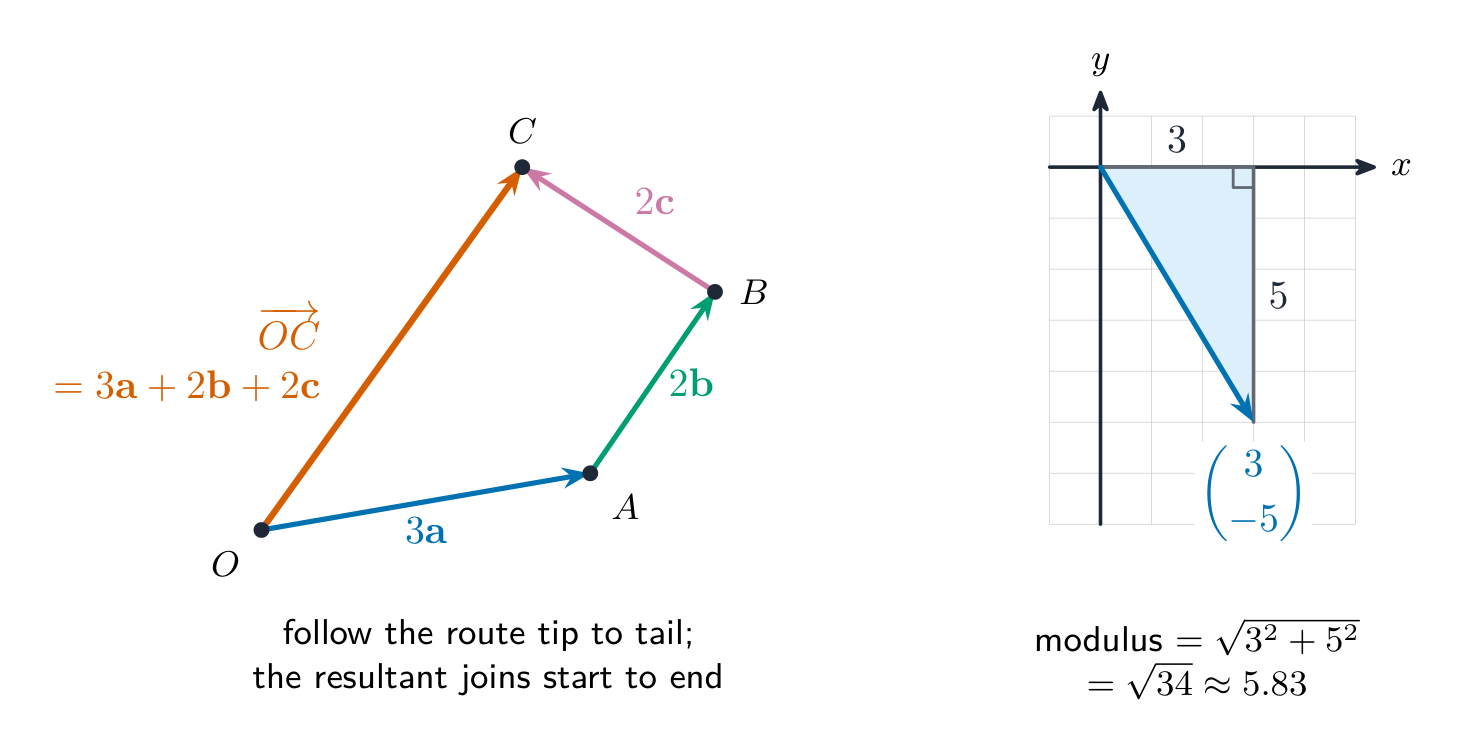
You can write a vector in three ways: in bold, $\mathbf{a}$ (underlined, $\underline{a}$, when handwritten); as $\overrightarrow{AB}$, the vector from $A$ to $B$; or as a column vector 列向量 such as $\dbinom{3}{-5}$, which means 3 across to the right and 5 down.

A sailing boat with a full spinnaker
Wind and current both push a boat: vectors with size and direction add to a resultant

A scalar multiple 数乘 of a vector changes its length but keeps it on a line in the same direction. $2\mathbf{a}$ is twice as long as $\mathbf{a}$ and parallel 平行 to it; $\frac12\mathbf{a}$ is half as long; $-\mathbf{a}$ is the same length but points the opposite way. Two vectors are parallel when one is a scalar multiple of the other.

Add column vectors by adding the top numbers and the bottom numbers: $\dbinom{2}{5} + \dbinom{-1}{3} = \dbinom{1}{8}$.

To add vectors as arrows, put them tip to tail: $\overrightarrow{AB} + \overrightarrow{BC} = \overrightarrow{AC}$. The resultant 合向量 is the single vector from the start of the route to the end. Going backwards along a vector changes its sign: $\overrightarrow{BA} = -\overrightarrow{AB}$.

The modulus 模 of a vector, written $\lvert\mathbf{a}\rvert$, is its magnitude. For a column vector, use Pythagoras: $\left\lvert\dbinom{3}{-5}\right\rvert = \sqrt{3^2 + (-5)^2} = \sqrt{34} = 5.83$ (3 s.f.).

Left: legs 3a, 2b and 2c tip to tail, and the resultant OC = 3a + 2b + 2c. Right: the column vector (3, −5) has modulus √34 ≈ 5.83

Worked example 1 (Higher). $\mathbf{p} = \dbinom{4}{-1}$ and $\mathbf{q} = \dbinom{-2}{3}$. Find $2\mathbf{p} + \mathbf{q}$ and its magnitude.

  • $2\mathbf{p} = \dbinom{8}{-2}$, so $2\mathbf{p} + \mathbf{q} = \dbinom{8 - 2}{-2 + 3} = \dbinom{6}{1}$.
  • Magnitude $= \sqrt{6^2 + 1^2} = \sqrt{37} = 6.08$ (3 s.f.).
Vector AB drawn 4 across and 3 up
AB = (4, 3) has magnitude √(4² + 3²) = 5
探索

向量与变换几何

相加对应的向量分量并相减位置矢量以找到位移。

对比模型与已解案例,并说明其中一处变化。

词汇 训练
English 中文 拼音
vector/ˈvektə/ 向量 xiàng liàng
scalar/ˈskeɪlə/ 标量 biāo liàng
magnitude/ˈmæɡnɪtjuːd/ 大小 dà xiǎo
column vector/ˈkɒlʌm ˈvektə/ 列向量 liè xiàng liàng
scalar multiple/ˈskeɪlə ˈmʌltɪpl/ 数乘 shù chéng
parallel/ˈpærəlel/ 平行 píng xíng
resultant/rɪˈzʌltənt/ 合向量 hé xiàng liàng
modulus/ˈmɒdjʊləs/ 模 mó
.5.1.G

Vector geometry proofs

English

(Higher) To prove something with vectors, write the vectors you need in terms of the given vectors, usually $\mathbf{a}$ and $\mathbf{b}$, by following a route through points you know.

  • To show two lines are parallel, show that one vector is a scalar multiple of the other.
  • To show three points lie on one straight line, show that two of the vectors joining them are parallel and share a point.
  • To find an unknown ratio, write the same vector in two different ways and compare the coefficients 系数 of $\mathbf{a}$ and of $\mathbf{b}$.

Worked example 2 (Higher). $OABC$ is a parallelogram 平行四边形 with $\overrightarrow{OA} = \mathbf{a}$ and $\overrightarrow{OC} = \mathbf{c}$. $M$ is the midpoint 中点 of the diagonal 对角线 $OB$. Prove that the diagonals bisect 平分 each other.

  • In a parallelogram $\overrightarrow{AB} = \overrightarrow{OC} = \mathbf{c}$, so $\overrightarrow{OB} = \mathbf{a} + \mathbf{c}$ and $\overrightarrow{OM} = \frac12(\mathbf{a} + \mathbf{c})$.
  • $\overrightarrow{AM} = \overrightarrow{AO} + \overrightarrow{OM} = -\mathbf{a} + \frac12(\mathbf{a} + \mathbf{c}) = \frac12(\mathbf{c} - \mathbf{a})$.
  • The other diagonal is $\overrightarrow{AC} = -\mathbf{a} + \mathbf{c} = \mathbf{c} - \mathbf{a}$, so $\overrightarrow{AM} = \frac12\overrightarrow{AC}$.
  • So $M$ is also the midpoint of $AC$: the diagonals cut each other in half.

Worked example 3 (Higher). In triangle $OAB$, $\overrightarrow{OA} = \mathbf{a}$ and $\overrightarrow{OB} = \mathbf{b}$. $P$ is on $AB$ with $AP : PB = 1 : 2$, and $M$ is the midpoint of $OB$. The lines $OP$ and $AM$ meet at $Q$. Find $OQ : OP$.

  • $\overrightarrow{AB} = \mathbf{b} - \mathbf{a}$, so $\overrightarrow{OP} = \mathbf{a} + \frac13(\mathbf{b} - \mathbf{a}) = \frac23\mathbf{a} + \frac13\mathbf{b}$.
  • $Q$ is on $OP$, so $\overrightarrow{OQ} = k\left(\frac23\mathbf{a} + \frac13\mathbf{b}\right)$ for some number $k$.
  • $Q$ is also on $AM$, and $\overrightarrow{AM} = \frac12\mathbf{b} - \mathbf{a}$, so $\overrightarrow{OQ} = \mathbf{a} + \lambda\left(\frac12\mathbf{b} - \mathbf{a}\right) = (1 - \lambda)\mathbf{a} + \frac{\lambda}{2}\mathbf{b}$ for some number $\lambda$.
  • Compare coefficients. $\mathbf{b}$: $\frac13k = \frac12\lambda$, so $\lambda = \frac23k$. $\mathbf{a}$: $\frac23k = 1 - \lambda = 1 - \frac23k$, so $k = \frac34$.
  • So $OQ : OP = 3 : 4$. Since $\lambda = \frac12$, $Q$ is also the midpoint of $AM$.

Never assume a point is a midpoint: give the unknown fraction a letter and find it.

Triangle OAB with P one third of the way from A to B, M the midpoint of OB, and the lines OP and AM crossing at Q
$Q$ lies on both $OP$ and $AM$, so $\overrightarrow{OQ}$ can be written two ways; equating the coefficients of $\mathbf{a}$ and $\mathbf{b}$ gives $k = \tfrac34$.
词汇 训练
English 中文 拼音
coefficient/ˌkəʊɪˈfɪʃənt/ 系数 xì shù
parallelogram/ˌpærəˈleləɡræm/ 平行四边形 píng xíng sì biān xíng
midpoint/ˈmɪdpɔɪnt/ 中点 zhōng diǎn
diagonal/daɪˈæɡənl/ 对角线 duì jiǎo xiàn
bisect/baɪˈsekt/ 平分 píng fēn
.5.2.A .5.2.B .5.2.C .5.2.D .5.2.E .5.2.F .5.2.G .5.2.H .5.2.I

Transformations: rotation, reflection, translation

English

A transformation moves a shape, the object, to a new position, the image 像.

  • A reflection 反射 flips the shape in a mirror line 镜像线, such as $x = 1$, $y = 2$ or $y = x$. Each point and its image are the same distance from the line.
  • A rotation 旋转 turns the shape about a centre through an angle, clockwise 顺时针 or anticlockwise 逆时针.
  • A translation 平移 slides the shape without turning it. Describe it with a column vector: $\dbinom{3}{-2}$ means 3 right and 2 down.

Reflections, rotations and translations keep lengths and angles the same, so the image is congruent 全等 to the object.

Islamic geometric tile patterns
Patterned tiles are built by rotating, reflecting and translating one motif

Rules for points:

Transformation Rule
reflection in the $x$-axis $(x, y) \to (x, -y)$
reflection in the $y$-axis $(x, y) \to (-x, y)$
reflection in $y = x$ $(x, y) \to (y, x)$
rotation $90°$ anticlockwise about $(0, 0)$ $(x, y) \to (-y, x)$
rotation $180°$ about $(0, 0)$ $(x, y) \to (-x, -y)$
translation by $\dbinom{a}{b}$ $(x, y) \to (x + a, y + b)$

For other centres and mirror lines, use tracing paper.

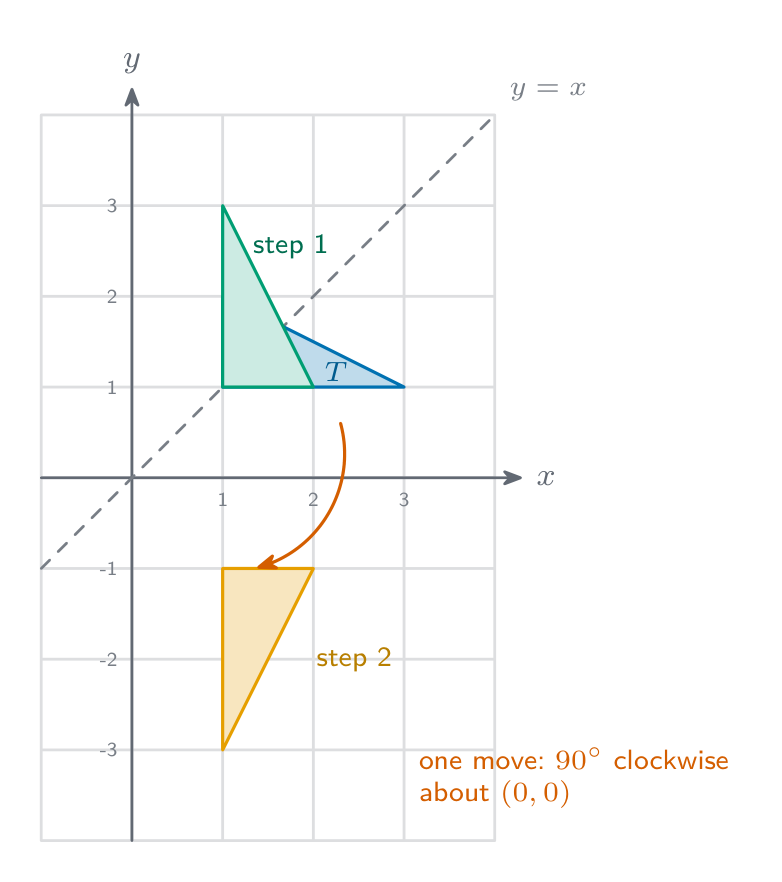
Worked example 4. Triangle $T$ has vertices 顶点 $(1, 1)$, $(3, 1)$ and $(1, 2)$. Reflect $T$ in $y = x$, then reflect the image in the $x$-axis. Describe fully the single transformation that does both.

  • Follow a general point: $(x, y) \to (y, x) \to (y, -x)$.
  • So $(1, 1) \to (1, -1)$, $(3, 1) \to (1, -3)$ and $(1, 2) \to (2, -1)$.
  • The rule $(x, y) \to (y, -x)$ is a rotation of $90°$ clockwise about $(0, 0)$.
Triangle T with vertices (1, 1), (3, 1) and (1, 2) reflected in y = x, then in the x-axis, landing at (1, -1), (1, -3) and (2, -1): the same as a 90 degree clockwise rotation about the origin
Two reflections in lines through O make one rotation: T ends up turned 90 degrees clockwise about (0, 0)
探索

反射、旋转和位似变换。

平移是加上一个向量。

解释为什么直接对P进行缩放会得到不同的放大效果。

词汇 训练
English 中文 拼音
image/ˈɪmɪdʒ/ 像 xiàng
reflection/rɪˈflekʃn/ 反射 fǎn shè
mirror line/ˈmɪrə laɪn/ 镜像线 jìng xiàng xiàn
rotation/rəʊˈteɪʃn/ 旋转 xuán zhuǎn
clockwise/ˈklɒkwaɪz/ 顺时针 shùn shí zhēn
anticlockwise/ˌæntɪˈklɒkwaɪz/ 逆时针 nì shí zhēn
translation/trænˈsleɪʃn/ 平移 píng yí
congruent/ˈkɒŋɡruːənt/ 全等 quán děng
vertex/ˈvɜːteks/ 顶点 dǐng diǎn
.5.2.J .5.2.K .5.2.L .5.2.M

Enlargement and describing transformations

English

An enlargement 放大 changes the size of a shape. You need a centre of enlargement 位似中心 and a scale factor 相似比. Each image point is on the line from the centre through the object point, and its distance from the centre is multiplied by the scale factor. A scale factor between 0 and 1, such as $\frac12$, makes the shape smaller.

An enlargement keeps the angles but changes the lengths, so the image is similar 相似 to the object, not congruent. About the origin, an enlargement with scale factor $k$ maps $(x, y)$ to $(kx, ky)$.

Worked example 5. Enlarge the point $P(3, 2)$ by scale factor 2 with centre $(1, 1)$.

  • From the centre to $P$ is 2 across and 1 up.
  • Double it: 4 across and 2 up from $(1, 1)$, so the image is $(5, 3)$.
Enlargement from centre (1, 1): P(3, 2) maps to (5, 3) on the same line
Scale factor 2 from (1, 1): the image is twice as far from the centre as P

To find the centre of an enlargement on a grid, draw lines through each point and its image. They meet at the centre.

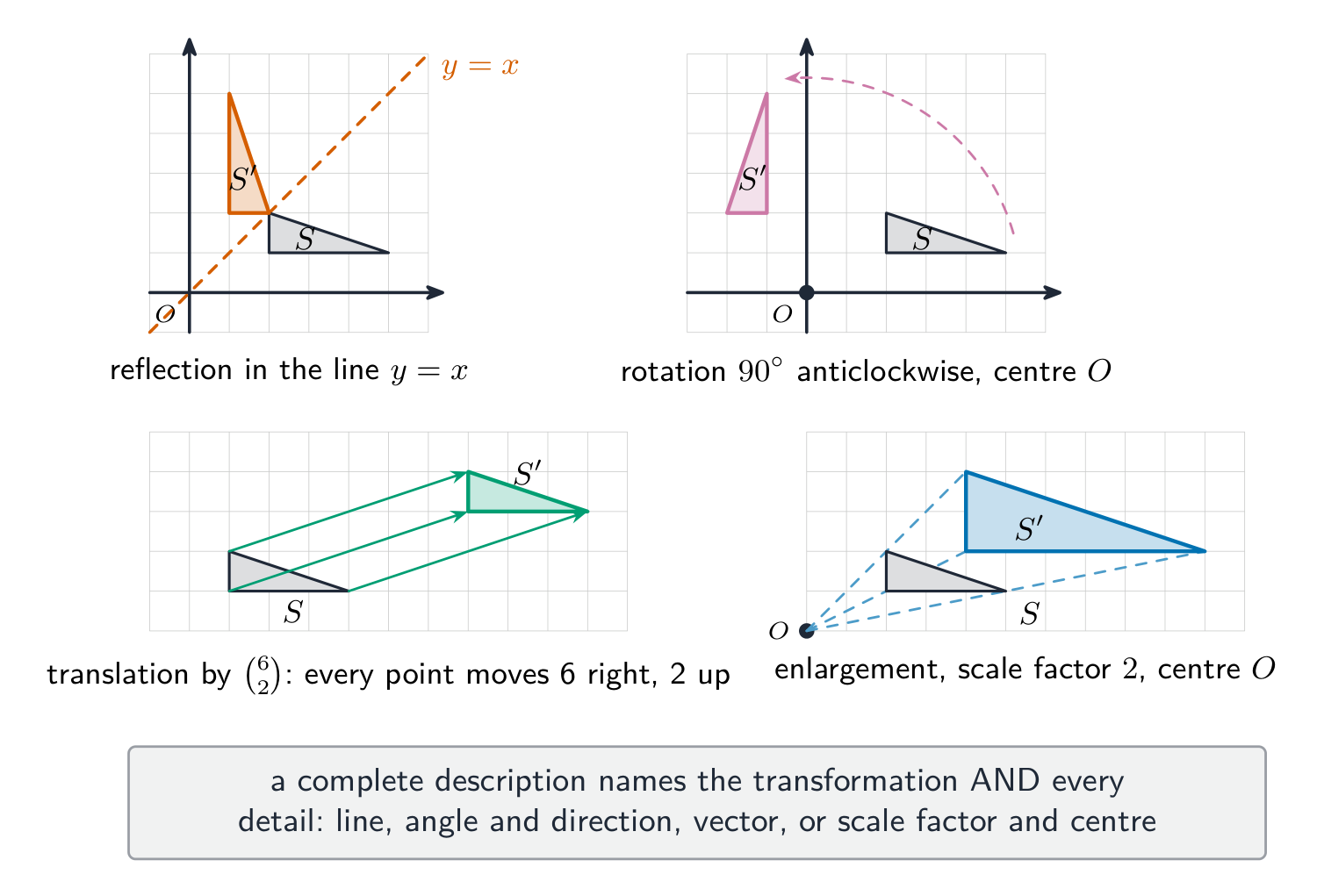
To describe a transformation fully, name it and give every detail it needs:

  • "reflection in the line $y = x$";
  • "rotation $90°$ anticlockwise about $(0, 1)$";
  • "translation by $\dbinom{3}{-2}$";
  • "enlargement, scale factor 2, centre $(1, 1)$".

A missing centre, direction or vector loses marks, and words like "moved" or "turned" earn nothing.

Object S and image S′: reflection in y = x, rotation 90° anticlockwise about O, translation by (6, 2), and enlargement with scale factor 2, centre O
探索

反射、旋转和位似变换。

平移是加上一个向量。

解释为什么直接对P进行缩放会得到不同的放大效果。

词汇 训练
English 中文 拼音
enlargement/enˈlɑːdʒmənt/ 放大 fàng dà
centre of enlargement/ˈsentə ɒv enˈlɑːdʒmənt/ 位似中心 wèi shì zhōng xīn
scale factor/skeɪl ˈfæktə/ 相似比 xiāng sì bǐ
similar/ˈsɪmɪlə/ 相似 xiāng sì
.5.2.J .5.2.K .5.2.L .5.2.M

本课资料

English
  • Pearson Edexcel, International GCSE (9–1) Mathematics A specification (Issue 2, 2017), topic 5.
  • Pearson Edexcel, 4MA1 Paper 2H, June 2024 (adapted).
  • S. Stevin, De Beghinselen der Weeghconst (Leiden, 1586).
.5.2.J .5.2.K .5.2.L .5.2.M

常见错误

English
  • Writing a column vector as a coordinate, $(3, -5)$, instead of $\dbinom{3}{-5}$.
  • Forgetting to change the sign when going backwards along a vector.
  • Assuming a point is a midpoint instead of finding the fraction.
  • Describing a rotation without its centre or its direction.
  • Reflecting in $y = x$ by swapping the signs instead of swapping the coordinates.
  • Measuring an enlargement from the origin when the centre is somewhere else.
  • Giving two transformations when the question asks for a single transformation.
.5.2.J .5.2.K .5.2.L .5.2.M

关键术语

English
  • Vector: a quantity with a size and a direction.
  • Resultant: the single vector from the start to the end of a route.
  • Modulus: the magnitude, or length, of a vector.
  • Image: the shape after a transformation.
  • Centre of enlargement: the fixed point that an enlargement is measured from.
  • Congruent: exactly the same shape and size.
  • Similar: the same shape, with all lengths multiplied by the same scale factor.
.5.2.J .5.2.K .5.2.L .5.2.M

自我检测

English
  1. $\mathbf{a} = \dbinom{2}{-3}$ and $\mathbf{b} = \dbinom{1}{4}$. Find $3\mathbf{a} - \mathbf{b}$.
  2. Find the magnitude of $\dbinom{-8}{6}$.
  3. $\overrightarrow{AB} = \mathbf{p}$ and $\overrightarrow{BC} = \mathbf{q}$. Write $\overrightarrow{CA}$ in terms of $\mathbf{p}$ and $\mathbf{q}$.
  4. Is $\dbinom{6}{-9}$ parallel to $\dbinom{2}{-3}$? Give a reason.
  5. Find the image of $(4, 1)$ after a rotation of $180°$ about $(0, 0)$.
  6. Find the image of $(2, 5)$ after a reflection in $y = x$.
  7. Find the image of $(4, 6)$ after an enlargement, scale factor $\frac12$, centre $(0, 0)$.

Answers: 1. $\dbinom{5}{-13}$. 2. $10$. 3. $-\mathbf{p} - \mathbf{q}$. 4. Yes: $\dbinom{6}{-9} = 3\dbinom{2}{-3}$. 5. $(-4, -1)$. 6. $(5, 2)$. 7. $(2, 3)$.

这有帮助吗?

该知识点的互动课程

逐步完成,配合即时检查练习。

更多 Edexcel International GCSE 数学 A 知识点

登录或创建账户

IGCSE, A-Level & AP