Energy, speed and balance
Three questions decide whether a reaction is useful: does it heat or cool, how fast is it, and does it finish? Physical chemistry answers them — calorimetry and Q = mcΔT, collision theory with its four levers, and the dynamic equilibrium a reversible reaction reaches in a closed vessel.
Edexcel International GCSE Chemistry 4CH1, Section 3 (statements 3.1–3.22C) is short but calculation-heavy. C-suffixed statements are Chemistry-only.
Energetics
Exothermic 放热 reactions give out heat (combustion, neutralisation, most displacements) — the mixture warms, ΔH is negative. Endothermic 吸热 reactions take heat in (thermal decomposition, some dissolving) — the mixture cools. Simple calorimetry 量热: measure the temperature change of a known mass (polystyrene cup for solutions; spirit burner under a water beaker for combustion).
Worked check. 50 g of water rises 24 °C in a spirit-burner trial: $Q = 50 \times 4.2 \times 24 = 5040$ J. If 0.010 mol of fuel burned: $\Delta H = -5040/0.010 = -504\,000\ \mathrm{J\,mol^{-1}} = -504\ \mathrm{kJ\,mol^{-1}}$.
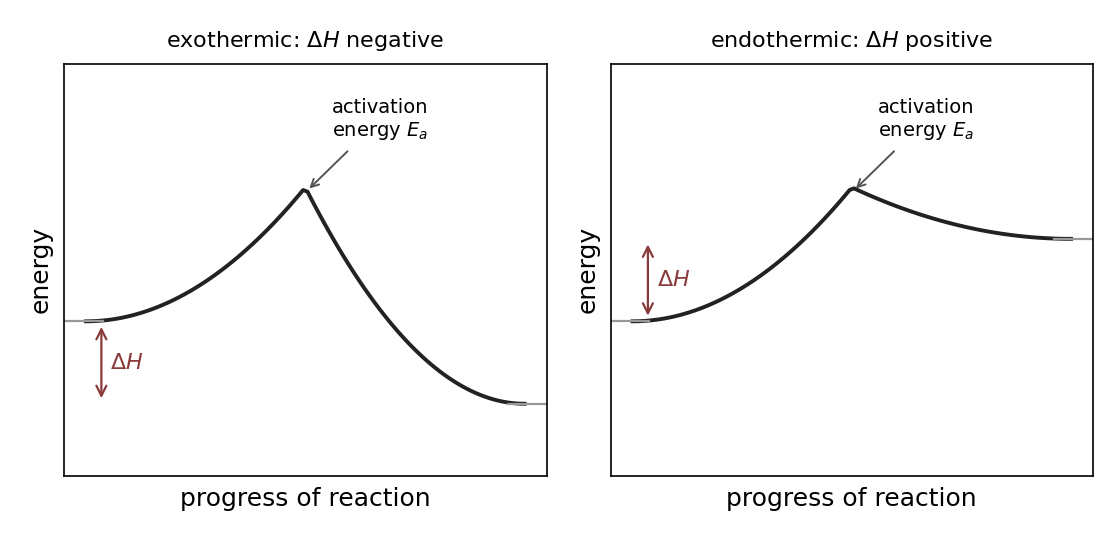
(C) Bond breaking is endothermic; bond making is exothermic. ΔH = bonds broken − bonds formed. Worked check. H₂ + Cl₂ → 2HCl: broken 436 + 242 = 678; formed 2 × 431 = 862; ΔH = 678 − 862 = −184 kJ/mol (exothermic).
Rates of reaction
Experiments follow a reaction that is visible: gas volume (marble + acid), mass loss on a balance, or disappearing cross (sodium thiosulfate + acid). Four levers: surface area of a solid, concentration (or gas pressure), temperature, and a catalyst 催化剂.
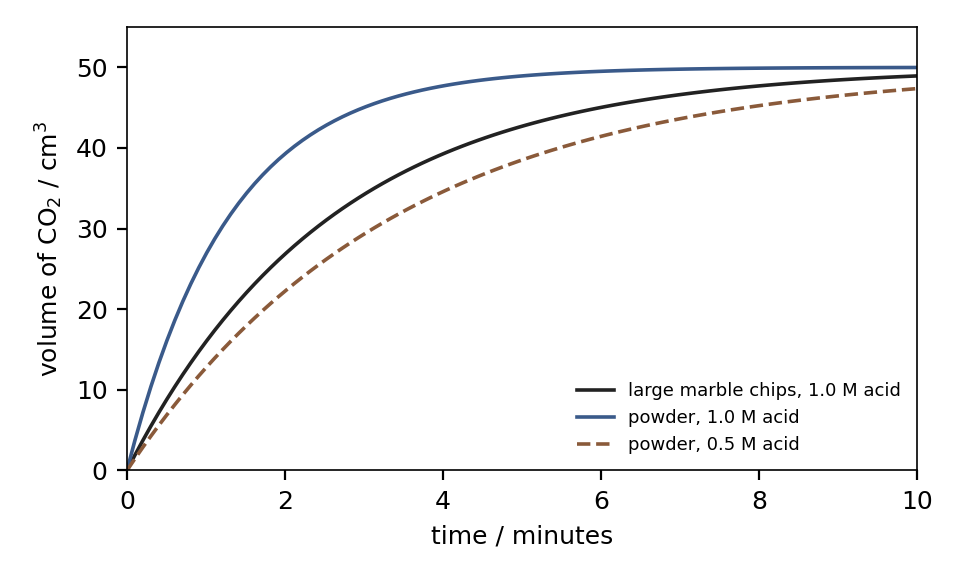
Collision theory 碰撞理论 explains them all: reactions need collisions with at least the activation energy 活化能. Powder gives more exposed surface → more collisions per second; higher concentration or pressure packs particles closer → more frequent collisions; higher temperature makes particles faster → collisions both more frequent and more energetic — the only lever that raises the fraction of successful collisions. A catalyst provides an alternative pathway with lower activation energy — more collisions succeed — and is chemically unchanged at the end; it does not change the amount of product, only how fast it appears.
Reversible reactions and equilibria
A reversible reaction 可逆反应 (⇌) runs both ways: hydrated copper(II) sulfate ⇌ anhydrous salt + water (heat drives it forward, water reverses it); ammonium chloride ⇌ ammonia + hydrogen chloride on heating. (C) In a sealed container it reaches dynamic equilibrium 动态平衡: forward and reverse rates are equal, and all concentrations stay constant — both reactions still run.
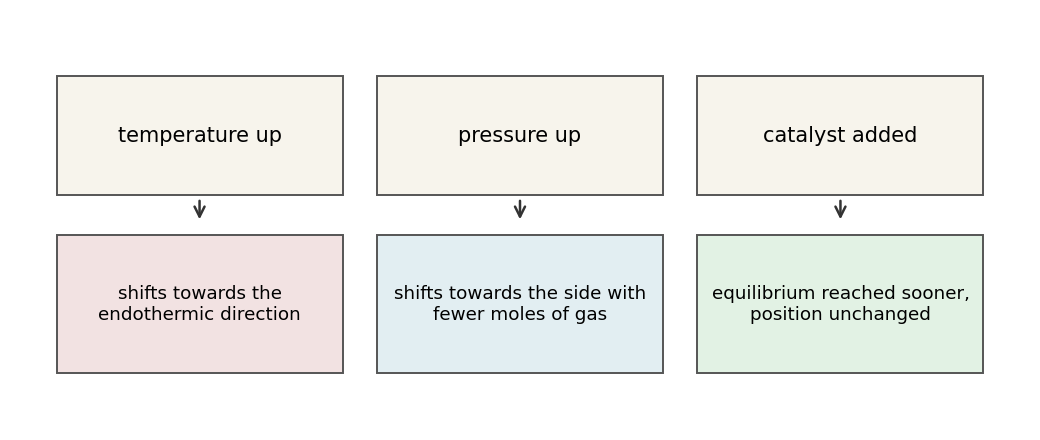
(C) Temperature up → equilibrium shifts in the endothermic direction; pressure up → shifts towards the side with fewer moles of gas; a catalyst speeds both directions equally and leaves the position unchanged.
Check yourself
- Classify as exo- or endothermic: combustion, thermal decomposition, neutralisation.
- 100 g of water cools by 8.0 °C in a dissolving experiment. Calculate Q.
- (C) State the sign of ΔH for bond breaking and bond making.
- Use bond energies to find ΔH for 2H₂ + O₂ → 2H₂O (H–H 436, O=O 498, O–H 463 kJ/mol).
- Why does powdered marble react faster with acid than one large chip?
- Which rate lever increases the fraction of successful collisions, and why?
- Define a catalyst.
- (C) State the two characteristics of dynamic equilibrium.
- (C) N₂ + 3H₂ ⇌ 2NH₃: what does raising the pressure do, and why?
- (C) Why does a catalyst not change the position of equilibrium?
Answers: 1 exothermic (combustion), endothermic (thermal decomposition), exothermic (neutralisation); 2 $Q = 100 \times 4.2 \times 8.0 = 3360$ J taken in — the water cools, so the dissolving is endothermic; 3 (C) breaking positive (endothermic), making negative (exothermic); 4 broken: 2(436) + 498 = 1370; formed: 4(463) = 1852; ΔH = 1370 − 1852 = −482 kJ/mol (per 2 mol H₂O); 5 powder exposes far more surface, so more acid collisions per second; 6 temperature — faster particles collide more often AND more collisions exceed the activation energy; 7 a substance that increases the rate but is chemically unchanged at the end; 8 (C) forward and reverse rates equal; concentrations of all substances constant; 9 (C) shifts right — 4 moles of gas on the left, 2 on the right, so higher pressure favours the fewer-mole side.
Answers continued: 10 (C) it lowers the activation energy of forward and reverse equally, speeding both without changing their balance.