Skip to content
科目

Pearson Edexcel · International GCSE · 化学

  • 1

    1 · Principles of chemistry

    学习计划即将上线

    Handout

    The language of chemistry

    Everything in this course is written in one language: particles, formulae and equations. Section 1 teaches it — how particles arrange themselves in solids, liquids and gases; how atoms are built and lined up in the Periodic Table; how to turn a sentence about a reaction into a balanced equation and a mass calculation; and how the three kinds of bonding give every substance its properties.

    Edexcel International GCSE Chemistry 4CH1, Section 1 (statements 1.1–1.60C) is the largest section and the foundation for the other three. C-suffixed statements are the separate-science (Chemistry-only) extension.

    States of matter and solutions
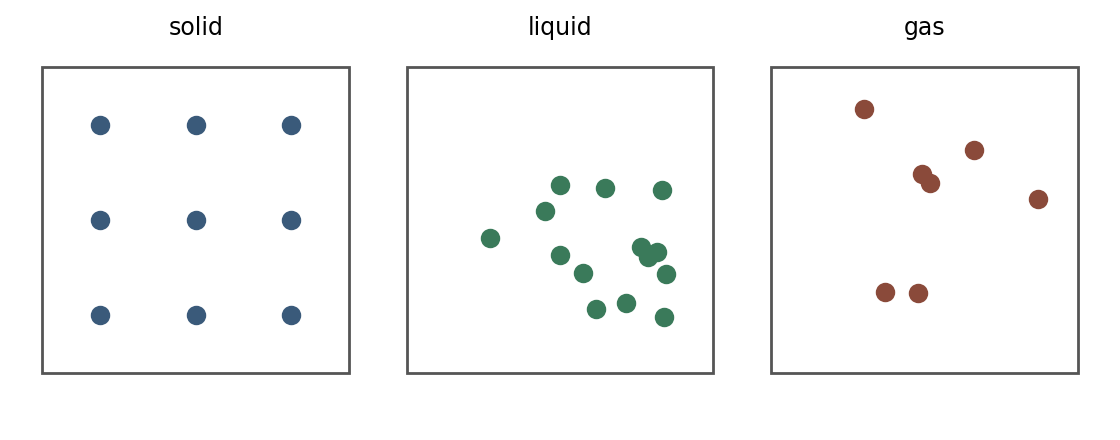
    Particle arrangements in the three states: fixed rows in solids, touching but disordered in liquids, far apart and fast in gases.

    Solid: particles vibrate about fixed positions in a regular pattern. Liquid: particles touch but move past each other at random. Gas: particles far apart, fast, random. Interconversions: melting 熔化 / freezing 凝固, boiling 沸腾 / condensation 凝结, evaporation 蒸发 (surface only, below boiling), sublimation 升华 (solid → gas directly). Energy is absorbed to separate particles and released as they bond again.

    A solvent 溶剂 dissolves the solute 溶质 to make a solution 溶液; a saturated solution 饱和溶液 holds all the solute it can at that temperature. (C) Solubility is the mass dissolved per 100 g of solvent at a stated temperature, read from a solubility curve 溶解度曲线 — points on the line are saturated; below it, unsaturated.
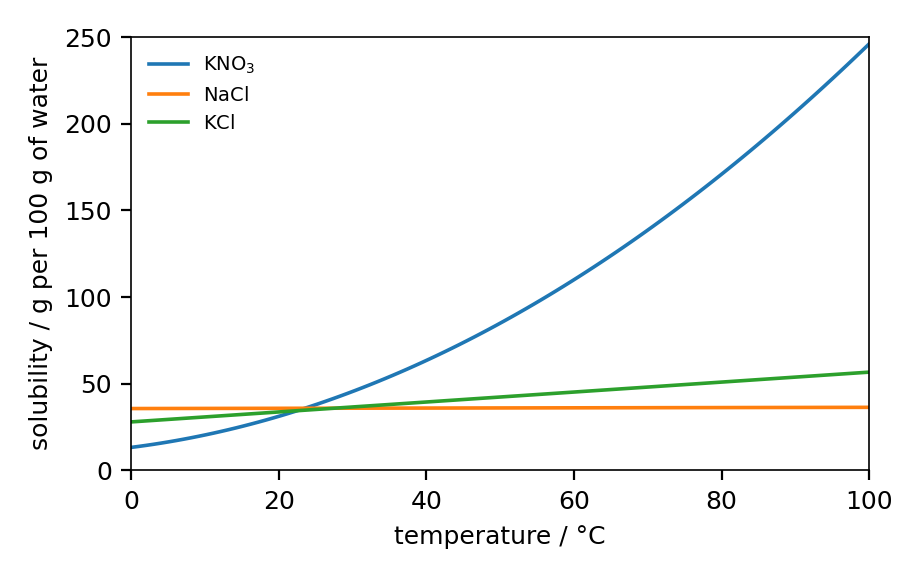
    Solubility curves rise with temperature for most solids; read the saturated mass at a stated temperature.

    Dilution of coloured solutions and gas diffusion (bromine spreading through air) both show particles moving from where they are many to where they are few.

    Elements, compounds, mixtures and separation

    An element 元素 contains one type of atom; a compound 化合物 holds different atoms chemically joined; a mixture 混合物 is not chemically joined. A pure substance has a sharp melting/boiling point; mixtures melt and boil over a range — the test for purity.

    Separation techniques, matched to the job: filtration 过滤 (insoluble solid from liquid); crystallisation 结晶 (evaporate a solution to leave crystals); simple distillation 蒸馏 (liquid from dissolved solid — evaporate then condense); fractional distillation 分馏 (liquids with close boiling points, using a fractionating column); paper chromatography 纸层析 (solutes that dissolve differently in a solvent).
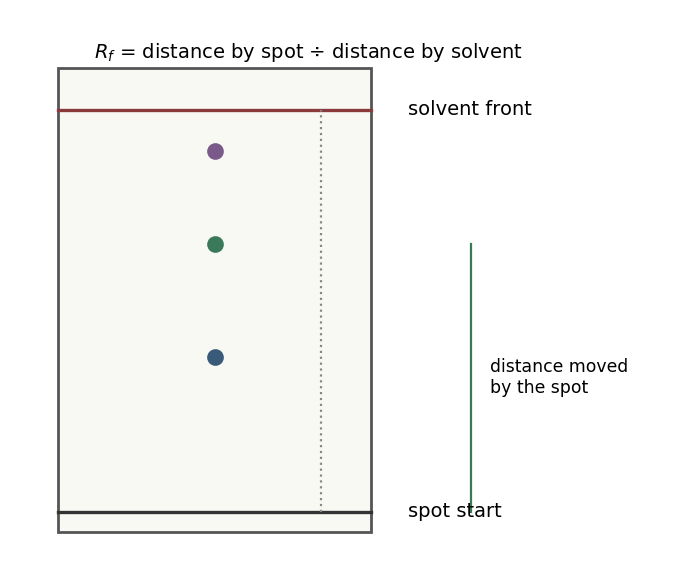
    A chromatogram: the solvent front and spot distances give Rf values that identify each component.

    Rf = distance moved by the spot ÷ distance moved by the solvent. The same substance always has the same Rf in the same solvent — comparing with known values identifies the components of the mixture.

    Atoms and the Periodic Table
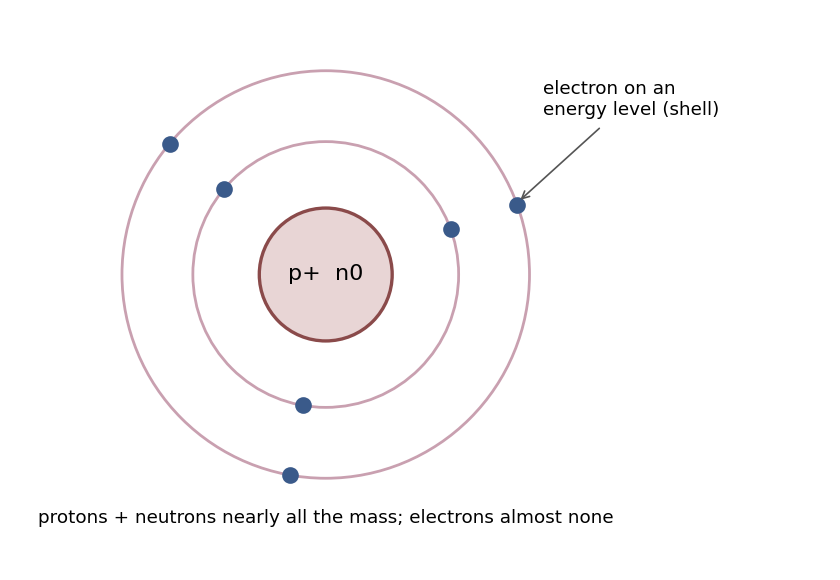
    The nuclear atom: protons and neutrons in the nucleus, electrons in shells.
    Particle Relative mass Relative charge
    proton 1 +1
    neutron 1 0
    electron 1/1835 (≈0) −1

    Atomic number 质子数 = protons; mass number 质量数 = protons + neutrons. Isotopes 同位素 have the same protons but different neutrons. Relative atomic mass ($A_r$) is the weighted mean over the isotopes.

    Worked check. Chlorine: 75 % Cl-35, 25 % Cl-37 → $A_r = (75 \times 35 + 25 \times 37)/100 = 35.5$.

    The Periodic Table lists elements by atomic number into groups 族 (columns, same outer electrons) and periods 周期 (rows). The first 20 electronic configurations follow 2,8,8,2 shells (e.g. sodium 2.8.1). Metals sit left/centre: their oxides are basic and they conduct; non-metal oxides are acidic. Group members behave alike because they have the same number of outer electrons; Group 0 noble gases have full outer shells and do not readily react.

    Formulae, equations and calculations

    Balance equations with state symbols 状态符号: (s), (l), (g), (aq). $M_r$ sums the $A_r$ values. The mole 摩尔 is the amount of substance: $n = m/M_r$ (mass in grams).

    Worked check (reacting masses). What mass of magnesium oxide forms from 6.0 g of magnesium? $2\mathrm{Mg} + \mathrm{O_2} \rightarrow 2\mathrm{MgO}$: $n(\mathrm{Mg}) = 6.0/24 = 0.25$ mol → $n(\mathrm{MgO}) = 0.25$ mol → mass $= 0.25 \times 40 = 10$ g.

    Percentage yield 产率 $=$ actual ÷ theoretical × 100 %. Empirical formula 实验式 is the simplest whole-number ratio (divide each mass by its $A_r$, scale to integers); the molecular formula is the true count ($M_r$ ÷ empirical mass gives the multiplier).

    Worked check. A hydrocarbon is 85.7 % C, 14.3 % H: C 85.7/12 = 7.14, H 14.3/1 = 14.3 → ratio 1:2 → empirical CH₂. With $M_r = 56$: 56/14 = 4 → molecular C₄H₈.

    (C) Solutions: $n = c \times V$ with $c$ in mol/dm³ and $V$ in dm³ (cm³ ÷ 1000). Gases: molar volume 24 dm³ at rtp, so $n = V/24$. (C-practical) A metal oxide's formula comes from combustion (weigh magnesium, burn, weigh the oxide) or reduction (weigh copper(II) oxide, reduce with hydrogen, weigh the copper).

    Bonding

    Ionic bonding 离子键: metals lose electrons to non-metals; the charged ions attract electrostatically in a giant lattice — dot-and-cross diagrams show the transfer (Groups 1–3 with 5–7). High melting points (strong attractions); conduct only when molten or dissolved (ions free to move). Learn the charges: Groups 1/2/3 → 1+/2+/3+; Groups 5/6/7 → 3−/2−/1−; Ag⁺, Cu²⁺, Fe²⁺, Fe³⁺, Pb²⁺, Zn²⁺; OH⁻, NH₄⁺, CO₃²⁻, NO₃⁻, SO₄²⁻. Formulae balance the charges: calcium nitrate Ca(NO₃)₂, ammonium sulfate (NH₄)₂SO₄.

    Covalent bonding 共价键: shared pairs of electrons (dot-and-cross for H₂, O₂, N₂, halogens, HCl, H₂O, NH₃, CO₂ and small organics). Simple molecular substances have weak intermolecular forces — low melting points, rising with $M_r$; they do not conduct (no ions, no free electrons). Giant covalent: diamond (each C bonded to 4 — very hard, non-conductor), graphite (3 bonds + one free electron per C, layers with weak forces — soft, conducts, slippery), C₆₀ fullerene (simple molecular cage).
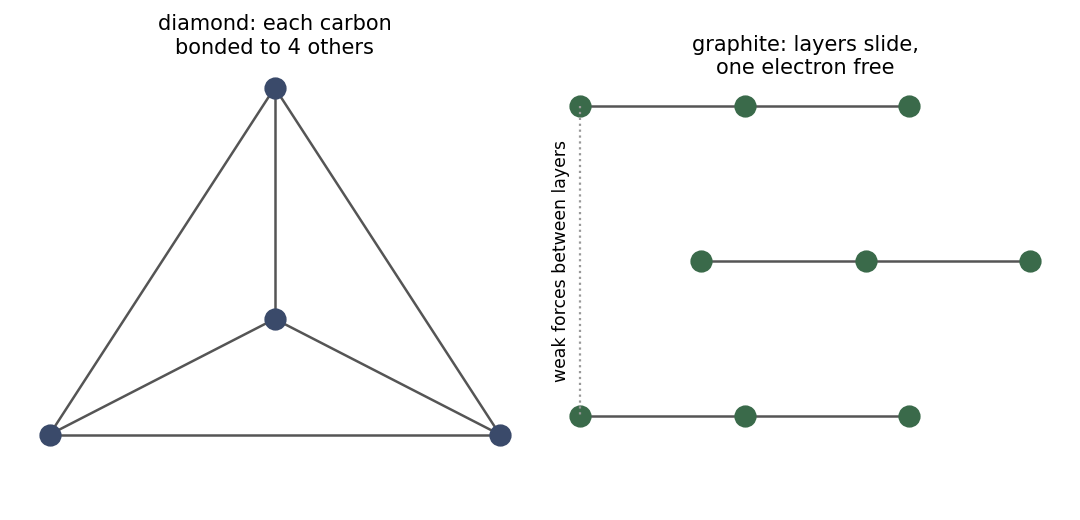
    Diamond bonds every carbon to four others; graphite bonds three and keeps one electron free between weak layers.

    (C) Metallic: a lattice of positive ions in a sea of delocalised electrons — electrostatic attraction; the free electrons conduct electricity, and layers slide (malleable).

    Electrolysis (C)
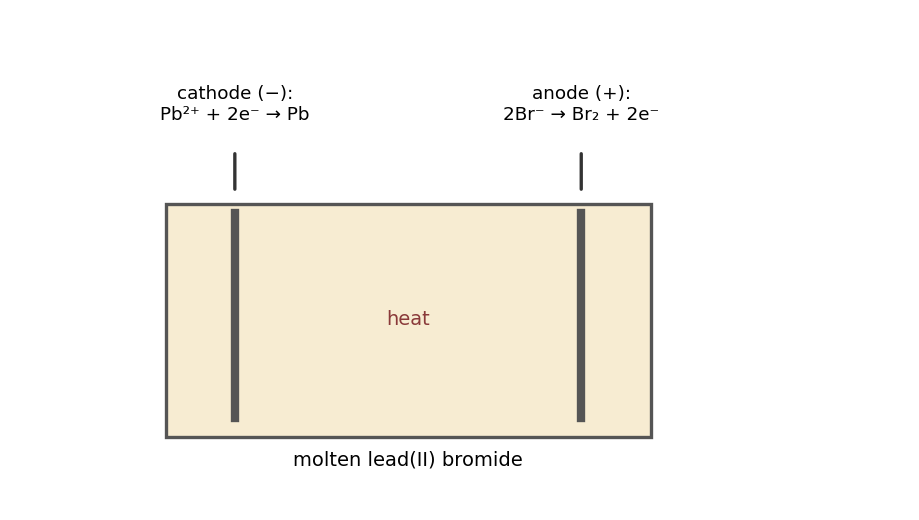
    Electrolysis of molten lead(II) bromide: lead forms at the cathode, bromine at the anode.

    Electrolysis 电解 uses electricity to split molten or dissolved ionic compounds: the cathode 阴极 (negative) attracts cations 阳离子; the anode 阳极 (positive) attracts anions 阴离子. Molten PbBr₂ gives Pb at the cathode (Pb²⁺ + 2e⁻ → Pb) and Br₂ at the anode (2Br⁻ → Br₂ + 2e⁻). In aqueous solution, hydrogen forms at the cathode if the metal is more reactive than hydrogen; at the anode, halide ions give the halogen, otherwise oxygen (4OH⁻ → O₂ + 2H₂O + 4e⁻). Loss of electrons is oxidation 氧化, gain is reduction 还原.

    Check yourself

    1. Describe the particle arrangement and movement in a liquid.
    2. Define saturated solution, and state the units of solubility.
    3. Which technique separates two miscible liquids with close boiling points?
    4. An isotope has 17 protons and 20 neutrons. Give its mass number and the numbers of each particle.
    5. Calculate $A_r$ of an element with 80 % of mass 20 and 20 % of mass 22.
    6. Balance with state symbols: magnesium + oxygen → magnesium oxide.
    7. 8.4 g of the oxide of calcium forms from 6.0 g of calcium. Show the empirical formula of the oxide.
    8. Write the formula of ammonium carbonate.
    9. Explain why graphite conducts but diamond does not.
    10. (C) What forms at each electrode in the electrolysis of molten potassium chloride?

    Answers: 1 particles touch but are disordered, moving randomly past each other; 2 a solution containing the maximum mass of dissolved solute at that temperature; g per 100 g of solvent; 3 fractional distillation; 4 mass number 37; 17 protons, 20 neutrons, 17 electrons; 5 $(80 \times 20 + 20 \times 22)/100 = 20.4$; 6 2Mg(s) + O₂(g) → 2MgO(s); 7 Ca 6.0/40 = 0.15 mol; O mass 8.4 − 6.0 = 2.4 g → 2.4/16 = 0.15 mol; ratio 1:1 → empirical formula CaO; 8 (NH₄)₂CO₃; 9 graphite uses three bonds per carbon, leaving one delocalised electron per carbon free to move between layers — diamond uses all four in fixed bonds; 10 (C) potassium at the cathode (K⁺ + e⁻ → K) and chlorine at the anode (2Cl⁻ → Cl₂ + 2e⁻).
    词汇
    English 中文 拼音
    melting/ˈmeltɪŋ/ 熔化 róng huà
    freezing/ˈfriːzɪŋ/ 凝固 níng gù
    boiling/ˈbɔɪlɪŋ/ 沸腾 fèi téng
    evaporation/ɪˌvæpəˈreɪʃn/ 蒸发 zhēng fā
    condensation/kɒndenˈseɪʃn/ 凝结 níng jié
    sublimation/ˌsʌblɪˈmeɪʃn/ 升华 shēng huá
    solvent/ˈsɒlvənt/ 溶剂 róng jì
    solute/ˈsɒljuːt/ 溶质 róng zhì
    solution/səˈluːʃn/ 溶液 róng yè
    saturated solution/ˈsætʃəreɪtɪd səˈluːʃn/ 饱和溶液 bǎo hé róng yè
    solubility curve 溶解度曲线 róng jiě dù qū xiàn
    element/ˈelɪmənt/ 元素 yuán sù
    compound/ˈkɒmpaʊnd/ 化合物 huà hé wù
    mixture/ˈmɪkstʃə/ 混合物 hùn hé wù
    filtration/fɪlˈtreɪʃn/ 过滤 guò lǜ
    crystallisation/ˌkrɪstəlaɪˈzeɪʃn/ 结晶 jié jīng
    simple distillation/ˈsɪmpl dɪstɪˈleɪʃn/ 蒸馏 zhēng liú
    fractional distillation/ˈfrækʃənl dɪstɪˈleɪʃn/ 分馏 fēn liú
    paper chromatography/ˈpeɪpə krəʊməˈtɒɡrəfi/ 纸层析 zhǐ céng xī
    Atomic number/əˈtɒmɪk ˈnʌmbə/ 质子数 zhì zǐ shù
    mass number/mæs ˈnʌmbə/ 质量数 zhì liàng shù
    Isotope/ˈaɪsətəʊp/ 同位素 tóng wèi sù
    group/ɡruːp/ 族 zú
    period/ˈpɪərɪəd/ 周期 zhōu qī
    state symbol/steɪt ˈsɪmbl/ 状态符号 zhuàng tài fú hào
    mole/məʊl/ 摩尔 mó ěr
    Percentage yield/pəˈsentɪdʒ jiːld/ 产率 chǎn lǜ
    Empirical formula/emˈpɪrɪkl ˈfɔːmjʊlə/ 实验式 shí yàn shì
    Ionic bonding/aɪˈɒnɪk ˈbɒndɪŋ/ 离子键 lí zi jiàn
    cation/ˈkætaɪən/ 阳离子 yáng lí zi
    anion/ˈænaɪən/ 阴离子 yīn lí zi
    Covalent bonding/ˈkəʊvələnt ˈbɒndɪŋ/ 共价键 gòng jià jiàn
    Electrolysis/ɪlekˈtrɒləsɪs/ 电解 diàn jiě
    cathode/ˈkæθəʊd/ 阴极 yīn jí
    anode/ˈænəʊd/ 阳极 yáng jí
    oxidation/ˌɒksɪˈdeɪʃn/ 氧化 yǎng huà
    reduction/rɪˈdʌkʃn/ 还原 huán yuán
  • 2

    2 · Inorganic chemistry

    学习计划即将上线

    Handout

    The reactive world of inorganic chemistry

    Drop lithium in water and it fizzes gently; drop potassium and it ignites. This section follows the patterns behind those observations — the families of the Periodic Table, the air we breathe, the ladder of reactivity that decides how every metal is extracted and why iron rusts — and then the huge practical centre of the course: acids, alkalis, salt preparation and the identification tests.

    Edexcel International GCSE Chemistry 4CH1, Section 2 (statements 2.1–2.50) supplies most of the recall and practical questions on both papers. C-suffixed statements are Chemistry-only.

    Group 1 and Group 7

    Group 1 (Li, Na, K) react with water to make the hydroxide and hydrogen — fizzing, floating, melting (Na), lilac flame (K). The reactions get faster and more vigorous down the group: a family with a trend. (C) Reactivity rises because the outer electron is further from the nucleus and lost more easily.

    Group 7 (Cl₂ pale green gas, Br₂ orange-brown liquid, I₂ grey-black solid) darken down the group. A more reactive halogen displaces a less reactive one's salt: chlorine displaces bromine from potassium bromide (solution turns orange). (C) Reactivity falls down the group — the outer shell is further away, so gaining an electron is harder.

    Air and gases

    Dry air: about 78 % nitrogen, 21 % oxygen, 0.96 % argon, 0.04 % carbon dioxide (the four most abundant). The oxygen percentage can be measured by using it up — iron rusting in damp air over water, or phosphorus burning, so the water rises about one-fifth of the way. Elements burn in oxygen: magnesium gives a bright white flame and white MgO; hydrogen burns with a pop to steam; sulfur gives a blue flame and choking SO₂. Copper(II) carbonate decomposes on heating: CuCO₃ → CuO + CO₂ (limewater turns milky). CO₂ is a greenhouse gas 温室气体 whose rising level contributes to climate change.

    The reactivity series and metals

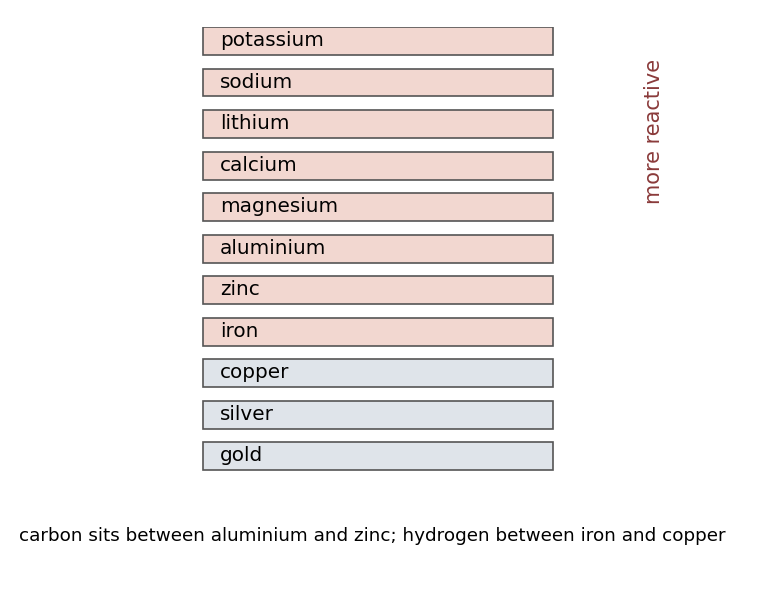
    Order to learn: potassium, sodium, lithium, calcium, magnesium, aluminium, (carbon), zinc, iron, (hydrogen), copper, silver, gold. Metals above hydrogen — everything down to iron — react with dilute HCl/H₂SO₄ giving hydrogen; the more reactive, the faster the fizz. A metal displaces any less reactive metal from its salt solution or oxide.

    The reactivity series ladder: potassium at the top, gold at the bottom, with carbon and hydrogen between the metals.

    Rusting 生锈 needs oxygen and water; prevented by barrier methods (paint, oil, plastic), galvanising 镀锌 (zinc coat) and sacrificial protection 牺牲保护 (a more reactive metal such as zinc or magnesium corrodes instead). Oxidation 氧化 is loss of electrons or gain of oxygen; reduction 还原 the reverse; a redox reaction has both; the oxidising agent 氧化剂 is reduced, the reducing agent 还原剂 is oxidised.

    (C) Extraction matches reactivity: unreactive metals (gold, silver) occur native; those below carbon (iron) are reduced by carbon in a blast furnace; those above (aluminium) need electrolysis of molten ore. Aluminium (low density, resists corrosion), copper (conducts), iron and steels (strong; stainless resists rust) are chosen for their properties. Alloys 合金 mix a metal with other elements and are harder because the different-sized atoms disturb the layers' sliding.

    Acids, alkalis and salts

    Acids provide H⁺(aq); alkalis provide OH⁻(aq). Indicators: litmus (red in acid, blue in alkali), phenolphthalein (colourless → pink), methyl orange (red → yellow). The pH scale pH值 0–14 classifies solutions (0–3 strongly acidic … 11–14 strongly alkaline); universal indicator measures approximate pH. Neutralisation: acid + alkali → salt + water. (C) Acids are proton donors, bases proton acceptors; alkalis are soluble bases. (C) Titration 滴定: fixed volume of alkali with indicator in a flask, acid from a burette dropwise to the colour change, repeat for concordant results.

    Solubility rules: sodium, potassium and ammonium salts — soluble; all nitrates — soluble; chlorides — soluble except AgCl and PbCl₂; sulfates — soluble except BaSO₄, CaSO₄ and PbSO₄; carbonates — insoluble except Na⁺, K⁺, NH₄⁺; hydroxides — insoluble except Na⁺, K⁺ (Ca(OH)₂ slightly).

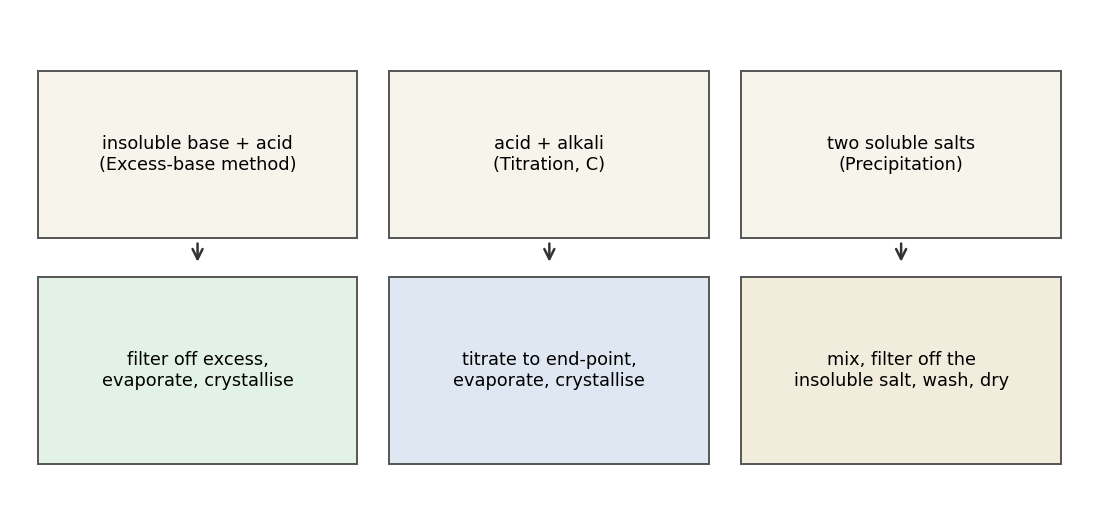
    Three salt-preparation routes matched to the reactants available.

    Acid + metal / base / carbonate gives a salt: e.g. Zn + H₂SO₄ → ZnSO₄ + H₂; CuO + 2HNO₃ → Cu(NO₃)₂ + H₂O. Soluble salt from an insoluble reactant (CuO + warm dilute H₂SO₄): add excess base, filter, evaporate, crystallise. (C) From acid + alkali: titrate, then evaporate. (C) Insoluble salt: mix two solutions so a precipitate 沉淀 forms (Pb(NO₃)₂ + Na₂SO₄ → PbSO₄↓ + 2NaNO₃), filter, wash, dry.

    Chemical tests

    Flame-test colours for five cations.

    Gases: hydrogen — a lit splint pops; oxygen — relights a glowing splint; carbon dioxide — turns limewater milky; ammonia — turns damp red litmus blue; chlorine — bleaches damp litmus paper white. Cations: flame tests 焰色试验 (Li⁺ red, Na⁺ yellow, K⁺ lilac, Ca²⁺ orange-red, Cu²⁺ blue-green); NH₄⁺ warms with NaOH(aq) giving ammonia; Cu²⁺/Fe²⁺/Fe³⁺ give blue/green/rust-brown precipitates with NaOH(aq). Anions: Cl⁻/Br⁻/I⁻ give white/cream/pale-yellow precipitates with acidified silver nitrate; SO₄²⁻ gives a white precipitate with acidified barium chloride; CO₃²⁻ fizzes with dilute HCl giving CO₂. Water: turns anhydrous copper(II) sulfate white → blue; a pure water sample boils sharply at 100 °C.

    Check yourself

    1. Describe the trend in reactivity down Group 1 and give the (C) electron reason.
    2. What is seen when chlorine water is added to potassium bromide, and why?
    3. Name the four most abundant gases in dry air with approximate percentages.
    4. State the two conditions needed for iron to rust, and two prevention methods.
    5. Define oxidation and reduction in terms of electrons.
    6. (C) Why is aluminium extracted by electrolysis but iron by carbon reduction?
    7. Which chlorides are insoluble, and which sulfates?
    8. Write the equation for copper(II) oxide reacting with sulfuric acid.
    9. Describe the flame-test colours for sodium, potassium and copper.
    10. Describe the test for sulfate ions and the positive result.

    Answers: 1 reactivity increases down the group (B1); (C) the outer electron is in a shell further from the nucleus, so it is lost more easily; 2 the solution turns orange — chlorine displaces bromine because chlorine is the more reactive halogen; 3 nitrogen ≈78 %, oxygen ≈21 %, argon ≈0.96 %, carbon dioxide ≈0.04 %; 4 oxygen and water; barrier methods (paint/grease/plastic) and galvanising or sacrificial zinc; 5 oxidation is loss of electrons, reduction is gain; 6 (C) aluminium lies above carbon in the reactivity series, so carbon cannot reduce its oxide — electrolysis of molten alumina is needed; iron lies below carbon, so carbon displaces it from its oxide; 7 AgCl and PbCl₂; BaSO₄, CaSO₄ and PbSO₄; 8 CuO(s) + H₂SO₄(aq) → CuSO₄(aq) + H₂O(l); 9 sodium yellow, potassium lilac, copper blue-green; 10 acidify with dilute hydrochloric acid, add barium chloride solution — a white precipitate of BaSO₄ confirms sulfate.

    词汇
    English 中文 拼音
    greenhouse gas/ˈɡriːnhaʊs ɡæs/ 温室气体 wēn shì qì tǐ
    rusting/ˈrʌstɪŋ/ 生锈 shēng xiù
    galvanising/ˈɡælvənaɪzɪŋ/ 镀锌 dù xīn
    sacrificial protection/ˌsækrɪˈfɪʃl prəˈtekʃn/ 牺牲保护 xī shēng bǎo hù
    oxidation/ˌɒksɪˈdeɪʃn/ 氧化 yǎng huà
    reduction/rɪˈdʌkʃn/ 还原 huán yuán
    oxidising agent/ˈɒksɪdaɪzɪŋ ˈeɪdʒənt/ 氧化剂 yǎng huà jì
    reducing agent/rɪˈdjuːsɪŋ ˈeɪdʒənt/ 还原剂 huán yuán jì
    alloy/ˈælɔɪ/ 合金 hé jīn
    titration/taɪˈtreɪʃn/ 滴定 dī dìng
    pH scale/piː eɪtʃ skeɪl/ pH值 pH zhí
    flame test/fleɪm test/ 焰色试验 yàn sè shì yàn
    precipitate/prɪˈsɪpɪteɪt/ 沉淀 chén diàn
  • 3

    3 · Physical chemistry

    学习计划即将上线

    Handout

    Energy, speed and balance

    Three questions decide whether a reaction is useful: does it heat or cool, how fast is it, and does it finish? Physical chemistry answers them — calorimetry and Q = mcΔT, collision theory with its four levers, and the dynamic equilibrium a reversible reaction reaches in a closed vessel.

    Edexcel International GCSE Chemistry 4CH1, Section 3 (statements 3.1–3.22C) is short but calculation-heavy. C-suffixed statements are Chemistry-only.

    Energetics

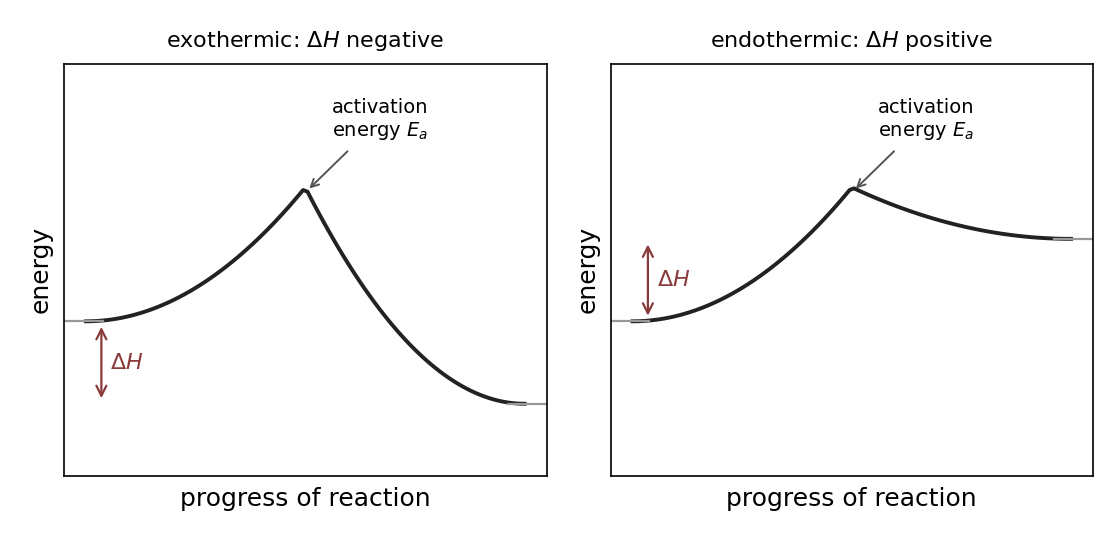
    Exothermic 放热 reactions give out heat (combustion, neutralisation, most displacements) — the mixture warms, ΔH is negative. Endothermic 吸热 reactions take heat in (thermal decomposition, some dissolving) — the mixture cools. Simple calorimetry 量热: measure the temperature change of a known mass (polystyrene cup for solutions; spirit burner under a water beaker for combustion).

    $$Q = mc\Delta T$$

    Worked check. 50 g of water rises 24 °C in a spirit-burner trial: $Q = 50 \times 4.2 \times 24 = 5040$ J. If 0.010 mol of fuel burned: $\Delta H = -5040/0.010 = -504\,000\ \mathrm{J\,mol^{-1}} = -504\ \mathrm{kJ\,mol^{-1}}$.

    Energy profiles: exothermic (products below reactants) and endothermic (products above), each with its activation energy.

    (C) Bond breaking is endothermic; bond making is exothermic. ΔH = bonds broken − bonds formed. Worked check. H₂ + Cl₂ → 2HCl: broken 436 + 242 = 678; formed 2 × 431 = 862; ΔH = 678 − 862 = −184 kJ/mol (exothermic).

    Rates of reaction

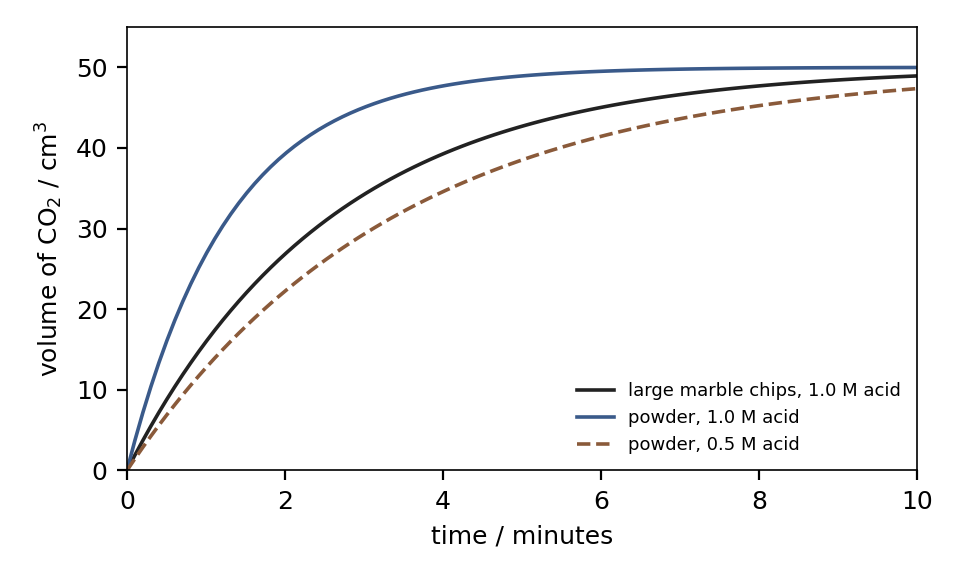
    Experiments follow a reaction that is visible: gas volume (marble + acid), mass loss on a balance, or disappearing cross (sodium thiosulfate + acid). Four levers: surface area of a solid, concentration (or gas pressure), temperature, and a catalyst 催化剂.

    Rate curves for marble chips and acid: powder reacts faster than chips; weaker acid slows the reaction.

    Collision theory 碰撞理论 explains them all: reactions need collisions with at least the activation energy 活化能. Powder gives more exposed surface → more collisions per second; higher concentration or pressure packs particles closer → more frequent collisions; higher temperature makes particles faster → collisions both more frequent and more energetic — the only lever that raises the fraction of successful collisions. A catalyst provides an alternative pathway with lower activation energy — more collisions succeed — and is chemically unchanged at the end; it does not change the amount of product, only how fast it appears.

    Reversible reactions and equilibria

    A reversible reaction 可逆反应 (⇌) runs both ways: hydrated copper(II) sulfate ⇌ anhydrous salt + water (heat drives it forward, water reverses it); ammonium chloride ⇌ ammonia + hydrogen chloride on heating. (C) In a sealed container it reaches dynamic equilibrium 动态平衡: forward and reverse rates are equal, and all concentrations stay constant — both reactions still run.

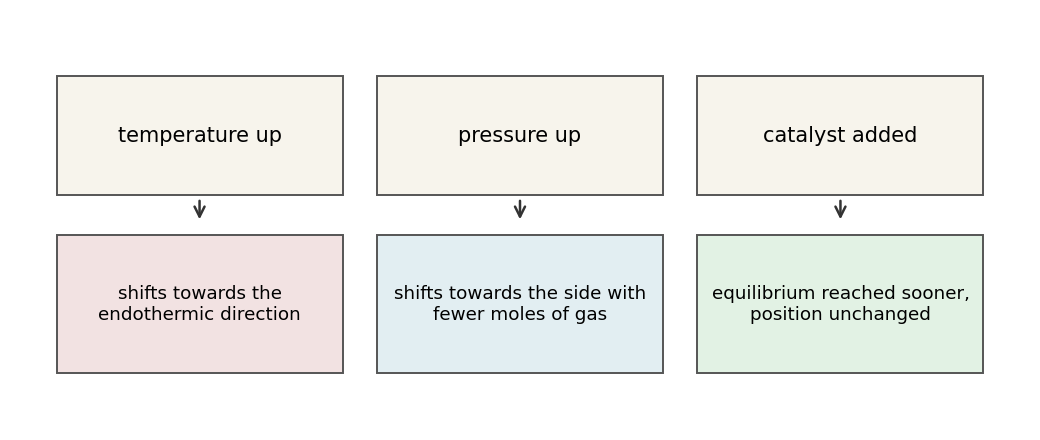
    What each change does to the position of equilibrium.

    (C) Temperature up → equilibrium shifts in the endothermic direction; pressure up → shifts towards the side with fewer moles of gas; a catalyst speeds both directions equally and leaves the position unchanged.

    Check yourself

    1. Classify as exo- or endothermic: combustion, thermal decomposition, neutralisation.
    2. 100 g of water cools by 8.0 °C in a dissolving experiment. Calculate Q.
    3. (C) State the sign of ΔH for bond breaking and bond making.
    4. Use bond energies to find ΔH for 2H₂ + O₂ → 2H₂O (H–H 436, O=O 498, O–H 463 kJ/mol).
    5. Why does powdered marble react faster with acid than one large chip?
    6. Which rate lever increases the fraction of successful collisions, and why?
    7. Define a catalyst.
    8. (C) State the two characteristics of dynamic equilibrium.
    9. (C) N₂ + 3H₂ ⇌ 2NH₃: what does raising the pressure do, and why?
    10. (C) Why does a catalyst not change the position of equilibrium?

    Answers: 1 exothermic (combustion), endothermic (thermal decomposition), exothermic (neutralisation); 2 $Q = 100 \times 4.2 \times 8.0 = 3360$ J taken in — the water cools, so the dissolving is endothermic; 3 (C) breaking positive (endothermic), making negative (exothermic); 4 broken: 2(436) + 498 = 1370; formed: 4(463) = 1852; ΔH = 1370 − 1852 = −482 kJ/mol (per 2 mol H₂O); 5 powder exposes far more surface, so more acid collisions per second; 6 temperature — faster particles collide more often AND more collisions exceed the activation energy; 7 a substance that increases the rate but is chemically unchanged at the end; 8 (C) forward and reverse rates equal; concentrations of all substances constant; 9 (C) shifts right — 4 moles of gas on the left, 2 on the right, so higher pressure favours the fewer-mole side.

    Answers continued: 10 (C) it lowers the activation energy of forward and reverse equally, speeding both without changing their balance.

    词汇
    English 中文 拼音
    exothermic/eɡzəˈðɜːmɪk/ 放热 fàng rè
    endothermic/ˌendəʊˈθɜːmɪk/ 吸热 xī rè
    calorimetry/ˌkælɔːˈrɪmətri/ 量热 liàng rè
    catalyst/ˈkætəlɪst/ 催化剂 cuī huà jì
    collision theory/kəˈlɪʒn ˈθɪəri/ 碰撞理论 pèng zhuàng lǐ lùn
    activation energy/ˌæktɪˈveɪʃn ˈenədʒi/ 活化能 huó huà néng
    reversible reaction/rɪˈvɜːsɪbl rɪˈækʃn/ 可逆反应 kě nì fǎn yìng
    dynamic equilibrium/daɪˈnæmɪk ˌiːkwɪˈlɪbrɪəm/ 动态平衡 dòng tài píng héng
  • 4

    4 · Organic chemistry

    学习计划即将上线

    Handout

    Carbon's family tree

    Crude oil is a mixture of hydrocarbons — compounds of carbon and hydrogen only — built from the smallest molecules in the gas fraction to the tars of bitumen. This section organises them into families, follows crude oil from well to fraction, and then meets each family in turn: the unreactive alkanes, the double-bonded alkenes, and (C) the alcohols, acids, esters and polymers that come after.

    Edexcel International GCSE Chemistry 4CH1, Section 4 (statements 4.1–4.50C) closes the course. C-suffixed statements are Chemistry-only.

    Introduction and crude oil

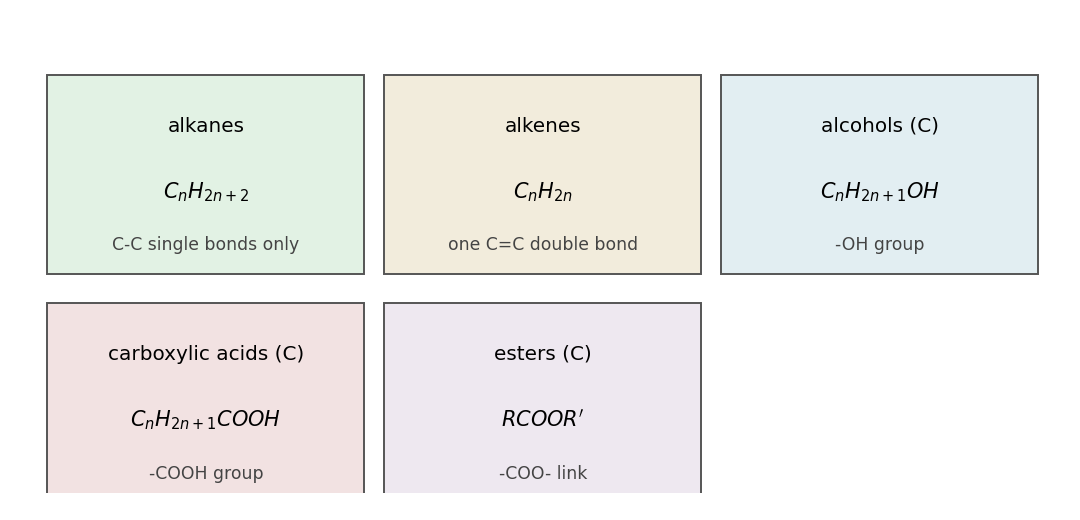
    A hydrocarbon 烃 holds hydrogen and carbon only. Molecules are drawn as empirical, molecular, general, structural and displayed formulae 结构式. A homologous series 同系列 shares a general formula and functional group 官能团, members differing by CH₂; isomerism 同分异构现象 — isomers 同分异构体 share a molecular formula with different structures. IUPAC naming runs to six carbons.

    The homologous series of this specification with general formulae and functional groups.

    Crude oil separates by fractional distillation 分馏: the furnace vaporises the oil, and vapours rise up the column, cooling as they go — small molecules with low boiling points collect at the top, large viscous molecules at the bottom.

    The fractionating column with its six fractions and their uses, small molecules at the top.

    Fractions darken and thicken down the column (rising boiling point and viscosity). Complete combustion gives CO₂ + H₂O; incomplete combustion 不完全燃烧 also gives carbon monoxide — poisonous because it reduces the blood's oxygen-carrying capacity — and soot. In engines, hot air makes nitrogen and oxygen combine into oxides of nitrogen; sulfur impurities burn to SO₂; both gases dissolve in rain making it acidic (acid rain damages leaves, lakes and buildings). Cracking 裂解 converts long-chain alkanes to alkenes + shorter alkanes over silica/alumina at 600–700 °C — because the refinery's supply of long fractions outstrips demand while short fractions are wanted.

    Alkanes and alkenes

    Alkanes 烷烃 ($C_nH_{2n+2}$) are saturated 饱和 — only single C–C bonds. Methane, ethane, propane, butane, pentane. With halogens in ultraviolet light they substitute one hydrogen: CH₄ + Cl₂ → CH₃Cl + HCl (substitution 取代).

    Alkenes 烯烃 ($C_nH_{2n}$) carry C=C — unsaturated 不饱和. With bromine they add across the double bond to a dibromoalkane (addition 加成): C₂H₄ + Br₂ → C₂H₄Br₂. Bromine water distinguishes them: decolourised (orange → colourless) by an alkene, unchanged by an alkane.

    Alcohols, acids and esters (C)

    Alcohols 醇 carry –OH: methanol, ethanol, propan-1-ol, butan-1-ol. Ethanol oxidises to ethanoic acid by complete combustion, by microbial oxidation in air, or by warming with potassium dichromate(VI) in dilute sulfuric acid. Ethanol is made by ethene + steam over a phosphoric acid catalyst (≈300 °C, 60–70 atm) or by fermentation 发酵 of glucose with yeast enzymes in the absence of air at ≈30 °C — the optimum for the enzymes, and no oxygen so the yeast produces ethanol not water.

    Carboxylic acids 羧酸 carry –COOH: methanoic, ethanoic, propanoic, butanoic. Their solutions react with metals (giving H₂) and carbonates (giving CO₂) like other acids; vinegar is dilute ethanoic acid.

    Esters 酯 carry –COO–: ethanol + ethanoic acid, with an acid catalyst, give ethyl ethanoate 乙酸乙酯 and water (esterification). Given an alcohol and an acid, join the acid's –COOH to the alcohol's –O–. Esters are volatile, sweet-smelling, used as flavourings and perfumes.

    Synthetic polymers

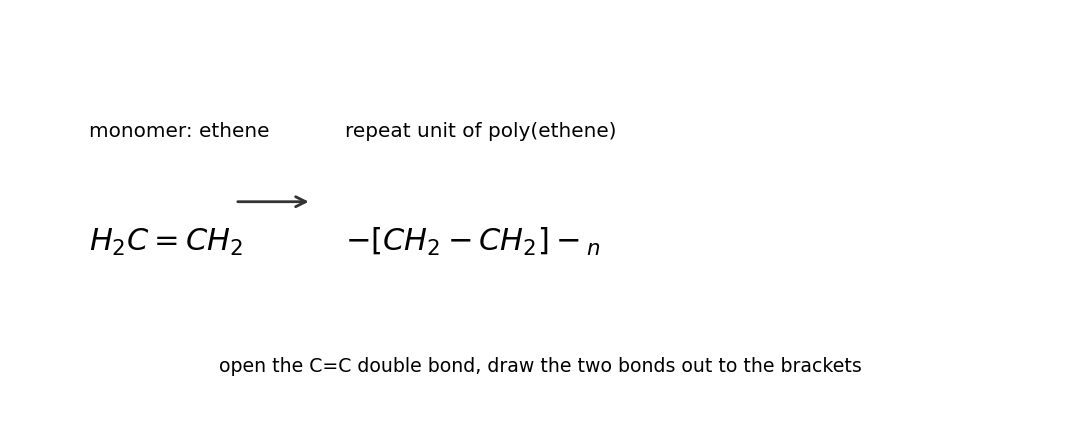
    Addition polymers 加成聚合物 form when many alkene monomers 单体 join, opening their C=C bonds.

    From ethene to poly(ethene): open the double bond and draw the repeat unit between brackets with n.

    Draw the repeat unit of poly(ethene), poly(propene), poly(chloroethene), PTFE; from a repeat unit, close the two bonds back into a C=C to recover the monomer. Disposal problems: polymers are inert and do not biodegrade, and burning can release toxic gases. (C) Condensation polymerisation: a dicarboxylic acid + a diol link ester bonds, releasing water — a polyester 聚酯; some (biopolyesters) biodegrade.

    Check yourself

    1. Define hydrocarbon, homologous series and isomerism.
    2. Name the six main fractions of crude oil in boiling-point order.
    3. Write the products of complete and incomplete combustion of a hydrocarbon.
    4. Give two pollutant gases from burning fuels and one source of each.
    5. Why is cracking necessary?
    6. Write the equation for methane reacting with chlorine in UV light, naming the reaction type.
    7. How does bromine water distinguish an alkene from an alkane?
    8. (C) Name the two methods of manufacturing ethanol with one condition for each.
    9. (C) Which alcohol and acid make ethyl ethanoate, and what else forms?
    10. (C) What monomers make a polyester, and what small molecule is released?

    Answers: 1 a compound of hydrogen and carbon only; a family with the same general formula and functional group, differing by CH₂; molecules with the same molecular formula but different structures; 2 refinery gases, gasoline, kerosene, diesel, fuel oil, bitumen; 3 complete: carbon dioxide + water; incomplete adds carbon monoxide (and soot); 4 carbon monoxide — incomplete combustion; sulfur dioxide — burning sulfur impurities; oxides of nitrogen — hot engine air; 5 supply of long-chain fractions exceeds demand while short fractions and alkenes are in short supply; 6 CH₄ + Cl₂ → CH₃Cl + HCl — substitution (photo, UV); 7 the alkene decolourises orange bromine water; the alkane leaves it orange; 8 (C) ethene + steam, phosphoric acid catalyst, ~300 °C, 60–70 atm; fermentation of glucose with yeast, no air, ~30 °C; 9 (C) ethanol + ethanoic acid — water also forms (acid catalyst); 10 (C) a dicarboxylic acid and a diol; water is released at each ester link.

    词汇
    English 中文 拼音
    hydrocarbon/ˈhaɪdrəkɑːbən/ 烃 tīng
    homologous series/həˈmɒləɡəs ˈsɪəriːz/ 同系列 tóng xì liè
    functional group/ˈfʌŋkʃənl ɡruːp/ 官能团 guān néng tuán
    isomerism/ˈaɪsəmərɪzəm/ 同分异构现象 tóng fēn yì gòu xiàn xiàng
    isomer/ˈaɪsəmə/ 同分异构体 tóng fēn yì gòu tǐ
    displayed formula/dɪˈspleɪd ˈfɔːmjʊlə/ 结构式 jié gòu shì
    fractional distillation/ˈfrækʃənl dɪstɪˈleɪʃn/ 分馏 fēn liú
    incomplete combustion/ɪŋkəmˈpliːt kəmˈbʌstʃn/ 不完全燃烧 bù wán quán rán shāo
    cracking/ˈkrækɪŋ/ 裂解 liè jiě
    alkane/ˈælkeɪn/ 烷烃 wán tīng
    alkene/ˈælkiːn/ 烯烃 xī tīng
    saturated/ˈsætʃəreɪtɪd/ 饱和 bǎo hé
    unsaturated/ʌnˈsætʃəreɪtɪd/ 不饱和 bù bǎo hé
    substitution/ˌsʌbstɪˈtjuːʃn/ 取代 qǔ dài
    addition/əˈdɪʃn/ 加成 jiā chéng
    alcohol/ˈælkəhɒl/ 醇 chún
    fermentation/fɜːmənˈteɪʃn/ 发酵 fā jiào
    carboxylic acid/ˌkɑːbəkˈsɪlɪk ˈæsɪd/ 羧酸 suō suān
    ester/ˈestə/ 酯 zhǐ
    ethyl ethanoate 乙酸乙酯 yǐ suān yǐ zhǐ
    addition polymer 加成聚合物 jiā chéng jù hé wù
    monomer/ˈmɒnəʊmə/ 单体 dān tǐ
    polyester/ˌpɒlɪˈestə/ 聚酯 jù zhǐ

登录或创建账户

IGCSE、A-Level 与 AP