Further Pure Mathematics 2: inequalities, further complex numbers and differential equations
Further Pure Mathematics 2 (FP2, paper WFM02/01, 1 hour 30 minutes, 75 marks, first assessment June 2020) builds directly on P1–P4 and FP1 and counts one sixth of an International Advanced Level. Every unit is equally weighted, so FP2 material can also surface inside Further Mathematics. P1–P4 assumed content stays live: partial fractions, parametric and implicit differentiation, integration by parts and substitution, and the whole FP1 complex-number and proof toolkit. This reference covers modulus inequalities, the method of differences, Euler's relation and de Moivre's theorem, loci and z→w transformations, first and second order differential equations, Maclaurin and Taylor series, and polar coordinates.
Must-know for FP2 (assumed, not re-taught):
| Family | Formulae |
|---|---|
| modulus | $\lvert x\rvert = x$ for $x \ge 0$ and $-x$ for $x < 0$; $\lvert z\rvert = \sqrt{a^2+b^2}$, $\lvert z_1z_2\rvert = \lvert z_1\rvert\lvert z_2\rvert$, $\arg(z_1z_2) = \arg z_1 + \arg z_2$ |
| sums | $\sum_{r=1}^n r = \tfrac12n(n+1)$, $\sum r^2$, $\sum r^3$ (booklet) |
| algebra | partial fractions, e.g. $\dfrac{1}{r(r+1)} = \dfrac1r - \dfrac1{r+1}$ (P4) |
| calculus | product, quotient and chain rules; integration by substitution, parts, partial fractions (P4) |
| differential equations | separation of variables; exponential growth/decay $y = Ae^{kt}$ (P4) |
Inequalities involving the modulus sign
Two safe moves and one banned move. Safe: split into cases from the definition of the modulus ($\lvert f\rvert = f$ where $f \ge 0$, $-f$ where $f < 0$), and square both sides of $\lvert A\rvert > \lvert B\rvert$ to get $A^2 > B^2$. Banned: multiplying or dividing by an expression whose sign you have not fixed — case-split on that sign instead, and intersect each case with its own domain.
Worked example — one branch dies (specimen style). Solve $\lvert x^2-1\rvert > 2(x+1)$. Where $x^2 \ge 1$: $x^2 - 2x - 3 > 0$, so $(x-3)(x+1) > 0$, giving $x > 3$ or $x < -1$; keeping only $x \le -1$ or $x \ge 1$ leaves $x < -1$ or $x > 3$. Where $x^2 < 1$: $1 - x^2 > 2x + 2$ becomes $(x+1)^2 < 0$ — impossible. The solution is $x < -1$ or $x > 3$. A dead branch is a result, not a mistake: report it.
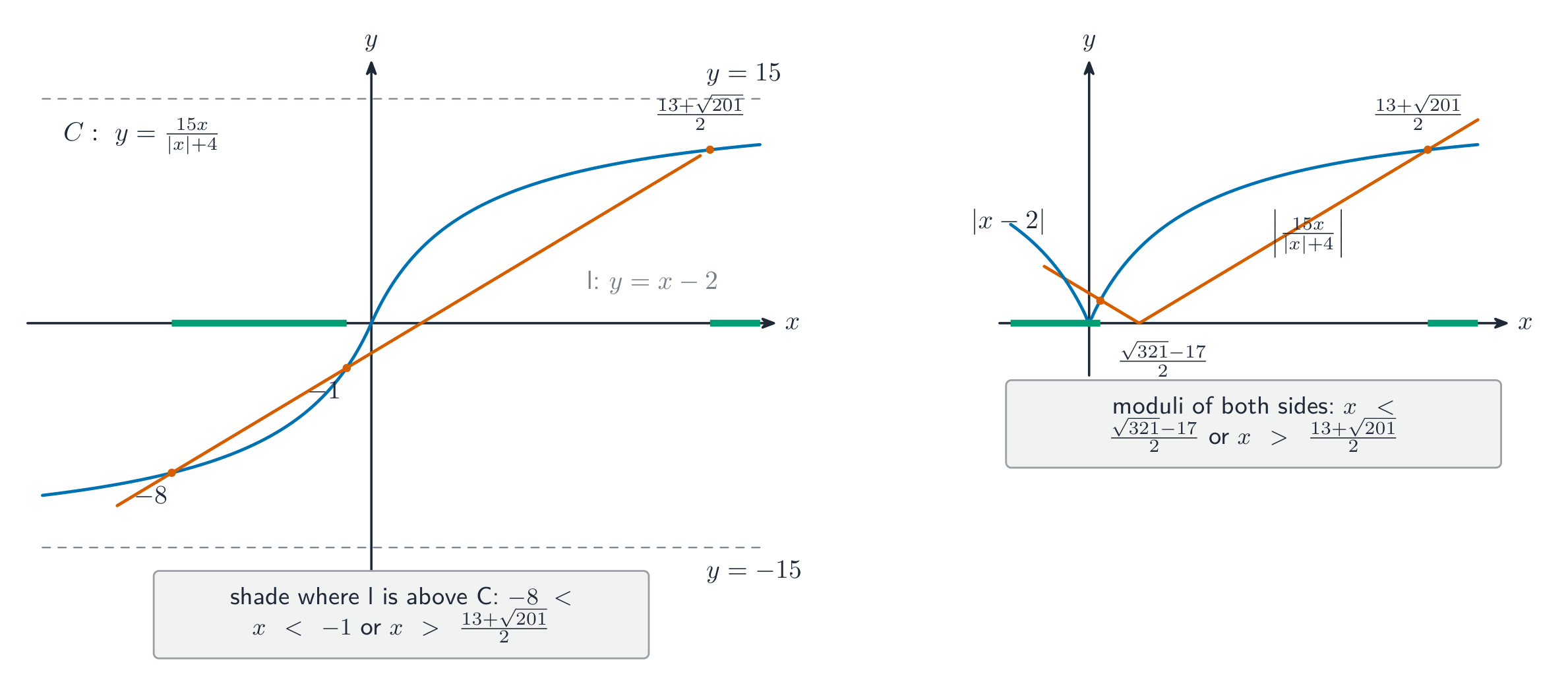
Worked example — modulus on both sides (WFM02 June 2025 Q8). The curve C has equation $y = \dfrac{15x}{\lvert x\rvert + 4}$ and the line l has equation $y = x - 2$.
(a) Solve $x - 2 > \dfrac{15x}{\lvert x\rvert+4}$. The denominator is always positive, so multiply straight through. For $x \ge 0$: $(x-2)(x+4) > 15x$ gives $x^2 - 13x - 8 > 0$, so $x > \tfrac{13+\sqrt{201}}2$ (the other root is negative). For $x < 0$: $(x-2)(4-x) > 15x$ gives $-x^2 - 9x - 8 > 0$, i.e. $(x+1)(x+8) < 0$, so $-8 < x < -1$. Together: $-8 < x < -1$ or $x > \tfrac{13+\sqrt{201}}2$.
(b) Solve $\lvert x-2\rvert > \left\lvert\dfrac{15x}{\lvert x\rvert+4}\right\rvert$. Squaring (both sides non-negative) turns this into $(x-2)(\lvert x\rvert+4) > 15x$ — part (a) — or $(x-2)(\lvert x\rvert+4) < -15x$. The new branch: for $x \ge 0$, $x^2 + 17x - 8 < 0$ gives $0 \le x < \tfrac{\sqrt{321}-17}2$; for $x < 0$, $x^2 - 21x + 8 > 0$ holds for every $x < 0$. So the answer is $x < \tfrac{\sqrt{321}-17}2$ or $x > \tfrac{13+\sqrt{201}}2$. The "hence" is real: half of part (b) is part (a)'s answer.
The method of differences
The method of differences 差分法 sums a series by splitting the summand (usually via partial fractions 部分分式) so that each term cancels part of a later one — the middle collapses and only the first and last fragments survive. Write out $r = 1$, $r = 2$, $r = n-1$, $r = n$ explicitly and watch what cancels; that display earns the marks.
Worked example — telescoping to a closed form (WFM02 June 2025 Q5). Show $\displaystyle\sum_{r=1}^n \frac{1}{(r+1)(r+2)} = \frac{n}{2(n+2)}$. Split:
The sum is $\left(\tfrac12 - \tfrac13\right) + \left(\tfrac13 - \tfrac14\right) + \cdots + \left(\tfrac1{n+1} - \tfrac1{n+2}\right)$: everything from $\tfrac13$ to $\tfrac1{n+1}$ cancels, leaving $\tfrac12 - \tfrac1{n+2} = \tfrac{n}{2(n+2)}$. (Check $n = 1$: both sides $\tfrac16$.) This is also how inequality follow-ups are set: $\dfrac{n}{2(n+2)} > 0.49$ needs $n > 98$, so the smallest is $n = 99$ — the algebra, not a table of values.
Euler's relation and de Moivre's theorem
Euler's relation 欧拉关系式 $e^{i\theta} = \cos\theta + i\sin\theta$ turns the polar form into an exponential: $z = re^{i\theta}$, and $z^n = r^ne^{in\theta}$ becomes pure arithmetic. Read off the companions $\cos\theta = \tfrac12(e^{i\theta} + e^{-i\theta})$ and $\sin\theta = \dfrac1{2i}(e^{i\theta} - e^{-i\theta})$. De Moivre's theorem 棣莫弗定理 $(\cos\theta + i\sin\theta)^n = \cos n\theta + i\sin n\theta$ follows, and is provable for every positive integer $n$ by induction: true for $n = 1$; if true for $k$, multiplying $(\cos k\theta + i\sin k\theta)(\cos\theta + i\sin\theta)$ and expanding with the addition formulae gives $\cos(k+1)\theta + i\sin(k+1)\theta$. For negative $n$, take reciprocals and note $\cos(-n\theta) + i\sin(-n\theta)$ has modulus 1 and the right argument.
Worked example — a multiple-angle identity (WFM02 June 2025 Q9). Expand the imaginary part of $(\cos\theta + i\sin\theta)^5$ by the binomial theorem:
De Moivre says this equals $\sin 5\theta$. Substituting $c^2 = 1 - s^2$: $5s(1-s^2)^2 - 10s^3(1-s^2) + s^5 = 16s^5 - 20s^3 + 5s$, so
Setting $5\theta = \pi$ gives $16s^4 - 20s^2 + 5 = 0$, so $s^2 = \tfrac{5\pm\sqrt5}8$ and $\sin\tfrac\pi5 = \sqrt{\tfrac{5-\sqrt5}8} = \tfrac{\sqrt{10-2\sqrt5}}4$ — take the smaller root because $\sin\tfrac\pi5 < \sin\tfrac{3\pi}5$, and indeed $\sin\tfrac{3\pi}5$ is the larger root.
Worked example — fifth roots (WFM02 June 2025 Q1). Solve $z^5 = -2\sqrt2 - 2\sqrt6i$. Modulus $\sqrt{8 + 24} = \sqrt{32} = 4\sqrt2$; the argument is $-\tfrac{2\pi}3$ (third quadrant, $\tan = \sqrt3$). So
five roots spaced $\tfrac{2\pi}5$ apart on the circle $\lvert z\rvert = \sqrt2$. Use the $n$th-root pattern $\sqrt[n]{r}\,e^{i(\theta + 2\pi k)/n}$ — never decimal approximations.
Loci, regions and z→w transformations
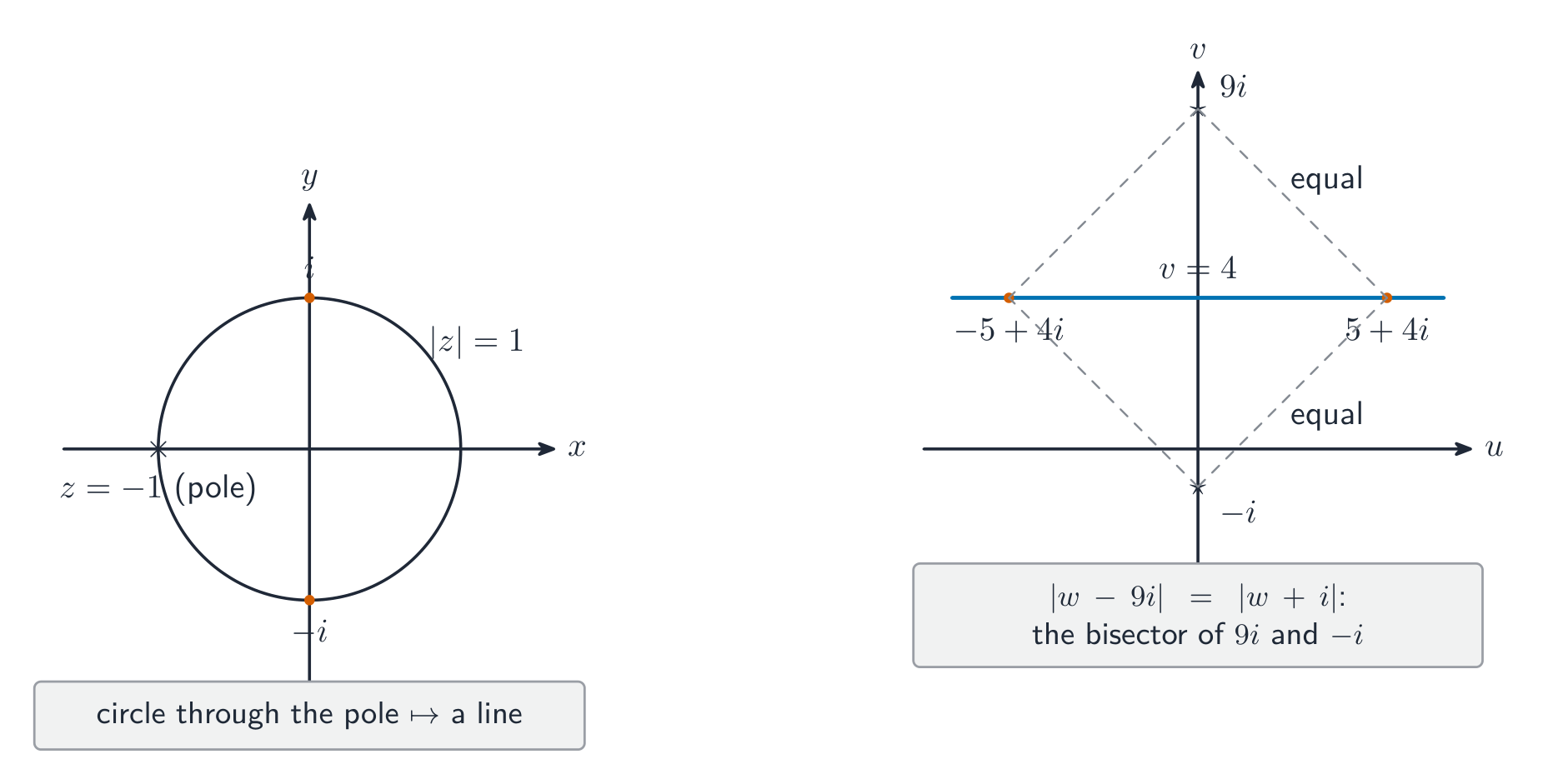
Locus 轨迹 toolkit in the Argand diagram: $\lvert z - a\rvert = b$ is a circle (centre $a$, radius $b$); $\lvert z - a\rvert = \lvert z - b\rvert$ is the perpendicular bisector 垂直平分线 of $a$ and $b$; $\lvert z - a\rvert = k\lvert z - b\rvert$ with $k \ne 1$ is a circle (square both sides and collect terms); $\arg(z - a) = \beta$ is a half-line from $a$. Regions replace = by < or >: test one convenient point (the origin rarely lies on the locus). For Möbius transformations 莫比乌斯变换 $w = \dfrac{az+b}{cz+d}$, never try to substitute point-by-point: make $z$ the subject first, then take moduli (or arguments) of both sides. A circle through the pole $z = -\tfrac dc$ maps to a straight line; a circle not through the pole maps to a circle.
Worked example — image of a circle (WFM02 June 2025 Q3). $w = \dfrac{9i - iz}{1+z}$ ($z \ne -1$) maps P, where $\lvert z\rvert = 1$, to a line l. Making $z$ the subject: $z(w + i) = 9i - w$, so $z = \dfrac{9i - w}{w+i}$. Then $\lvert z\rvert = 1$ forces
so $20v = 80$ and l is $v = 4$ — the perpendicular bisector of $9i$ and $-i$, exactly as the equal-moduli reading predicts. Spot-check with the endpoints of the vertical diameter: $z = i \mapsto 5 + 4i$ and $z = -i \mapsto -5 + 4i$; both land on $v = 4$.
First order differential equations
Separable equations are assumed. The new standard form is $\dfrac{dy}{dx} + Py = Q$ with $P, Q$ functions of $x$: multiply by the integrating factor 积分因子 $e^{\int P\,dx}$, chosen so the left side becomes $\dfrac d{dx}\left(ye^{\int P\,dx}\right)$, then integrate once. For a given substitution (say $z = f(y)$), compute $\dfrac{dz}{dx}$ by the chain rule, rewrite the equation in $z$ and $x$, solve the (now linear or separable) equation, and substitute back — the question names the target form, so end in it.
Worked example — integrating factor warm-up. $\dfrac{dy}{dx} + 2y = e^{-x}$: $e^{\int 2\,dx} = e^{2x}$, so $\dfrac d{dx}(ye^{2x}) = e^x$ and $ye^{2x} = e^x + C$, i.e. $y = e^{-x} + Ce^{-2x}$.
Worked example — a substitution then an integrating factor (WFM02 June 2025 Q6). Equation (I) is $2\dfrac{dy}{dx} + y\cot x + y^3\tan x\sec x = 0$ on $0 < x < \tfrac\pi2$.
(a) With $z = \tfrac1{y^2}$, $\dfrac{dz}{dx} = -2y^{-3}\dfrac{dy}{dx}$, so $2\dfrac{dy}{dx} = -y^3\dfrac{dz}{dx}$. Substituting and dividing by $y^3$: $-\dfrac{dz}{dx} + y^{-2}\cot x + \tan x\sec x = 0$, i.e.
(b) The integrating factor is $e^{-\int\cot x\,dx} = \csc x$, so $\dfrac d{dx}(z\csc x) = \csc x\tan x\sec x = \dfrac1{\cos^2x} = \sec^2x$. Hence $z\csc x = \tan x + C$, giving $z = \sin x\tan x + C\sin x$ and
(c) At $x = \tfrac\pi6$: $y^2 = \tfrac{4\sqrt3}3$ so $z = \tfrac{\sqrt3}4 = \tfrac12\cdot\tfrac1{\sqrt3} + \tfrac C2$, forcing $C = \tfrac1{2\sqrt3}$. At $x = \tfrac\pi3$: $z = \tfrac{\sqrt3}2\cdot\sqrt3 + \tfrac1{2\sqrt3}\cdot\tfrac{\sqrt3}2 = \tfrac32 + \tfrac14 = \tfrac74$, so $y^2 = \tfrac47$ and $y = \pm\dfrac2{\sqrt7}$. Both signs are answers — $y^2$, not $y$, was determined.
Second order differential equations
For $a\dfrac{d^2y}{dx^2} + b\dfrac{dy}{dx} + cy = f(x)$, the general solution is $\text{CF} + \text{PI}$: the complementary function 余函数 solves the homogeneous equation via the auxiliary equation 辅助方程 $am^2 + bm + c = 0$; the particular integral 特积分 is any single solution of the full equation.
| Auxiliary equation | Complementary function |
|---|---|
| distinct real roots $m_1 \ne m_2$ | $y = Ae^{m_1x} + Be^{m_2x}$ |
| repeated root $m$ | $y = (A + Bx)e^{mx}$ |
| complex roots $p \pm qi$ | $y = e^{px}(A\cos qx + B\sin qx)$ |
| Right-hand side $f(x)$ | Trial PI |
|---|---|
| $ke^{px}$ | $\lambda e^{px}$; if $p$ is a root, use $\lambda xe^{px}$ (again if repeated) |
| $a + bx( + cx^2)$ | $\lambda + \mu x( + \nu x^2)$ — every degree present |
| $m\cos\omega x + n\sin\omega x$ | $\lambda\cos\omega x + \mu\sin\omega x$ |
Given initial or boundary conditions, find the constants last, from the full general solution.
Worked example — resonance, then conditions (WFM02 June 2025 Q4). Given that $y = \lambda xe^{3x}$ is a particular integral of $4\dfrac{d^2y}{dx^2} - 11\dfrac{dy}{dx} - 3y = 78e^{3x}$:
(a) $y' = \lambda e^{3x}(1 + 3x)$ and $y'' = \lambda e^{3x}(6 + 9x)$, so the left side is $\lambda e^{3x}\big(24 + 36x - 11 - 33x - 3x\big) = 13\lambda e^{3x}$. Matching $78e^{3x}$ gives $\lambda = 6$. (The plain trial $\lambda e^{3x}$ would give $0\cdot e^{3x}$ — hence the extra $x$.)
(b) Auxiliary equation $4m^2 - 11m - 3 = (4m+1)(m-3) = 0$, so $m = -\tfrac14$ or $3$: $y = Ae^{-x/4} + Be^{3x} + 6xe^{3x}$.
(c) With $y = \tfrac92$ and $y' = 0$ at $x = 0$: $A + B = \tfrac92$ and $-\tfrac A4 + 3B + 6 = 0$. Solving, $A = 6$, $B = -\tfrac32$, so
Maclaurin and Taylor series
The Maclaurin series 麦克劳林级数 of $f$ is $\displaystyle\sum_{n=0}^\infty \frac{f^{(n)}(0)}{n!}x^n$ — differentiate as many times as the question asks (third and higher derivatives are examinable in their own right). The Taylor series 泰勒级数 about $x = a$ replaces $x$ by the offset: $\displaystyle\sum_{n=0}^\infty \frac{f^{(n)}(a)}{n!}(x-a)^n$. For a differential equation, differentiate the equation itself to climb the derivative ladder: $y(a)$ and $y'(a)$ feed the equation for $y''(a)$, then the derivative of the equation for $y'''(a)$, and so on — never re-derive, differentiate.
Worked example — a series solution about a non-zero centre (WFM02 June 2025 Q2). Given $\dfrac{d^2y}{dx^2} - 4\dfrac{dy}{dx} - 5y = e^{2x/9}$ with $y = 2$ and $y' = -1$ at $x = 3$:
at $x = 3$: $y'' = 4y' + 5y + e^{2/3} = -4 + 10 + e^{2/3} = 6 + e^{2/3}$, so the quadratic term is $\tfrac12(6 + e^{2/3})(x-3)^2 = (3 + \tfrac12e^{2/3})(x-3)^2$. Differentiating the equation, $y''' = 4y'' + 5y' + \tfrac29e^{2x/9}$, so at $x = 3$: $y''' = 4(6 + e^{2/3}) - 5 + \tfrac29e^{2/3} = 19 + \tfrac{38}9e^{2/3}$, and the cubic term is $\tfrac16y'''(x-3)^3$. The series is
Polar coordinates and areas
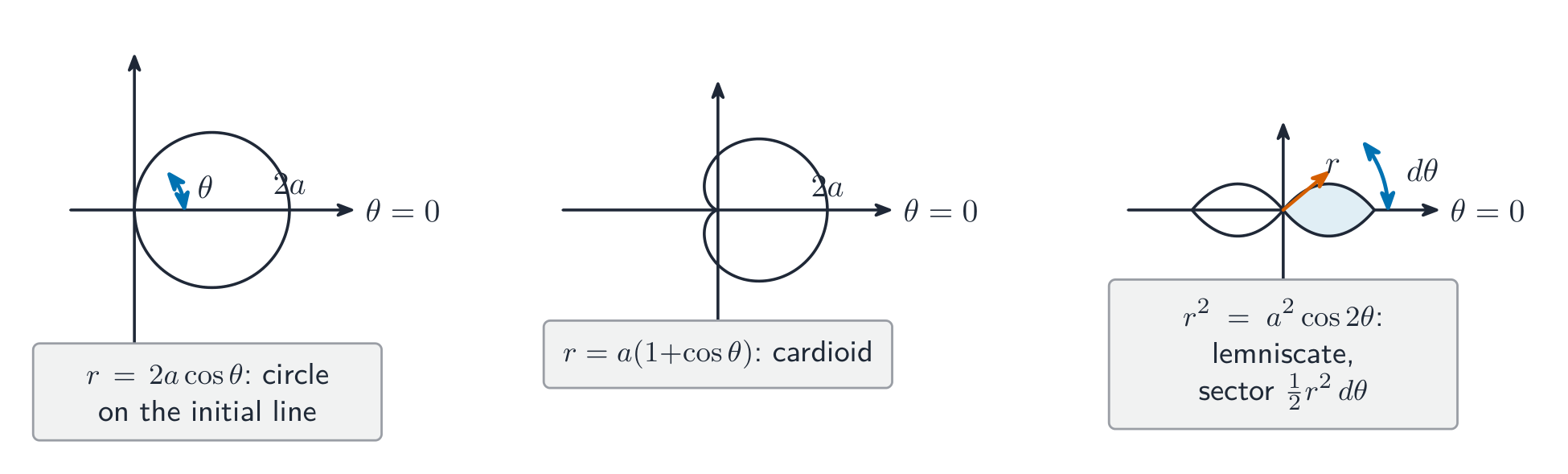
In polar coordinates 极坐标 a point is $(r, \theta)$ with $r \ge 0$ measured from the initial line 初始线 (the positive $x$-axis, $\theta$ anticlockwise). Convert with $x = r\cos\theta$, $y = r\sin\theta$, $r^2 = x^2 + y^2$: for example $r = 4\cos\theta$ gives $r^2 = 4r\cos\theta$, i.e. $x^2 + y^2 = 4x$ — the circle $(x-2)^2 + y^2 = 4$. Know the sketch staples: $r = 2a\cos\theta$ (circle on the initial line through the pole), $r = k\theta$ (spiral), $r = a(1+\cos\theta)$ (cardioid 心形线), $r = a\cos2\theta$ (four petals), $r^2 = a^2\cos2\theta$ (lemniscate 双纽线, existing only where $\cos2\theta \ge 0$). The area swept from $\theta = \alpha$ to $\beta$ is $\tfrac12\displaystyle\int_\alpha^\beta r^2\,d\theta$; tangents parallel to the initial line occur where $\dfrac{dy}{d\theta} = \dfrac{dr}{d\theta}\sin\theta + r\cos\theta = 0$.
Worked example — exact areas. The whole lemniscate $r^2 = 8\cos2\theta$: by symmetry the right loop is $\tfrac12\int_{-\pi/4}^{\pi/4}8\cos2\theta\,d\theta = 4\Big[\tfrac12\sin2\theta\Big]_{-\pi/4}^{\pi/4} = 4$, so both loops enclose total area $8$. The cardioid $r = 2(1+\cos\theta)$: $\tfrac12\int_{-\pi}^{\pi}4(1+\cos\theta)^2d\theta = 2\int_{-\pi}^{\pi}(1 + 2\cos\theta + \cos^2\theta)d\theta = 2(2\pi + 0 + \pi) = 6\pi$, since $\int_{-\pi}^\pi\cos^2\theta\,d\theta = \pi$.
Checklist before you call this unit done
- Solve modulus inequalities by case split and by squaring; handle $|x|$ inside denominators; report dead branches; reuse an earlier part when "hence" appears.
- Sum finite series by partial fractions and cancellation, writing the $r = 1, 2, n-1, n$ lines; close the follow-up inequality by algebra.
- Use $e^{i\theta}$, the exponential forms of $\cos$ and $\sin$, and de Moivre (proved for integer $n$) to expand multiple angles and powers, and to find all $n$th roots in exact polar form.
- Sketch circles, bisectors, Apollonius circles and argument half-lines; test regions; make $z$ the subject of a Möbius transformation and equate moduli or arguments.
- Solve $\frac{dy}{dx} + Py = Q$ with an integrating factor; execute given substitutions and answer in the form demanded, minding $\pm$ from $y^2$.
- Solve second order equations via auxiliary equation and trial PI (including the multiply-by-$x$ resonance), then fit initial conditions.
- Build Maclaurin and Taylor series, including series solutions of differential equations by differentiating the equation.
- Sketch polar staples, convert to and from Cartesian, and evaluate exact areas with $\frac12\int r^2\,d\theta$.