跳到主要内容

生物学实践技能 II

Edexcel International A-Level 生物 · 知识点 6

6.2

像科学家一样规划,像考官一样写作

English

WBI16 is the last Biology paper you will sit, and it looks like no other: one question may hand you a half-complete statistics table, another asks you to design a whole investigation 探究 from a hypothesis 假设 you did not choose. Everything comes from the practical work of Units 4 and 5 — respirometers 呼吸计, spirometers 肺活量计, quadrats 样方, dilution plates — but now you must plan, measure, present, test and conclude at IA2 depth.

WBI16/01 Practical Skills in Biology II is 1 hour 20 minutes, 50 marks, all compulsory. The specification's assessed list matches Unit 3's, with one difference in emphasis: plan whole investigations, analyse data and evaluate results and methodology — a 16-mark plan question closes the paper, and statistics enter: standard deviations, null hypotheses and a correlation coefficient with critical values.
词汇 训练
English 中文 拼音
investigation/ɪnˌvestɪˈɡeɪʃn/ 探究 tàn jiū
hypothesis/haɪˈpɒθəsɪs/ 假设 jiǎ shè
respirometers/rɪspɪˈrɒmɪtəz/ 呼吸计 hū xī jì
spirometers/spɪˈrɒmɪtəz/ 肺活量计 fèi huó liàng jì
quadrats/ˈkwɒdræts/ 样方 yàng fāng
6.2

实施与测量评估(单元6大纲,实施部分)

English
Core practical Method core What is measured
10 Photosynthesis rate Aquatic plant under light of varied intensity/wavelength, temperature, CO₂ supply; gas collected over time Gas volume per time; rate and limiting-factor plateaus
11 Ecology of a habitat Quadrats and transects 样带; abiotic 非生物 factors measured at each site Distribution and abundance 丰度; means with spread
12 Development rate Seedling growth or brine-shrimp hatching at different temperatures, ethical use of organisms Growth/hatch rate per temperature
13 Liquid-culture growth Microorganism grown in broth; samples over time, safe and ethical use Growth curve by cell count, mass or turbidity 浊度
14 Antibiotics on bacteria Aseptic 无菌 plating; antibiotic discs or plant extracts on a seeded lawn; incubate inverted below 30 °C Zones of inhibition 抑菌圈
15 Respiration in yeast Artificial hydrogen carrier — redox indicator 氧化还原指示剂 (TTC, methylene blue, DCPIP) — changes colour as yeast respires; the direction depends on the indicator Time to colour change at each condition
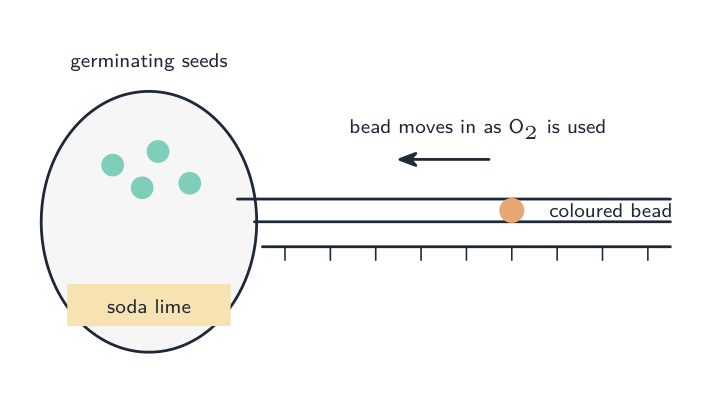
16 Respirometer and RQ Organism in a sealed chamber; CO₂ absorbent (soda lime) draws the fluid marker as O₂ is used; with and without the absorber gives RQ O₂ uptake per time; RQ = CO₂ produced ÷ O₂ used
17 Exercise and ventilation Spirometer trace: tidal volume 潮气量, breathing rate, minute ventilation 每分钟通气量, O₂ uptake before and after exercise Recovery time to resting values
18 Amylase in germinating grain Extracts from grains at different germination times tested on starch Appearance/effect of amylase with germination
Respirometer: germinating seeds over soda lime in a sealed chamber, with a coloured bead moving along a scaled tube as oxygen is used
CP16: soda lime takes up carbon dioxide, so the bead tracks oxygen use.
词汇 训练
English 中文 拼音
transects/trænˈsekts/ 样带 yàng dài
abiotic/ˌæbɪˈɒtɪk/ 非生物 fēi shēng wù
abundance/əˈbʌndəns/ 丰度 fēng dù
turbidity/tɜːˈbɪdɪti/ 浊度 zhuó dù
Aseptic/æˈseptɪk/ 无菌 wú jūn
Zones of inhibition/zəʊnz ɒv ɪnhɪˈbɪʃn/ 抑菌圈 yì jūn quān
redox indicator/rɪˈdɒks ˈɪndɪkeɪtə/ 氧化还原指示剂 yǎng huà huán yuán zhǐ shì jì
tidal volume/ˈtaɪdl ˈvɒljuːm/ 潮气量 cháo qì liàng
minute ventilation/ˈmɪnɪt ˌventɪˈleɪʃn/ 每分钟通气量 měi fēn zhōng tōng qì liàng
6.1

规划A2探究(单元6大纲,规划部分)

English

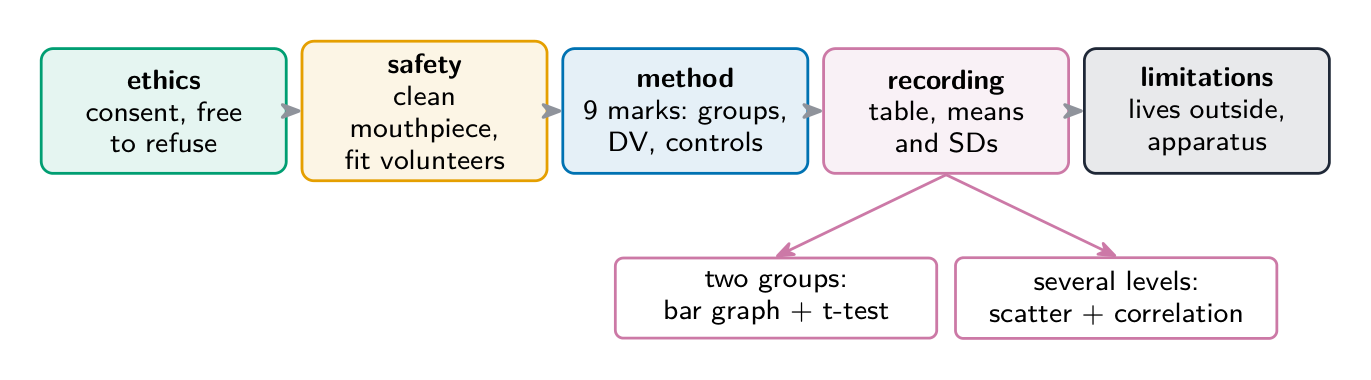
The closing question (2025: fitness programmes and recovery time) pays out in named blocks — answer in the same order. Ethics 伦理: informed consent 知情同意 of volunteers; no one is forced to participate. Safety: sterilise or replace the mouthpiece between students (infection); check volunteers are healthy enough for the exercise. Method, nine marks: two groups (with and without the fitness programme); the dependent variable 因变量 stated as the time for the breathing rate and tidal volume to return to resting values; apparatus used in detail — soda lime in the canister, nose clip, practise breaths first; find the resting values first; the same standardised exercise for everyone; two control variables 控制变量 and the method of control for one; repeats giving means and standard deviations 标准差. Recording and analysis: a table of raw times with headings and units from which means are calculated; a bar graph of mean recovery time per group (two groups) tested with a t-test t检验, or a line/scatter graph (several fitness levels) tested with a correlation 相关 test. Limitations 局限性: volunteers' lives outside the experiment cannot be fully controlled; apparatus difficulties (leaks, soda lime exhausted, abnormal breathing through a mouthpiece).

The 16-mark plan as five blocks in order: ethics, safety, method worth nine marks, recording with means and standard deviations, limitations; recording branches to a bar graph with a t-test for two groups or a scatter graph with correlation for several levels
Answer in the blocks the marks are paid in.
词汇 训练
English 中文 拼音
Ethics/ˈeθɪks/ 伦理 lún lǐ
informed consent/ɪnˈfɔːmd kənˈsent/ 知情同意 zhī qíng tóng yì
dependent variable/dɪˈpendənt ˈveərɪəbl/ 因变量 yīn biàn liàng
control variables/kənˈtrəʊl ˈveərɪəblz/ 控制变量 kòng zhì biàn liàng
standard deviations/ˈstændəd ˌdiːvɪˈeɪʃnz/ 标准差 biāo zhǔn chà
t-test/tiː test/ t检验 t jiǎn yàn
correlation/ˌkɒrɪˈleɪʃn/ 相关 xiāng guān
Limitations/ˌlɪmɪˈteɪʃnz/ 局限性 jú xiàn xìng
6.1 6.2

规划A2探究(单元6大纲,规划部分)

English

Random sampling 随机取样 has a method: lay a grid over the area, generate random coordinate 坐标 pairs (random numbers, or numbers drawn from a bag), and only then visit those points with the quadrat. Saying "sample at random" earns nothing. Record the abiotic variables that matter — soil pH, moisture, minerals, light intensity, season — and control what you can by choosing matched sites. A photograph's magnification 放大倍数 is image ÷ actual: an earthworm 5.0 cm in a photograph and 13.5 cm real gives ×0.37 — photographs can be smaller than life.

A 50 cm quadrat with a ruler for scale: where each quadrat goes must follow a rule fixed before sampling
A quadrat with a ruler for scale: random coordinates decide where each one goes
A sampling grid: coordinates chosen with random numbers before visiting, five 1 × 1 quadrat squares marked.
A sampling grid with coordinates chosen by random numbers before visiting, five quadrat squares marked.
探索

估计值取决于选择哪些样方

课例中的3、4、6、5、2平均为每0.25 m²有4株,即每平方米16株,100 m²估计有1600株。在已知总数的模型生境中,比较随机样本和刻意选择的密集样方。

词汇 训练
English 中文 拼音
Random sampling/ˈrændəm ˈsæmplɪŋ/ 随机取样 suí jī qǔ yàng
coordinate/kəʊˈɔːdɪnət/ 坐标 zuò biāo
magnification/ˌmæɡnɪfɪˈkeɪʃn/ 放大倍数 fàng dà bèi shù
6.2

实施与测量评估(单元6大纲,实施部分)

English
Serial dilution from stock to 1/1000: too many to count, a countable 34-colony plate, too few.

A drop of soil suspension holds too many bacteria to count, so dilution plating 稀释涂布 justifies each step: serially dilute 连续稀释 the culture (1 part + 9 parts water, repeated) because raw samples are too numerous to count; plate a known volume of a suitable dilution so that separate colonies 菌落 can be counted; incubate for a fixed time and temperature so that colonies become visible; work aseptically to avoid contamination 污染 and counting errors. Use a countable plate and the method’s accepted count range. Colony count × dilution factor 稀释倍数 ÷ plated volume estimates colony-forming units per unit volume; one colony can come from one cell or a clump. Use approved teaching cultures and supervised school procedures.

词汇 训练
English 中文 拼音
dilution plating/daɪˈluːʃn ˈpleɪtɪŋ/ 稀释涂布 xī shì tú bù
serially dilute/ˈsɪərɪəli daɪˈluːt/ 连续稀释 lián xù xī shì
colonies/ˈkɒləniz/ 菌落 jūn luò
contamination/kənˌtæmɪˈneɪʃn/ 污染 wū rǎn
dilution factor/daɪˈluːʃn ˈfæktə/ 稀释倍数 xī shì bèi shù
6.3

分析、统计与有根据的结论(单元6大纲,分析部分)

English

The formula is supplied; the skill is completing the table. For five sites with masses 18.1, 19.7, 16.2, 13.8, 17.1 g (mean 16.98 ≈ 17.0): each deviation $(X - \bar{X})$ is squared — 1.21, 7.29, 0.64, 10.24, 0.01 — summed $\sum(X-\bar{X})^2 = 19.39$, divided by $n - 1 = 4$:

$$s = \sqrt{\frac{\sum(X-\bar{X})^2}{n-1}} = \sqrt{\frac{19.39}{4}} = \sqrt{4.8475} = 2.2\ \text{g}$$

To compare two groups, plot mean ± SD (error bars 误差线): if the bars do not overlap, the difference is likely significant 显著的 — properly, a t-test decides.

Two pairs of means with standard-deviation bars: one pair overlaps, so the difference may be chance; the other pair does not overlap, so the difference is likely significant, though only a test confirms it
Overlapping bars warn; a test decides

Worked example (original). Recovery times after standard exercise: trained group mean 94 s ($s = 11$, $n = 8$), untrained 126 s ($s = 14$, $n = 8$). The t-test gives $t = 32 \div \sqrt{11^2/8 + 14^2/8} = 5.08$ at $n_1 + n_2 - 2 = 14$ degrees of freedom 自由度; the critical value 临界值 at $p = 0.05$ is 2.145. Calculated exceeds critical, so reject the null hypothesis 零假设: the programme significantly shortens recovery. Write the same three sentences as for Spearman below — compare, reject, conclude — and quote the degrees of freedom, which examiners check.

词汇 训练
English 中文 拼音
error bars/ˈerə bɑːz/ 误差线 wù chā xiàn
significant/sɪɡˈnɪfɪkənt/ 显著的 xiǎn zhù de
degrees of freedom/dɪˈɡriːz ɒv ˈfriːdəm/ 自由度 zì yóu dù
critical value/ˈkrɪtɪkl ˈvæljuː/ 临界值 lín jiè zhí
null hypothesis/nʌl haɪˈpɒθəsɪs/ 零假设 líng jiǎ shè
6.3

分析、统计与有根据的结论(单元6大纲,分析部分)

English

Null hypothesis: "there is no correlation between the percentage of oil remaining and the time stored." Rank both variables (largest = 1), find each difference $d$ and square it, then:

$$r_s = 1 - \frac{6\sum d^2}{n(n^2-1)} = 1 - \frac{6 \times 104}{7 \times 48} = 1 - 1.857 = -0.857$$

Compare the magnitude (0.857, ignore the sign for the comparison) with the critical value at $p = 0.05$ for $n = 7$ (0.786). Calculated exceeds critical, so reject the null hypothesis: there is a significant negative correlation 负相关 between oil remaining and time. Write all three sentences — comparison, reject, conclusion.

A negative-correlation scatter with a line of best fit that ignores one anomalous point.

Choosing the test: difference between two group means → t-test (bar chart); association between two measured variables → correlation (scatter or line graph). Never a t-test on a correlation question.

词汇 训练
English 中文 拼音
negative correlation/ˈneɡətɪv ˌkɒrɪˈleɪʃn/ 负相关 fù xiāng guān
6.3

分析、统计与有根据的结论(单元6大纲,分析部分)

English

The oil-decay graph is a line graph 折线图 — time is continuous 连续的 — with labelled axes 坐标轴 and units (days; mean % oil left), linear scales 刻度, points plotted exactly, and a single best-fit line. The 90-day reading (0.65 %) sits above every neighbour: it is anomalous 异常的. The best fit ignores it; you check it by repeating that sampling, never delete it silently.

词汇 训练
English 中文 拼音
line graph/laɪn ɡræf/ 折线图 zhé xiàn tú
continuous/kənˈtɪnjuːəs/ 连续的 lián xù de
axes/ˈæksɪz/ 坐标轴 zuò biāo zhóu
scales/skeɪlz/ 刻度 kè dù
anomalous/əˈnɒmələs/ 异常的 yì cháng de
6.3

书面练习无法做到的事

English

As with Unit 3: a perfect written plan does not demonstrate that you performed aseptic technique, read a spirometer trace live, or handled organisms ethically in the room. Those competences are built in class while studying Units 4 and 5; this paper examines the thinking around them.

6.3

自我检测

English
  1. Name two artificial hydrogen carriers usable in CP15, and state what happens to their colour as yeast respires.
  2. Write a null hypothesis for: "the number of bacteria in soil increases as crude oil is broken down."
  3. Masses 21.4, 19.8, 18.6, 22.1, 20.6 g. Compute the sum of squared deviations and the standard deviation.
  4. Ranks give $\sum d^2 = 104$ with $n = 7$. Calculate $r_s$ and state the conclusion against the 0.05 critical value 0.786.
  5. In the oil-decay table, which reading is anomalous, and what two things do you do about it?
  6. State two abiotic variables (not temperature) affecting an earthworm study and one method of control.
  7. A plan compares two groups' recovery times. Which graph and which test? And with five fitness levels?
  8. Give the two ethical/safety points the spirometer plan must include before any practical work.
  9. Justify "serially dilute the culture" and "spread on agar to make a lawn" in dilution plating.
  10. An earthworm is 13.5 cm long and appears 5.4 cm in a photograph. Calculate the magnification.

Answers: 1 any two of TTC, methylene blue or DCPIP; as they accept hydrogen from respiration, methylene blue and DCPIP lose their blue colour, while TTC turns from colourless to red; 2 no correlation between bacterial number and oil broken down (correlation coefficient zero); 3 mean 20.5; squared deviations total 7.48; $s = \sqrt{7.48/4} = 1.4$ g; 4 $r_s = 1 - 624/336 = -0.857$; 0.857 > 0.786, reject the null hypothesis: significant negative correlation; 5 the 90-day value (0.65 %): ignore it on the best fit, check it by repeating that sampling; 6 two of soil pH, moisture, minerals, light, season; control e.g. compare only matched soil-moisture sites; 7 bar graph of means and a t-test; five levels: scatter/line graph and a correlation test; 8 informed consent (no compulsion); sterilise or replace the mouthpiece (infection); 9 dilution brings numbers down to countable; the lawn separates individuals so each forms a countable colony; 10 $5.4/13.5 = 0.40$ (×0.4).

更多 Edexcel International A-Level 生物 知识点

登录或创建账户

IGCSE, A-Level & AP