Scope and prerequisites
ACT framework, February 2026 revision. Original classroom cases are not an official form; preserve the scored/field-test boundaries of each source form.
- Identify and interpret standard circle, ellipse 椭圆, parabola 抛物线 and hyperbola 双曲线 forms
- Use circle angle, tangent and secant 割线 relationships under their conditions
- Calculate area, surface area or volume with the correct dimension and units
Prerequisites: Completing squares; squared semiaxes 半轴; circle geometry; volume units.
Explain and choose the method
A circle has form (x-h)²+(y-k)²=r². An ellipse uses two positive squared terms divided by squared semiaxes; a hyperbola has a difference of such terms. A parabola has one squared coordinate in its standard aligned form. In y²=4px, the vertex is the origin and the focus is (p,0); read the sign and axis before interpreting direction.
For (x-1)²/9+(y+2)²/4=1, centre is (1,-2), horizontal semiaxis 3 and vertical semiaxis 2. Complete the square when the centre is hidden in an expanded circle. An equation’s coefficients and signs distinguish conic types; a rough sketch does not supply missing algebraic information.
A tangent is perpendicular to the radius at contact. An inscribed angle is half the central angle subtending the same arc. For two secants from the same exterior point, outside segment times whole secant is equal for both; a tangent length squared equals that product. Whole length includes the outside portion, so do not multiply outside and inside alone.
Separate boundary measures from space measures. Circle circumference is 2πr and area πr²; cylinder volume is πr²h; cone volume is πr²h/3; sphere volume is 4πr³/3. Surface area sums exposed faces. If all corresponding lengths scale by k, area scales by k² and volume by k³; changing only one dimension needs the original formula.
An ellipse $(x-h)^2/a^2+(y-k)^2/b^2=1$ has centre $(h,k)$. Semiaxes are square roots of the positive denominators. A parabola $y^2=4px$ has focus $(p,0)$ and directrix $x=-p$. Distinguish these equations from a hyperbola with a difference of squares.
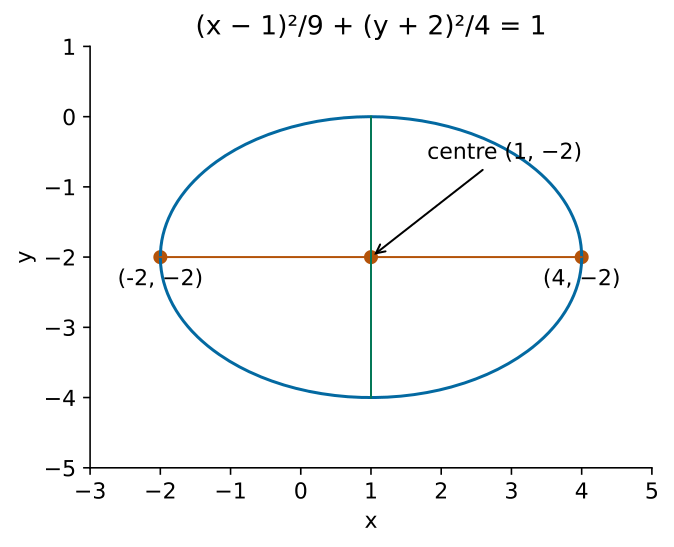
Existing worked example: The ellipse (x-1)²/9+(y+2)²/4=1 has horizontal endpoints (-2,-2) and (4,-2). y²=8x has p=2 and focus (2,0). Secants with outside/whole lengths 3/12 and 4/9 both have product 36, so a tangent from the same point has length 6. A cone radius 3, height 8 has volume 24π.
Complete original context
Every transfer question states all data it needs.
Independent practice and checked reasoning
Transfer 1
For $(x+2)^2/25+(y-1)^2/9=1$, state centre, horizontal and vertical semiaxes, and four axis endpoints. For $y^2=-12x$, state vertex and focus.
Reasoning: Centre is $(-2,1)$, semiaxes 5 and 3, endpoints $(-7,1),(3,1),(-2,-2),(-2,4)$. In the parabola, $4p=-12$, so $p=-3$; vertex $(0,0)$, focus $(-3,0)$.
Transfer 2
From one exterior point a tangent has length 6 cm. A secant has outside segment 4 cm. Find its whole and inside lengths.
Reasoning: Use tangent–secant relation $t^2=ew$. Rearrange $w=t^2/e=(6\,\mathrm{cm})^2/(4\,\mathrm{cm})=9\,\mathrm{cm}$. Inside length is $w-e=9\,\mathrm{cm}-4\,\mathrm{cm}=5\,\mathrm{cm}$. The product uses whole length, not just inside.
Transfer 3
A cylindrical container has radius 3 cm and height 8 cm. Find its volume and total closed surface area. What happens to each if every length doubles?
Reasoning: $V=\pi r^2h=\pi(3\,\mathrm{cm})^2(8\,\mathrm{cm})=72\pi\,\mathrm{cm^3}$. $A=2\pi r^2+2\pi rh=2\pi(3\,\mathrm{cm})^2+2\pi(3\,\mathrm{cm})(8\,\mathrm{cm})=66\pi\,\mathrm{cm^2}$. Doubling all lengths multiplies volume by 8 and area by 4.
Transfer 4
Classify $x^2/16-y^2/9=1$ and $x^2+y^2=16$. Find the circle circumference and area. For two secants from the same exterior point, one has outside/whole lengths 3/12 cm and the other outside length 4 cm: find its whole and inside lengths.
Reasoning: The difference of squared terms defines a hyperbola centred at the origin. The sum with equal coefficients defines a circle of radius 4. Its circumference is $C=2\pi r=8\pi$ and area $A=\pi r^2=16\pi$ in coordinate length and square-length units respectively. Secant products match: $e_1w_1=e_2w_2$. Thus $w_2=(3\,\mathrm{cm})(12\,\mathrm{cm})/(4\,\mathrm{cm})=9\,\mathrm{cm}$; inside length is $9-4=5\,\mathrm{cm}$. Outside times inside would apply the wrong relation.
Limits and next use
Take square roots for radii and semiaxes; use entire secant lengths and cubic units for volume.
All tasks here are public original practice with authored guidance. They are not official questions or fresh diagnostics. Existing protected tests and mocks remain separate.