Scope and prerequisites
ACT framework, February 2026 revision. Original classroom cases are not an official form; preserve the scored/field-test boundaries of each source form.
- Transform coordinates while distinguishing rigid motions 刚体变换 from dilation
- Use distance, midpoint and slope as geometric evidence 证据
- Use valid congruence 全等 and angle relationships rather than a diagram’s appearance
Prerequisites: Coordinate differences; triangle congruence; angles on parallel lines.
Explain and choose the method
A translation 翻译 adds a displacement to each point; reflection across the x-axis sends (x,y) to (x,-y). A 90° counterclockwise rotation around the origin sends (x,y) to (-y,x). These rigid motions preserve lengths and angles. Dilation by factor k about the origin scales coordinates and lengths by k when k is positive, preserving shape but generally changing size.
Distance between two points follows the Pythagorean theorem: square the coordinate differences, add and take the root. The midpoint averages each coordinate. Slope compares vertical and horizontal change; perpendicular nonvertical slopes have product -1. Vertical and horizontal lines require separate treatment rather than division by zero.
A geometric argument 论证 starts from stated or marked conditions. Vertical angles are equal; parallel lines give corresponding and alternate-angle relationships. Triangle angles sum to 180°. SSS, SAS and ASA/AAS can establish congruence with proper correspondence, while two equal angles establish similarity 相似 but not equal size.
Construction reasoning uses a compass to transfer lengths and draw equal-radius arcs. An intersection of equal-distance arcs can locate a perpendicular bisector 垂直平分线; it is not a guessed midpoint from a sketch. Coordinate evidence can support a proof, but one specially chosen picture does not establish a general statement for every triangle.
Rigid motions preserve lengths and angles. A 90-degree anticlockwise rotation sends $(x,y)$ to $(-y,x)$ about the origin. Distance is $d=\sqrt{(x_2-x_1)^2+(y_2-y_1)^2}$. Equal angles establish similarity , but congruence also fixes size.
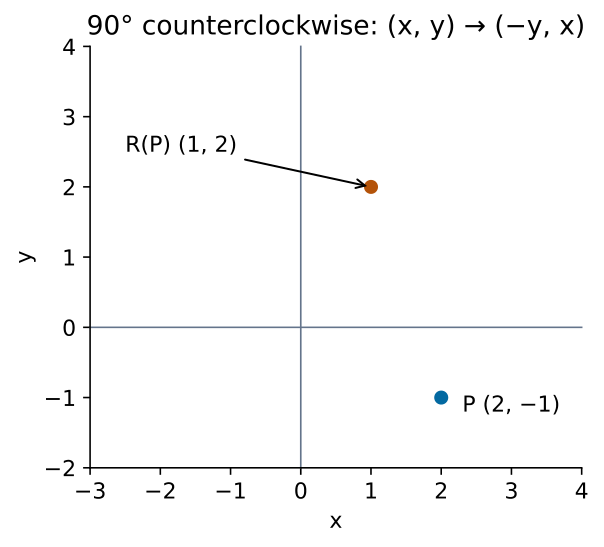
Existing worked example: Point (2,-1) translated by (3,4) becomes (5,3); rotated 90° counterclockwise about the origin it becomes (1,2). Between (1,2) and (7,10), distance is √(6²+8²)=10 and midpoint (4,6). Two triangles with matching side lengths 3,4,5 are congruent by SSS; triangles with equal angles may instead differ by scale.
Complete original context
Every transfer question states all data it needs.
Independent practice and checked reasoning
Transfer 1
Rotate A = $(2,-3)$ by 90° anticlockwise about the origin, then translate by $(4,1)$. Reverse the order and compare endpoints.
Reasoning: Rotate first to $(3,2)$, then translate to $(7,3)$. Translate first to $(6,-2)$, then rotate to $(2,6)$. The endpoints differ, so transformation 转化 order matters.
Transfer 2
A = $(-1,2)$ and B = $(5,10)$ are endpoints of a segment. Find its length, midpoint and perpendicular-bisector equation.
Reasoning: $d=\sqrt{(5+1)^2+(10-2)^2}=10$. Midpoint $M=(({-1}+5)/2,(2+10)/2)=(2,6)$. Segment slope is $8/6=4/3$, so perpendicular slope is $-3/4$. The bisector is $y-6=-(3/4)(x-2)$.
Transfer 3
Two triangles have angles 40°,60°,80°. One has longest side 9 cm; the other 15 cm. State what is proved and the ratio of their areas.
Reasoning: The triangles are similar by equal angles, not congruent because corresponding longest sides differ. Length ratio is $15/9=5/3$ and larger-to-smaller area ratio is $25/9$.
Transfer 4
Describe a compass-and-straightedge construction of the perpendicular bisector of segment AB. Give a reason valid for every constructed point, and distinguish it from measuring one diagram. Then explain what SSS proves for triangles with corresponding side lengths 3,4,5 cm.
Reasoning: Use the same compass radius, greater than half AB, to draw arcs centred at A and B meeting at P and Q on opposite sides. Draw PQ. PA=PB and QA=QB by equal radii. Thus both P and Q lie on the locus equidistant from A and B; PQ is the perpendicular bisector. Equivalently use congruent triangles and the common chord to establish perpendicularity and bisection. A ruler reading on one picture does not prove the general locus. SSS proves the two stated triangles congruent, fixing size as well as shape; Pythagoras also shows these particular triangles are right-angled.
Transfer 5
Two parallel lines are cut by a transversal. One corresponding angle is 68°. Find its matching corresponding angle and the adjacent angle on the second line. Explain which given condition justifies each step.
Reasoning: Parallelism gives the matching corresponding angle 68°. The adjacent pair forms a straight angle, so the other is 180°−68°=112°. Equal corresponding angles require the stated parallel lines; the straight-angle sum uses adjacency on one line. A similar-looking sketch without parallelism would not justify the first equality.
Limits and next use
Follow the specified centre and order of transformations. Do not use a visually parallel or perpendicular pair as a stated condition.
All tasks here are public original practice with authored guidance. They are not official questions or fresh diagnostics. Existing protected tests and mocks remain separate.