Joining: welds through their throat, bonds in shear
Đã giới thiệu| English | Ý nghĩa |
|---|---|
| welding | Joining parts by melting and fusing them, usually with added filler metal. |
| heat input | The energy delivered by a welding arc per unit length of weld, which controls cooling rate and distortion. |
| fillet weld | A triangular weld joining two surfaces at an angle, such as in a T-joint or lap joint. |
| throat | The shortest distance from the root to the face of a weld, used to calculate its strength. |
| adhesive bonding | Joining parts with a glue layer that carries load mainly in shear. |
The weakest place in the assembly
- A bracket welded to a frame and a cover glued on: the joint is usually where an assembly fails first, so it is sized on purpose, not by eye.
- Welding melts and fuses the parent metal. The heat input $H = \eta VI/v$ (J/mm) controls the weld size and how much the nearby metal is damaged.
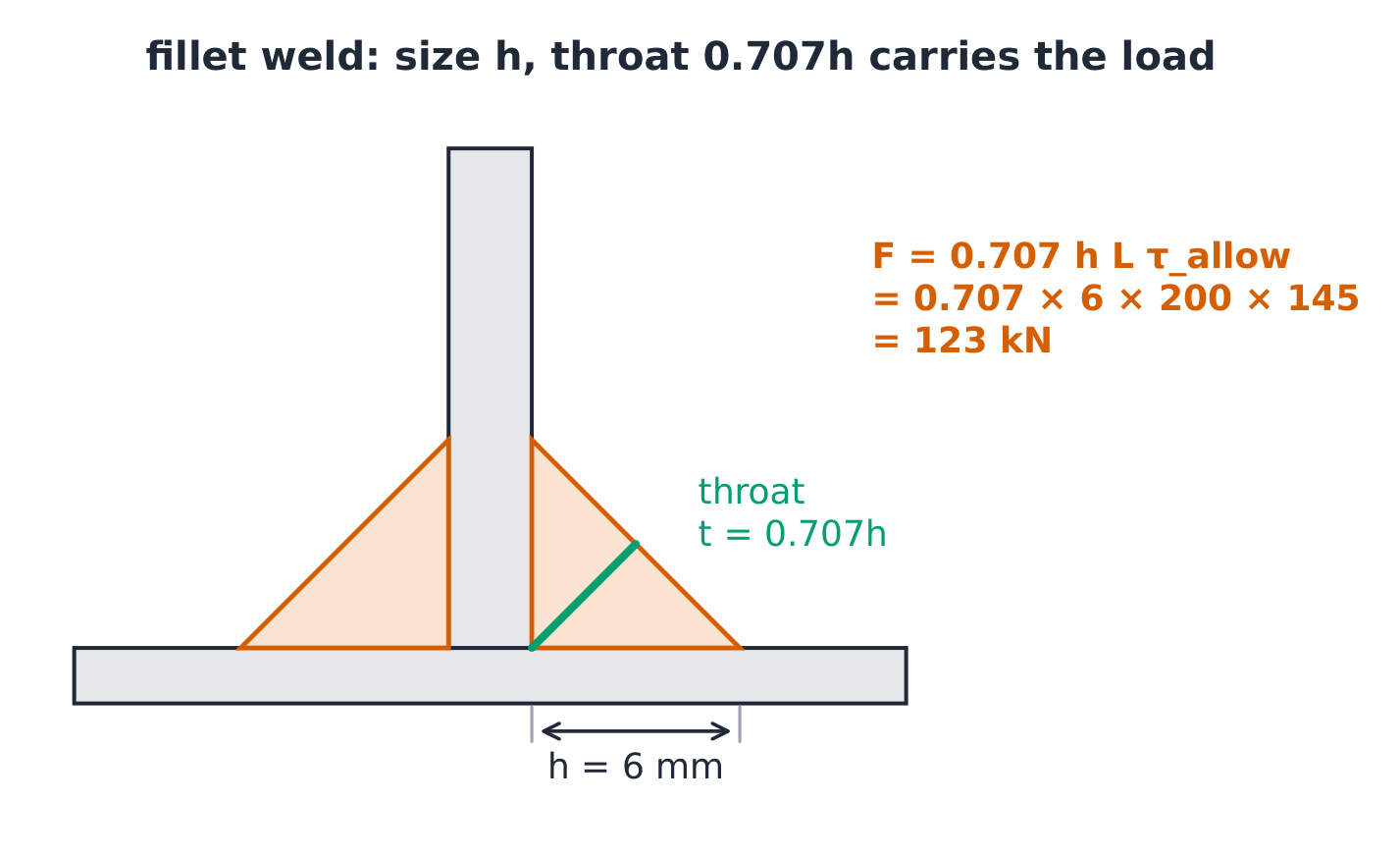
Why 0.707
- An equal-leg fillet weld is a right-angled triangle with legs $h$. The shortest line from root to face is $h\sin45° = 0.707h$: the throat.
- Shear on that plane is $\tau = F/(0.707hL)$, so the weld carries $F = 0.707hL\tau_{allow}$.
Which joint rule applies?
Match each joint question to its rule.
Throat of a 6 mm equal-leg fillet (two decimals, mm)?
Độ khó 2/5 · 140 xu + phần thưởng nhỏ khi hoàn thành lần đầu tiên hôm nay
0.707 times 6.
The bracket welds
- Two fillets, each 100 mm long with a 6 mm leg; allowable shear $0.3 \times 482 = 145$ MPa.
- $F = 0.707 \times 6 \times 200 \times 145 = \mathbf{123}$ kN.
- Heat input at 80% efficiency, 25 V, 200 A and 5 mm/s: $H = \mathbf{800}$ J/mm, normal for 6 mm fillets.
Two such fillets, 100 mm each, at 145 MPa allowable shear (kN, whole number)?
Độ khó 2/5 · 140 xu + phần thưởng nhỏ khi hoàn thành lần đầu tiên hôm nay
0.707 h L tau with L = 200 mm.
Heat input at eta = 0.8, 25 V, 200 A, 5 mm/s (J/mm)?
Độ khó 2/5 · 140 xu + phần thưởng nhỏ khi hoàn thành lần đầu tiên hôm nay
eta V I over v.
The bonded cover
- Adhesive bonding spreads the load over an area. A $25 \times 12.5$ mm lap with a 20 MPa epoxy carries $\mathbf{6.25}$ kN.
- The shear stress peaks at the ends of the overlap, so doubling the overlap does not double the strength. Bonds are strong in shear and weak in peel.
A 25 x 12.5 mm lap bond at 20 MPa (two decimals, kN)?
Độ khó 2/5 · 140 xu + phần thưởng nhỏ khi hoàn thành lần đầu tiên hôm nay
20 MPa times 312.5 mm2.
Doubling the overlap of a lap bond:
Độ khó 1/5 · 100 xu + phần thưởng nhỏ khi hoàn thành lần đầu tiên hôm nay
The stress peaks at the overlap ends.
Adhesive joints are strongest in peel.
Độ khó 1/5 · 100 xu + phần thưởng nhỏ khi hoàn thành lần đầu tiên hôm nay
They are strongest in shear and weakest in peel.
80% efficiency, 25 V, 200 A at 10 mm/s: heat input (J/mm)?
Độ khó 2/5 · 140 xu + phần thưởng nhỏ khi hoàn thành lần đầu tiên hôm nay
$0.8 \times 25 \times 200/10 = 400$ J/mm.
Welding faster always gives a tougher heat-affected zone, because less heat goes in.
Độ khó 1/5 · 100 xu + phần thưởng nhỏ khi hoàn thành lần đầu tiên hôm nay
Less heat means faster cooling, which in hardenable steels can form brittle martensite; that is why procedures set heat input and preheat.
Heat input sets the cooling rate
- Double the travel speed to 10 mm/s and $H$ halves to $\mathbf{400}$ J/mm. The weld is smaller and cools faster.
- Fast cooling in a hardenable steel can form brittle martensite in the heat-affected zone. Preheating the plate, or more heat input, slows the cooling: weld procedures fix $H$ for that reason.
123 kN on two 60 mm fillets at 145 MPa allowable: leg size (one decimal, mm)?
Độ khó 2/5 · 140 xu + phần thưởng nhỏ khi hoàn thành lần đầu tiên hôm nay
$h = 123\,000/(0.707 \times 120 \times 145) = 10.0$ mm.
Worked example: a shorter weld
- The frame leaves room for only two 60 mm fillets, and the joint must still carry 123 kN at 145 MPa.
- The leg follows from the throat: $h = F/(0.707 L \tau) = 123\,000/(0.707 \times 120 \times 145) = \mathbf{10.0}$ mm. Less length means a bigger leg, and a bigger leg means more passes and more heat.
Three joining slips
- The leg instead of the throat. Use $0.707h$.
- Ignoring the heat-affected zone. Hardened steel softens or cracks beside the weld.
- Loading a bond in peel. Design it so the load is shear.
Recap
- $H = \eta VI/v = 800$ J/mm.
- Throat $0.707h$; $F = 0.707hL\tau_{allow} = 123$ kN for two 100 mm, 6 mm fillets.
- Bonds in shear, never in peel: 6.25 kN for the lap.