Casting and forming: freeze last, flow safely
Đã giới thiệu| English | Ý nghĩa |
|---|---|
| riser | A reservoir of molten metal in a mould that feeds the casting as it shrinks, and must solidify last. |
| feed | The distance the tool advances per revolution or per tooth during machining. |
| casting/ˈkæstɪŋ/ | shaping by freezing liquid metal in a mould |
| Chvorinov's rule | The rule that a casting's solidification time is proportional to the square of its volume-to-surface-area ratio. |
| casting modulus | The volume of a casting section divided by its cooling surface area, which sets how long it takes to solidify. |
| forming/ˈfɔːmɪŋ/ | Shaping metal by plastic deformation, such as rolling, forging, extrusion or sheet bending, without removing material. |
| flow stress | The stress needed to keep a metal deforming plastically at a given strain. |
| shrinkage allowance | The extra size given to a casting pattern so the part is right after the solid metal contracts on cooling. |
The riser must freeze last
- A cast pump housing shrinks as it freezes. If the thick part freezes after its feeder, a hole forms inside. A riser is a reservoir of hot metal that must freeze last and feed the casting.
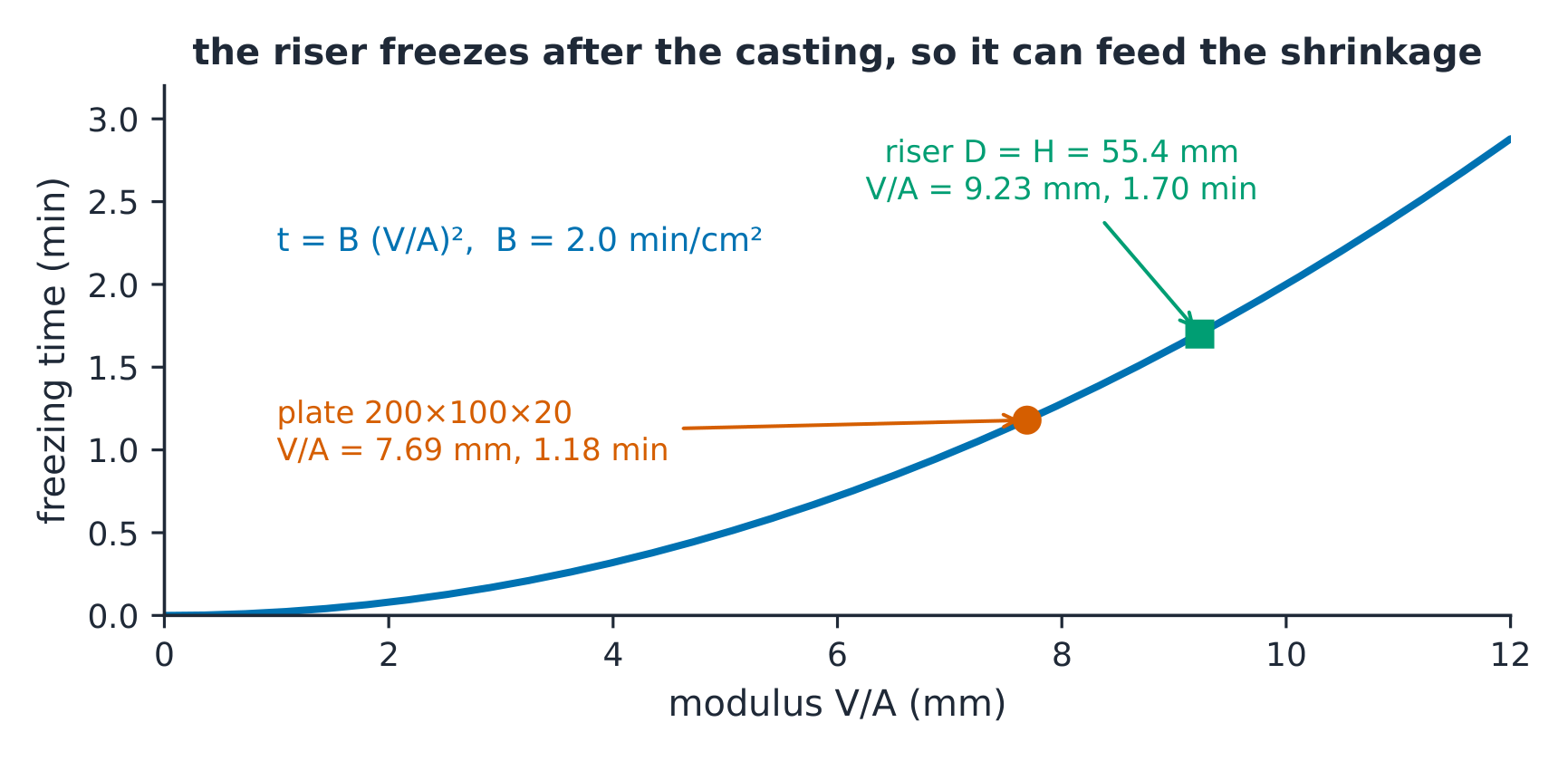
- Chvorinov's rule gives the freezing time: $t = B\,(V/A)^2$, where $V/A$ is the casting modulus.
A riser must:
Độ khó 1/5 · 100 xu + phần thưởng nhỏ khi hoàn thành lần đầu tiên hôm nay
It feeds shrinkage only while it is still liquid.
The plate and its riser
- A $200 \times 100 \times 20$ mm steel plate: $V/A = 400\,000/52\,000 = \mathbf{7.69}$ mm, so with $B = 2.0\ \mathrm{min/cm^2}$, $t = \mathbf{1.18}$ min.
- A cylindrical riser with $D = H$ has $V/A = D/6$. A modulus 20% larger needs $D = \mathbf{55.4}$ mm; it freezes in $\mathbf{1.70}$ min.
Casting modulus of a 200 x 100 x 20 mm plate (two decimals, mm)?
Độ khó 2/5 · 140 xu + phần thưởng nhỏ khi hoàn thành lần đầu tiên hôm nay
V over A = 400 000 over 52 000.
Its freezing time with B = 2.0 min/cm2 (two decimals, min)?
Độ khó 2/5 · 140 xu + phần thưởng nhỏ khi hoàn thành lần đầu tiên hôm nay
2.0 times 0.769 squared.
D = H riser with a modulus 1.2 times the plate's (one decimal, mm)?
Độ khó 2/5 · 140 xu + phần thưởng nhỏ khi hoàn thành lần đầu tiên hôm nay
D/6 = 1.2 x 7.69.
Forming: plastic flow
- Forming (forging, rolling, extrusion, drawing) shapes solid metal by plastic flow. The force follows the flow stress $\sigma_f = K\varepsilon^n$, with true strain $\varepsilon = \ln(A_0/A_f)$.
- The ideal drawing stress is $\sigma_d = \bar Y\ln(A_0/A_f)$, with average flow stress $\bar Y = K\varepsilon^n/(1+n)$.
Casting rule or forming rule?
Route each question to the rule that answers it.
Forming calculations use engineering strain.
Độ khó 1/5 · 100 xu + phần thưởng nhỏ khi hoàn thành lần đầu tiên hôm nay
They use true strain because it adds across passes.
Drawing the shaft wire
- Draw 6 mm wire to 5 mm with $K = 500$ MPa and $n = 0.2$: $\varepsilon = \ln(36/25) = \mathbf{0.365}$ and $\bar Y = \mathbf{341}$ MPa.
- $\sigma_d = \mathbf{124}$ MPa and the force is $\mathbf{2.44}$ kN. The drawn wire's flow stress is 409 MPa, so the pass uses only 30% of it: safe, with room for friction. The ideal limit is $\varepsilon = 1 + n$.
True strain drawing 6 mm wire to 5 mm (three decimals)?
Độ khó 2/5 · 140 xu + phần thưởng nhỏ khi hoàn thành lần đầu tiên hôm nay
ln of 36/25.
Ideal drawing force with sigma_d = 124 MPa on the 5 mm wire (two decimals, kN)?
Độ khó 2/5 · 140 xu + phần thưởng nhỏ khi hoàn thành lần đầu tiên hôm nay
Stress times the exit area.
A 200 mm steel dimension with a 2% shrinkage allowance: pattern size (mm)?
Độ khó 2/5 · 140 xu + phần thưởng nhỏ khi hoàn thành lần đầu tiên hôm nay
$200 \times 1.02 = 204$ mm.
A riser that feeds the casting well also removes the need for a shrinkage allowance on the pattern.
Độ khó 1/5 · 100 xu + phần thưởng nhỏ khi hoàn thành lần đầu tiên hôm nay
The riser feeds liquid and freezing shrinkage; the solid still contracts about 2% as it cools, which the pattern allows for.
The pattern is not the part
- Solid steel contracts about 2% as it cools from freezing to room temperature, after the riser has fed the liquid shrinkage. The pattern is made larger by a shrinkage allowance 收缩余量.
- The 200 mm plate needs a $200 \times 1.02 = \mathbf{204}$ mm pattern, plus machining allowance on every face that will be cut.
6 mm wire, $n = 0.2$: smallest diameter in one ideal pass (two decimals, mm)?
Độ khó 2/5 · 140 xu + phần thưởng nhỏ khi hoàn thành lần đầu tiên hôm nay
$\varepsilon_{max} = 1.2$, $A_f/A_0 = e^{-1.2} = 0.301$; $d_f = 6\sqrt{0.301} = 3.29$ mm.
Worked example: how far can one pass draw?
- The ideal limit $\varepsilon = 1 + n = 1.2$ means $A_f/A_0 = e^{-1.2} = 0.301$. Beyond it the drawn wire would need more stress than it can carry.
- From 6 mm the smallest wire in one ideal pass is $6\sqrt{0.301} = \mathbf{3.29}$ mm. Friction and redundant work lower that, so real dies take about 30% area per pass: 6 to 5 mm is comfortable.
Three shaping slips
- Volume alone in Chvorinov. Shape enters through the area $A$.
- A riser that freezes first. Its modulus must be larger than the casting's.
- Engineering strain in forming. Use true strain, $\ln(A_0/A_f)$.
Recap
- $t = B(V/A)^2$: 1.18 min for the plate; a 55.4 mm riser freezes in 1.70 min.
- $\sigma_d = \bar Y\ln(A_0/A_f)$ with $\bar Y = K\varepsilon^n/(1+n)$: 124 MPa, 2.44 kN for 6 to 5 mm.
- Ideal drawing limit: $\varepsilon = 1 + n$.