Centroids and distributed loads
Đã giới thiệu| English | Ý nghĩa |
|---|---|
| centroid/ˈsentrɔɪd/ | trọng tâm |
| distributed load/ˈdɪstrɪbjuːtɪd ləʊd/ | tải trọng phân bố |
| resultant/rɪˈzʌltənt/ | lực hợp |
A beam feels a shape, not a point
- Snow lies deeper in the middle of a roof than at its edges. The beam under it is not pushed at one point but all along its length.
- Engineering answers with one move: swap the whole shape for a single force at its balance point. Then every tool from earlier lessons works unchanged.
Area is the force, centroid is the place
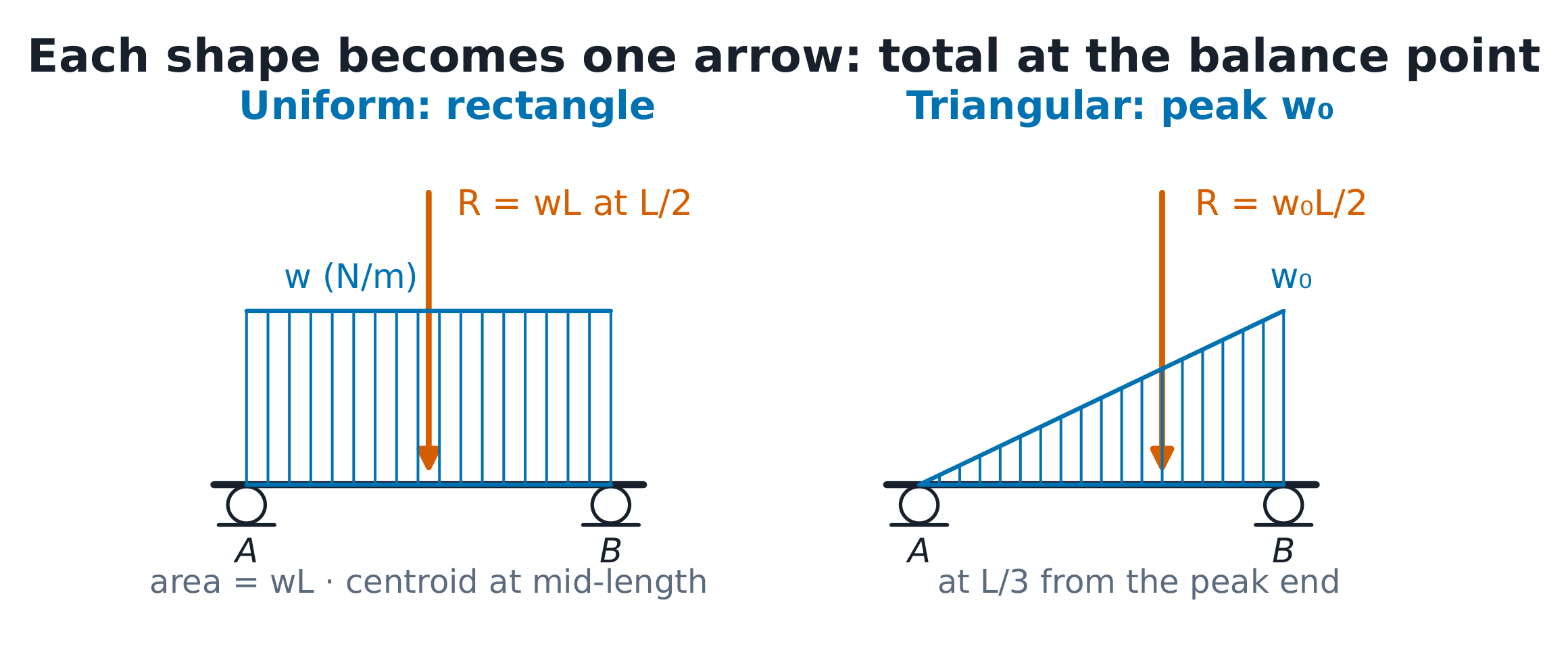
- A distributed load 分布载荷 $w$ is force per length, in $\dfrac{\text{kN}}{\text{m}}$. Its resultant 合力 equals the area under the load diagram.
- The resultant acts at the area's centroid 形心, its balance point. For finding reactions the swap is exact, not an approximation.
A floor beam carries a uniform $3\ \dfrac{\text{kN}}{\text{m}}$ over its whole $5\ \text{m}$ length. What is the resultant load, in kN?
Độ khó 2/5 · 140 xu + phần thưởng nhỏ khi hoàn thành lần đầu tiên hôm nay
The resultant is the area of the rectangle: $R = wL = 3 \times 5 = 15\ \text{kN}$, acting at the middle, $2.5\ \text{m}$ from either end.
Two shapes to know by heart
- Rectangle (uniform $w$ over length $L$): $R = wL$, at the middle, $\tfrac{L}{2}$ from either end.
- Triangle (zero rising to $w_0$ over $L$): $R = \tfrac{1}{2}w_0L$, at $\tfrac{L}{3}$ from the high end. The load is heavier there, so the balance point moves towards it.
A load rises steadily from zero at one end to its peak at the other end of a span $L$. Where does its resultant act?
Độ khó 1/5 · 100 xu + phần thưởng nhỏ khi hoàn thành lần đầu tiên hôm nay
More load sits near the peak, so the balance point moves towards it: $\tfrac{L}{3}$ from the peak, $\tfrac{2L}{3}$ from the zero end.
A triangular load rises to $9\ \dfrac{\text{kN}}{\text{m}}$ over $6\ \text{m}$. How far from the peak end does its resultant act, in m?
Độ khó 2/5 · 140 xu + phần thưởng nhỏ khi hoàn thành lần đầu tiên hôm nay
$\tfrac{L}{3} = \tfrac{6}{3} = 2\ \text{m}$ from the peak. The resultant itself is $\tfrac{1}{2} \times 9 \times 6 = 27\ \text{kN}$.
Worked example: a triangular load
- A load rises from $0$ at A to $6\ \dfrac{\text{kN}}{\text{m}}$ at B over a $4\ \text{m}$ beam on simple supports at A and B.
- $R = \tfrac{1}{2} \times 6 \times 4 = 12\ \text{kN}$, at $\tfrac{4}{3} = 1.33\ \text{m}$ from B, so $2.67\ \text{m}$ from A.
- Moments about A: $R_B \times 4 = 12 \times 2.67$, so $R_B = 8\ \text{kN}$, and $R_A = 12 - 8 = 4\ \text{kN}$. The high end carries more.
A beam spans $5\ \text{m}$ between simple supports and carries a uniform $4\ \dfrac{\text{kN}}{\text{m}}$ along its length. What is each support reaction, in kN?
Độ khó 2/5 · 140 xu + phần thưởng nhỏ khi hoàn thành lần đầu tiên hôm nay
$R = 4 \times 5 = 20\ \text{kN}$ at mid-span. By symmetry (or moments about one end: $5R_B = 20 \times 2.5$) each support takes $10\ \text{kN}$.
Two loads, two resultants, one beam
- A $6\ \text{m}$ beam on supports at A and B carries $2\ \dfrac{\text{kN}}{\text{m}}$ over its first $3\ \text{m}$, then a triangle rising to $4\ \dfrac{\text{kN}}{\text{m}}$ at B over the last $3\ \text{m}$.
- Rectangle: $6\ \text{kN}$ at $1.5\ \text{m}$ from A. Triangle: $6\ \text{kN}$ at $1\ \text{m}$ from B, so $5\ \text{m}$ from A.
- Moments about A: $6R_B = 6 \times 1.5 + 6 \times 5 = 39$, so $R_B = 6.5\ \text{kN}$ and $R_A = 5.5\ \text{kN}$.
- Check about B: $5.5 \times 6 = 33 = 6 \times 4.5 + 6 \times 1$.
Split a trapezoid
- A load rising from $w_1$ to $w_2$ is a rectangle of height $w_1$ plus a triangle of height $w_2 - w_1$. Find each resultant, then combine.
- From $2$ to $5\ \dfrac{\text{kN}}{\text{m}}$ over $3\ \text{m}$: $6\ \text{kN}$ at $1.5\ \text{m}$ plus $4.5\ \text{kN}$ at $2\ \text{m}$. Together $10.5\ \text{kN}$ at $\dfrac{6 \times 1.5 + 4.5 \times 2}{10.5} = 1.71\ \text{m}$ from the low end.
A load rises from $2$ to $5\ \dfrac{\text{kN}}{\text{m}}$ over $3\ \text{m}$. How far from the low end does its resultant act, in m?
Độ khó 2/5 · 140 xu + phần thưởng nhỏ khi hoàn thành lần đầu tiên hôm nay
Rectangle $2 \times 3 = 6\ \text{kN}$ at $1.5\ \text{m}$; triangle $\tfrac{1}{2} \times 3 \times 3 = 4.5\ \text{kN}$ at $2\ \text{m}$. Combined: $\dfrac{9 + 9}{10.5} = 1.714\ \text{m}$, past the middle towards the heavy end.
Centroids of composite areas
- Cut a shape into rectangles and take moments of area: $\bar y = \dfrac{\Sigma A_i\bar y_i}{\Sigma A_i}$, measured from any line you choose.
- A T-section: a $120 \times 20\ \text{mm}$ flange on a $20 \times 80\ \text{mm}$ web. From the top: $\bar y = \dfrac{2400 \times 10 + 1600 \times 60}{4000} = 30\ \text{mm}$. It sits close to the wide flange, as it should.
An inverted T is a $100 \times 20\ \text{mm}$ flange lying flat at the bottom with a $20 \times 60\ \text{mm}$ web standing on it. How high is the centroid above the bottom edge, in mm?
Độ khó 2/5 · 140 xu + phần thưởng nhỏ khi hoàn thành lần đầu tiên hôm nay
Flange: $2000\ \text{mm}^{2}$ at $10\ \text{mm}$. Web: $1200\ \text{mm}^{2}$ at $20 + 30 = 50\ \text{mm}$. $\bar y = \dfrac{20\,000 + 60\,000}{3200} = 25\ \text{mm}$, inside the web just above the flange.
Marks that slip away
- Putting a triangle's resultant in the middle. It is $\tfrac{L}{3}$ from the high end, always.
- Using the peak instead of the area. A triangle peaking at $6\ \dfrac{\text{kN}}{\text{m}}$ over $4\ \text{m}$ gives $12\ \text{kN}$, not $24\ \text{kN}$.
- Forgetting to check the centroid's position. It must lie inside the shape and lean towards the larger area.
Replacing a distributed load by its resultant at the centroid gives exactly the right support reactions.
Độ khó 1/5 · 100 xu + phần thưởng nhỏ khi hoàn thành lần đầu tiên hôm nay
The resultant has the same total force and the same moment about every point, so the equilibrium equations cannot tell the difference. Inside the beam, later topics still need the real shape.
You've got it
- A distributed load becomes one resultant = the area under it, acting at the centroid.
- Rectangle: $wL$ at $\tfrac{L}{2}$. Triangle: $\tfrac{1}{2}w_0L$ at $\tfrac{L}{3}$ from the high end. Split anything else into these.
- Composite area: $\bar y = \dfrac{\Sigma A_i\bar y_i}{\Sigma A_i}$.