Maxwell's equations
Đã giới thiệu| English | Ý nghĩa |
|---|---|
| charge conservation/tʃɑːdʒ ˌkɒnsəˈveɪʃn/ | charge conservation |
The missing ampere
- Charge conservation forced Maxwell's correction: without $\varepsilon_{0}\partial E/\partial t$ the Ampère law contradicts $\nabla \cdot J = -\partial\rho/\partial t$. With it, the four equations form one loop.
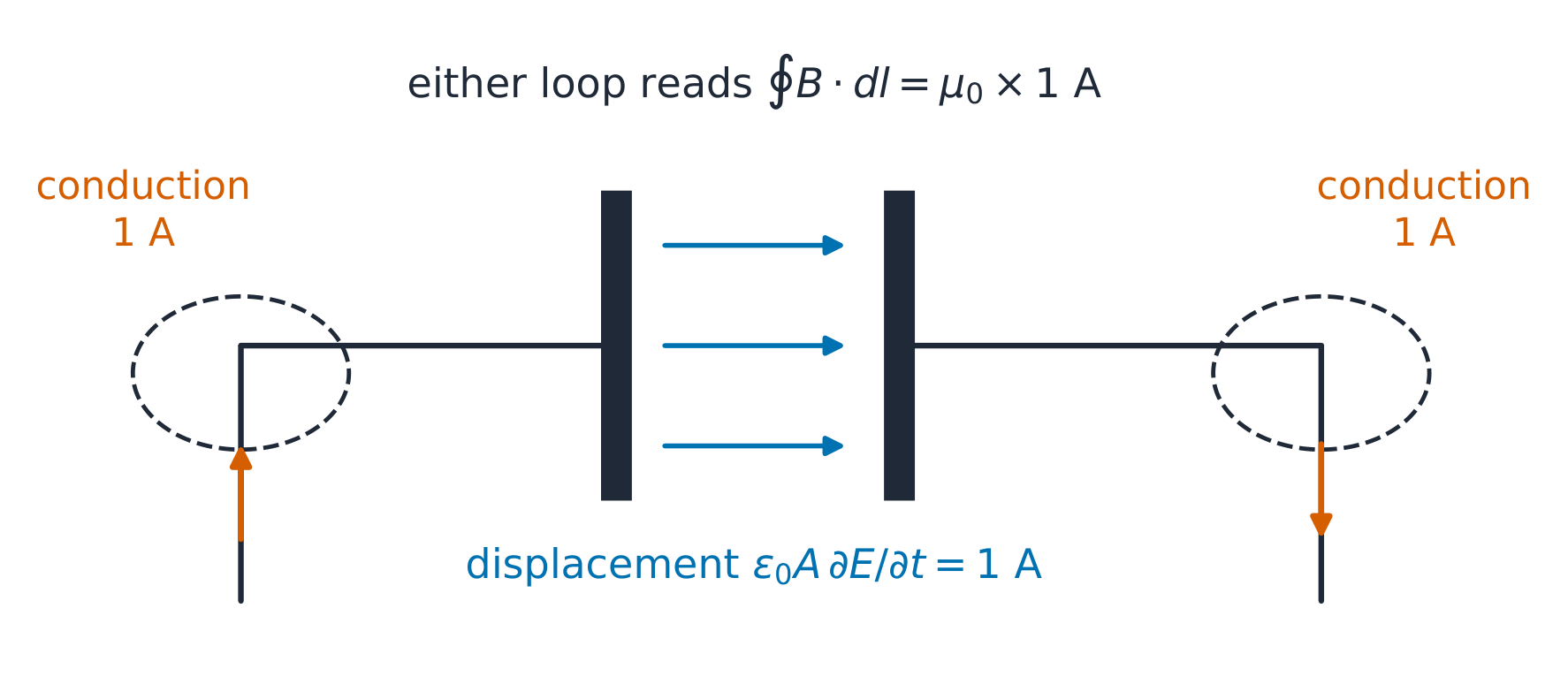
A capacitor charging at 1 A: between the plates $\varepsilon_{0}A\,\partial E/\partial t = dQ/dt = 1$ A ✓ — displacement equals conduction, numerically.
{exercise:uni-ee0741-capacitor}
Between the plates of a charging capacitor, an Amperian loop reads —
Độ khó 1/5 · 100 xu + phần thưởng nhỏ khi hoàn thành lần đầu tiên hôm nay
ε0·A·∂E/∂t = dQ/dt exactly — the loop integral cannot depend on which surface you span it with.
Which equation carries the minus sign?
Độ khó 1/5 · 100 xu + phần thưởng nhỏ khi hoàn thành lần đầu tiên hôm nay
The minus sign in Faraday (Lenz) is what makes waves decay forward in time rather than blow up backward.
Light falls out
- Take the curl of Faraday, substitute Ampère: in vacuum $\nabla^{2}E = \mu_{0}\varepsilon_{0}\,\partial^{2}E/\partial t^{2}$ — waves at $c = 1/\sqrt{\mu_{0}\varepsilon_{0}} = 3 \times 10^{8}$ m/s from two bench constants.
{exercise:uni-ee0742-speed}
The wave speed 1/√(μ0ε0) evaluates to —
Độ khó 1/5 · 100 xu + phần thưởng nhỏ khi hoàn thành lần đầu tiên hôm nay
Two bench-measured constants give 1/√(4π×10⁻⁷ × 8.854×10⁻¹²) = 3.0×10⁸ m/s — the speed light was hiding in.