Laplace transform and system functions
Đã giới thiệu| English | Ý nghĩa |
|---|---|
| system function | hàm truyền |
Poles carry the modes
- The system function $H(s) = Y(s)/X(s)$ pairs with the impulse response; each pole contributes $e^{pt}$; causal stability puts every pole in the open left half-plane.
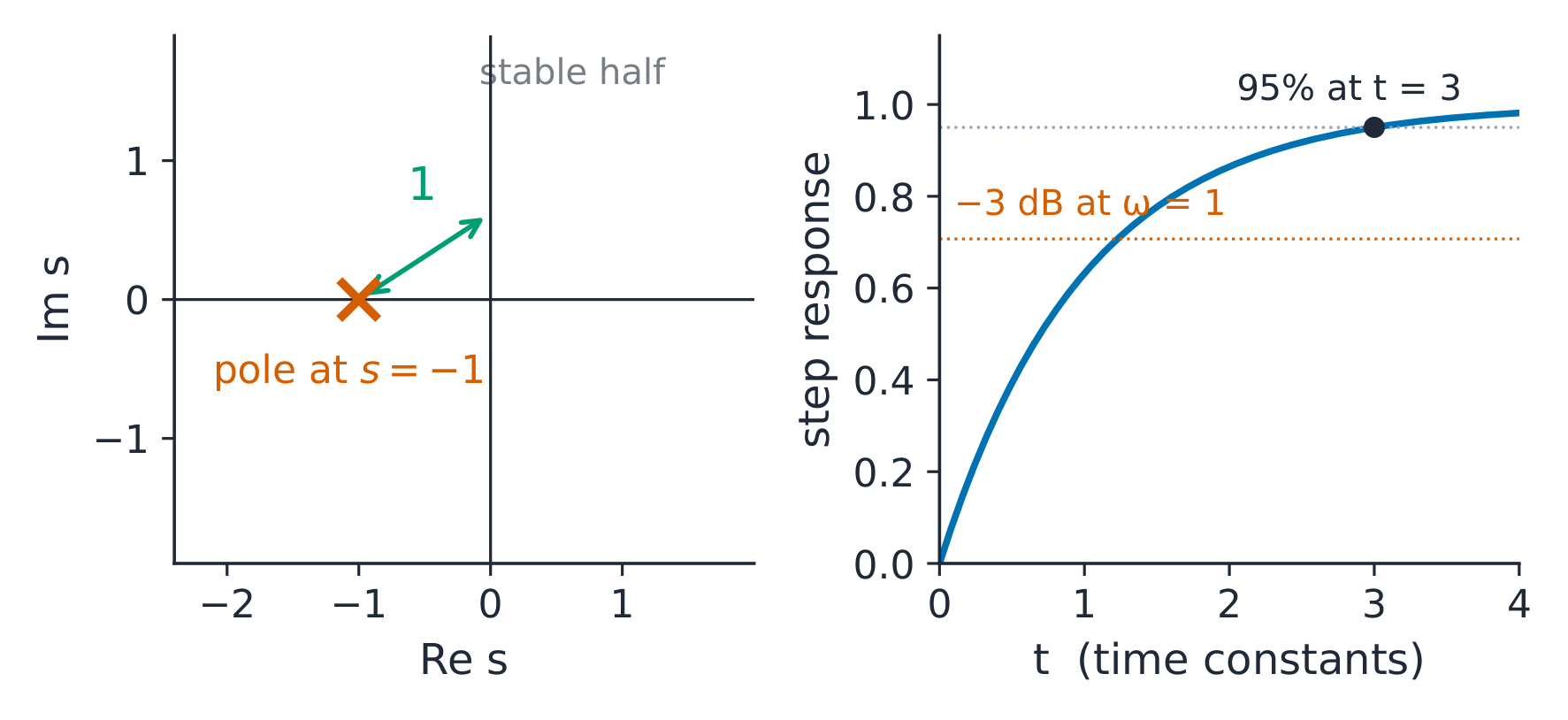
$H(s) = 1/(s+1)$: step $Y = 1/s - 1/(s+1) \to 1 - e^{-t}$ — three lines of algebra reproducing the convolution result ✓. $|H(j1)| = 0.707$ — the −3 dB point at the pole distance.
{exercise:uni-ee0651-pole}
For H(s) = 1/(s+1), the −3 dB frequency sits at —
Độ khó 1/5 · 100 xu + phần thưởng nhỏ khi hoàn thành lần đầu tiên hôm nay
|H(jω)| = 1/√(1+ω²): at ω = 1 it is 1/√2 = 0.707 — the −3 dB point at the pole frequency magnitude, phase −45°.
Stability of a causal rational H(s) requires —
Độ khó 1/5 · 100 xu + phần thưởng nhỏ khi hoàn thành lần đầu tiên hôm nay
Causal ROC extends rightward from the rightmost pole; it contains the jω axis only if that pole has negative real part.
The equaliser, legible at a glance
- A bass boost with zeros at $-1 \pm j9.95$ and poles at $-1, -10$: DC gain $10$ (20 dB), HF gain 1, the transition between the poles — the whole curve from five marked points.
{exercise:uni-ee0652-boost}
The bass boost (s² + 2s + 100)/((s+1)(s+10)) has DC gain —
Độ khó 1/5 · 100 xu + phần thưởng nhỏ khi hoàn thành lần đầu tiên hôm nay
At s = 0 the ratio is 100/10 = 10 → 20 dB of lift; as s → ∞ the s² terms match and the gain tends to 1.