Laplace circuit analysis
Đã giới thiệu| English | Ý nghĩa |
|---|---|
| initial condition/ɪˈnɪʃl kənˈdɪʃn/ | initial condition |
| s-domain | s-domain |
| pole/pəʊl/ | pole |
Laplace circuits: initial conditions become sources
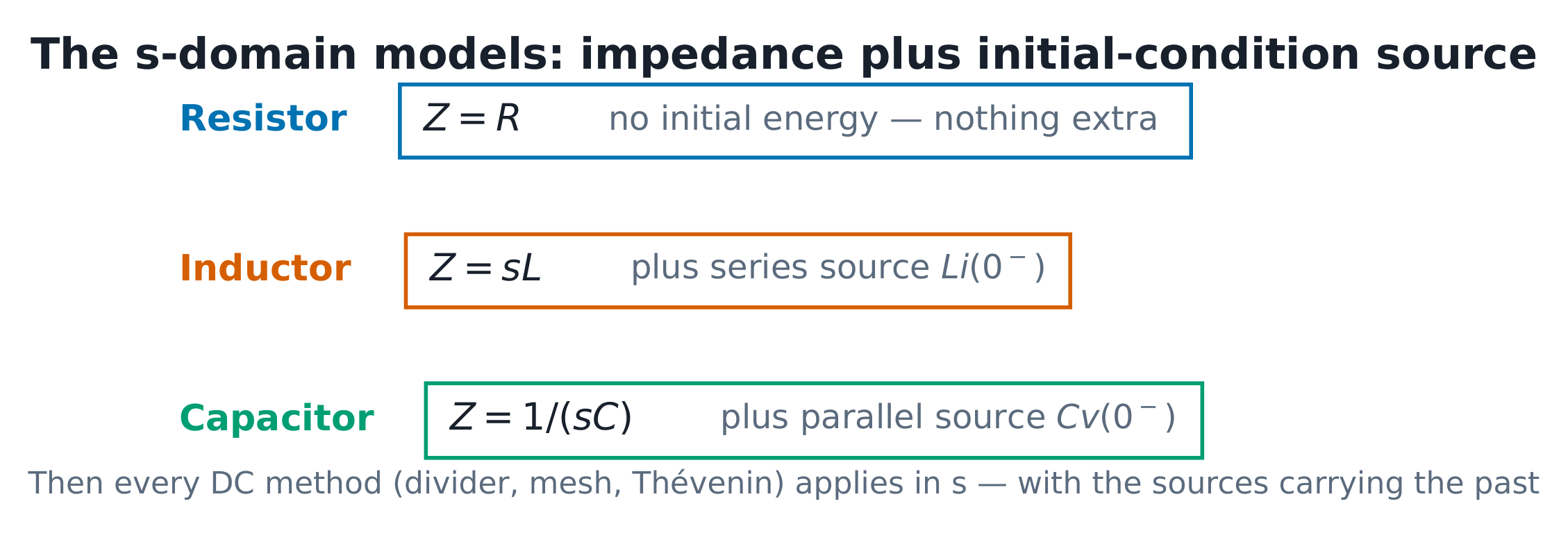
- In the s-domain each element is an impedance plus an initial-condition source: $R$; $sL$ with $L\,i(0)$ volts in series; $1/(sC)$ with $C\,v(0)$ amperes in parallel. Then every DC method applies in $s$.
- The response's poles carry the transient and the input's poles the steady state — so the poles are the $α$ and $ω_{d}$ of the time-domain regime arithmetic.
The series RLC with $R = 2$ Ω, $L = 0.2$ H, $C = 0.05$ F released with $i(0) = 1$ A, $v_{C}(0) = 0$: mesh KVL in $s$ reads $(0.2s + 2 + 20/s)I = 0.2$, so $I(s) = s/(s^{2} + 10s + 100)$ with poles $-5 \pm j8.66$ — exactly $α = 5$, $ω_{d} = 8.66$ from lesson 4.3. Drop the $L\,i(0)$ source and the equation claims the circuit starts at rest.
{exercise:uni-ee4x-laplace}
A reciprocal two-port cascade of unit-determinant ABCD sections has AD − BC equal to —
Độ khó 1/5 · 100 xu + phần thưởng nhỏ khi hoàn thành lần đầu tiên hôm nay
det(M1M2) = det M1 · det M2 — each section contributes 1, so any cascade of reciprocal sections keeps AD − BC = 1. It is the standing check of every conversion.
A source-free series RLC (R = 2, L = 0.2, C = 0.05, i0 = 1 A) gives I(s) = s/(s^2 + 10s + 50). The poles are
Độ khó 1/5 · 100 xu + phần thưởng nhỏ khi hoàn thành lần đầu tiên hôm nay
The poles of the s-domain mesh ARE the time-domain regime numbers: alpha = R/2L = 5, omega-d = sqrt(100 − 25) = 8.66. Two notations, one physics.
In the s-domain, the inductor with initial current i(0) becomes
Độ khó 1/5 · 100 xu + phần thưởng nhỏ khi hoàn thành lần đầu tiên hôm nay
The initial condition enters as a SOURCE: L i(0) volts in series (or i(0)/s in parallel). Drop it and every answer claims the circuit starts at rest.