Laplace transforms
Đã giới thiệu| English | Ý nghĩa |
|---|---|
| pole/pəʊl/ | pole |
| partial fraction/ˈpɑːʃl ˈfrækʃn/ | partial fraction |
Laplace: differentiation becomes multiplication
- The Laplace transform turns $\frac{dy}{dt}$ into $sY - y(0)$: an ODE becomes algebra, initials included.
- $\mathcal{L}\{e^{at}\} = \frac{1}{s-a}$ — the exponential eats its own decay, leaving a simple pole.
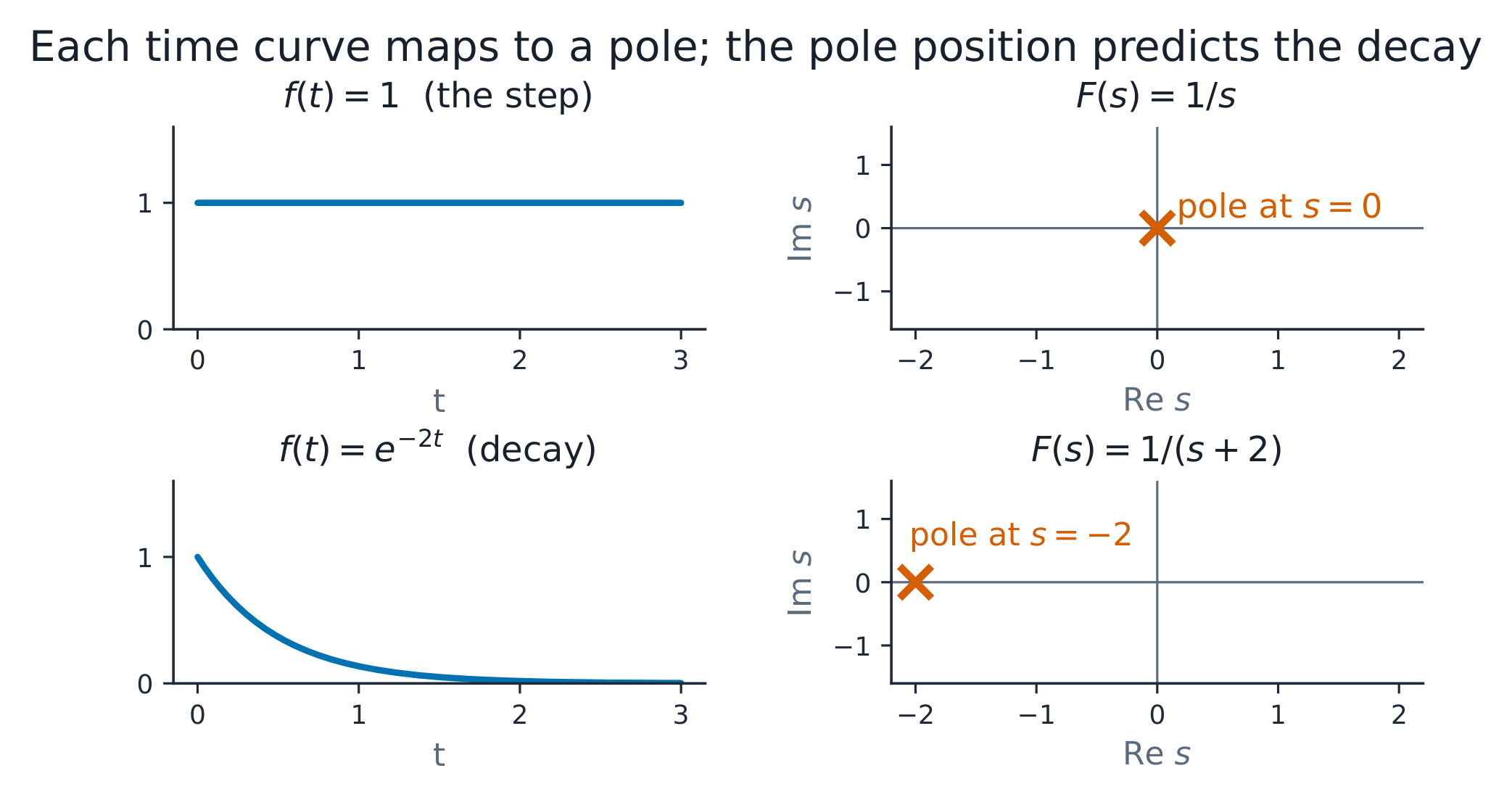
$dy/dt + 2y = 10$, $y(0)=1$: transformed $sY - 1 + 2Y = 10/s$; partial fractions give $Y = 5/s - 4/(s+2)$, so $y = 5 - 4e^{-2t}$ — the same answer as the classical route, with bookkeeping instead of algebra.
{exercise:uni-ee2x-laplace}
Y(s) has poles at s = 0 and s = −2. The response shape is —
Độ khó 1/5 · 100 xu + phần thưởng nhỏ khi hoàn thành lần đầu tiên hôm nay
A pole at 0 is a constant term; a real pole at −a is e^{−at}. Poles read the waveform before any inversion — complex pole pairs would mean oscillation.
The Laplace transform rule for dy/dt is —
Độ khó 1/5 · 100 xu + phần thưởng nhỏ khi hoàn thành lần đầu tiên hôm nay
Integration by parts moves the derivative off y and onto e^{-st}; the boundary term at t = 0 survives as -y(0). Forgetting it is the classic Laplace bug.
Second order: poles ARE the behaviour
- $(s^2 + 3s + 2)Y = s + 3$ → $Y = \frac{2}{s+1} - \frac{1}{s+2}$ → $y = 2e^{-t} - e^{-2t}$, verified: $y(0)=1$, $y'(0)=0$.
- The slower pole dominates the tail — the dominant-pole idea later courses reuse.
The two poles $-1$ and $-2$ are the two decays; at $t=1$, $y = 2e^{-1} - e^{-2} = 0.600$ (machine-checked). No inversion table needed to predict the shape: two dying exponentials, the slower one owning the tail.
{exercise:uni-ee2x-poles}
Y(s) = (s+3)/((s+1)(s+2)) has poles at -1 and -2. The slowest-decaying term of y(t) is —
Độ khó 1/5 · 100 xu + phần thưởng nhỏ khi hoàn thành lần đầu tiên hôm nay
e^{-t} outlives e^{-2t}, so the pole nearer the origin owns the tail - the dominant-pole idea. y = 2e^{-t} - e^{-2t}: at t = 1 the e^{-t} term is 0.736 against 0.135.