Your learning plan · Continue · Review →
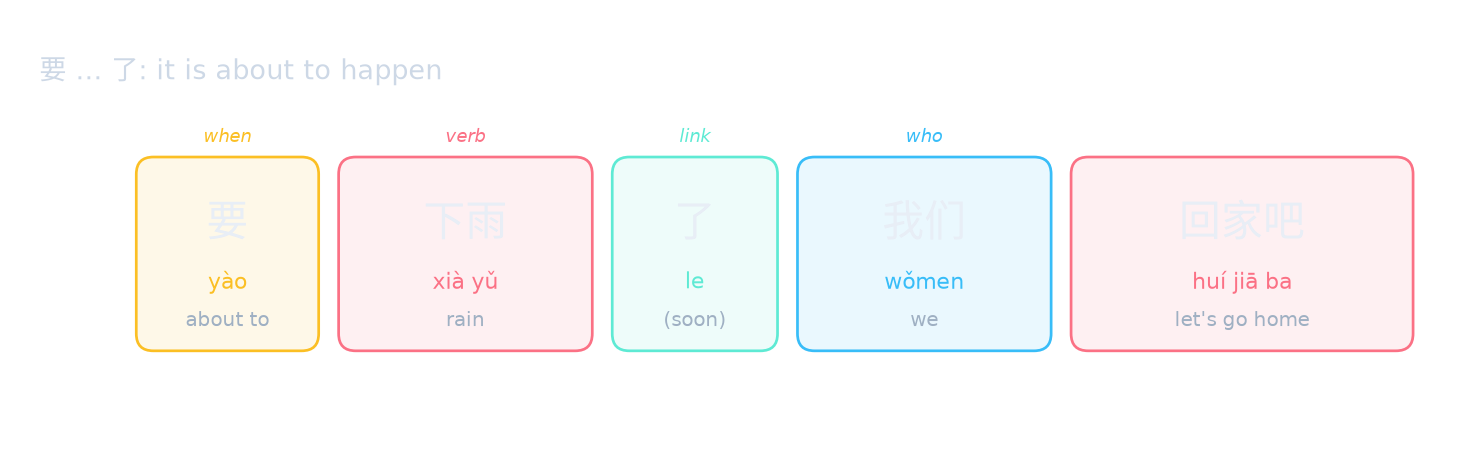
要……了 — about to happen
Đã giới thiệuVị trí đã lưu của bạn vẫn giữ nguyên trong trình duyệt này. Tiếp tục sẽ không hoàn thành bài học hay trả lời câu hỏi của nó.
Dark clouds over the park
- You are in the park with a friend. The sky turns dark and the wind picks up.
- about to要to rain下雨(completed / change)了,we我们回家吧。 — "It's about to rain. Let's go home."
about to要 + verb + (completed / change)了: about to happen
- about to要……(completed / change)了 says something will happen very soon: about to要to rain下雨(completed / change)了, it's about to rain; train火车about to要leave开(completed / change)了, the train is about to leave.
- (completed / change)了 at the end is required in this pattern. about to要to rain下雨 alone can sound like a plan or a forecast, not "any minute now".
train火车about to要leave开了。
Complete: “It’s about to rain.” 要下雨____。
Độ khó 1/5 · 100 xu + một phần thưởng nhỏ cho lần hoàn thành đầu tiên trong ngày
The final 了 is required in 要……了.
Sooner still: nearly at the point of…快要……(completed / change)了 and about to就要……(completed / change)了
- nearly at the point of…快要……(completed / change)了 and rapid快……(completed / change)了 stress that it is very close: 快到(completed / change)了, we're nearly there.
- about to就要……(completed / change)了 can take a time word: we我们tomorrow明天about to就要take an exam考试(completed / change)了。 — "We have the exam tomorrow."
we我们tomorrow明天about to就要take an exam考试了。
Which says “We have the exam tomorrow”?
Độ khó 1/5 · 100 xu + một phần thưởng nhỏ cho lần hoàn thành đầu tiên trong ngày
With a time word such as 明天, use 就要……了. 快要 does not take a time word.
Build: “We are nearly there.”
Độ khó 3/5 · 200 xu + một phần thưởng nhỏ cho lần hoàn thành đầu tiên trong ngày
快 + verb + 了 says something is very close to happening.
Answering
- Answer a question like movie电影about to要to start开始(completed / change)了(yes/no ?)吗? with about to要to start开始(completed / change)了 (yes, any minute) or still / also还not / haven't没(and …? / softener)呢 (not yet).
- about to要……(completed / change)了 talks about the near future, so do not use it for something that has already happened.
火车要开了 means the train left some time ago.
Độ khó 1/5 · 100 xu + một phần thưởng nhỏ cho lần hoàn thành đầu tiên trong ngày
False. 要……了 means the train is about to leave.
Watch out
- With a time word, use about to就要……(completed / change)了, not nearly at the point of…快要……(completed / change)了: tomorrow明天about to就要take an exam考试(completed / change)了, not tomorrow明天nearly at the point of…快要take an exam考试(completed / change)了.
- Keep the final (completed / change)了. Without it, about to要 may sound like “want to” or a plan: I / me我about to要take an exam考试 can mean “I am going to take an exam”.
Recap
- (rapid快/then / just就)about to要 + verb + (completed / change)了 = about to happen: about to要to rain下雨(completed / change)了, 快到(completed / change)了.
- Use about to就要……(completed / change)了 with a time word (tomorrow明天about to就要take an exam考试(completed / change)了). Keep the final (completed / change)了.
You are on a train with a friend. Say the train is about to arrive, that it is about to rain, and that you have a class tomorrow. Close the examples. Say it, then write it in Chinese.
Compare meaning and word order with the model; your sentences need not copy it. A partner or teacher must hear the spoken version to comment on pronunciation.