Asymmetric Cryptography
Đã giới thiệu| English | Ý nghĩa |
|---|---|
| key pair/kiː peə/ | Cặp khóa |
| asymmetric encryption/ˌeɪsɪˈmetrɪk enˈkrɪpʃn/ | Mã hóa bất đối xứng |
| public key/ˈpʌblɪk kiː/ | Khóa công khai |
| private key/ˈpraɪvət kiː/ | Khóa riêng tư |
| elliptic curve cryptography/ɪˈlɪptɪk kɜːv krɪpˈtɒɡrəfi/ | Mã hóa đường cong elip |
The key pair
- Asymmetric encryption 非对称加密 uses a key pair 密钥对.
- A public key 公钥 anyone may see, and a private key 私钥 kept secret.
- The keys are mathematical inverses: what one locks, only the other unlocks.
Sending a secret
- To send you a secret, I encrypt with your public key.
- Only your private key can decrypt it.
- We never had to share a secret key in advance.
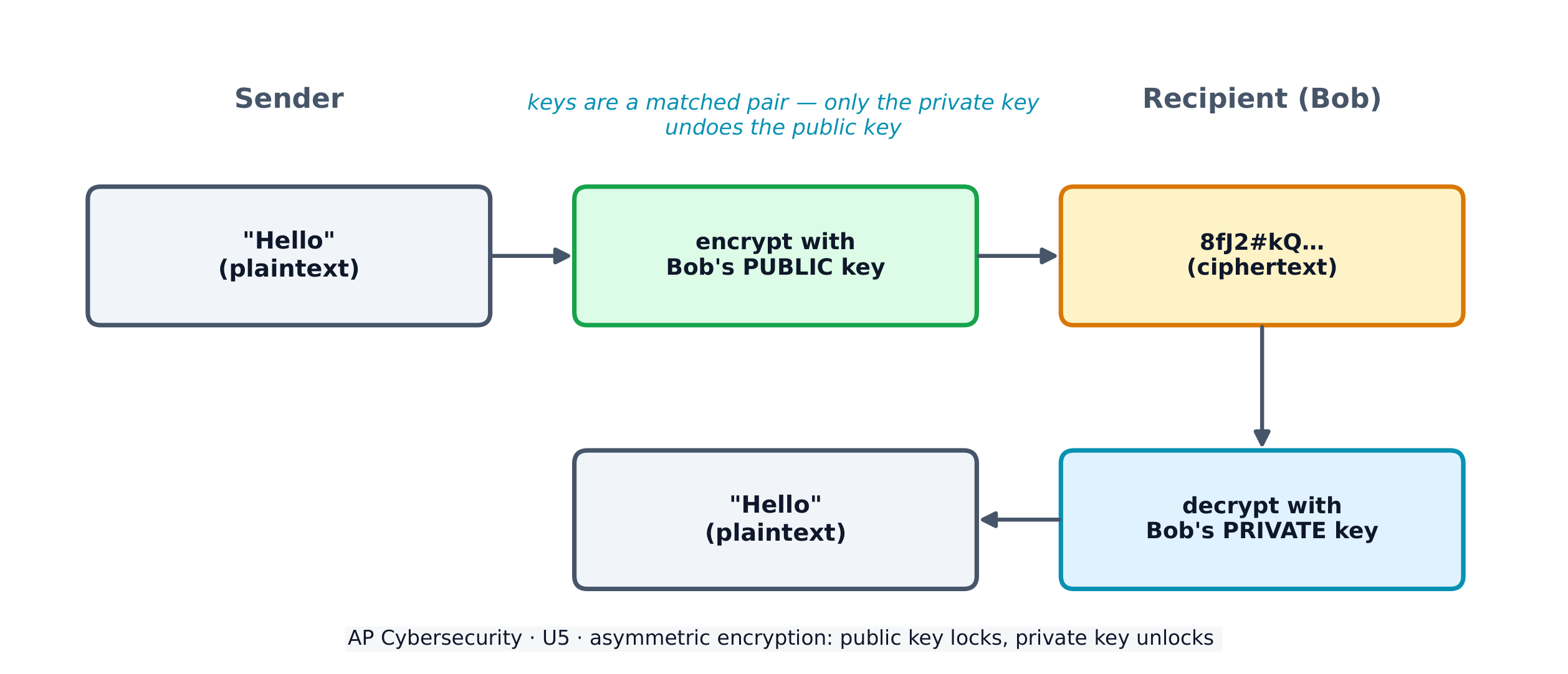
Asymmetric encryption: the public key locks and only the private key unlocks
Which key does the job?
Encrypt with the recipient's public key; only their private key decrypts. The private key stays secret.
To send Bob an encrypted message, you use...
Độ khó 1/5 · 100 xu + một phần thưởng nhỏ cho lần hoàn thành đầu tiên trong ngày
Encrypt with the recipient's public key.
Asymmetric encryption's big advantage over symmetric is that it...
Độ khó 1/5 · 100 xu + một phần thưởng nhỏ cho lần hoàn thành đầu tiên trong ngày
No shared secret needs to be exchanged first.
A public key and its matching private key together form a key ____.
Độ khó 1/5 · 100 xu + một phần thưởng nhỏ cho lần hoàn thành đầu tiên trong ngày
They are a mathematically linked key pair.
Which are asymmetric encryption algorithms? (Choose all)
Độ khó 2/5 · 140 xu + một phần thưởng nhỏ cho lần hoàn thành đầu tiên trong ngày
AES is symmetric, not asymmetric.
Key length and algorithms
- Longer keys mean larger keyspaces and more security, but slower.
- Common algorithms: RSA and elliptic curve cryptography (ECC) 椭圆曲线密码学.
- Compare key lengths only within the same algorithm.
The direction matters. To send someone a secret, you use their public key (not yours). Only their matching private key can open it. Mixing up whose key to use is the most common mistake here.
The private key should be shared with anyone who sends you encrypted messages.
Độ khó 1/5 · 100 xu + một phần thưởng nhỏ cho lần hoàn thành đầu tiên trong ngày
False. The public key is shared; the private key must stay secret, because security rests on only you being able to decrypt.
Asymmetric encryption solves symmetric's key-sharing problem. Bob publishes his public key for the world. Anyone can encrypt a message to Bob with it, but only Bob's secret private key can decrypt it — no secret ever had to be exchanged first.
Asymmetric encryption uses a public/private key pair. Encrypt with the recipient's public key; only their private key decrypts — solving symmetric's key-sharing problem. Algorithms: RSA, ECC. Longer keys are safer; compare lengths only within one algorithm.